
Tattoo Cartridge Needle Supplier Sustainability Scorecard
Most tattoo cartridge needle purchasing decisions are settled against a single order. A sample set is tested, a price is agreed, a delivery date is fixed, and the supplier is judged on that exchange. The question that decides whether a studio, distributor, or private-label brand is still reliably supplied two or three years later is a different one: can this manufacturer hold the same specification, the same sterility, and the same documentation across dozens of repeat batches? A long-term supplier sustainability evaluation exists to answer that question before the answer becomes expensive.
Definition. In tattoo cartridge needle procurement, supplier sustainability is not an environmental claim. It describes a manufacturer's structural ability to reproduce an approved product over time — the same needle geometry, the same material grades, the same sterilization method, the same compliance documentation, and the same delivery reliability — without the buyer having to re-qualify the product at every reorder.
Why Order-Level Evaluation Breaks Down Over Time
A cartridge needle is a consumable with a short clinical life and a long procurement relationship. Once a sterile cartridge is opened, it is used and discarded; but the supply agreement that puts it on the bench may run for years. The mismatch between a disposable product and a durable relationship is where most procurement risk accumulates.
Order-level evaluation measures what is easy to observe: unit price, lead time, the feel of a first sample. It does not measure what changes slowly — a housing resin substituted by a second-tier vendor, a sterilization cycle shortened under volume pressure, a tolerance drifting from the center of its range toward the edge, or a compliance certificate that quietly expires while orders keep shipping. None of these appear on a purchase order. All of them appear in the artist's hands, usually months later, and by then the buyer has already built inventory, packaging, and customer expectations around that supplier.
The opportunity is straightforward. Buyers who evaluate a supplier's long-term capability before committing volume tend to renegotiate less, reject less, and absorb fewer surprises. That evaluation does not require an audit team. It requires a structured scorecard and a willingness to ask for evidence rather than assurances.

The Scorecard at a Glance
A practical procurement scorecard for tattoo cartridge needles separates six dimensions. Each one is scored against evidence the supplier can produce on request, not against statements in a catalogue.
| Dimension | Core question | Evidence to request |
|---|---|---|
| Manufacturing continuity | Can output scale with your demand without displacing your specification? | Facility footprint, installed capacity, staffing, production and packaging line overview |
| Quality system stability | Is quality management a maintained system or a one-time certificate? | ISO 13485 certification scope, validity window, surveillance audit history |
| Material and precision control | Are material grades and tolerances controlled batch to batch? | Material grade declarations, incoming inspection practice, tolerance measurement method |
| Sterilization and packaging | Does sterility hold through storage and transport, not just at release? | Sterilization method, cycle records, packaging seal validation, shelf-life statement |
| Compliance documentation upkeep | Are certificates current, scoped, and re-issued after changes? | Certificate set, revision dates, notified body details, material safety documentation |
| Commercial and acceptance terms | Are defects, replacements, and change notifications defined in writing? | Acceptance criteria, defect definitions, change notification clause, documentation with each shipment |
Dimension 1 — Manufacturing Continuity and Capacity
The first sustainability question is physical: does the manufacturer own enough process to protect your specification when demand rises? A supplier that outsources assembly, packaging, or sterilization has less ability to hold a specification stable, because control has moved outside its walls.
Suzhou Creditech Electronic Technology Co., Ltd. — the manufacturer behind the CREDITECH MED brand and the SPACEDRAGON TATTOO, ESTLIA, and LPT Tattoo Supply brands — provides a concrete example of the evidence buyers should be looking for. Established in 2009, the company operates a 3,000 m² manufacturing facility with an annual production capacity of 100 million units, supported by approximately 180 staff and a 20-engineer R&D team. Export business accounts for 90% of total sales, with major markets in Europe, North America, South America, and Southeast Asia.
Those figures matter less as marketing numbers than as capacity-ratio inputs. A buyer taking 500,000 units per year is asking a 100-million-unit annual capacity to allocate half a percent of output. That is a comfortable position. The same buyer placing with a facility operating at 95% utilization during peak season is not buying capacity — it is buying a queue position, and queue positions are where specification substitutions happen.
Practical check: ask how many assembly and packaging lines serve the specific cartridge configuration being purchased, how many shifts run in peak months, and whether the tooling for that configuration is dedicated or shared. Answers that stay general are themselves a data point.
Dimension 2 — Quality System Stability
A certificate proves that a system existed on the day it was issued. A sustainable supplier proves that the system kept running between audits. ISO 13485 defines the quality management requirements applied to medical devices and related manufacturing, and the current published edition of the standard is ISO 13485:2016.
For a cartridge needle buyer, the useful questions are about scope and continuity rather than presence. Does the certificate's scope statement actually name cartridge needle design and manufacture, or does it cover a broader product family into which needles only loosely fall? Is the certificate within its validity window? Who issued it? Were non-conformities raised at the last surveillance audit, and were corrective actions closed?
Creditech operates under an ISO 13485 certified quality management system, and its public product documentation also references CE compliant products and FDA test reports available for applicable products. For a buyer building a scorecard, that combination is a baseline rather than a conclusion — the next step is to match each claim to the specific model under consideration.
Practical check: request the certificate with its annex or scope page. If the scope page is never provided, assume the scope is narrower than the headline claim.
Dimension 3 — Material and Precision Control
Cartridge needles fail in the hand, not on the specification sheet. The specification sheet tells you what is intended; batch control tells you what is delivered.
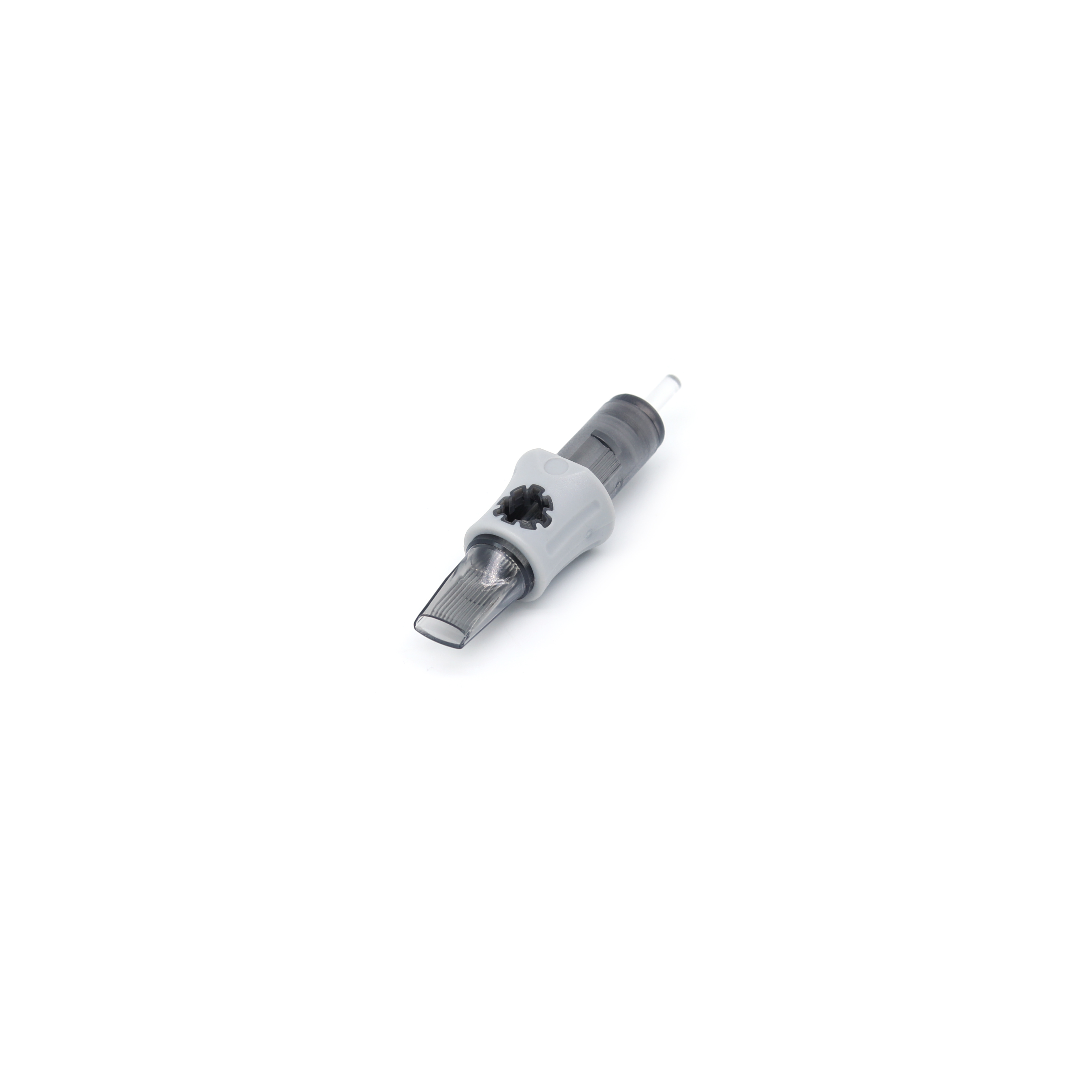
Across the SP5, HM3, and HM6 cartridge needle models, the published specification platform is consistent: medical-grade stainless steel needles, medical-grade PC housing, a silicone elastic membrane system, and a non-toxic transparent plastic tip. Precision tolerance is stated at ±0.02–0.05 mm. Needle diameters are available in 0.15 mm, 0.20 mm, 0.25 mm, 0.30 mm, and 0.35 mm. Taper length runs from 1.5 mm to 7 mm, with extra long taper available. Configurations cover RL, RS, RM, Magnum, and Flat. The cartridges use a silicone anti-backflow membrane, a stable controlled ink delivery system, and a low vibration design, and are compatible with rotary tattoo machines.
Those figures define the envelope. What a scorecard should test is how tightly the manufacturer holds position inside that envelope over successive shipments. A tolerance band of ±0.02–0.05 mm is only meaningful if the measurement method is stated, the sampling plan is defined, and the results are trended rather than spot-checked.
Practical check: ask which parameter the ±0.02–0.05 mm figure applies to on the model you are buying, how it is measured, and whether measurement data from the last three production lots can be shared. A supplier that can produce three lot records is a different proposition from one that can only produce a specification.
Dimension 4 — Sterilization and Packaging Integrity
Sterility is a process outcome, not a product attribute. A cartridge can be sterile at the release gate and compromised by the time it reaches a studio if the packaging seal, the breathable film, or the storage conditions were not controlled.
For the cartridge models described here, sterilization is by EO gas, and packaging uses a sterile breathable film packaging system. Both are common approaches in this category, and both depend on verification that a buyer can request: sterilization cycle parameters, batch release records, and seal integrity validation for the packaging format.
Shelf life is the criterion most often skipped. A distributor holding three months of inventory needs a supplier whose stated shelf life comfortably exceeds the realistic time from production to end use — including customs, warehousing, and resale. If the shelf life is short and the supply chain is long, the scorecard should record the mismatch, not the specification.
Dimension 5 — Compliance Documentation That Stays Current
Compliance is the dimension where sustainability is most visibly tested, because documents expire and regulations change while supply agreements continue. A supplier that treats certificates as finished assets will eventually ship against an outdated dossier.
Rather than asking whether a manufacturer “has certifications,” the scorecard should record which documents exist, what each one covers, and when it was last refreshed. The following items are the ones most commonly requested in tattoo cartridge needle procurement dossiers.
| Documentation | Verification checkpoint |
|---|---|
| FDA 21 CFR 175.300 | Confirm the report identifies the specific component and material it covers, states the issue date, and has been re-issued after any material or supplier change. |
| FDA 21 CFR 180.22 | Confirm the referenced regulation matches the polymer actually used in the component, and that the report is tied to a named material grade rather than a generic product family. |
| ASTM C738-94 | Confirm the test method is applied to the correct component and that the testing laboratory is identified on the report. |
| CE MDR (EU) 2017 / 745 | Confirm the classification claimed, the role and details of the notified body where applicable, and the validity window of the certificate. |
| RoHS 2.0 | Confirm the restricted-substance declaration is current, aligns with the RoHS Directive 2011/65/EU framework, and covers all cartridge components including the housing and tip. |
| MSDS / SDS | Confirm the safety data sheet reflects the material actually shipped and is reviewed whenever a component source changes. |
| ISO 13485 | Confirm the certificate scope names cartridge needle manufacture and that the current certificate is ISO 13485:2016. |
Two habits separate sustainable suppliers from the rest. First, they re-issue documentation after a change instead of waiting for renewal. Second, they deliver documentation with the shipment, so the buyer's own compliance file stays current without a separate request cycle.
Dimension 6 — Purchasing Terms and Acceptance Criteria
The commercial layer is where a scorecard becomes enforceable. Ambiguity here is what turns a minor quality deviation into a commercial dispute.
Four clauses carry most of the weight. A written acceptance criteria statement defines what is inspected, at what sampling level, and against which defect classification. A change notification clause requires the supplier to inform the buyer before altering material grade, sterilization parameters, packaging, or production location. A replacement and remedy clause sets out what happens when a lot fails. And a documentation delivery clause specifies which records accompany each shipment.
Buyers who write these four items into the first purchase order — rather than the tenth — find that the supplier relationship becomes easier to sustain, not harder, because expectations stop being renegotiated at every quality event.

Applying the Scorecard Across Buyer Types
The same six dimensions carry different weight depending on who is buying.
Professional tattoo studios buy relatively small volumes but are the most exposed to batch inconsistency, because artists notice changes in needle feel immediately. Their scorecard should weight material and precision control heavily, and treat documentation as a secondary but non-negotiable item for insurance and hygiene compliance.
PMU studios and SMP clinics require single-use sterile cartridges with fine-diameter needles for eyebrow, lip, eyeliner, and scalp micropigmentation work. For them, sterilization validation and shelf-life statements move up the ranking, since inventory is often held longer between procedures.
Distributors and wholesalers carry the widest risk surface because they hold inventory across a portfolio. Their scorecard should weight commercial terms and change notification most heavily, alongside capacity, because a supply interruption affects an entire customer base rather than one bench.
OEM and private-label brands need the deepest evaluation, since the product carries their name. Here the scorecard connects directly to development capability: structural design, prototyping, mass production, and customized packaging all sit inside the supplier's control. Creditech provides OEM and ODM services covering product development, structural design, prototyping, mass production, and customized packaging solutions for global tattoo brands, distributors, wholesalers, and professional studios — which means the sustainability question becomes broader: not only whether the supplier can hold a specification, but whether it can hold a specification it helped to define.
Market Signals Behind the Shift Toward Supplier Durability
The commercial case for long-term supplier evaluation is reinforced by category growth. Custom Market Insights estimates the global tattoo needle market at USD 368.3 million in 2024, projected to reach USD 468.6 million by 2033. Estimates for the base year vary across research houses — Insightace Analytic placed the 2023 figure at USD 289.8 million and Credence Research at USD 278.16 million — largely because reports scope traditional needles and cartridges differently. The variation is itself a useful reminder that suppliers should be assessed on verifiable capability rather than on market-share claims.
Within that market, tattoo needle cartridges hold the largest share of the product type segment, according to Deep Market Insights, a position attributed to their sterility and compatibility with modern rotary machines. An industry survey reported by Elite Tattoo found that approximately 73% of professional tattoo artists preferred needle cartridges over traditional bar needles in 2024, citing ease of use and safety.
Adjacent demand is also expanding. Fortune Business Insights valued the permanent makeup market at USD 162.09 million in 2025, with an 8.12% CAGR forecast for the needle-heavy microblading segment — a category where single-use sterile cartridges are the default format. On the supply side, OEC data puts China's exports of medical instruments, including needles, at approximately USD 1.19 billion in May 2026 alone, with the United States as the leading destination.
The practical implication for buyers is that supplier bases are broad and increasingly international. Named participants in the tattoo needle market include Dragonhawk, Kwadron, Bishop Rotary, Cheyenne, and EZ Tattoo Supply, alongside a large tier of OEM manufacturers. A broader supplier base increases choice, but it also increases the cost of evaluating any single supplier well — which is precisely the argument for a reusable scorecard rather than fresh due diligence on every new contact.
Comparison With Traditional Sourcing Practice
Traditional sourcing in this category is transactional. The buyer requests samples, approves one, negotiates price, and reorders until a problem appears. It is fast, requires little administration, and works reasonably well for low-volume or short-horizon purchasing. Its weakness is that it treats the first approved sample as a permanent reference, when in fact the reference can drift without anyone noticing.
A scorecard approach inverts the sequence. Capability is assessed before volume is committed, and the assessment is repeated at intervals — typically before a volume increase, after a supplier-side change, or annually. The trade-off is real: scorecards add administrative work, and they only reflect the documents the buyer actually reviews. A scored dossier built entirely from supplier-provided PDFs can create confidence that the underlying process does not justify.
There are further boundaries worth stating plainly. A scorecard cannot predict a sudden regulatory change in a destination market, cannot detect a raw-material shortage that forces a supplier to substitute a component source, and cannot replace incoming inspection once shipments arrive. It is a planning instrument, not a guarantee. For small studios with limited purchasing resources, a simplified three-dimension version — material control, sterilization, and documentation currency — will deliver most of the available value.
Future Outlook
Three developments are likely to shape how buyers evaluate cartridge needle suppliers over the next several years.
First, documentation maintenance is becoming a continuous obligation rather than a periodic one. Regulatory frameworks in major markets continue to tighten around single-use medical consumables, and a dossier that was sufficient at the time of approval will not stay sufficient indefinitely. Suppliers that build documentation refresh into their production cycle will hold an advantage with distributors operating in regulated markets.
Second, quality management certification is shifting from differentiator to entry requirement. ISO 13485 has become the baseline expected from medical-grade suppliers, which means buyers will increasingly differentiate on evidence depth — lot records, measurement trends, sterilization validation — rather than on the certificate itself.
Third, the growth of the PMU and SMP segments continues to pull demand toward fine-diameter cartridge formats. Category expansion of this kind raises the value of supply continuity, because a supplier change in a fine-line or microblading range forces studios and clinics to re-qualify a product that directly affects procedure outcomes.
Taken together, the direction is toward procurement decisions that reward reproducibility. Price and lead time will remain the visible variables, but the differentiator will increasingly be whether a manufacturer can demonstrate, with records, that the product shipped in year three matches the product approved in year one.
FAQ
What does supplier sustainability mean when buying tattoo cartridge needles?
It describes a manufacturer's ability to keep delivering a consistently specified product over time — the same needle diameter, taper, material grades, sterilization method, packaging, and compliance documentation across repeat orders. It is a capability question about the supplier's process stability, not a statement about environmental performance.
What evidence should a buyer request before committing to a long-term cartridge needle supply agreement?
The most useful evidence set includes the ISO 13485 certificate with its scope page, material grade declarations for the needle and housing, the method used to measure precision tolerance, sterilization cycle and batch release records, the packaging shelf-life statement, and the current compliance document set. Each item should be matched to the specific model being purchased rather than to a general product family.
Which compliance documents need to be tracked over the life of a supply agreement?
The documents commonly requested in this category include FDA 21 CFR 175.300 and FDA 21 CFR 180.22 material documentation, ASTM C738-94 test reports, CE MDR (EU) 2017/745 certification, RoHS 2.0 declarations aligned with Directive 2011/65/EU, MSDS or SDS sheets, and ISO 13485 certification. The tracking task is not only confirming that each exists, but verifying its scope, revision date, and whether it was re-issued after any material or process change.
How does a supplier scorecard differ from a one-time factory audit?
An audit captures a point in time. A scorecard is a repeatable framework applied at intervals — before a volume increase, after a supplier-side change, or annually — so that drift becomes visible. Audits tend to be resource-intensive and infrequent; scorecards are lighter, comparable across suppliers, and easier to update as conditions change.
Does a high scorecard score guarantee consistent cartridge needle quality?
No. A scorecard reflects the evidence a buyer has reviewed and can be limited by incomplete documentation or by changes that occur after the review. It cannot predict regulatory shifts in a destination market, raw-material shortages that prompt component substitution, or manufacturing deviations that occur between assessments. It is a planning instrument that should be paired with incoming inspection on delivered lots.
How do models such as SP5, HM3, and HM6 fit into long-term supply planning?
They share a common published specification platform — medical-grade stainless steel needles, medical-grade PC housing, a silicone anti-backflow membrane, precision tolerance of ±0.02–0.05 mm, needle diameters from 0.15 mm to 0.35 mm, taper lengths from 1.5 mm to 7 mm with extra long taper available, and RL, RS, RM, Magnum, and Flat configurations. Because the platform overlaps, a buyer can standardize on one supplier relationship across fine line, shading, and general cartridge use without re-qualifying material and sterilization controls for each model, though configuration-level performance should still be verified on samples.
This analysis is an independent industry reference prepared for procurement and specification readers. Product specifications referenced above reflect published manufacturer documentation for the SP5, HM3, and HM6 tattoo cartridge needle models. Market figures are attributed to their original sources and may vary between research houses due to differing scope definitions. Buyers should verify all documentation against the specific model and destination market before purchase. A company brochure and product documentation pack can be downloaded here.