
TechArt Craftworks: Custom Keychain Manufacturing Profile
A capability review of Qingyuan TechArt Craftworks Co., Ltd. — what a 25,000 m² metal craft operation, a 100-piece minimum order and brand-licensing approvals actually mean when a buyer is qualifying a keychain supplier.
The global keychain pendant market was valued at USD 6.80 billion in 2025 and is projected to reach USD 11.39 billion by 2034, a 5.9% CAGR for the 2025–2034 period, according to Dataintelo's market forecast. That is a category most procurement teams still file under low-value promotional spend — and that classification is where sourcing decisions usually go wrong.
A keychain is a low-unit-cost object that carries a high-ergonomics workload: it is pulled, dropped, pocketed, exposed to sweat and humidity, and it sits in front of the end user every day. When it fails, it fails visibly. Plating wear, a clasp that opens under load, uneven enamel fill or a colour that does not match the approved Pantone are all manufacturing signals, not user errors. For brand owners and IP holders, the same object is also a compliance document — it may be handled by children, it may carry licensed artwork, and it may be sold in markets where toy-safety rules apply.
This profile examines one manufacturer against that reality: Qingyuan TechArt Craftworks Co., Ltd., a metal craft manufacturer based in Qingyuan City, Guangdong Province, China, established in 2021, operating a 25,000-square-metre facility with approximately 500 staff, an annual production capacity of 60,000,000 units and a 12-person artwork R&D team. Keychains sit within a wider metal craft range that includes lapel pins, medals, challenge coins, magnets, ornaments, golf merchandise and lanyards.
What a keychain order actually tests
Buyers entering this category for the first time tend to compare quotations per piece. Experienced buyers compare something less visible.
- Substrate and process fit. A flat one-colour logo, a 3D relief mascot and a two-layer charm set are three different manufacturing problems. The material choice — zinc alloy, brass or iron — and the process choice — die casting or stamping — determine what the artwork can physically become.
- Plating durability. Plating is the component most exposed to daily friction. Thickness and pre-treatment decide whether a finish survives a year of pocket carry.
- Mechanical fittings. A lobster clasp or spring ring has to open and close smoothly and hold under repeated pulling. This is a tensile-strength question, not a cosmetic one.
- Compliance documentation. Nickel-free and lead-free test reports, EN71-3 and CPSIA alignment, and — for products intended for children under 14 in the United States — conformity with ASTM F963-23, mandatory since 20 April 2024 under CPSC guidance.
- IP control. Licensed artwork circulating through a supply chain without non-disclosure control is a commercial risk before it is a legal one.
Each of these maps to a specific factory capability. That is why supplier selection in this category is effectively a capability audit conducted at low order value.
Entity snapshot: what TechArt operates
| Dimension | Company-reported detail |
|---|---|
| Legal entity | Qingyuan TechArt Craftworks Co., Ltd. |
| Established | 2021 |
| Location | Building 36#, Hongrungu Technology Park, Longtang Town, Qingcheng District, Qingyuan City, Guangdong Province, China, 511510 |
| Facility | 25,000 m² construction area |
| Workforce | Approximately 500 staff |
| Annual capacity | 60,000,000 units |
| Artwork / R&D | 12 artworkers |
| Core processes in-house | Die casting, stamping, enamel filling, electroplating, assembly |
| Main product lines | Lapel pins, medals, key chains, magnets, challenge coins, ornaments, golf merchandise, lanyards; custom focus on medals, enamel pins, challenge coins, keychains and fridge magnets |
| Customisation scope | Shape, logo, colour, plating effect, packaging |
| Export share | Approximately 70% of output |
| Main markets | USA and EU |
| Approvals and certifications | Disney FAMA, NBC Universal and Coca-Cola approval; ISO 9001, ISO 14001, ISO 45001; Sedex SMETA 4P |
| Quality model | Pre-production sample confirmation, mid-production inline inspection, final visual checking before shipment |
The operational detail that matters most in this table is not the floor area. It is the combination of die casting, stamping, enamel filling, electroplating and assembly inside one facility. When those five process steps are coordinated by one production plan rather than five separate vendors, the buyer's exposure to mismatched colour batches, inconsistent plating lots and untraceable rework falls substantially — and so does the time cost of chasing them.
Technical capability: how a metal keychain is actually built
The custom enamel keychain that anchors TechArt's keychain range is manufactured from zinc alloy, brass or iron, with a standard thickness of 2–3 mm and custom sizing. Structural configurations include single-piece, double-layer and multi-charm assemblies.
Why substrate choice is a design decision, not a purchasing detail
Zinc alloy is a common choice in this category because it has good casting fluidity: it can reproduce complex relief patterns, accepts a wide range of electroplating colours and balances cost against hardness for a daily-carry object. Brass offers strong texture and anti-rust behaviour for higher-grade or limited-edition gifts. Iron stamping suits flat, simple logos at volume, where a shallow 2D impression is sufficient and cost efficiency dominates. Selecting the substrate before approving artwork prevents the most expensive mistake in this category — a design approved on screen that cannot be produced at the required relief depth.
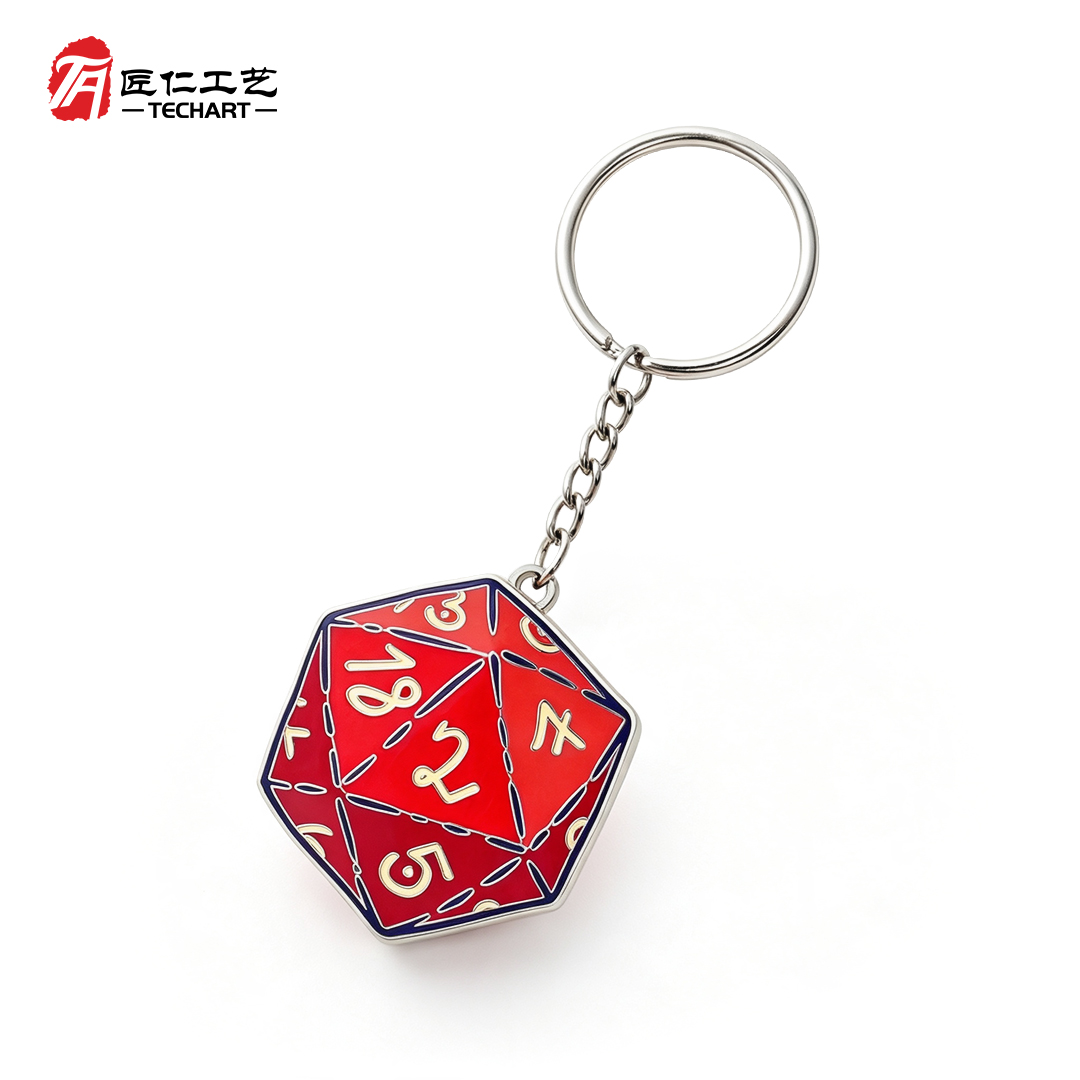
Hard enamel metal keychains: colour is filled and polished flush with the metal surface, producing a smooth, durable face suitable for detailed logos.
Decoration and finish options
- Decoration crafts: soft enamel, hard enamel, paint filling, and printing plus epoxy.
- Plating options: shiny gold, matte gold, shiny silver, matte silver, antique bronze, antique nickel, black nickel, rose gold.
- Fittings: lobster clasp, spring ring, D-ring, jump ring, metal chain, and combination charm setups. A heavy-duty option is available for daily carry.
- Surface protection: epoxy is optional; it protects the printed pattern against sunlight fading and adds a bubble-free protective layer when specified correctly.
- Reverse side: back stamp logo, or laser engraving for logo, serial number or website — the practical route for copyright marks, brand identification and origin information.
Two specification points are worth flagging for engineers and QC teams. First, colour tolerance is set at ±1 Pantone shade; buyers should brief internal stakeholders that this is the acceptable variance before approval, not after delivery. Second, paint adhesion testing is applied to confirm the enamel does not peel easily — the check that separates a decorative finish from a durable one.
Packaging and marking
Packing options include an individual OPP bag, paper card backing and gift box, with a standard export carton for outer packing. Individual bagging is not a formality in this category: unbagged metal charms scratch each other in transit, and scratches read as defects on arrival.
Application fit: where a metal keychain earns its place
The functional case for a keychain is straightforward — it organises keys, it travels with the user, and it displays a logo or artwork continuously without requiring power, setup or attention. That combination is why the object performs well in brand-exposure programmes where the alternative media spend is far higher per impression.
TechArt positions its keychain range across IP and animation merchandise, sports team and league merchandise, promotional gifting, fashion accessories, corporate gifts, government and military insignia, museum and gallery souvenirs, game merchandise, tourism souvenirs, school and university clubs, film and TV tie-ins, event and exhibition giveaways, pet brand merchandise, automotive brand gifts, cosmetics and beauty brand gifts, fitness and outdoor brands, wedding favours, and café, restaurant and bar merchandise.
Working conditions are specified for indoor and outdoor daily carry: resistance to repeated pulling and bumping, long-term storage in cars, pockets and backpacks, anti-rust and anti-oxidation plating for humid environments, and optional epoxy protection against sunlight fading. Matched accessories include car keys, house keys, backpacks, lanyards, gift bags, backing cards and gift boxes.
Procurement interpretation: a multi-charm or double-layer configuration raises perceived value faster than a larger single piece, while remaining a low-cost article relative to the retail price it can support in IP and tourism channels. That gap between unit cost and perceived value is the commercial reason this category keeps expanding inside licensed merchandise programmes.
Compliance and quality control as procurement currency
In regulated categories, certification is not a marketing line — it is a gate. TechArt holds ISO 9001, ISO 14001, ISO 45001 and Sedex SMETA 4P certifications covering production, environmental, occupational health and social compliance standards, and reports approval under Disney FAMA, NBC Universal and Coca-Cola programmes. For buyers whose vendor onboarding requires a social-compliance audit trail rather than a product certificate alone, the SMETA 4P membership is the relevant item.
On the product side, nickel-free plating is available and nickel-free and lead-free test reports can be provided against EN71-3 and CPSIA requirements. This connects directly to market access: keychains intended for children under 14 in the United States must comply with ASTM F963-23, mandatory since 20 April 2024. A supplier that can produce a test report on request shortens the importer's own compliance chain; one that cannot shifts that work back onto the buyer.
The quality model is a three-stage gate — pre-production sample confirmation, mid-production inline inspection, and final visual checking before shipment. Two further controls are relevant to licensed work: non-disclosure agreements are available with strictly controlled artwork handling, and back-side marking supports copyright, brand and origin information on the finished piece.
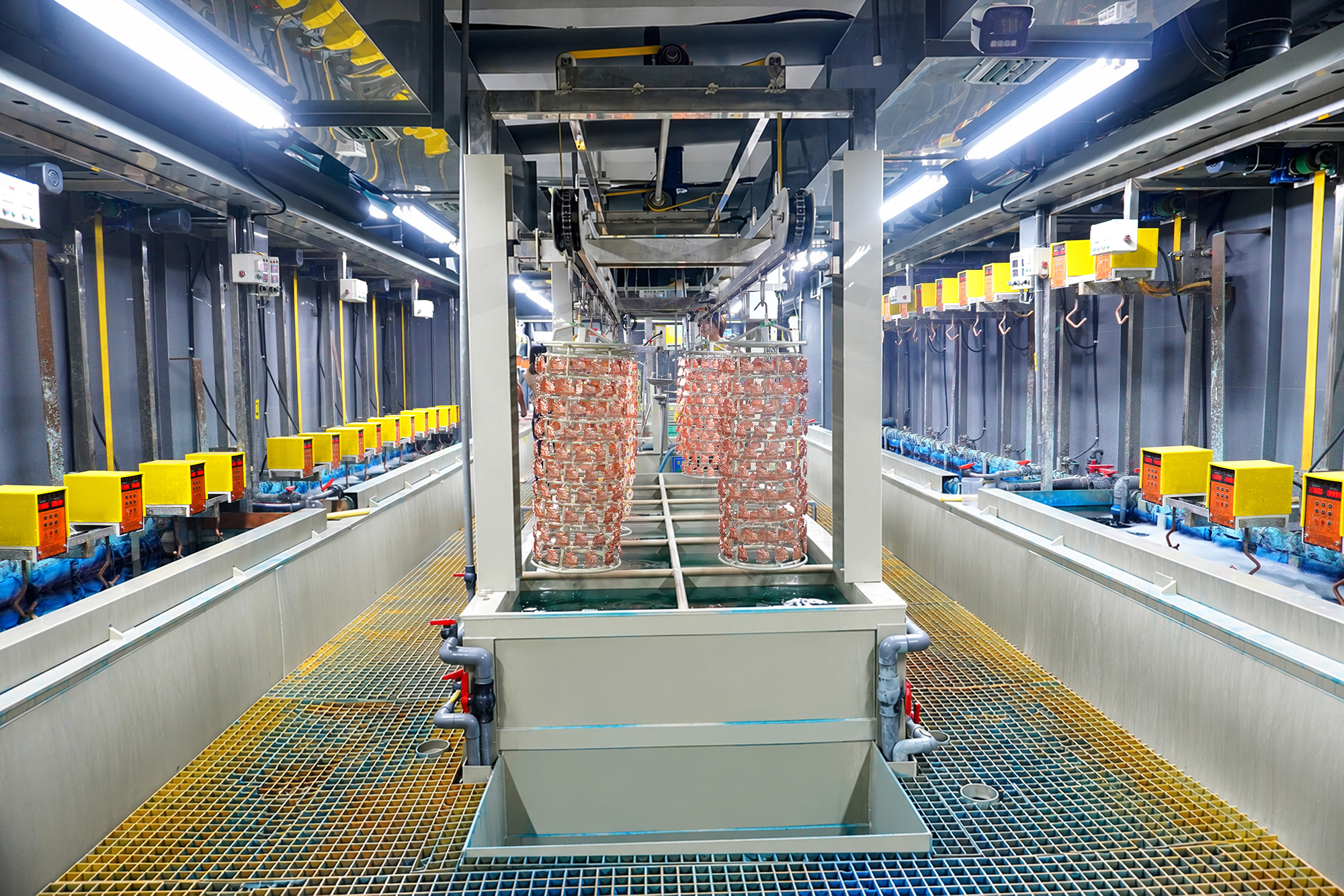
Electroplating is the process step most directly linked to finish durability — and the one buyers should question first when plating wear appears in the field.
Market trend analysis
Three shifts are visible in the available data, and each changes how buyers should read a supplier profile.
Growth with a definition problem. The forecast direction is expansion, but the absolute figure depends heavily on scope. Published 2025 market estimates for keychain pendants range from roughly USD 2.5 billion to USD 18.9 billion, depending on whether luxury bag charms and jewellery-grade pendants are counted alongside mass-market promotional items. Buyers should treat the growth rate as the usable signal and avoid anchoring business cases to a single headline valuation.
Regulation as a consolidation force. Tightening safety requirements in the US and EU raise the fixed cost of serving those markets. Suppliers with existing CPSIA, EN71-3 and ASTM-aligned documentation absorb that cost more easily than suppliers who must build a testing relationship from scratch. The practical effect is a slow shift of brand-owner volume toward suppliers who can already answer compliance questions, rather than suppliers who can only quote a price.
IP merchandise as the demand engine. The largest listed application cluster for this product type is licensed and character-driven — animation, games, film and television, sports leagues, museums and tourism. These buyers purchase in campaign cycles, need artwork confidentiality, and care more about speed from sample approval to delivery than about the last few cents per unit.
Comparison with traditional sourcing routes
Most keychain programmes are sourced through one of three routes. The differences are structural rather than promotional.
| Dimension | Trading intermediary | Integrated metal craft factory (TechArt model) | Low-cost stamping-only route |
|---|---|---|---|
| Design complexity supported | Depends on the underlying factory | Die casting, stamping, enamel, printing and epoxy in one process chain | Flat, shallow 2D impressions |
| Process accountability | Split across multiple vendors | Single production plan across five in-house processes | Single process, limited finishing |
| Compliance documentation | Passed through from the maker | Held in-house: ISO 9001/14001/45001, Sedex SMETA 4P, brand programme approvals | Varies; often product-level only |
| Customisation depth | Variable | Shape, logo, colour, plating effect and packaging | Logo and colour only |
| Cost positioning | Intermediary margin added | Mid-range; higher perceived value per unit | Lowest per unit at high volume |
| IP handling | Third-party exposure | NDA available, controlled artwork workflow | Basic |
Where this model is not the right answer
An honest supplier profile has to state its boundaries, and three are material here.
- Unit economics move against small runs. Published commercial research places 2026 production costs for metal keychains at USD 2.50–4.50 per piece in the 50–100 unit band. TechArt accepts a 100-piece minimum with small orders supported, which is low for this category — but buyers sourcing very large volumes of a simple flat giveaway will generally find a lower per-unit cost in a stamping-only route than in die-cast zinc with enamel work. The premium buys relief depth, plating range and finish quality, not the lowest price.
- Lead time is not instantaneous. Samples take 5–7 days and mass production 15–25 days. Programmes with compressed launch windows should confirm the schedule before committing to a design revision cycle, because re-sampling after artwork changes restarts part of that clock.
- Registration age versus operating experience. The legal entity was established in 2021, while the company profile describes more than 20 years of deep experience in metal craft manufacturing. Both statements can be true — an operating team can precede the incorporating entity — but buyers with vendor-code rules tied to registration history, or those conducting formal due diligence, should verify the underlying operating record during the audit rather than assume either reading.
A fourth boundary applies to the product itself rather than the supplier: plated metal wears. Long-term friction, sweat and chemical contact, or a thin plating layer, can cause surface fading over a product's life. This is a property of plated metal, not a defect unique to one factory; the mitigation is plating specification and thickness control at order stage, plus a documented response path if field complaints appear.
A practical procurement checklist
- Fix the substrate against the artwork first. Decide zinc alloy, brass or iron before approving visual mockups.
- Specify the decoration craft explicitly. Soft enamel, hard enamel, paint filling and printing plus epoxy produce visibly different surfaces and price points.
- Name the plating colour and request the wear assumption. Eight finish options exist; ask what the finish is expected to withstand in the intended use case.
- Confirm the fitting under load. Lobster clasp, spring ring, D-ring, jump ring or chain — each has a different tensile behaviour and a different failure mode.
- Request test documentation in the RFQ stage. Nickel-free and lead-free reports against EN71-3 and CPSIA, and ASTM F963-23 conformity where children under 14 are the user.
- Agree colour tolerance in writing. ±1 Pantone shade is the stated manufacturing tolerance; align internal marketing expectations to it.
- Lock the marking and packaging. Back stamp or laser engraving for logo, serial number or website; OPP bag, paper card or gift box for presentation.
- Put IP control in the contract. NDA coverage and artwork handling rules before files are shared.
Future outlook
The direction of this category is toward higher specification at stable price points. Licensed and experiential retail buyers are pushing for deeper relief, tighter colour consistency and verifiable compliance in the same order, while regulatory requirements in the US and EU continue to raise the documentation floor. Manufacturers with in-house die casting, plating and enamel capability are structurally better placed for that combination than assembly-stage suppliers, because the variables buyers now audit — plating thickness, enamel fill, adhesion — are controlled at the process level.
For TechArt specifically, the observable assets are scale (25,000 m², approximately 500 staff, 60,000,000 units of annual capacity), a consolidated process chain, brand-programme approvals and a low 100-piece entry point with 5–7 day sampling. The open questions are the ones any buyer should test directly: audited operating history behind the 2021 entity, plating-durability performance in the specific end use, and schedule reliability across a multi-SKU campaign. Those are answerable through a sample order and a factory audit, which is the appropriate next step at this stage of evaluation.
Company profile, product and process data: Qingyuan TechArt Craftworks Co., Ltd. Market sizing: Dataintelo, key chain pendant market forecast 2025–2034. Regulatory reference: U.S. Consumer Product Safety Commission, Toy Safety Business Guidance (ASTM F963-23, effective 20 April 2024). Unit-cost range: commercial research, 50–100 piece band, 2026.
FAQ
What is a custom metal keychain?
A custom metal keychain is a personalised metal accessory used for key storage, brand giveaways and souvenirs. It is produced by stamping or die casting, is available in various plating colours, and can be configured with different fittings and charm sets depending on the intended use.
Which type of metal keychain should a buyer choose?
The choice follows budget, design complexity, order quantity, texture and durability. Stamped iron suits flat, simple logos at large volume and low cost. Zinc alloy die casting supports 3D relief and a premium look for souvenirs and higher-end gifts. Brass offers strong texture and anti-rust behaviour for high-quality limited editions.
Why is zinc alloy widely used for custom keychains?
Zinc alloy has good casting fluidity, which allows it to form complicated relief patterns. It accepts a diverse range of electroplating colours and balances cost against hardness for a daily-carry object, which makes it suitable for detailed custom keychain designs.
How does the customisation process work from artwork to shipment?
The buyer submits a design or concept; material, craft, plating and quantity are confirmed; quotation and deposit are settled; a mockup and sample are approved; mass production begins after sample confirmation; the balance is paid and shipment arranged. IP authorisation for licensed artwork should be confirmed before production starts.
What are the typical minimum order quantity and lead times?
For TechArt's custom keychain range, the MOQ is 100 pieces with small orders accepted. Sample lead time is 5–7 days and mass production lead time is 15–25 days. Colour tolerance is stated at ±1 Pantone shade, and packing options range from individual OPP bags to paper card backing and gift boxes.
What happens if metal keychain plating fades after use?
Plating fade is usually caused by prolonged friction, contact with sweat or chemicals, or a thin plating layer. The diagnostic sequence is to confirm whether the item is subject to frequent rubbing or corrosive exposure, then check the plating thickness of the product. Photographs of the affected units are typically used to assess a rework or compensation plan.
Company reference: Qingyuan TechArt Craftworks Co., Ltd., www.techartgroup.net, info@techartgroup.net, +86-763-388 9709. Product catalogue and capability brochure: TechArt Craftworks 2026 brochure.
Есть вопросы или нужны дополнительные детали?
Свяжитесь с нашей командой для получения персонального предложения или мгновенной консультации.
Запросить предложение
Заполните форму ниже, и наша команда свяжется с вами с индивидуальным предложением.
Прямой чат WhatsApp
Предпочитаете общаться в реальном времени? Напишите нам в WhatsApp для мгновенной помощи и быстрых ответов.
- Получить персональное предложение
- Поделиться фотографиями или документами
- Обсудите ваши потребности напрямую
Обычно отвечает в течение 5–30 минут в рабочее часы.