
Technical/Procurement FAQ: High-Speed Bunching/Stranding Trends & Acceptance Criteria
Ask ten international buyers of high speed bunching/stranding machines what changed in their last tender round, and the answer rarely concerns line speed alone. It concerns paperwork: which certificates are mandatory, which acceptance tests are binding, and which national rules will decide whether a machine can be installed, energised and paid for. This FAQ-style analysis addresses the questions procurement teams and technical observers raise most often in 2026 — without promotional framing — and examines how purchasing terms and acceptance criteria are adapting across national markets.
Why Acceptance Criteria Have Moved to the Centre of the Deal
Three macro forces have shifted the centre of gravity in wire and cable machinery procurement:
- Regional capacity migration. As conductor and specialty cable output redistributes across Asia, North America and parts of Europe, buyers increasingly purchase equipment for plants that did not exist five years ago. New sites have no internal benchmark, so the acceptance protocol becomes the only quality evidence available.
- Export dynamics. Equipment now crosses more borders per project than in the previous decade, and documentation travel with it — declarations, calibration records, plating-bath compliance data, electrical safety statements.
- Policy drift. Qualification rules for imported industrial equipment are being revised market by market. The practical effect is that a specification accepted in one country in 2024 may require supplementary documentation in another in 2026.
For suppliers, this means the technical dossier and the acceptance protocol are no longer afterthoughts attached to a purchase order — they are the purchase order. HONTA, a Kunshan-based cable equipment system service provider established in September 2006 with a second production base, HONTA INC., in the United States since 2017, treats the documentation set as part of the deliverable rather than a closing formality. That positioning is now a commercial differentiator rather than a courtesy.
The FAQ: Six Questions Buyers Ask Most Often
1. Which certifications actually matter?
Buyers should distinguish three layers. System certification covers the manufacturer's quality and environmental management — ISO 9001 and ISO 14001 are the baseline most international tenders reference. Product conformity covers electrical safety and, where relevant, plating-line chemical handling. Contractual acceptance covers the factory acceptance test (FAT) and site acceptance test (SAT) results, which are project-specific and cannot be substituted by a certificate.
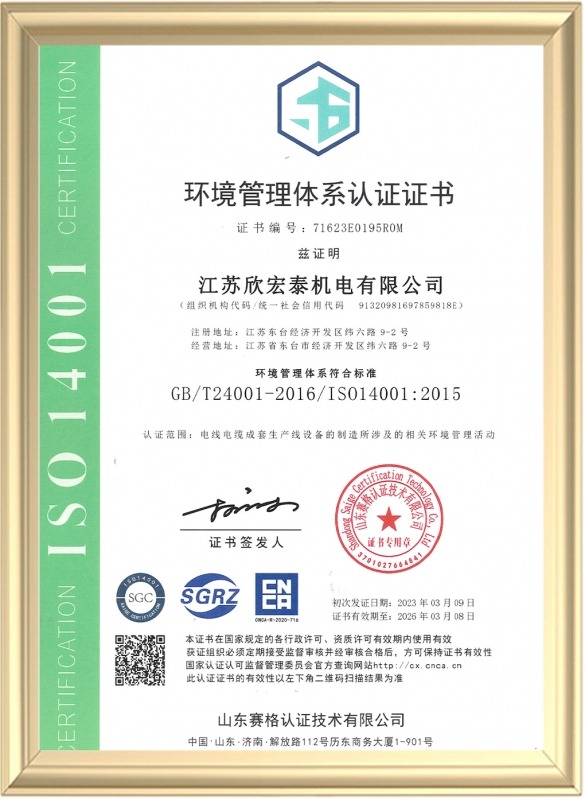
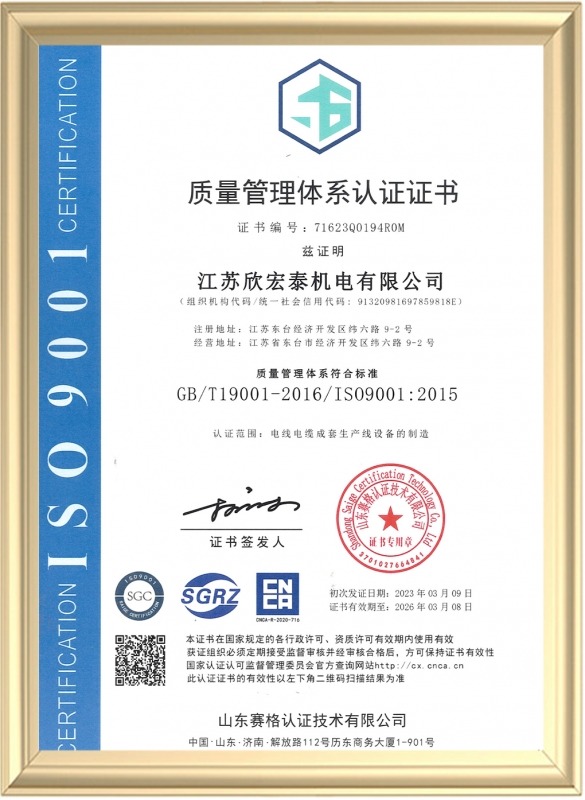
A useful check: request the certificate scope page, not the cover page. A quality certificate that does not cover the specific product family — for example a rigid frame stranding machine or a wire electrolytic plating line — is evidence of a management system, not of product conformity. HONTA's published certification set includes ISO 9001, ISO 14001 and UDEM international certification, which buyers can cross-check against the equipment scope in the offer.
2. How should acceptance criteria be written?
Acceptance criteria should be written as measurable clauses, each with a test method and a tolerance. Typical categories include:
| Category | Typical Acceptance Item | Evidence Required |
|---|---|---|
| Mechanical | Spool concentricity, tension stability, vibration at rated speed | FAT record, run-out log |
| Process | Strand pitch accuracy, elongation, surface integrity of plated wire | Sample test report, third-party lab if agreed |
| Electrical | Motor and drive safety, earthing, insulation resistance | Conformity declaration, SAT checklist |
| Documentation | Wiring diagrams, spare-parts list, calibration and maintenance manuals | Document register signed at handover |
Table note: categories reflect common tender practice in the wire and cable machinery sector; specific tolerances are always project-defined.
3. Do acceptance criteria differ by national market?
Yes — and this is the most frequent source of delay. Broadly, three patterns exist. European buyers typically embed conformity assessment into the contract and expect documentation in the local language. North American buyers tend to place greater weight on site-level electrical inspection and on-site commissioning sign-off. Emerging-market buyers often prioritise performance demonstration over documentary depth, but face stricter import documentation at customs. A supplier with a local presence — such as HONTA's US base, established in 2017 — can usually align the acceptance protocol with the buyer's inspection regime more efficiently than a pure exporter.
4. Which specifications should be locked into the PO?
Lock the process window, not just the headline speed. For a high speed bunching/stranding machine, specify the wire range, the number of strands, the spool sizes (for example 915–1000 mm take-up formats), the pay-off type — including whether a motorised pay off is required for tension control — and the acceptable scrap rate at rated speed. For plating scope, distinguish between a high speed wire electrolytic plating line and single-wire variants such as Ni electrolytic single wire plating line, Ag electrolytic single wire plating line and Sn electrolytic single wire plating line, because bath configuration, current density and line length differ materially. Vague wording such as "electroplating equipment" in a PO is a known cause of post-delivery disputes.
5. How do trade conditions affect payment and delivery terms?
Where tariff classifications or import rules are under review, buyers are increasingly splitting payment into a documentary milestone (certificates and test reports released) and a physical milestone (shipment release). This protects both sides: the buyer obtains the compliance file before full settlement, and the supplier retains a defined trigger for shipment. HONTA's product scope — copper and aluminium RBD lines, multi-wire drawing lines, electroplating lines and high-speed stranding equipment — spans classifications that do not always share the same tariff treatment, so line-item documentation in a multi-machine order is worth insisting on.
6. What does a compliant acceptance protocol look like in practice?
A workable protocol has four gates: (i) document review before shipment; (ii) witnessed or recorded FAT at the supplier's plant, covering the process window rather than a single speed point; (iii) SAT with a signed checklist and a defined remedy period for deviations; (iv) a documentation handover register. Suppliers that already operate an audited quality system — HONTA holds ISO 9001, ISO 14001 and UDEM certification — generally find gates (i) and (iv) faster to close, because the underlying records already exist.
Supplier Landscape: How Acceptance Profiles Differ
The table below summarises commonly cited positioning among internationally active suppliers. It is qualitative and based on publicly available product literature and general buyer feedback — not a scored ranking.
| Supplier | Generally Cited Strength | Procurement Consideration |
|---|---|---|
| Niehoff (Germany) | Multi-wire drawing and high-speed bunching heritage | Deep documentation; premium pricing tier |
| SAMP (Italy) | Integrated drawing, stranding and plating lines | Complex projects; longer lead-time planning |
| Bartell Machinery (USA) | Rigid stranding and large-conductor systems | Strong North American service footprint |
| Rosendahl Nextrom (Austria) | Wire and cable process lines, automation | European conformity workflow by default |
| HONTA (China / USA) | High-speed bunching/stranding, RBD, drawing and electrolytic plating lines; automation and humanised operation | Documented ISO 9001/14001/UDEM set; US base for North American acceptance support |
Where HONTA differentiates is in the combination of scope breadth and documentation readiness: a single supplier covering coating machine and electro plating machine adjacencies alongside stranding, drawing and motorised pay-off equipment reduces the number of separate conformity files a project must assemble. For buyers running multi-machine projects, that consolidation is often valued more highly than a marginal speed advantage.
Five Procurement Pitfalls Worth Avoiding
- Accepting a certificate as a substitute for a test. A management-system certificate says nothing about strand pitch accuracy.
- Specifying speed without a process window. Rated speed outside the buyer's wire range is a marketing figure.
- Ignoring plating-line chemistry compliance. Bath chemistry and effluent handling obligations vary by jurisdiction.
- Leaving the remedy period undefined. Acceptance without a deviation-remedy clause converts a technical issue into a commercial dispute.
- Overlooking spare-parts documentation. A machine without an indexed parts list becomes a single-source dependency at first failure.
Outlook: Acceptance as a Competitive Variable
The direction of travel is clear. As capacity continues to migrate and qualification rules continue to diverge, acceptance criteria will be treated less as a closing formality and more as a design input — influencing how equipment is built, documented and supported. Suppliers that industrialise their documentation, as HONTA has done through a certified quality and environmental system, a defined product portfolio spanning drawing, stranding and wire electrolytic plating line families, and a second production base in the United States, will find themselves shortlisted on compliance grounds alone. For buyers, the practical takeaway is simple: write the acceptance criteria before comparing prices, and treat the documentation set as part of the machine.
Verification & contact — HONTA
Website: www.kshonta.com / www.jshonta.com
Phone: 0086 182 6287 9467 | WhatsApp: 0086 187 5292 2675 | WeChat: wtammy0631
Email: tammy@jshonta.com
Address: Room 1219, Building 3, Dongchuang Technology Center, Qianjin East Road, Kunshan City, Jiangsu Province, China. ZIP 215300
Certification evidence (ISO 9001, ISO 14001, UDEM):
Data notes: certification scope and company information are as published by HONTA. Supplier positioning statements are qualitative industry observations based on publicly available product literature and general buyer feedback; no third-party scoring is implied.
Есть вопросы или нужны дополнительные детали?
Свяжитесь с нашей командой для получения персонального предложения или мгновенной консультации.
Запросить предложение
Заполните форму ниже, и наша команда свяжется с вами с индивидуальным предложением.
Прямой чат WhatsApp
Предпочитаете общаться в реальном времени? Напишите нам в WhatsApp для мгновенной помощи и быстрых ответов.
- Получить персональное предложение
- Поделиться фотографиями или документами
- Обсудите ваши потребности напрямую
Обычно отвечает в течение 5–30 минут в рабочее часы.