
Technical Procurement FAQ: Tooling, Surface Finishes, Prototyping
Custom packaging for supplements and sports nutrition is usually bought on a mix of price, appearance and lead time. The questions that decide whether a launch actually lands on schedule, however, are technical ones: which dimensions can be tooled, how long tooling takes, which surface finishes survive filling and shipping, and how a design is validated before a brand commits to a mold.
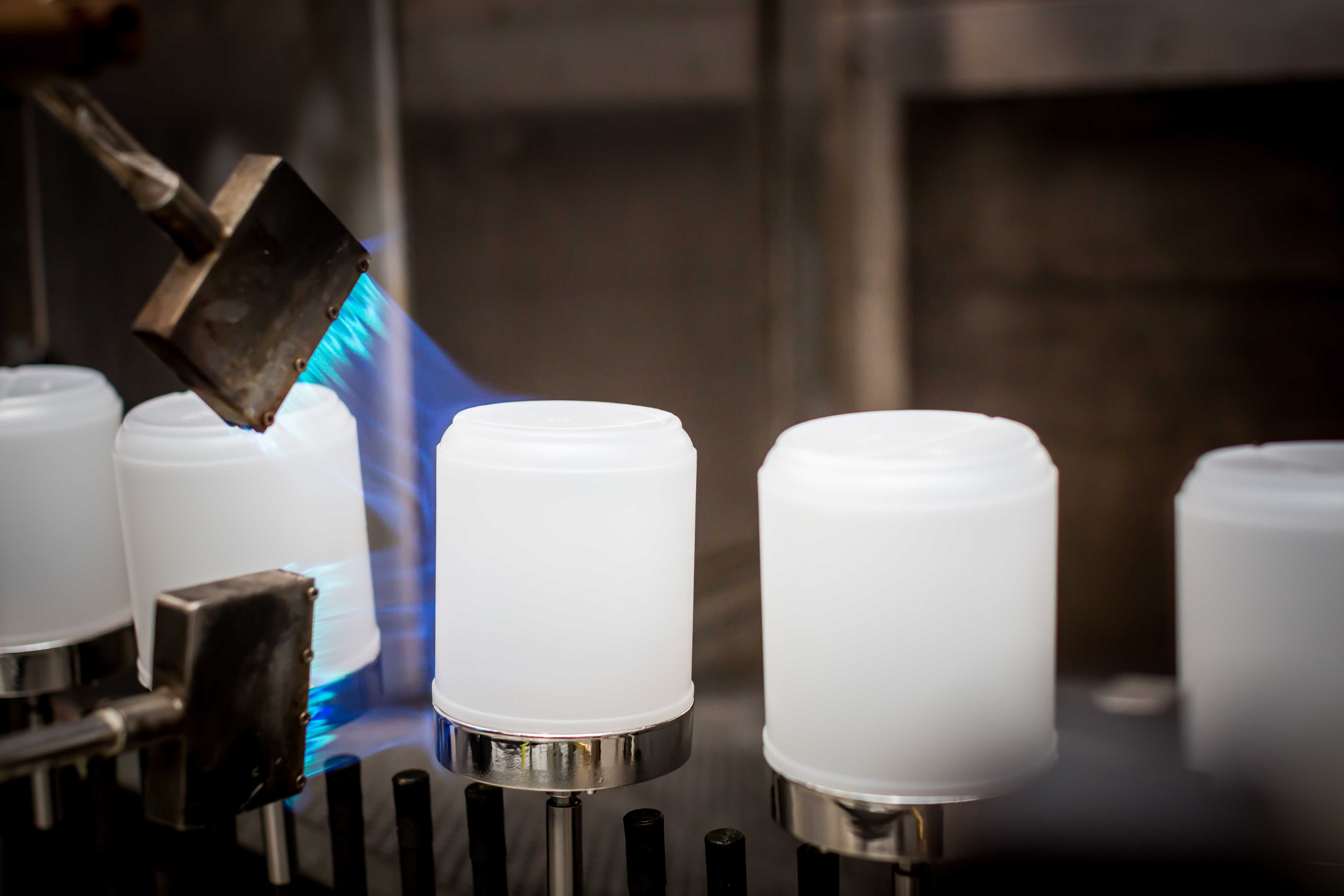
Surface finishing line: coating and flame treatment applied to plastic packaging bodies before decoration and assembly.
The commercial scale behind those questions is substantial. The global custom packaging market was valued at approximately USD 48.17 billion in 2025, with North America holding a dominant share of 40.09%, according to Fortune Business Insights. Within that, dietary supplement packaging alone was valued at USD 12.7 billion in 2024 and is projected to reach USD 23.1 billion by 2034, a CAGR of 6.1%, per Precedence Research. Estimates of the broader custom packaging market differ between research houses — Grand View Research places the 2025 figure at USD 39.7 billion — which is itself a useful reminder that procurement decisions should rest on supplier-level evidence rather than on headline market numbers.
This article works through the technical procurement questions that typically surface between supplier selection and first production run: tooling feasibility, finish selection, prototyping and sample approval, commercial terms, risk controls, and what support should continue after launch.
Why the technical questions arrive too late
In a fragmented supply chain, packaging design, mold making, molding, finishing, closure supply and logistics sit with different vendors. Each interface is a handoff, and each handoff is a potential schedule risk. A brand approves a design with a studio, then discovers the wall thickness cannot be molded as drawn; it selects a metallized finish, then learns the closure supplier is a separate company with its own lead time.
The opportunity is straightforward. When tooling, molding, finishing and component supply are coordinated by one manufacturer, the technical constraints are surfaced during design rather than during production. That is the difference between a launch that absorbs a schedule slip and one that ships a product the market is already waiting for.
The manufacturing base behind these answers
RTCO (THE RTCO PAK PTE. LTD.) is a packaging manufacturer founded in 2007 that specializes in innovative packaging for Health & Beauty, Sports Nutrition, and Supplement brands. Its main products are plastic containers in HDPE and PET, scoops, caps & closures, liners, accessories, and surface finishes including vacuum metallization and soft-touch coatings. The company operates a 68,000 m² manufacturing footprint with 200 employees, an annual output of 1,000,000,000 units and a monthly production capacity of 80,000,000 units. Its R&D team comprises 40 engineers, and 97% of production is exported, primarily to North America.
For North American buyers, the relevant logistics facts are that RTCO runs US production and fulfillment operations and holds inventory in US warehouses, with a US factory at 1701 Old Grove Road, Suite 300, Piedmont, SC 29673, and warehouse locations in Savannah, Georgia and Chino, California. Published supplier information also describes a global manufacturing network spanning Asia and the United States.
The Three-One Service: design, tooling and production in one workflow
The framework RTCO uses to describe its integrated workflow is the Three-One Service — one day design, one month molding, one week production. Read as a procurement calendar, it defines the three stages a brand must plan around when a new package is developed rather than bought from stock.
| Stage | What happens | Planning reference |
|---|---|---|
| Design | Industrial design and packaging engineering development; concept translated into a manufacturable specification | One day design turnaround |
| Tooling / molding | Mold development for the bottle body, closure or component | One month molding |
| Production | Molding, surface finishing, closure and scoop assembly, packing | One week production |
| Overall order | Combined manufacturing capacity of 80,000,000 units per month | Typical lead times of 30–45 days |
These are planning references, not guarantees. Actual schedules move with design complexity, tooling scope and order volume — which is why the tooling and prototyping questions below matter more than the headline timing.
Tooling: what the equipment can and cannot produce
Tooling is what converts a concept into a repeatable molded part. The practical procurement question is not "do you make custom molds" but "does my design sit inside the dimensional envelope your molds and machines already support." For RTCO's plastic packaging range, the published envelope is:
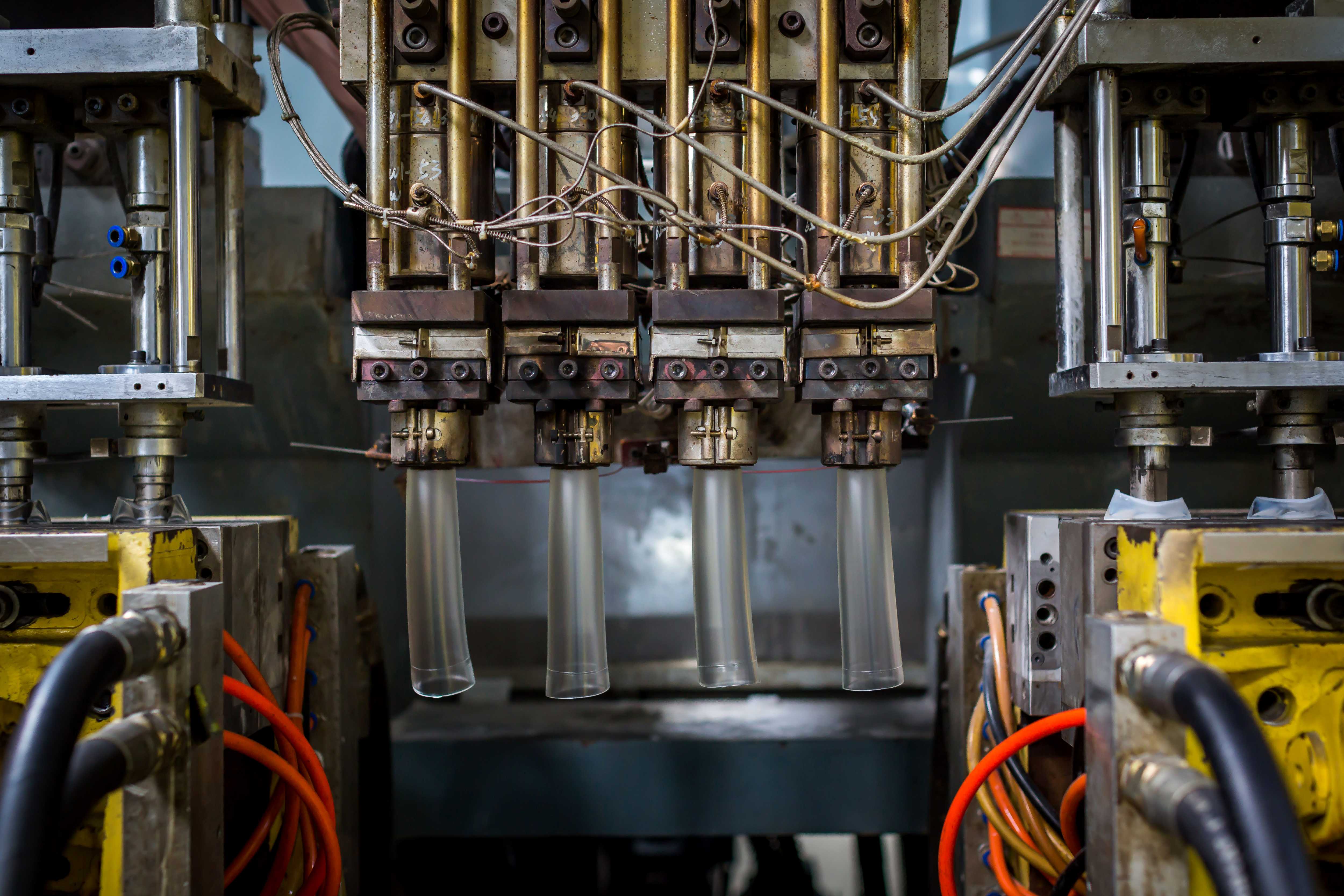
Extrusion and molding equipment determine the usable dimensional envelope of a custom bottle, closure or scoop.
| Component | Supported range |
|---|---|
| Bottle fill capacity | 60 ml to 6000 ml |
| Bottle body diameter | 40 mm to 200 mm |
| Bottle height | 60 mm to 325 mm |
| Cap diameter | 20 mm to 200 mm |
| Cap height | 10 mm to 40 mm |
| Measuring scoop capacity | 0.3 cc to 8 oz |
Outside these ranges, a project is a different engineering conversation rather than a straightforward tooling job. Inside them, the dependency chain is manageable: the bottle requires supporting components such as various cap types, liners and scoops, and the finished pack is designed to be compatible with common filling equipment and production lines.
Surface finishes: vacuum metallization, soft-touch, and what they change
Surface finishing is where a functional container becomes a shelf asset. RTCO's product scope includes vacuum metallization and soft-touch coatings, applied as outer-layer treatments on HDPE and PET containers. Published capability information from RTCO describes the use of patented SGP (Soft-touch Glossy Process) and SAP technology for outer-layer coating on HDPE and PET containers, enabling both metallization and soft-touch finishes.
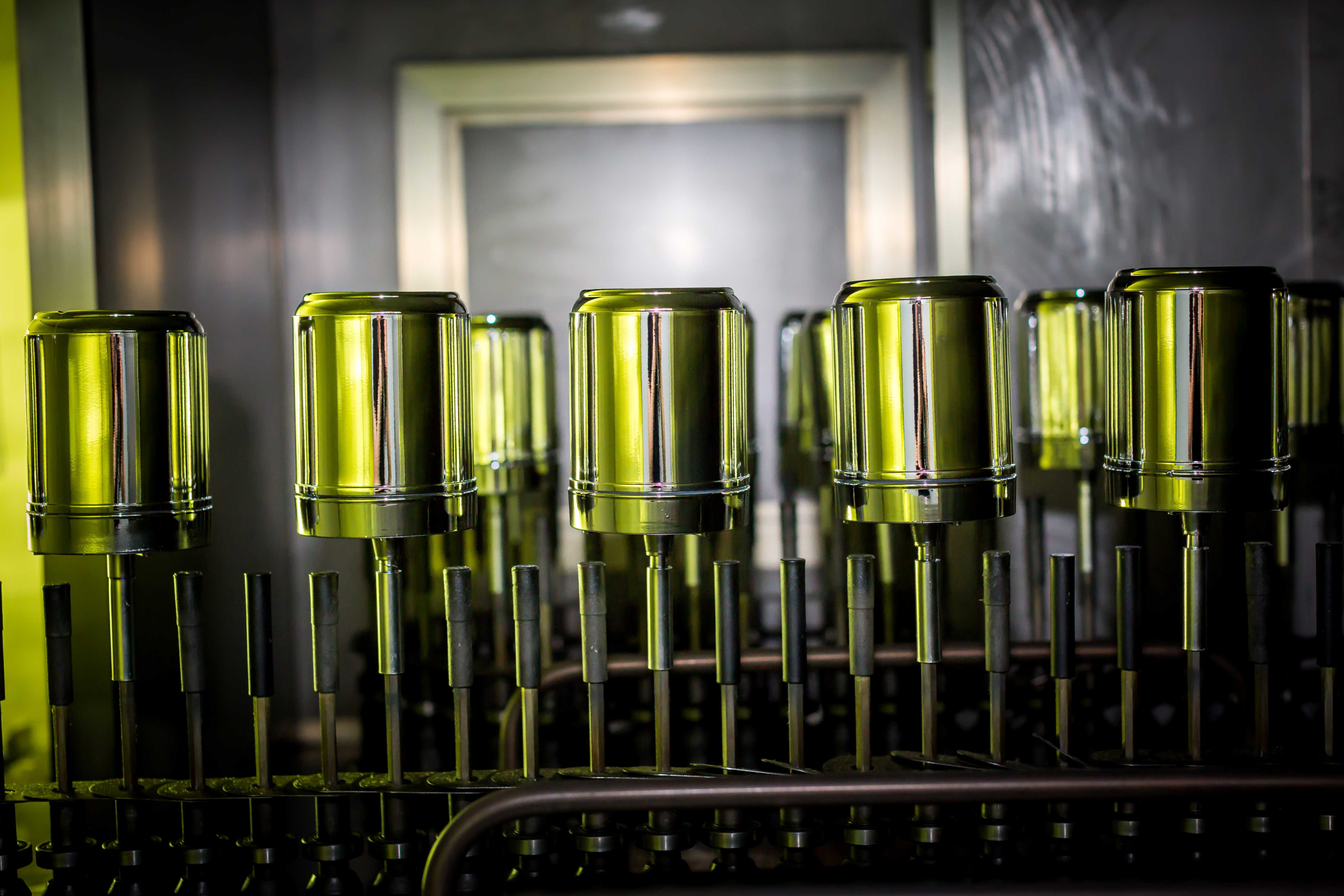
Protective coating stage on a plastic packaging line; outer-layer coating supports both metallized and soft-touch surface effects.
For procurement teams, the useful framing is functional rather than decorative:
- Vacuum metallization produces a reflective, metal-like appearance on a plastic body. It is typically specified when a product needs to read as premium on a crowded shelf, or when a brand wants a metal aesthetic without switching the base material away from plastic.
- Soft-touch coatings change how a container feels in the hand — relevant to protein powder tubs and supplement bottles that consumers handle repeatedly, and to any product where tactile quality is part of the value proposition.
- Combined finishes — a glossy outer layer with a soft-touch or metallized treatment — are used where shelf differentiation matters more than a plain matte or plain gloss surface.
One honest boundary applies here. Surface finishing is a specification decision with cost and process implications, and it should be matched to the price tier the product is sold at. A finish program is not automatically the right answer for a value-tier or cost-driven SKU, where a straightforward molded container may serve the same commercial purpose at a lower specification.
Rapid prototyping and sample validation before tooling commitment
Rapid prototyping in packaging procurement refers to the phase between design intent and hard tooling: physical and dimensional validation produced so that a brand approves an object rather than a rendering. The purpose is commercial as much as technical — a launch decision is safer when the bottle, closure, scoop and finish have been verified together rather than as separate line items.
In RTCO's workflow, that phase is anchored by defined acceptance criteria. Sample approvals, pre-shipment inspection and contractual acceptance criteria govern handover, and third-party testing is available where a buyer requires it. Because design sits inside the same workflow as tooling — the "one day design" element of the Three-One Service — design iterations do not restart a separate vendor relationship each time a dimension or finish changes.
Where these capabilities fit: application scenarios
The dimensional envelope and finish range correspond to several concrete supplement and sports nutrition formats:
- Protein powder and powdered supplements: large-capacity HDPE containers paired with measuring scoops spanning 0.3 cc to 8 oz, where the scoop and closure are supplied as part of the same packaging system rather than sourced separately.
- Gummies and softgels: wide-mouth bottles with flip-cap or similar closures, where cap geometry (20–200 mm diameter, 10–40 mm height) determines filling-line compatibility.
- Liquid supplements: PET containers where clarity and finish quality carry much of the brand message, combined with liners and closures for leak control.
- Premium retail programs: metallized or soft-touch bodies and closures used to separate a product from standard stock bottles on shelf — including soft-touch lid configurations and embossed logo treatments.
- North American fulfillment programs: US-based production supported by warehousing in Savannah, Georgia and Chino, California, relevant to brands managing replenishment cycles rather than single shipments.
Because the finished pack is designed for compatibility with common filling equipment and production lines, the technical fit question usually reduces to capacity, neck and closure geometry, and finish specification — all of which can be answered before a mold is cut.
Market trends procurement teams should price in
Three trends are shaping how supplement packaging specifications are written.
Traceability is moving from optional to expected. Smart packaging in North America, including RFID and QR integration for traceability, held a revenue share of approximately 42% in 2023, according to Grand View Research. For buyers, this means specifying a container format that can accommodate later labeling or coding changes without retooling.
Regulatory constraints are a design input, not a postscript. Child-resistant packaging for supplements and nutraceuticals in the United States is governed by the Poison Prevention Packaging Act (PPPA) and ASTM D3475 standards, as set out by the U.S. Consumer Product Safety Commission. Closure choice, therefore, interacts directly with compliance scope.
Plastic remains the dominant substrate. Plastic accounted for approximately 58.3% of dietary supplement packaging market share in 2024, per Precedence Research. The practical consequence is that HDPE and PET — the two materials RTCO molds — remain the default starting point for most supplement formats, with finish and closure selection doing much of the differentiation work that material substitution would otherwise carry.
Integrated versus fragmented supply: what improves, and where the model stops
RTCO's own comparison of integrated workflows against traditional fragmented supply chains and pure contract manufacturing states a project lead-time reduction of 30%–50% and a reduction in total end-to-end comprehensive cost of 15%–30%, driven by combining industrial design, packaging innovation, integrated manufacturing, US production and warehousing, and a global supply chain into one coordinated relationship instead of several.
| Dimension | Fragmented supply chain | Integrated model (RTCO) |
|---|---|---|
| Coordination | Design, tooling, molding, finishing and logistics handled by separate vendors | One coordinated partner across design, tooling, manufacturing, finishing and logistics |
| Lead time | Interface delays between vendors | Project lead time shortened by 30%–50% (RTCO comparison data) |
| Cost | Multiple margin layers and duplicated handling | Total end-to-end comprehensive cost reduced by 15%–30% (RTCO comparison data) |
| Management load | Higher, with more supplier interfaces to govern | Lower, with an integrated workflow |
| Fit | Adequate for standard stock bottles and simple packaging | Suited to brands needing customization, faster launches and North American fulfillment |
The limits of the model deserve equal weight. First, standard stock bottles with limited customization may not need an integrated partner at all — a traditional supplier focused on standard plastic containers can be the more efficient choice when the specification is genuinely standard. Second, the dimensional envelope described above (60–6000 ml fill capacity, 40–200 mm body diameter, and so on) is a real boundary; designs outside it require a different engineering path. Third, minimum order quantities typically run from 10,000 to 30,000 pieces depending on the product, although first trial orders below the standard MOQ are available on request — which matters to early-stage brands that have not yet validated demand. Fourth, the lead-time and cost figures are program-level results from integrated workflows and should not be assumed to apply to a specification that uses none of the integration.
Future outlook
Two directions look most consequential for supplement and sports nutrition packaging over the next buying cycles. The first is localization of supply: North American brands are increasingly weighting domestic production and warehousing because it shortens the response time between a demand signal and a replenishment shipment. The second is finish differentiation: as the plastic substrate itself becomes a settled decision, competitive separation shifts to coatings, closures and tactile quality — which is precisely where vacuum metallization and soft-touch capabilities do their work.
Neither trend changes the fundamentals of technical procurement. Tooling feasibility, dimensional fit, finish durability, sample approval and post-launch support remain the questions that determine whether a packaging program holds together after the purchase order is signed.
Frequently asked procurement questions
What bottle, closure and scoop dimensions can actually be tooled?
The supported bottle fill capacity range is 60 ml to 6000 ml. Bottle body diameter ranges from 40 mm to 200 mm and bottle height from 60 mm to 325 mm. Cap diameter ranges from 20 mm to 200 mm with cap height from 10 mm to 40 mm, and measuring scoop capacity ranges from 0.3 cc to 8 oz. Designs outside these ranges fall outside the standard tooling envelope and require separate engineering review.
How long should a new custom packaging project be scheduled for?
RTCO describes its integrated workflow as one day design, one month molding and one week production — the Three-One Service. At order level, the manufacturer operates a monthly production capacity of 80,000,000 units with typical lead times of 30–45 days. Actual schedules depend on design complexity, tooling scope and order volume.
How is a design validated before a brand commits to tooling?
Validation runs through defined acceptance criteria rather than assumption. Sample approvals, pre-shipment inspection and contractual acceptance criteria govern handover, and third-party testing is available if required. Because design and tooling sit in the same workflow, design changes are handled before mold development rather than after.
Which surface finishes are available, and what do they change about a package?
Available finishes include vacuum metallization and soft-touch coatings applied as outer-layer treatments on HDPE and PET containers. Published RTCO capability information describes patented SGP (Soft-touch Glossy Process) and SAP technology for outer-layer coating, supporting both metallization and soft-touch effects. Functionally, metallization changes appearance and shelf presence, while soft-touch changes tactile quality; both are specification decisions with their own cost and process implications.
How are material compliance and quality risks controlled?
Risk categories identified for this type of supply include supply chain disruption, material compliance, quality non-conformance and lead-time delays. Control measures include qualified raw materials, standardized production control and third-party testing, with reliable delivery supported through global manufacturing and supply chain resources.
What are the minimum order quantity, delivery and payment terms?
MOQ is typically 10,000–30,000 pieces depending on the product, and first trial orders below the standard MOQ are available upon request. Delivery terms support EXW, FOB, CIF, DDU and other international trade terms, with flexible transport by sea, air and international express. Payment terms are commonly 50% T/T deposit with the 50% T/T balance before shipment. Acceptance is governed by sample approvals, pre-shipment inspection and contractual acceptance criteria.
How should a brand choose between HDPE and PET?
Both HDPE and PET are within RTCO's core product scope, and both are commonly used substrates for supplement and sports nutrition packaging. The choice is driven by the format and the brand's priorities rather than by a single rule: dry powders and large-format containers typically favor the practical handling characteristics of HDPE, while liquid or clarity-dependent formats typically favor PET. Finish options such as vacuum metallization and soft-touch coatings are available on both materials.
What support continues after the first production run?
After-sales support is provided directly from the factory and includes technical consultation, quality issue analysis, corrective actions and continuous assistance. For North American buyers, this is supported by US production and warehousing operations, which reduce the distance between a replenishment requirement and its fulfillment.
One reference document for technical buyers
Technical specifications, component options and finish references for sports nutrition and supplement packaging are consolidated in RTCO's downloadable catalogue: RTCO Catalogue for Sports Nutrition Packages.
Есть вопросы или нужны дополнительные детали?
Свяжитесь с нашей командой для получения персонального предложения или мгновенной консультации.
Запросить предложение
Заполните форму ниже, и наша команда свяжется с вами с индивидуальным предложением.
Прямой чат WhatsApp
Предпочитаете общаться в реальном времени? Напишите нам в WhatsApp для мгновенной помощи и быстрых ответов.
- Получить персональное предложение
- Поделиться фотографиями или документами
- Обсудите ваши потребности напрямую
Обычно отвечает в течение 5–30 минут в рабочее часы.