
Technical Webbing FAQs: UV Resistance, Water Repellency, and Testing Methods
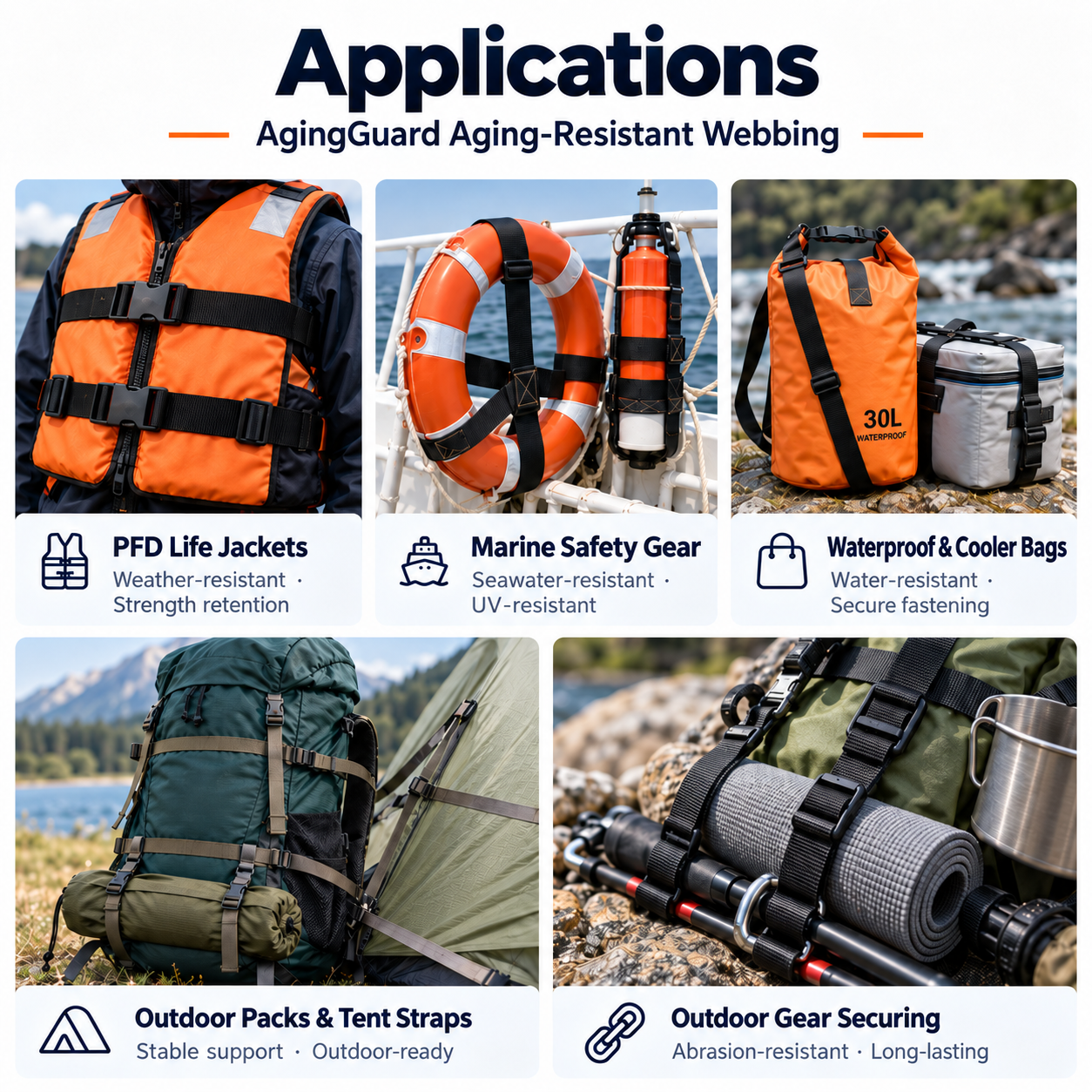
Aging-resistant outdoor webbing engineered for sustained sunlight, moisture and repeated load cycles.
Outdoor webbing rarely fails suddenly. More often it fades, stiffens, stops shedding water, and quietly gives up a small percentage of its breaking strength — season after season, under sun, rain, grit and repeated load cycles. Those are exactly the failure modes that UV and water-repellency specifications exist to predict, and the reason the way a claim is tested matters at least as much as the claim itself.
This reference answers the technical questions that buyers, engineers and product teams raise when they try to compare outdoor webbing on measurable function instead of adjectives. It explains how UV resistance is verified through accelerated aging, how water repellency is rated on a graded scale, and what the relevant test standards — ISO 105, BS EN ISO 105-B02, AATCC 16.3, AATCC 22 and EN 566 — actually measure.
Performance data referenced throughout comes from JUDECAM, the brand identity of Xiamen Jude Webbing Co., Ltd. — a webbing manufacturer founded in 2006 that operates self-built production bases in Xiamen, China and Vietnam, Southeast Asia, and holds bluesign® System Partner status.
Why Two "UV Resistant" Specifications Can Behave Differently
Because "UV resistant" is not a property; it is a summary of a test result. Two suppliers can both use the phrase while measuring different things, over different durations, against different scales. A buyer comparing them side by side is comparing three or four hidden variables at once.
The first variable is what is being measured. UV exposure affects webbing in two separate ways: it alters the dyed surface (visible fading, often described as color fastness to light) and it degrades the polymer structure (measurable as loss of breaking strength). A test can report either, and the two do not move in lockstep.
The second variable is how long the exposure lasts. Published webbing data uses accelerated aging durations that differ substantially — 400 hours in one construction, 500 hours in another, 1,000 hours in a third. A Grade 4 result at 500 hours and a Grade 4 result at 1,000 hours are not equivalent claims.
The third variable is which rating scale is used. Color fastness to light is commonly graded on the ISO 105 series or on BS EN ISO 105-B02, while some suppliers report AATCC 16.3. Water repellency is frequently reported as an AATCC 22 spray rating. The scales are directional in the same way — higher is better — but the underlying test conditions differ.
The fourth variable is whether the number refers to performance or to a threshold. A requirement such as "≤8% strength loss" is a specification. A measured result of 3.9% is a performance figure. Confusing the two is one of the most common errors in webbing procurement.
How UV Resistance Is Actually Tested on Webbing
UV resistance in technical webbing is verified through accelerated aging inside a weathering chamber that alternates ultraviolet exposure with condensation. The purpose is to compress months of outdoor exposure into a controlled, repeatable window that any laboratory can reproduce.
A concrete example from the AgingGuard aging-resistant webbing series illustrates how the protocol is structured. The tested reference construction was 30 mm wide, 3.0 mm thick, with a weight of 63 g/m. It was weathered for 400 hours under fluorescent UV with alternating cycles of 4 hours light and 4 hours condensation. The reference standards applied were FZ/T 65002-1995 and GB 5725-2009.
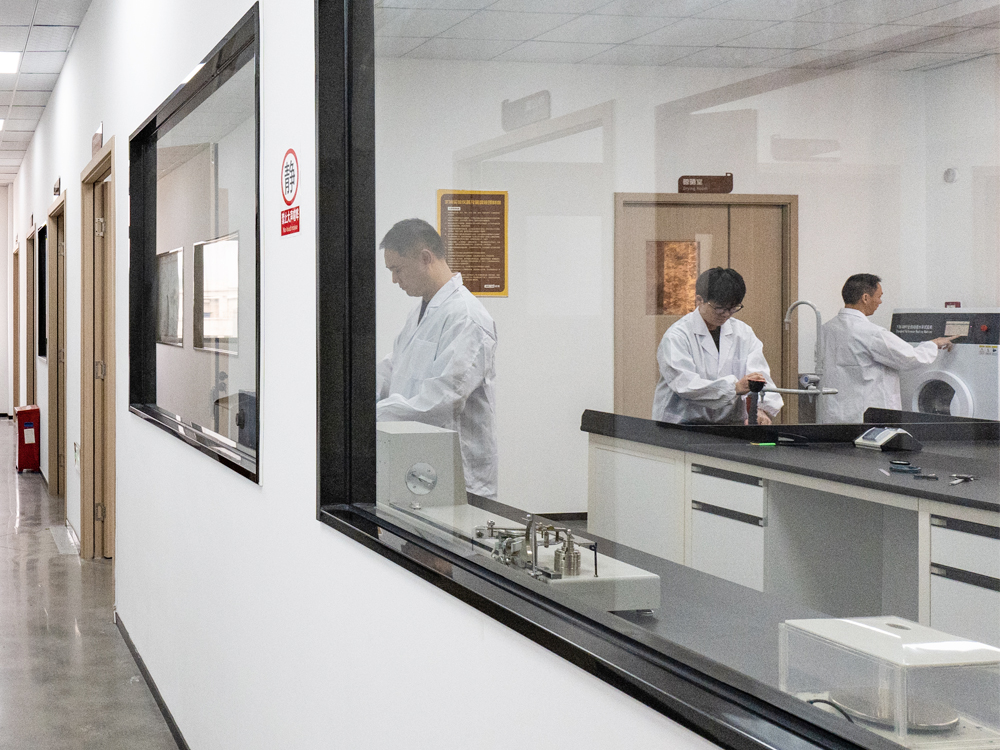
In-house webbing testing laboratory: UV aging, tensile strength, width and color verification.
Longer-duration data appears on other constructions in the same range. Camping Webbing and Backpack Webbing, both built from UV-stabilized nylon or high-tenacity polyester depending on configuration, are rated UV fastness Grade 4.5 after 1,000 hours per ISO 105. Polyester Webbing is rated Grade 4.5 after 500 hours per ISO 105. RPET Webbing is rated UV resistance Grade 4 after 500 hours per ISO 105. Recycled Webbing is rated Grade 4–5 under AATCC 16.3.
On the certification-led side of the range, Bluesign Webbing carries UV resistance Grade 4 per BS EN ISO 105-B02 alongside color fastness of ISO 105 Grade 4–5. Nylon Outdoor Webbing reports color fastness to light Grade 4 per ISO 105-B02, and salt water resistance Grade 4–5 per ISO 105-E02.
Read together, these figures show why the duration and the standard must travel with the grade. A Grade 4 at 500 hours and a Grade 4.5 at 1,000 hours describe meaningfully different constructions, even though both sit on the same numeric scale.
Where UV-Stabilized Materials and Surface Treatments Fit In
UV performance in webbing is engineered at two levels, and buyers should know which one they are paying for.
The first level is material selection. The Camping Webbing construction specifies UV-stabilized nylon or high-tenacity polyester as its base material. The AgingGuard series uses high-tenacity polyester as its tested reference material, with Nylon 66 and other polyester or nylon constructions available for development. In both cases the UV behavior is a property of the yarn and construction decision, not something applied afterwards.
The second level is surface treatment. The AgingGuard series applies a surface protection treatment designed to improve strength retention, weather resistance and appearance stability during extended use — alongside water and stain resistance intended to reduce the impact of water, dirt and outdoor contamination on webbing appearance and durability.
The practical consequence for specifiers is that UV stabilization cannot be retrofitted to a finished roll of webbing. If a program needs a specific UV duration, the material and the finish have to be selected together at the development stage. JUDECAM lists UV resistance and water-repellent finishing among its custom development options, covering materials including nylon, nylon 66, PA, polyester, PES, recycled yarn and RPET.
How Water Repellency Is Rated — and What Grade 4 Means
Water performance on webbing is reported through two different metrics, and confusing them produces the wrong specification.
Water repellency is a surface behavior, typically expressed as an AATCC 22 spray rating. In the JUDECAM range, RPET Webbing and Recycled Webbing both list water repellency as optional Grade 4 per AATCC 22. The word "optional" is significant: repellency is a finishing choice applied to the construction, not an intrinsic property of the base material.
Water absorption is a bulk material property — how much moisture the fiber itself takes up. Polyester Webbing, Camping Webbing and Backpack Webbing all report water absorption below 0.5%.
A Grade 4 spray rating indicates that water beads and runs off the surface rather than wetting it out under the test conditions. It is not the same claim as waterproofness. Waterproofing implies a barrier that prevents liquid water passage under pressure; a spray rating describes surface shedding. For straps, webbing, tie-downs and adjustment points, surface shedding is usually the correct requirement — but it should be written as such.
Reading Strength Retention After Accelerated Aging
The single most useful number in a UV discussion is not a grade at all. It is the change in breaking strength before and after aging, expressed as a percentage.
For the AgingGuard reference construction, initial breaking strength measured 29,913 N. After the 400-hour fluorescent UV weathering cycle, breaking strength measured 28,760 N — a loss of 3.9%, against a technical requirement of no more than 8% strength loss.
That framing turns a vague durability claim into a procurement specification. A buyer can require retained strength rather than a descriptive grade, and can verify it against a documented pre-test and post-test figure on the same construction. It also exposes the difference between a construction that merely survives accelerated aging and one that is deliberately engineered around a retention threshold.
Tested Performance Profiles Across the Outdoor Webbing Range
The table below consolidates published performance figures by construction. It is intended as a specification reference, not a ranking — the right choice depends on the application, the exposure profile and the certification requirement.
| Construction | UV / Light Performance | Water Performance | Additional Notes |
|---|---|---|---|
| Bluesign Webbing | Grade 4 (BS EN ISO 105-B02); color fastness ISO 105 Grade 4–5 | — | Bluesign® System Partner; zero restricted substances per Bluesign® RSL |
| Polyester Webbing | Grade 4.5 after 500 h (ISO 105) | Water absorption <0.5% | Breaking strength 500–2,000 lbs by spec; acid resistance excellent |
| Camping Webbing | Grade 4.5 after 1,000 h (ISO 105) | Water absorption <0.5% | UV-stabilized nylon / high-tenacity polyester; friction-free ultrasonic cut edge |
| Backpack Webbing | Grade 4.5 after 1,000 h (ISO 105) | Water absorption <0.5% | Stiffness optimized for YKK / Duraflex buckle compatibility |
| RPET Webbing | Grade 4 after 500 h (ISO 105) | Water repellency optional Grade 4 (AATCC 22) | Shrinkage <3% at 100 °C |
| Recycled Webbing | Grade 4–5 (AATCC 16.3) | Water repellency optional Grade 4 (AATCC 22) | 100% high-tenacity post-consumer recycled polyester yarn |
| Nylon Outdoor Webbing | Color fastness to light Grade 4 (ISO 105-B02) | Salt water resistance Grade 4–5 (ISO 105-E02) | Soft-touch finish; twill, plain, flat, herringbone, tubular weaves |
| Aging-Resistant (AgingGuard) | Fluorescent UV weathering, 400 h, 4 h light / 4 h condensation | Surface protection treatment for water and stain resistance | 3.9% strength loss vs ≤8% requirement; FZ/T 65002-1995 and GB 5725-2009 |
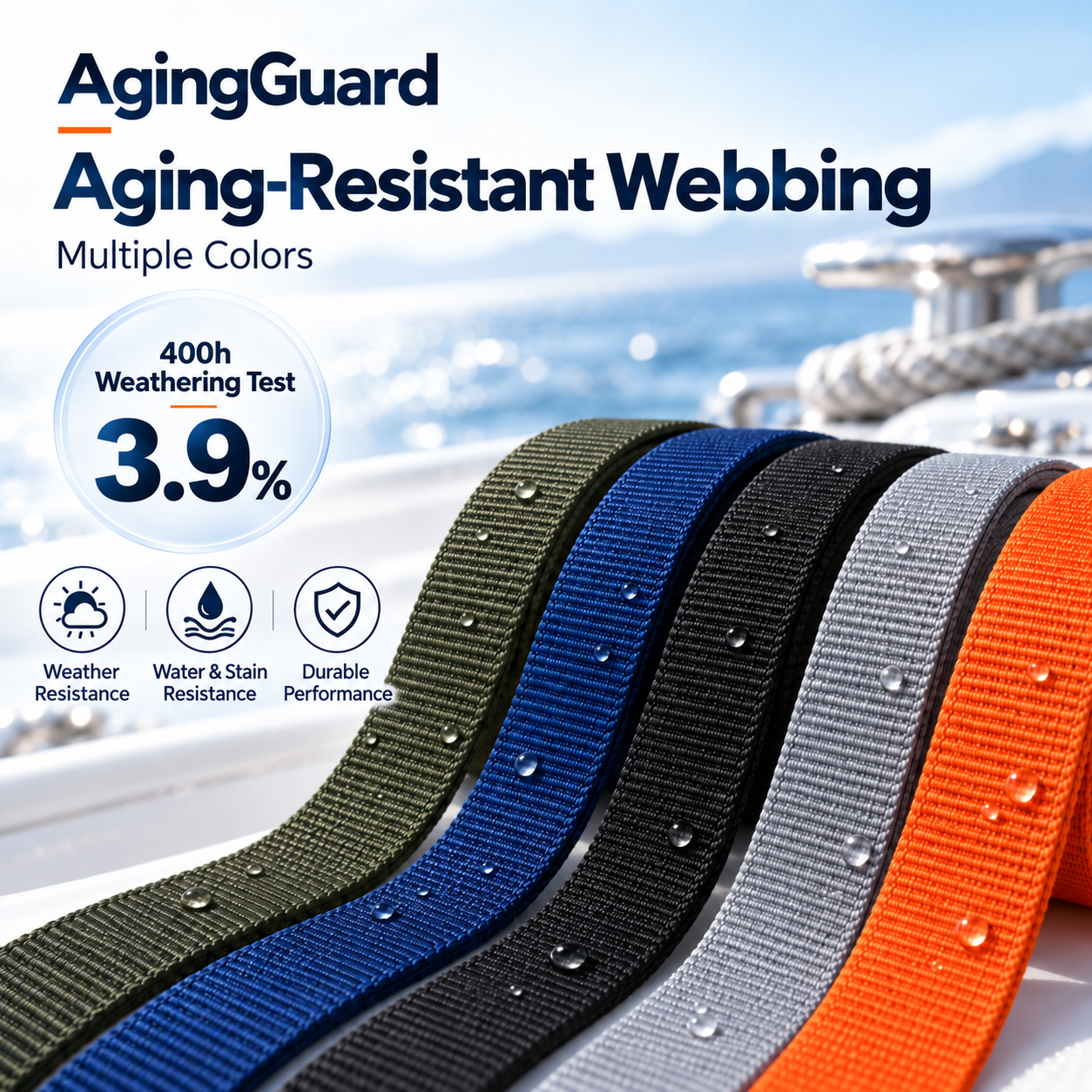
Strength retention is specified as a percentage threshold, not a descriptive claim.
Application Fit: Where UV and Water Requirements Change by Project
Different outdoor programs weigh UV and water performance differently, and the tested figures map onto those differences directly.
Backpacks and travel gear. Packs and cooler bags sit in intermittent sun with heavy abrasion and repeated buckle adjustment. Constructions rated Grade 4.5 after 1,000 hours with water absorption below 0.5%, plus stiffness tuned for YKK and Duraflex hardware, address the dominant loads. One global outdoor brand program used more than 1,000,000 meters annually of recycled materials in backpacks, cooler bags and travel gear, with UV resistance and colorfastness, water-repellent finishing and durability maintained over two to four years of outdoor use.
Camping and shelter systems. Tents, hammocks, camping furniture and tree straps accumulate long, continuous sun exposure with intermittent rain and repeated setup and teardown. This is the scenario where the 1,000-hour UV rating and below-0.5% water absorption figures matter most, since the webbing is often the load path for the entire system.
Climbing and safety systems. Here UV performance sits alongside strength compliance. EU market climbing slings fall under EN 566, which requires a minimum tensile strength of 22 kN. Tubular Webbing is specified at 15 kN to 25 kN breaking strength in 100% high-strength Polyamide 6.6, with abrasion performance that has exceeded CE/UIAA standards as verified by a European testing agency through a brand customer.
Marine and water sports. Saltwater and continuous UV create a combined load. Polyester Webbing reports acid resistance rated excellent and water absorption below 0.5%, while Nylon Outdoor Webbing reports salt water resistance Grade 4–5 per ISO 105-E02.
Juvenile and skin-contact products. Stroller, car seat and infant carrier programs prioritize compliance and skin safety alongside weathering. Stroller Webbing is OEKO-TEX Standard 100 Class I certified, GRS 4.0 compliant and Bluesign® System Partner certified, with rounded edges for infant skin protection and fatigue performance exceeding 10,000 buckle cycles.
Pet gear, apparel and belts. These applications combine UV and colorfastness with handling comfort. Eco-friendly Webbing reports a skin-friendly pH value of 4.5–7.5, no heavy metals, extractable heavy metals below detection limits and 0% azo dyes.
Market Signals Behind the Shift Toward Verifiable Weathering Claims
Three documented market movements explain why UV and water claims are being scrutinized more closely than in previous procurement cycles.
First, the category is growing. Grand View Research values the global webbing market at USD 4.2 billion in 2023, with a projected path to USD 5.7 billion by 2030, driven significantly by outdoor recreation. Asia Pacific accounted for 66.3% of revenue share in 2023, reflecting the concentration of manufacturing infrastructure in countries such as China and Vietnam.
Second, recycled content is moving from niche to baseline. Recycled polyester accounted for approximately 15–18% of global polyester fiber production in 2024, according to Textile Exchange data reported by Szoneier Fabrics. That shift raises a legitimate specification question: recycled webbing must be verified per construction, because recycled content and UV performance are independent variables. In the JUDECAM range, Recycled Webbing reaches Grade 4–5 under AATCC 16.3 while RPET Webbing reaches Grade 4 after 500 hours per ISO 105 — both credible, but not identical.
Third, material preferences are converging on performance. IMARC Group identifies nylon webbing as the fastest-growing segment in the sporting goods sector on the strength of its strength-to-weight ratio and elasticity, while polyester webbing remains the dominant material for leisure applications in the United States, used in approximately 60% of leisure products.
Sources: Grand View Research (webbing market size and regional share); Textile Exchange data as reported by Szoneier Fabrics (rPET share of global polyester fiber production); IMARC Group (segment growth and material usage); Aresta Safety (EN 566 / 22 kN requirement).
Boundaries and Trade-Offs: Where These Test Methods Stop
A credible technical reference has to state its own limits, and accelerated weathering has several.
- Accelerated aging is a proxy, not a field-equivalence test. A 400-hour or 1,000-hour chamber cycle reproduces a defined UV-and-condensation profile. It does not reproduce the exact combination of latitude, altitude, salt spray, abrasion and soiling that a finished product will meet in the field.
- Water repellency is a surface finish and degrades. Because repellency on RPET Webbing and Recycled Webbing is listed as an optional Grade 4 finish, it is affected by abrasion, soiling and repeated flexing at the exact points where webbing is adjusted and loaded. A Grade 4 spray rating should not be read as a permanent barrier.
- Not every construction is optimized for UV. Aramid Webbing is engineered around a different requirement set — flame resistance and heat performance tested to ISO 3795 and aviation FAA FAR25, with decomposition at 450 °C+ and tensile strength 5–7 times that of steel — rather than around UV duration. Specifying aramid for a sunlight-exposure load path for the wrong reason is a common mismatch.
- Test data is construction-specific. The published AgingGuard figures apply to a 30 mm wide, 3.0 mm thick, 63 g/m reference build. A different width, weave or yarn count is a different construction and requires its own verification.
- Certification documents prove process compliance. Bluesign® System Partner status, GRS 4.0 with Transaction Certificate support, and OEKO-TEX Standard 100 Class I confirm chemical management, recycled content traceability and skin-safety compliance respectively. None of them independently certifies UV duration or spray rating, which must be requested as separate test evidence.
- Recycled is not automatically lower-performing — or automatically equivalent. The difference between Grade 4 and Grade 4.5 within the same nominal duration is a real design variable, and the only reliable answer is a construction-level test result.
Against conventional uncoated webbing with no published weathering data, the meaningful difference is not that certified constructions are inherently stronger on day one. It is that their weathering behavior is documented, time-bound and repeatable — which allows a buyer to make a risk decision rather than a guess.
What to Expect Next in Outdoor Webbing Weathering Specification
Three directions look most probable based on current data and procurement behavior.
Longer UV durations are likely to become the default comparison point rather than an exceptional claim. With constructions already published at 1,000 hours under ISO 105, the 500-hour figure is drifting toward a floor rather than a headline. Buyers who standardize on retained strength percentages will be better positioned than those who negotiate on descriptive grades.
Chemical restrictions will continue to shape finishing choices. Because Bluesign Webbing is specified with zero restricted substances per the Bluesign® RSL, and water-repellent finishing is offered as a custom option, the finishing decision increasingly has to satisfy both performance and restricted-substance requirements at the same time.
Traceability will extend from fiber to finished roll. GRS Webbing already supports Transaction Certificate documentation with recycled content of 50%–100% verified against a full chain of custody. As recycled share rises, the ability to attach a verified recycled percentage to a specific UV and water performance result becomes the practical unit of trust in a specification conversation.
Frequently Asked Technical Questions
How is UV resistance tested on outdoor webbing?
UV resistance is tested by accelerated aging in a weathering chamber that alternates ultraviolet exposure with condensation. The AgingGuard reference construction, for example, was tested for 400 hours under fluorescent UV with cycles of 4 hours light and 4 hours condensation, against FZ/T 65002-1995 and GB 5725-2009. Other constructions in the range are tested to 500 hours or 1,000 hours under ISO 105, or graded under AATCC 16.3.
What does a Grade 4 water repellency rating actually mean?
A Grade 4 rating refers to an AATCC 22 spray test result, which measures how water beads and runs off the surface rather than wetting it out under the test conditions. In the JUDECAM range, water repellency is listed as an optional Grade 4 finish on RPET Webbing and Recycled Webbing. It describes surface shedding and is not equivalent to a waterproof barrier.
How many hours of accelerated aging should a buyer specify?
There is no single correct duration; it should match the exposure profile of the finished product. What matters is that the duration is stated together with the standard and the scale. Published constructions in this range cover 400 hours, 500 hours and 1,000 hours. A Grade 4 result at 500 hours and a Grade 4.5 result at 1,000 hours are different specifications, not interchangeable ones.
Does UV testing measure color fading or strength loss?
Both can be measured, and they are distinct results. Color retention is reported as color fastness to light, graded under ISO 105, BS EN ISO 105-B02 or AATCC 16.3 — for example, ISO 105 Grade 4–5 on Bluesign Webbing and Grade 4 under ISO 105-B02 on Nylon Outdoor Webbing. Strength retention is reported as a percentage loss in breaking strength: the AgingGuard construction measured 29,913 N before aging and 28,760 N after, a 3.9% loss against a requirement of no more than 8%.
Can recycled webbing match virgin polyester for UV resistance?
It depends on the construction and must be verified per build rather than assumed. Recycled Webbing, made from 100% high-tenacity post-consumer recycled polyester yarn, is rated UV resistance Grade 4–5 under AATCC 16.3. RPET Webbing, also 100% post-consumer recycled polyester, is rated Grade 4 after 500 hours under ISO 105. Virgin Polyester Webbing is rated Grade 4.5 after 500 hours under ISO 105. Each figure applies only to its own construction and test method.
Is water-repellent webbing the same as waterproof webbing?
No. Water repellency describes surface shedding, expressed as an AATCC 22 spray rating of Grade 4 where that finish is applied. Water absorption describes how much moisture the fiber itself takes up — Polyester Webbing, Camping Webbing and Backpack Webbing all report water absorption below 0.5%. Neither figure constitutes a waterproof barrier, and repellency should be expected to reduce with abrasion, soiling and repeated flexing at adjustment points.
Есть вопросы или нужны дополнительные детали?
Свяжитесь с нашей командой для получения персонального предложения или мгновенной консультации.
Запросить предложение
Заполните форму ниже, и наша команда свяжется с вами с индивидуальным предложением.
Прямой чат WhatsApp
Предпочитаете общаться в реальном времени? Напишите нам в WhatsApp для мгновенной помощи и быстрых ответов.
- Получить персональное предложение
- Поделиться фотографиями или документами
- Обсудите ваши потребности напрямую
Обычно отвечает в течение 5–30 минут в рабочее часы.