
Teeth Whitening Kit Supplier Qualification: MSDS, Certification, and FDA/EU Status Questions
The questions that decide a teeth whitening kit order usually arrive before the price does. Before a distributor, private-label brand, or dental chain commits to a first production run, it sends a short list: Is the kit compliant for the EU market? Can you provide an MSDS? Is the product FDA approved? What is your CE-MDR status? And increasingly, where do you stand on US cosmetic registration obligations such as MoCRA? Each of these is a document request rather than a marketing claim, and each one can be answered with a file, a scope statement, or a category decision.
Why Supplier Qualification Now Starts With Paperwork
The global teeth whitening market was valued at USD 8.93 billion in 2025 and is projected to reach USD 14.31 billion by 2034, according to Fortune Business Insights. Within that market, at-home and individual-use formats accounted for 68.67% of the category in 2024, based on Straits Research figures, and Asia Pacific held a 33.80% share in 2025 according to Facts & Stats.
Those figures are useful for sizing a category, but they also describe how the category is bought. When roughly two-thirds of demand sits in at-home formats, the buyer is not purchasing a clinical service. The buyer is purchasing a sealed formula, a light device, a printed carton, and the documentation set that has to survive customs clearance, marketplace listing review, and retail compliance checks. That is why qualifying a teeth whitening kit supplier has become a documentation exercise as much as a manufacturing one.
The Five Questions Buyers Ask, and What Each One Actually Requests
Supplier questionnaires vary in wording, but they converge on five topics. The table below maps each buyer-facing question to the document or scope statement that genuinely answers it.
| What the buyer asks | What the question actually requests | Why it matters |
|---|---|---|
| Is it compliant for the EU market? | CPSR, CPNP and PIF documentation for cosmetic products; CE-MDR registration evidence for medical device products | The EU route depends on product classification, not on brand preference |
| Can you provide an MSDS? | A safety data sheet tied to the specific gel or formula, with a COA available at batch level | Needed for transport, storage and retail onboarding |
| Is the product FDA approved? | A statement of the FDA-certified scope — medical devices, cosmetics and OTC drugs | The scope is what makes the answer meaningful |
| What is your MDR status? | Evidence of CE-MDR registration for the medical device portion of the range | EU MDR applies to devices, not to every cosmetic item |
| Are you MoCRA registered? | The supplier's position on US cosmetic facility registration and product listing | A US-specific cosmetic obligation, separate from device rules |
Reading Each Answer as a Document Request
EU market compliance is a classification question first
For cosmetic products, the answer is a document set: CPSR (Cosmetic Product Safety Report), CPNP notification and PIF (Product Information File). For items placed as medical devices, the evidence shifts to CE-MDR registration. A supplier that can state both routes — and identify which of its items follows which one — is giving the buyer something more useful than a certificate logo.
The EU also imposes a market constraint that buyers should model before finalising artwork. Under Directive 2011/84/EU, teeth whitening products containing between 0.1% and 6% hydrogen peroxide require a first treatment by a dentist. That is not a supplier preference; it is a condition attached to the product's EU route, and it determines whether a consumer-positioned kit can be sold as an unsupervised at-home product.
MSDS availability is a baseline, not a differentiator
An MSDS is available on request, and for a whitening gel it should be tied to the specific formulation rather than to a product family name. Its value to the buyer lies in that specificity: the sheet should match the formula actually shipped, and it is normally paired with a COA when the buyer's quality system requires batch-level verification. A document issued for one gel does not travel automatically with a reformulated gel.
FDA status only means something with a scope attached
When a manufacturer states that its products are FDA approved and that the FDA-certified scope covers medical devices, cosmetics and OTC drugs, the operative word is scope. The useful follow-up question is which of those categories the specific kit falls into, and what that classification implies for labelling. The US FDA additionally recognises ISO 28399:2021 as a consensus standard for external tooth bleaching products, which gives buyers a technical reference point that exists independently of any individual supplier's claims.
MDR and MoCRA are two different regimes
These are frequently bundled into a single question, which is a mistake. EU MDR governs medical devices placed on the European market. MoCRA governs cosmetic facility registration and product listing in the United States. A supplier may have completed CE-MDR registration for a clinical whitening kit while holding a separate answer for a cosmetic-positioned retail kit. Buyers should request both answers separately and expect the supporting documents to differ.
Split the certification inventory into factory and product certificates
Suppliers often present one long list. It reads better as two columns.
- Factory certificates describe the manufacturing environment and quality system — for example CE, FDA, CPSR, CPNP, PIF, SCPN, MSDS, COA, RoHS, HALAL and Vegan documentation.
- Product certificates describe product-level system compliance — GMP, ISO 22716, ISO 13485, MDSAP and BSCI.
A qualification decision usually needs both columns, and the split helps a buyer see which document answers which internal requirement instead of treating a certificate list as one undifferentiated claim.
What a Documented Supplier Looks Like in Practice
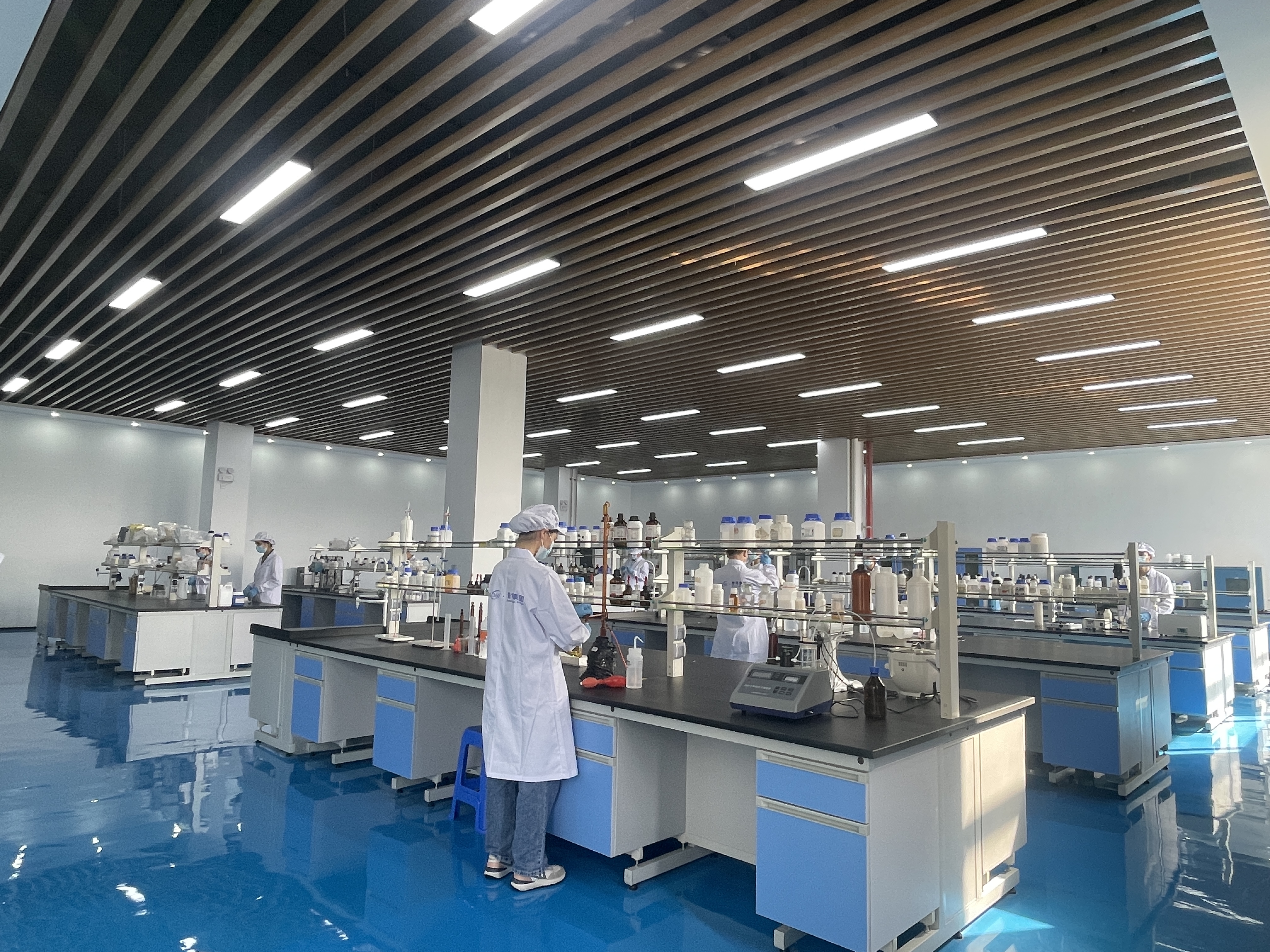
Jiangxi DentalBright Technology Co., Ltd., known commercially as Glorysmile Factory, is an oral care manufacturer established in 2013 and located in Jiangxi Province, China. The company operates a 36,000 m² facility that includes 20,000 m² of 100,000-class cleanrooms, plus a 1,000 m² laboratory equipped with a 100-class cleanroom for microbiological testing. It employs approximately 256 staff, including 17 R&D engineers and 11 QC specialists, and it holds both medical device and cosmetics production licenses.
On the document side, the company states that it is certified to MDSAP, ISO 13485, ISO 22716, US GMP, BSCI, HALAL and VEGEA, and that its products comply with FDA, CE, CPSR, PIF, CPNP and other major international standards. Its stated export position is 102 countries, with the EU, USA and UK as major markets and export business accounting for 90% of total sales.
For a buyer running a qualification, the relevant point is not the length of that list but how it maps onto the five questions above: which certificate answers the EU question, which answers the US question, and which answers the buyer's own internal quality requirement. A manufacturer producing both medical device and cosmetic items has to maintain two documentation paths, and that dual structure is what turns a compliance conversation into something checkable.
Applying the Checklist to Real Kit Configurations
Kit configurations differ enough that a single compliance answer rarely covers an entire range. Within the manufacturer's published kit family:
- GS-001J — a 16 LED kit powered plug-and-play via USB from a phone, laptop or power bank, with no built-in battery; recommended treatment time is 16 minutes per day.
- GS-001X — a 32 LED kit supplied with a charging and sterilization case; 16-minute light timer and a 3-minute disinfection cycle that auto-starts when the case is closed; EU patent 015062946-0001 and UK patent 6370462.
- DB-001M — a non-branded 32 LED kit with a storage case and 16-minute timer; US Patent No. US D1,128,065 S, EU Patent No. 015065790-0001 and UK Patent No. 6377277.
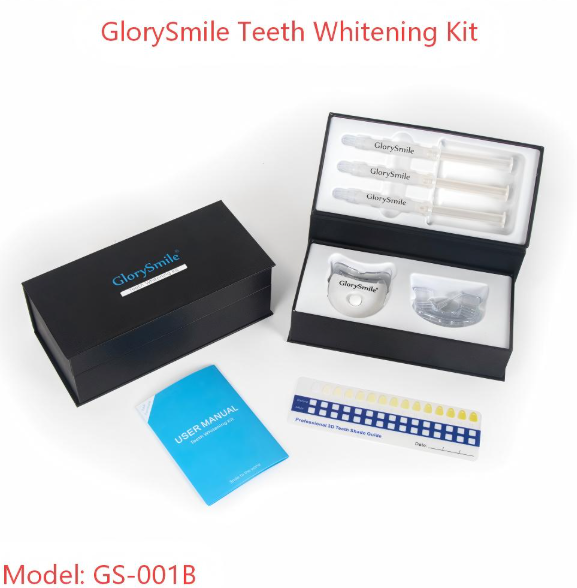
- GS-001B — a 5 LED kit supplied with three 3 ml whitening syringes, providing 40 uses at 10 minutes each, powered by two CR2032 lithium batteries.
- GS-001Y — a 5 LED kit with a 10-minute timer and 30 uses, powered by two CR2450 batteries.
- GS-001L — a clinic-use kit built around a 35% hydrogen peroxide gel, supplied with gum protector, cheek retractor, brush-ups, vitamin-E swabs, saliva towels, face gauze and bib.
Two practical conclusions follow. First, the whitening chemistry differs across the range: hydrogen peroxide, carbamide peroxide and PAP appear as available formula options, and PAP-based peroxide-free formulations are the ones most often requested for sensitivity-positioned products. Second, market position differs. A clinic-format kit built on a 35% hydrogen peroxide gel is not the same regulatory object as a retail LED kit with a low-concentration gel, so buyers should confirm the intended channel before assuming one document pack covers everything.
Tray and packaging detail matters to compliance reviewers as much as to marketing teams. Mouth trays are made from food-grade TPE, and application requirements for home whitening specify BPA-free tray material with labelling restricted to adults and children aged 16 and over. The kit family ships in a hard cardboard box. Private-label customisation is available across packaging, gel ingredient and pen or light colour, with an MOQ of 200 pcs for private label and 1 pc for regular product.
Market Trends Shaping Compliance Demand
Three shifts are visible in how buyers now approach the category.
PAP+ adoption. Demand for PAP+ (phthalimidoperoxycaproic acid) based peroxide-free whitening kits is rising as an alternative to traditional peroxide, driven largely by sensitivity concerns, according to The Insight Partners. For buyers this changes the document set: a peroxide-free formula follows a different cosmetic pathway than a hydrogen peroxide gel, and the safety documentation has to match the formula actually shipped.
A European market that separates consumer and professional routes. The 0.1%–6% hydrogen peroxide band under Directive 2011/84/EU, with its requirement for a first treatment by a dentist, means some whitening products cannot be sold in the EU as unsupervised consumer items. Buyers planning EU distribution should settle the route before approving artwork or claims.
A US cosmetic layer still being absorbed. MoCRA introduced facility registration and product listing obligations for cosmetics in the United States — requirements distinct from device rules. Suppliers already maintaining a cosmetics production licence and CPSR/PIF documentation are structurally closer to that workflow, but the answer still has to be requested and verified per product rather than assumed.
Comparison With Traditional Sourcing Routes
Most buyers compare two sourcing models rather than two brands: an intermediary-led purchase, or direct qualification of a source manufacturer. The difference shows up less in unit price than in who can answer a compliance question with a file.
| Comparison dimension | Intermediary-led sourcing | Source-manufacturer qualification |
|---|---|---|
| Who answers compliance questions | Forwarded to a third party; response time and accuracy vary by order | Answered by the party that holds the licence and the lab |
| Documentation depth | Generic certificate copies for a product family | Product-specific documents such as CPSR, PIF, MSDS and COA |
| Formula visibility | Limited; reformulation is often invisible to the buyer | Formula options listed per product, including PAP and peroxide variants |
| Lab and testing base | External testing, reported second-hand | In-house laboratory with microbiological testing capability |
| Customisation threshold | Often negotiated case by case | Published MOQ of 200 pcs for private label, 1 pc for regular product |
The boundaries are worth stating plainly, because they shape how a qualification should be sequenced.
- MOQ remains a commitment. Private-label customisation starts at 200 pcs per product in the manufacturer's published terms. Buyers testing a market usually begin with regular products and validate formula and packaging before converting to a private-label run.
- Documentation is product- and batch-specific. A CPSR issued for one whitening formula does not cover a differently formulated kit, and an MSDS issued for one gel does not travel with a reformulated gel. The document set should be re-requested whenever the formula, packaging material or target market changes.
- Patents are jurisdictional. The DB-001M kit holds US, EU and UK design patents and the GS-001X kit holds EU and UK patents, but that does not substitute for a buyer's own freedom-to-operate review in a market outside those filings.
- Classification cannot be assumed across a range. A clinic-format gel and a retail LED kit may sit on different regulatory routes in the same catalogue, so a single compliance statement should not be accepted as covering both.
Future Outlook
Supplier qualification for teeth whitening kits is moving from a one-time onboarding task to a recurring procurement gate. Buyers increasingly re-verify documents at each product change rather than at each supplier change, which favours manufacturers that already separate cosmetic and medical device documentation internally.
The second direction is formula-led compliance. As alternative actives such as PAP expand and as the EU hydrogen peroxide band continues to shape what can be sold as an unsupervised consumer product, the whitening chemistry itself will determine the paperwork. Buyers who ask about the formula before they ask about the price will find the rest of the qualification process considerably shorter.
FAQ
What documents should a buyer request to confirm EU market compliance for a teeth whitening kit?
For cosmetic products, the relevant documents are CPSR, CPNP notification and PIF. For products supplied as medical devices, the relevant evidence is CE-MDR registration. Because the EU route depends on classification, buyers should ask the supplier to confirm which route the specific kit follows before accepting a general compliance statement. Buyers should also check the hydrogen peroxide concentration, since Directive 2011/84/EU requires a first treatment by a dentist for products containing between 0.1% and 6% hydrogen peroxide.
Can a teeth whitening kit supplier provide an MSDS?
An MSDS is available from manufacturers that handle whitening gels as regulated formulations, and it should be tied to the specific formula rather than to a product family name. Buyers commonly request it together with a COA for batch-level verification. Because the sheet is formulation-specific, an MSDS issued for one gel does not automatically cover a reformulated version of that gel.
Is a teeth whitening kit FDA approved?
The answer depends on scope. Where a manufacturer states that its products are FDA approved and that the FDA-certified scope covers medical devices, cosmetics and OTC drugs, the practical question becomes which of those categories the specific kit falls into, and what that implies for labelling. The US FDA also recognises ISO 28399:2021 as a consensus standard for external tooth bleaching products, which provides an independent technical reference when reviewing supplier documentation.
What is the difference between CE-MDR registration and MoCRA registration?
CE-MDR registration relates to medical devices placed on the EU market, and completed CE-MDR registration is the evidence a supplier presents for the medical device portion of a product range. MoCRA relates to US cosmetic facility registration and product listing. They are separate regimes that can apply to different items in the same catalogue, so a CE-MDR statement does not answer a US cosmetic registration question, and both should be requested separately.
What certifications should a teeth whitening kit manufacturer be able to show?
Factory certificates describe the manufacturing environment and quality system, for example CE, FDA, CPSR, CPNP, PIF, SCPN, MSDS, COA, RoHS, HALAL and Vegan documentation. Product certificates describe product-level compliance, including GMP, ISO 22716, ISO 13485, MDSAP and BSCI. Buyers should ask which certificate addresses which requirement rather than treating the list as a single qualification outcome.
A Practical Sequence for the Next Quotation
The most efficient ordering is to attach the document requests to the quotation itself rather than to a later negotiation stage. Ask for the classification of the specific kit, the corresponding EU document set, an MSDS matched to the shipped formula, the FDA scope statement, and the MDR or MoCRA position as separate items. Then confirm those answers against the sample: the tray material, the gel chemistry, and the carton artwork are the three places where a document and a shipped product most often diverge.
A downloadable catalogue covering the teeth whitening kit range, formulation options and customisation services is available here: Glorysmile product catalogue (PDF). The manufacturer's site is published at www.glorysmile.com.