
Teeth Whitening Strip Supplier Audit: Warranty, Custom, Scale
Teeth Whitening Strip Supplier Audit: Warranty, Customization, Scale
A long-term whitening strip supplier is rarely chosen on unit price alone. The decision usually rests on three testable questions: what happens when a unit fails, how far the supplier can follow a brand through formulation and packaging changes, and whether the plant can absorb volume growth without altering the process that was approved at the start. Warranty terms, customization depth and capacity evidence are the auditable form of those questions.
This assessment uses the GS-001J whitening kit from Glorysmile Factory as a working reference. Glorysmile Factory is the trading name of Jiangxi Dentalbright Technology Co., Ltd., an oral care manufacturer based in Jiangxi Province, China, founded in 2008 with its current factory completed in 2013. The kit itself is not the whole subject. It is a reference point for what a buyer can verify in writing before committing to a multi-year supply agreement.
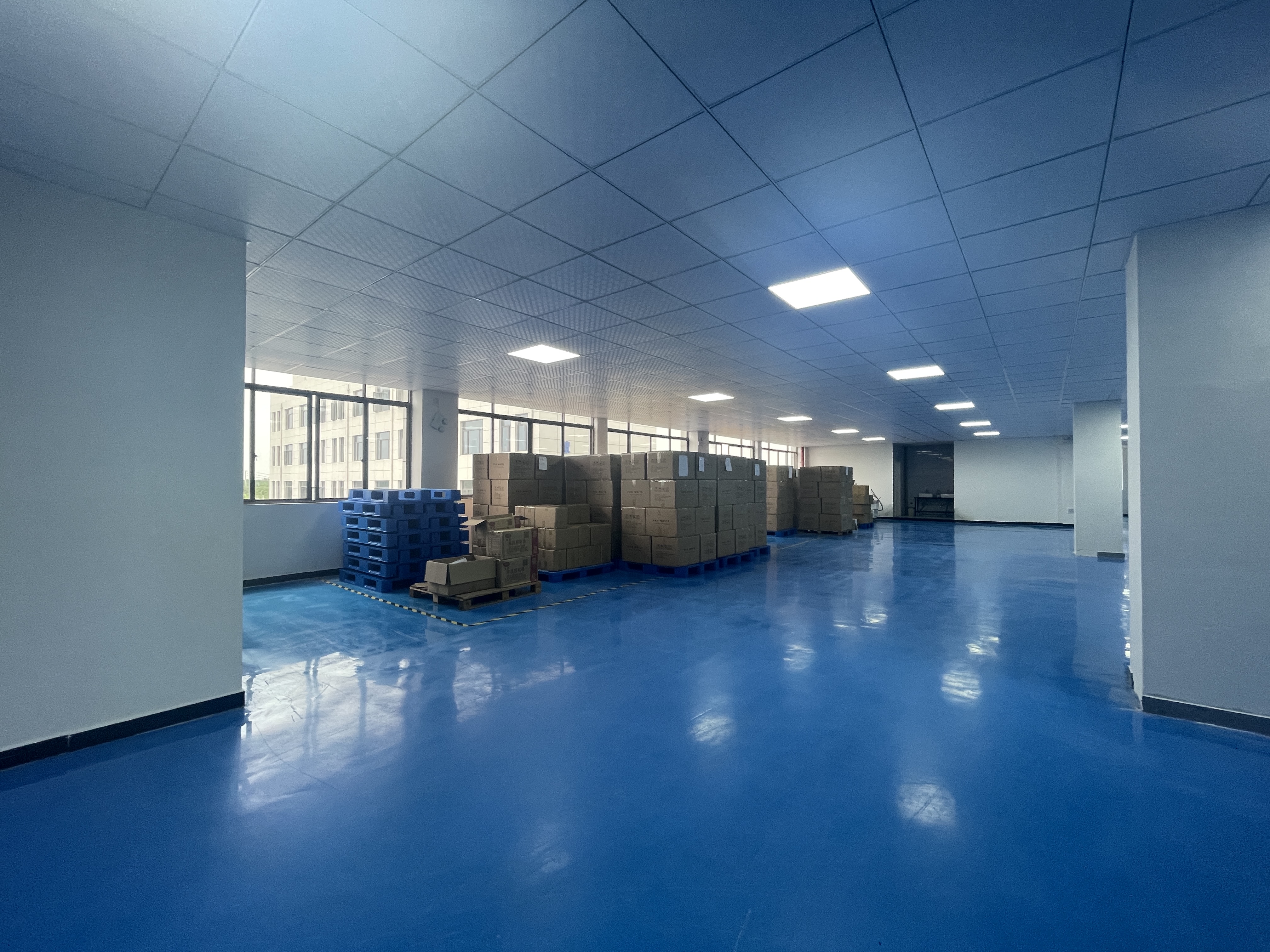
Finished-goods staging inside the Glorysmile Factory facility in Jiangxi Province, China.
A first order tests samples; a long-term order tests the system
A trial order answers a narrow question: does the sample match the specification. A repeat-order relationship answers a wider one: will the same supplier still be able to produce that specification two years later, at higher volume, under a changed regulatory file, without quietly changing a film layer or a gel viscosity.
That shift changes what belongs in a supplier questionnaire. Certificates remain relevant, but they become the entry ticket rather than the conclusion. The audit needs evidence of continuity: how failures are absorbed, how formulations and packaging are re-engineered for a new market, and how capacity is documented when a buyer doubles an order.
| Audit dimension | Evidence to request | What it actually reveals |
|---|---|---|
| Warranty and after-sales | Written warranty term, coverage scope, response mechanism | How failure cost is allocated between supplier and brand |
| Customization | Formulation options, packaging and design team, tooling ownership | Whether the brand can evolve without changing supplier |
| Scalability | Monthly capacity per category, cleanroom class, QC headcount, lead-time statement | Whether volume growth changes the approved process |
| Compliance | MDSAP, ISO 13485, ISO 22716, GMP, BSCI, production licences | Depth of the documentation and social-compliance trail |
| Design stability | Patent and design registrations per model | Risk of mid-contract tooling or housing changes |
Warranty: the cheapest quality signal to verify
Warranty is the supplier's own published estimate of its failure window, which makes it unusually informative. Glorysmile states that all electronic products in its range are backed by a 12-month warranty from the date of purchase. The GS-001J kit is an electronic kit built around a 16 LED whitening light, so its electronic assembly sits inside that stated policy, with the light offered at 16 LEDs as standard and 24 or 32 LEDs as options.
The kit's power design also changes the failure profile a buyer should price in. According to the specification, the GS-001J light is plug-and-play and draws power via USB from a phone, laptop or power bank, with no built-in battery. The wear items in the box are therefore the four 2 ml whitening pens, the dust-free cover and the four adapters (iPhone, Android, Type-C and USB), plus the food-grade TPE mouth tray.
A 12-month term tells a buyer that the supplier is willing to stand behind an electronic assembly across a full retail cycle. It does not, on its own, define how consumables are treated, who pays return freight, or whether replacement units come from the same batch. Those points belong in the contract. The supporting process matters as much as the term: Glorysmile operates a 24-hour after-sales response mechanism and states full-lifecycle product quality assurance as part of its partner model.
Customization: formulation, packaging and the limits of each
Customization is where long-term relationships are usually won or lost, because brand portfolios rarely stay still. On the GS-001J platform, the documented support covers custom packaging, custom gel ingredient and custom pen or light colour. The formulation options listed for the kit family are hydrogen peroxide, carbamide peroxide, PAP, sodium phytate, sodium bicarbonate, charcoal and fully custom formulations.
That menu has regulatory consequences rather than marketing ones. Under EU Regulation (EC) No. 1223/2009, hydrogen peroxide in over-the-counter teeth whitening products is restricted to 0.1% or less, which means a 6% HP strip or gel format is not a straightforward OTC retail option inside the European Union. A buyer building an EU-facing peroxide-free line is therefore pushed toward PAP-based chemistry, while markets without that ceiling can keep a peroxide SKU in the assortment. A supplier that can run both chemistries on the same platform removes the need for a second vendor when a brand changes market.
Packaging iteration is the second half of customization, and it is usually under-estimated. Glorysmile's team structure includes 17 R&D engineers and a 6-person packaging design team, with 11 QC specialists and 8 production management staff inside a 256-person organisation. For a brand that refreshes cartons, flavours or kit composition every season, in-house design capacity is the difference between a six-week refresh and a re-sourcing project.
One number should not be over-read. Product specification sheets list private-label MOQ at 200 pcs, with 1 pc for regular products, but the company states that minimum order quantity is determined by product category, customization requirements and production line configuration, with the exact figure confirmed during quotation and sampling. A 200-piece figure is a useful planning anchor for a pilot, not a contractual guarantee.
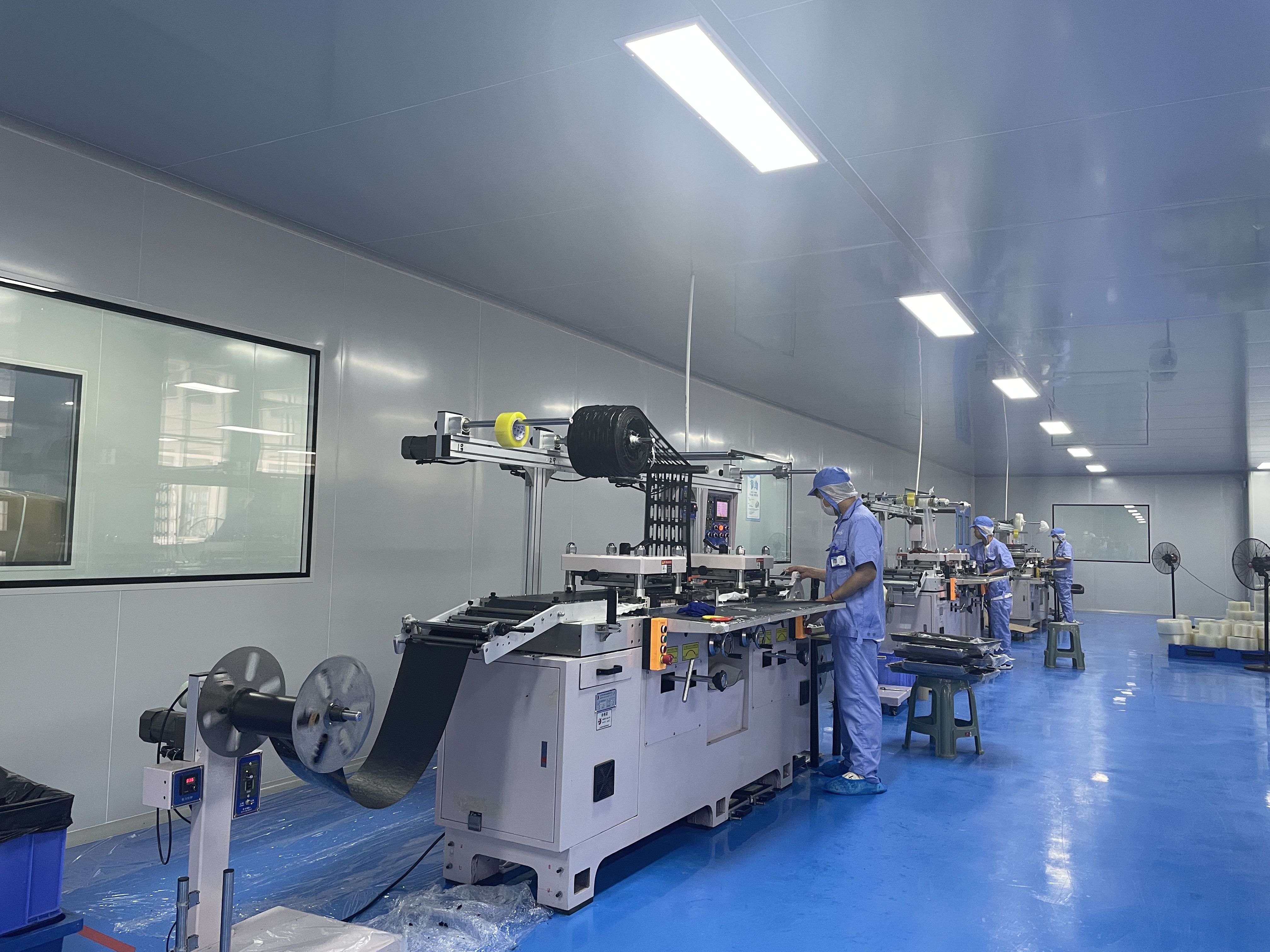
Production equipment inside the Glorysmile Factory facility, where strip and kit formats share the same quality system.
Scalability: capacity statements and how to test them
Scalability claims are only useful when they are stated per category, because capacity in one line does not transfer to another. The stated monthly capacity at Glorysmile is 105,000 home whitening kit sets, 8.33 million whitening gel sets and 29.2 million strip pieces. The physical base behind those figures is a 36,000 square metre facility that includes 20,000 square metres of 100,000-class cleanrooms and a 1,000 square metre laboratory with a 100-class cleanroom dedicated to microbiological testing.
The quality routine attached to that capacity is what a long-term buyer should interrogate. Kit-level controls listed by the manufacturer include incoming inspection of LED modules, batteries and electronic components with COA verification, in-process checks on appearance, silicone hardness, noise level, leakage current and dielectric strength, and batch release testing before shipment. Strip production is described as covering pre-shipment testing, third-party laboratory testing through SGS or UL, and microbial, pH and efficacy evaluation.
Documented programmes provide a second data point. A platform-owned brand project ran 1 million units over two years and held a Top 3 sales rank in its Oral Care category with a 99.8% positive feedback rate and no safety or compliance incidents. An e-commerce private-label launch shipped 5 million units over two years, reached Top 10 Bestseller status in its category and carried a 4.8-star user rating. A retail and corporate-gift programme delivered 7 million units over two years, passed third-party BSCI and ISO factory audits and recorded a zero return rate in large batch inspection.
Lead time is the one scalability input that cannot be audited from a brochure. The company states that lead time varies with order volume, product specifications, customization complexity and current production schedule, and that a precise delivery timeline is provided at order confirmation. A serious audit asks for that confirmation in writing, tied to a named line and a named volume band.
Certifications as an audit trail, not a badge
Certification lists are frequently copied into RFQ responses without interpretation. Read as an audit trail, each certificate answers a different question. Glorysmile Factory holds MDSAP, ISO 13485, ISO 22716, US GMP, BSCI, HALAL and VEGEA certifications, along with both medical device and cosmetics production licences.
ISO 13485 and MDSAP speak to device-grade quality management and to processes audited under a multi-regulator programme, which is the part that usually governs change control and documentation discipline. ISO 22716 and US GMP address cosmetics manufacturing hygiene and batch record-keeping. BSCI addresses social compliance, the element most often requested by retailers and marketplaces before a private-label line is accepted. For a multi-year agreement, the combination matters more than any single certificate, because it covers the three audits a brand is likely to face: its own, its retailer's and its regulator's.
Regulatory administration is now part of the same audit. Under the US MoCRA 2022 framework, cosmetic manufacturers must register facilities and list products, with reported costs of USD 849 per year for facility registration and USD 200 per product listing. On the trade side, teeth whitening strips are typically classified under HS Code 3306.90.00 for oral or dental hygiene preparations. A supplier that already carries these filings reduces the launch overhead a brand would otherwise absorb.
Design registrations and R&D stability
Design registrations matter to long-term buyers for an unglamorous reason: tooling continuity. A registered housing or light design is less likely to be quietly re-tooled mid-contract, and a supplier that registers designs tends to keep a documented design history. Within this kit family, the registrations listed include EU patent 015062946-0001 and UK patent 6370462 for the GS-001X kit, US design patent US D1,128,065 S with EU patent 015065790-0001 and UK patent 6377277 for the DB-001M kit, and EU patent 015075898-0001 for the K9P electric toothbrush.
The boundary here is important and often glossed over: patent coverage is model-specific. The GS-001J specification sheet does not itself list a patent number. A buyer who needs design protection should ask which registration, if any, applies to the exact model and mould being ordered rather than assuming family-wide coverage.
Short-term sourcing versus an audited long-term partnership
The contrast that matters for procurement is not factory versus factory, but spot buying versus an audited relationship. Spot sourcing through intermediaries can be faster on a single shipment and cheaper on a narrow SKU; it also leaves the brand holding regulatory filings, warranty exposure and reformulation work.
| Dimension | Short-term / intermediary sourcing | Audited long-term partnership |
|---|---|---|
| Warranty | Handled case by case, often absorbed by the brand | Stated 12-month term on electronic products, with a 24-hour response mechanism |
| Customization | Limited to what the trader already stocks | Custom gel ingredient, packaging and pen or light colour on the same platform |
| Capacity visibility | Opaque; depends on the trader's allocation | Category-level monthly capacity and cleanroom class disclosed |
| Compliance file | Certificate copies, ownership of filings unclear | MDSAP, ISO 13485, ISO 22716, GMP, BSCI, plus FDA, CE, CPSR, PIF and CPNP support |
Where this audit approach stops
Documents establish intent and capability; they do not prove a specific line on a specific day. Four limits are worth stating plainly.
- Warranty language is written for electronic products. Coverage of gel pens, trays and other consumables is not defined by that statement and must be negotiated separately.
- Patent coverage is model-specific, and the GS-001J sheet does not list a registration number. Design protection should be confirmed per ordered model.
- MOQ and lead time are confirmed only at quotation and order confirmation, so neither can be treated as a fixed figure at the audit stage.
- Capacity figures describe available capability, not reserved capacity. A buyer planning a seasonal peak needs an allocation commitment, not a monthly maximum.
There is also a market-data caveat. The widely cited USD 1.1 billion figure for 2025 published by Grand View Research covers teeth whitening strips and gels together, not strips in isolation, so it is useful as context for category scale and weak as a forecast for one product format.
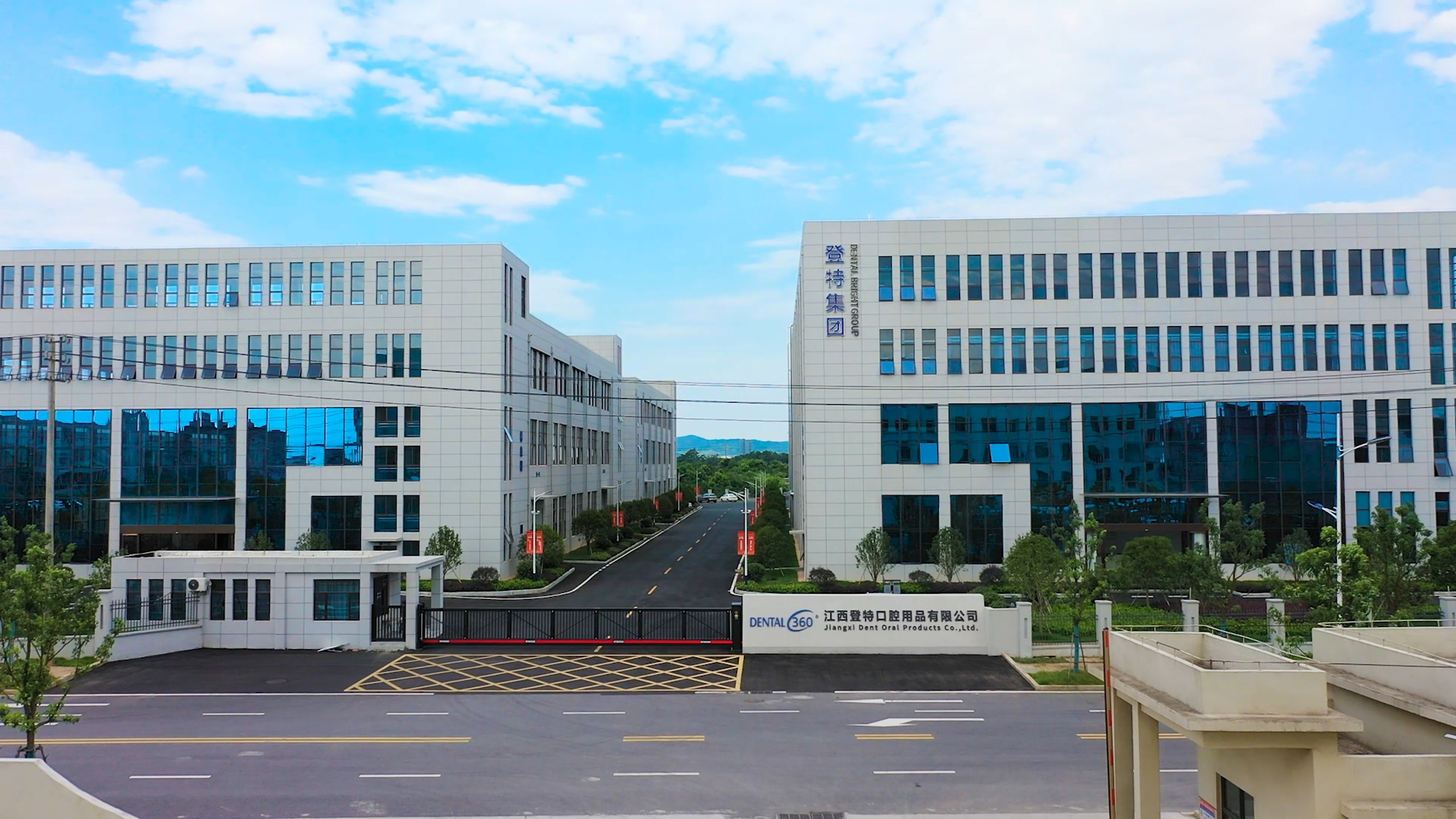
The Glorysmile Factory site in Jiangxi Province, China, which houses 20,000 square metres of 100,000-class cleanrooms.
Market context: regulation has become a selection criterion
The commercial logic of supplier auditing follows the regulatory logic. Grand View Research values the global teeth whitening strips and gels market at USD 1.1 billion in 2025. That is a sizeable category, and it is now governed by rules that fall on the manufacturer rather than the reseller: a 0.1% hydrogen peroxide ceiling for over-the-counter products in the EU, cosmetic facility registration and product listing obligations in the US, and a settled customs classification for oral hygiene preparations under HS 3306.90.00.
The practical consequence is that compliance documentation has become a channel-access asset. A brand that sources from a supplier without MDSAP, ISO 13485, ISO 22716, GMP and BSCI in place inherits the filing work, the audit exposure and the delay. That cost rarely appears in a unit price comparison, which is precisely why warranty, customization and scalability deserve to be audited before price is negotiated.
What buyers should expect next
Two directions look likely. First, formulation flexibility will keep moving toward peroxide-free positioning in regulated markets, which favours suppliers able to run PAP and peroxide chemistries on one platform without a new tooling cycle. Second, procurement questionnaires will get more specific: warranty scope by component, per-model patent status, reserved capacity for peak seasons and named-line lead times.
For suppliers, that means the audit file becomes a commercial document. For buyers, it means the difference between a supplier who can be replaced in a quarter and one who can carry a brand through a reformulation, a market entry and a volume spike. The GS-001J kit illustrates how much of that case can already be documented: a stated 12-month warranty on electronics, a customization menu that spans gel chemistry and packaging, category-level capacity figures, and an audit trail built from MDSAP, ISO 13485, ISO 22716, GMP and BSCI.
FAQ
What does the 12-month warranty cover on the GS-001J kit?
Glorysmile states that all electronic products are backed by a 12-month warranty from the date of purchase. In the GS-001J kit the electronic element is the whitening light, supplied with 16 LEDs as standard and 24 or 32 as options; the box also contains four 2 ml whitening pens, a dust-free cover, four adapters for iPhone, Android, Type-C and USB, a shade guide, a user manual and a gift box. Because the warranty statement is framed around electronic products, coverage of gel pens and other consumables should be confirmed separately in the supply agreement.
Which certifications belong in a long-term supplier audit?
Glorysmile Factory, the trading name of Jiangxi Dentalbright Technology Co., Ltd., holds MDSAP, ISO 13485, ISO 22716, US GMP, BSCI, HALAL and VEGEA certifications, together with medical device and cosmetics production licences, and supports FDA, CE, CPSR, PIF and CPNP documentation. In an audit, ISO 13485 and MDSAP indicate device-grade quality management and audited change control, ISO 22716 and GMP indicate cosmetics manufacturing hygiene and batch records, and BSCI indicates social-compliance readiness for retailer and marketplace reviews.
How much customization is available on this platform?
Documented support for the GS-001J kit covers custom packaging, custom gel ingredient and custom pen or light colour. Listed formulation options are hydrogen peroxide, carbamide peroxide, PAP, sodium phytate, sodium bicarbonate, charcoal and custom formulations. The manufacturer's organisation includes 17 R&D engineers and a 6-person packaging design team, which is the capacity that supports packaging and flavour refreshes. Private-label MOQ is stated at 200 pcs on product specification sheets, with the exact figure confirmed during quotation and sampling.
Can the factory scale from a pilot order to multi-million units?
Stated monthly capacity is 105,000 home whitening kit sets, 8.33 million whitening gel sets and 29.2 million strip pieces, supported by a 36,000 square metre facility with 20,000 square metres of 100,000-class cleanrooms and a 1,000 square metre laboratory. Documented programmes include a 1 million unit, two-year OEM project for a platform-owned brand that held a Top 3 rank in its Oral Care category, a 5 million unit, two-year e-commerce private-label programme rated 4.8 stars, and a 7 million unit, two-year retail and gift programme that passed third-party BSCI and ISO audits with a zero return rate in large batch inspection. Lead time is confirmed at order confirmation because it depends on volume, specification, customization and schedule.
Is patented design a reliable indicator across every model?
No. Registrations in this product range are model-specific: EU patent 015062946-0001 and UK patent 6370462 are listed for the GS-001X kit, US design patent US D1,128,065 S with EU patent 015065790-0001 and UK patent 6377277 for the DB-001M kit, and EU patent 015075898-0001 for the K9P electric toothbrush. The GS-001J specification does not list a patent number, so buyers should ask which registration, if any, applies to the exact model and mould they order.
How do peroxide rules affect which strip SKUs can enter a market?
Under EU Regulation (EC) No. 1223/2009, hydrogen peroxide in over-the-counter teeth whitening products is restricted to 0.1% or less, so a 6% HP formulation is not a straightforward OTC retail option in the European Union, while PAP-based formulations are positioned as peroxide-free alternatives. In the United States, the MoCRA 2022 framework requires cosmetic facility registration and product listing, reported at USD 849 per year and USD 200 per product respectively. Customs treatment is also settled in practice, with whitening strips typically classified under HS Code 3306.90.00.
Product specifications, certification details and the full range are documented in the Glorysmile Factory catalog, available for download: Glorysmile Factory catalog (PDF).
Есть вопросы или нужны дополнительные детали?
Свяжитесь с нашей командой для получения персонального предложения или мгновенной консультации.
Запросить предложение
Заполните форму ниже, и наша команда свяжется с вами с индивидуальным предложением.
Прямой чат WhatsApp
Предпочитаете общаться в реальном времени? Напишите нам в WhatsApp для мгновенной помощи и быстрых ответов.
- Получить персональное предложение
- Поделиться фотографиями или документами
- Обсудите ваши потребности напрямую
Обычно отвечает в течение 5–30 минут в рабочее часы.