
Teeth Whitening Strips: FDA, EU MDR and MoCRA Documentation
A whitening strip that sells without friction in one market can be stopped in another by paperwork rather than by formulation. The questions that decide a launch are specific: which regulatory route does the product claim belong to, which registration does the factory actually hold, and which document can a buyer verify before the deposit is paid.
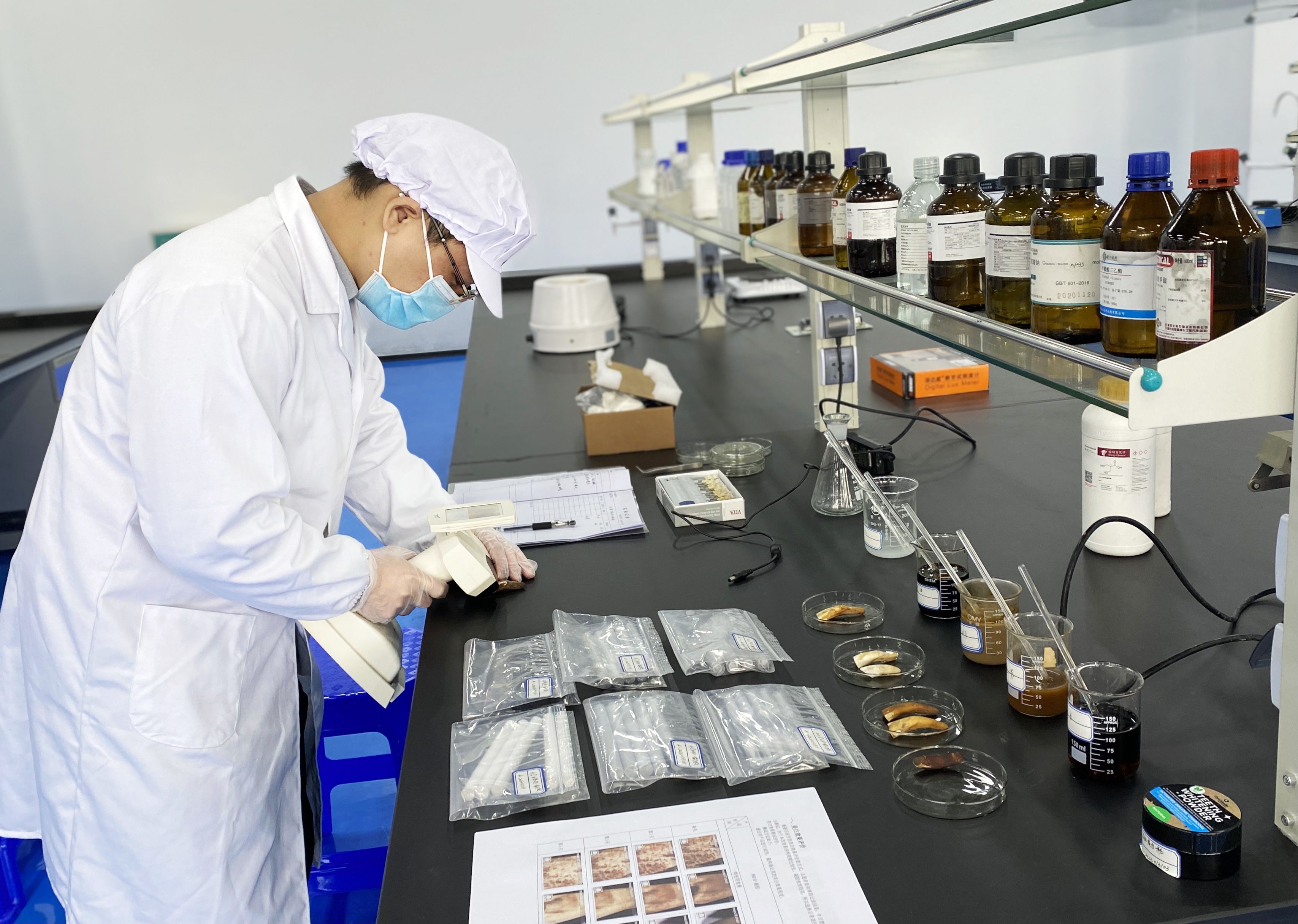
Quality control and formulation work sits upstream of the compliance file: test records, formula declarations and label wording all originate here.
Why Three Regulators, Not One, Decide a Strip Launch
Teeth whitening strips occupy an unusual regulatory position because the same physical product can be read as a cosmetic, an over-the-counter drug, or a medical device, depending on the claim printed on the pouch and the concentration of active ingredients inside it. A strip sold as a surface stain remover is treated differently from a strip positioned as a bleaching treatment, even when the two share a supplier and a production line.
That ambiguity produces three questions buyers raise in almost every sourcing conversation: US FDA status, EU market access, and, since 2022, US cosmetics facility registration and product listing under the Modernization of Cosmetics Regulation Act (MoCRA). A fourth, quieter question sits underneath all three. Which documents is the buyer entitled to request, and what does each one actually prove?
The commercial context matters too. Grand View Research values the global market for teeth whitening strips and gels at USD 1.1 billion in 2025. That figure covers strips and gels specifically; broader totals published for the whole teeth whitening category measure a different product scope and are not directly comparable. The narrower number implies something straightforward for sourcing: this is a niche large enough to support private-label volume, and small enough that one compliance failure can remove a listing.
EU Market: Cosmetics Files First, MDR Registration Only When the Claim Requires It
In the European Union the entry point depends on positioning. A strip marketed for surface stain removal and cosmetic brightening is handled as a cosmetic product, and the dossier that matters is the cosmetic one. A strip that claims to bleach teeth or carries device-level clinical functions moves toward the medical device route, where CE-MDR registration applies instead.
Concentration matters as much as wording. EU Regulation (EC) No. 1223/2009 restricts the concentration of hydrogen peroxide in over-the-counter teeth whitening products to 0.1% or less. That single limit explains why peroxide-free formulations are so common in EU-facing strip ranges, and why a 6% hydrogen peroxide strip engineered for the US market cannot simply be re-labelled for EU retail. The limit is a product-defining constraint, not a formatting choice.
The paperwork splits along the same line. Cosmetic positioning requires a Cosmetic Product Safety Report (CPSR), a Product Information File (PIF) and a CPNP notification, and the product needs an EU-established responsible person to hold that file. Medical device positioning requires the MDR route. Glorysmile states that it can supply CPSR, CPNP and PIF for cosmetic products, and that it has completed CE-MDR registration for medical devices.
United States: FDA Scope, the OTC Route and the MoCRA Layer
The US picture has two layers that are frequently confused. The first is whether a whitening strip is regulated as a cosmetic, an OTC drug, or a device, which follows from the claim. The second is MoCRA 2022, which added a registration and listing obligation for cosmetic products regardless of how the whitening benefit is framed.
Under MoCRA 2022, manufacturers of whitening strips classified as cosmetics must register facilities and list products, with published compliance costs of USD 849 per facility registration per year and USD 200 per product listing. These are administrative obligations. Paying them does not authorise a bleaching claim, and holding them does not replace a drug or device pathway where the claim requires one.
What buyers should verify is the scope of the FDA credential, not merely its existence. Glorysmile states that its products are FDA approved, and that its FDA-certified scope covers medical devices, cosmetics and OTC drugs. That distinction between a named scope and a generic compliance badge is the difference between a document that supports a marketplace listing and one that collapses during a platform audit.
One customs detail belongs in the same conversation. Teeth whitening strips are primarily classified under HS Code 3306.90.00, the heading for preparations for oral or dental hygiene, according to US Customs and Border Protection ruling NY N342147. Classification drives duty treatment and shapes the product description that must remain consistent with the registration file.
MDSAP and ISO 13485 Are Quality Credentials, Not Market Clearances
This is where sourcing conversations most often go wrong. MDSAP and ISO 13485 are quality management system credentials. They demonstrate that a facility has been audited against recognised requirements for process control, documentation and traceability, often across several jurisdictions through a single audit programme. They say something substantive about how a factory operates.
They do not, by themselves, constitute a US FDA marketing authorisation or an EU MDR certificate. A factory can hold ISO 13485 and MDSAP and still require separate market-specific registration for the product being shipped. The reverse is also fragile: a market registration attached to a weak quality system tends to fail at the first audit or complaint investigation.
The practical rule for buyers is to treat quality system certificates and market authorisations as two separate lines on the same checklist, and to request both: the audit certificate, and the market-specific document that names the facility or the product. If a supplier answers a market-access question with a quality certificate, the file is incomplete.
The Documentation Set Behind Glorysmile Whitening Strips
Glorysmile is the export brand of Jiangxi Dentalbright Technology Co., Ltd., an oral care manufacturer founded in 2008 with its current factory completed in 2013, and roughly 90% of output exported to the EU, USA and UK. The company holds both medical device and cosmetics production licences, a relatively unusual combination in this category because it allows cosmetic and device-classified products to be produced and documented under one roof.
Its stated certificate set separates factory-level and product-level documents. Factory certificates include CE, FDA, CPSR, CPNP, PIF, SCPN, MSDS, COA, RoHS, HALAL and Vegan. Product certificates include GMP, ISO 22716, ISO 13485, MDSAP and BSCI. Both lines are relevant to a strip buyer, because the factory file supports the site and the product file supports the SKU.
The manufacturing base behind those files is a 36,000 m² facility with 20,000 m² of 100,000-class cleanrooms, plus a 1,000 m² laboratory that includes a 100-class cleanroom for microbiological testing. Staffing totals 256 employees, of whom 17 are R&D engineers and 11 are QC specialists. Listed strip capacity runs at 29.2 million pieces per month, with quality control covering pre-shipment testing, third-party laboratory testing through SGS and UL, and microbial, pH and efficacy evaluation.
How Product Claims Determine Which Documents Are Needed
Strips are not one product. Format and formulation pull different paperwork, and the table below maps the most common positioning decisions to the documents that support them.
| Claim or positioning | Typical regulatory route | Documentation to request |
|---|---|---|
| Surface stain removal, cosmetic brightening | Cosmetic | CPSR, PIF and CPNP notification (EU); MoCRA facility registration and product listing (US) |
| Hydrogen peroxide whitening above the EU OTC ceiling | Restricted OTC / drug-type route | Concentration declaration and market-specific authorisation |
| Bleaching or clinical whitening claim | Medical device | CE-MDR registration and supporting device documentation |
| Peroxide-free PAP formulation | Cosmetic | Formula declaration, safety report, microbial and heavy-metal test records |
| Sensitive-teeth or enamel-safe positioning | Functional cosmetic | Anti-sensitivity formulation documentation and efficacy evaluation |
| Cross-border shipment | Customs / trade | HS Code 3306.90.00 classification reference, MSDS, COA, RoHS |

Format decisions such as dissolving, wet or dry strips determine both the label wording and the technical file that supports it.
A Buyer-Side Compliance Documentation Checklist
The checklist below is built from the questions that repeatedly decide whether a strip order can proceed. It is written from the buyer's side, because the documents a supplier holds matter less than the documents a buyer can actually obtain and verify.
- Quality system certificates: MDSAP, ISO 13485, ISO 22716, US GMP and BSCI, together with audit dates.
- Production licences: confirmation that the factory holds both medical device and cosmetics licences.
- Market-specific authorisations: an FDA-registered scope that names the product type, and CE-MDR registration where a device claim is made.
- Cosmetic dossier: CPSR, PIF, CPNP notification, and SCPN where applicable.
- Safety and analysis documents: MSDS, COA and RoHS.
- Testing evidence: third-party laboratory testing through SGS or UL, plus microbial limits, pH, heavy metals and efficacy records.
- Formula declaration: PAP, PAP with charcoal, purple colour corrector or 6% hydrogen peroxide, with the active ingredient and its concentration stated.
- Label wording review: claims mapped to the legal definition of cosmetic, drug or device for each destination market.
- Sample validation and packaging approval before mass production begins.
Application Fit: Stain Types, Sensitive Teeth and Travel Formats
Strips are sourced for a small number of well-defined use cases. The typical profile covers removing exogenous stains such as coffee, tea and tobacco, whitening teeth by 5–8 shades within a treatment programme, and protecting against sensitivity. The standard use pattern is once per day with a no-slip dry adhesive strip, with individually wrapped units that suit travel retail and subscription packs. An enamel-safe formula and a zero-peroxide option are commonly stated requirements rather than optional extras.
Format choice affects both the claim and the file. The Glorysmile strip range includes dry strips (GS-004H/V/C/P) offered as high-viscosity, residue-free and alcohol-free variants, wet strips (GS-V34-S07), and dissolving strips (DB-004L). Formula options span PAP, PAP with charcoal, purple colour corrector, 6% hydrogen peroxide, sodium phytate and sodium bicarbonate, all available with custom formulation. Packs are built on a three-layer construction of PET hard film, whitening gel and PE soft film inside an aluminium bag, supplied with 7, 14 or 21 strips, a shade guide and a user manual.
Flavour is a commercial decision that occasionally becomes a compliance detail, since flavour declarations must match the safety file. Listed options include blue raspberry, strawberry, peach, grape, watermelon, peppermint, orange, mint, pineapple, cherry blossom, coconut and mango.
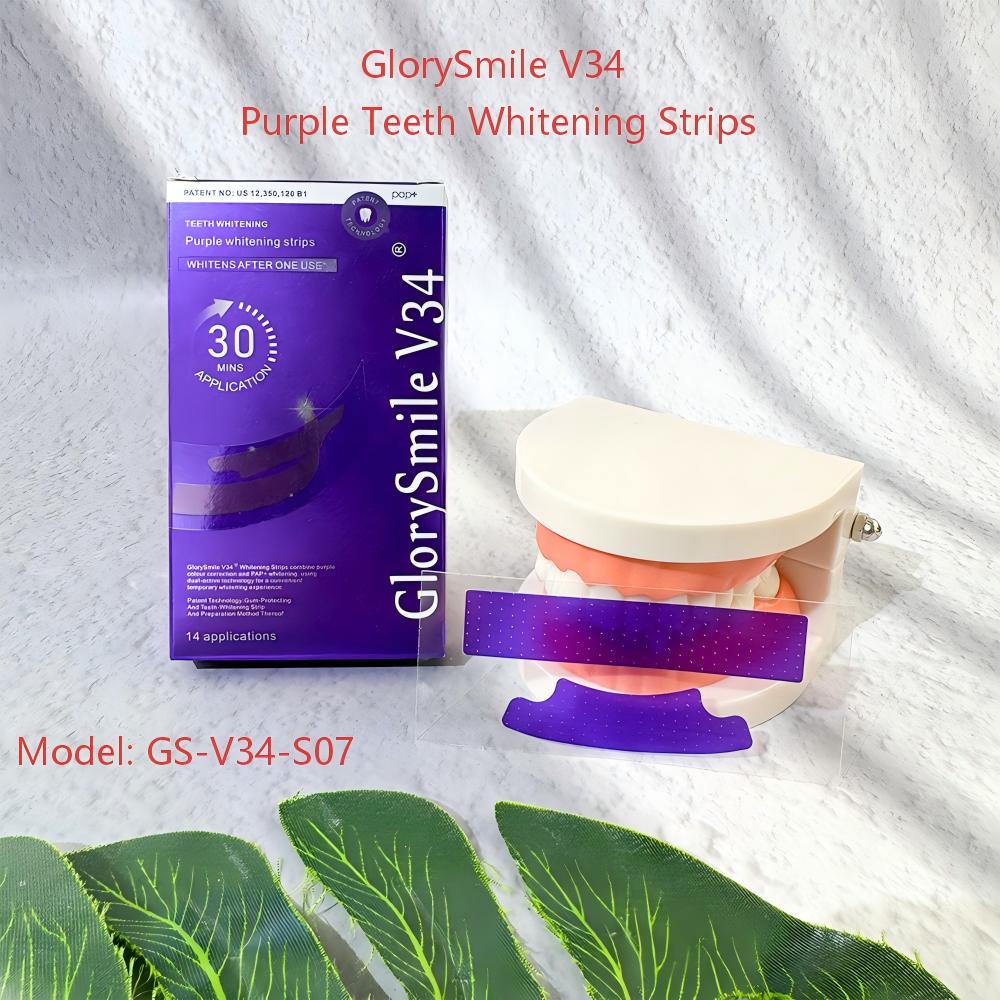
Wet strip formats such as GS-V34-S07 carry different formula declarations from dry and dissolving strips.
What Documentation Quality Looks Like in Practice
Compliance work shows up in operating outcomes rather than in certificate imagery. Three programmes in the manufacturer's case record are relevant to buyers assessing documentation risk.
A supply programme for supermarket chains and corporate gift buyers covered 7 million units over two years of promotional gift sets for pharmacy chain and supermarket retail. The programme passed third-party factory audits under BSCI and ISO, and recorded a zero return rate in large batch inspection.
A strategic OEM partnership with a cross-border e-commerce platform, 1 million units over two years, maintained a Top 3 sales rank in the platform's Oral Care category with a 99.8% positive feedback rate and zero safety or compliance incidents. The stated basis for that record is label wording built on precise legal definitions rather than marketing phrasing.
A private-label launch for an e-commerce seller, 5 million units over two years, reached Top 10 bestseller status in its category with a 4.8-star user rating, supported by an FDA and CE compliant formula and a low minimum order quantity for initial testing. Taken together, the pattern across all three is that compliance effort is front-loaded into labels, formula declarations and audit readiness, not added after a listing goes live.
Market Trend: A Billion-Dollar Niche Under Tightening Rules
The strips and gels segment, valued at USD 1.1 billion in 2025 by Grand View Research, is expanding alongside private-label oral care generally, while the paperwork around it tightens. MoCRA registration and listing in the United States and the 0.1% hydrogen peroxide ceiling in the European Union push in the same direction: toward peroxide-free and low-sensitivity formulations, and toward documentation that travels with the SKU.
For suppliers, that shifts competition from price per strip toward whether the factory can support a listing. For buyers, it turns the compliance file into a sourcing criterion rather than a post-purchase formality. Both effects tend to favour manufacturers that already hold cosmetic-side and device-side credentials as standing infrastructure, rather than assembling them per order.
Where Documentation-Led Sourcing Has Limits
A documentation-led approach is necessary but not self-sufficient, and buyers should be explicit about the boundaries.
- Quality credentials do not convert into market authorisation. MDSAP and ISO 13485 evidence process control; FDA scope and CE-MDR registration are separate documents. A certificate that does not name the facility or the product may not support the listing at all.
- Regulatory files are jurisdiction-specific. An EU cosmetic dossier does not satisfy US MoCRA registration, and a US registration creates no EU market access. Each destination needs its own file.
- Concentration limits are product-defining. With hydrogen peroxide capped at 0.1% for OTC whitening products under EU Regulation (EC) No. 1223/2009, high-peroxide formats cannot be repositioned for that market by changing artwork.
- MoCRA compliance is administrative. Facility registration and product listing fees do not authorise claims that fall outside cosmetic definitions.
- Documentation cannot replace sample validation. Third-party testing and stability checks still consume time before mass production, and timelines depend on order volume, specification and customisation complexity.
- Formula and claim must match. Sensitive-teeth positioning, enamel-safe claims and whitening shade expectations require formulation support in the technical file, not only in the sales copy.
Future Outlook
The direction of travel is toward a single sourcing file that combines quality system certificates, market-specific authorisations, cosmetic dossiers and test data, requested at the sampling stage rather than after the purchase order. Platform-level enforcement of labelling and registration requirements is likely to keep raising the cost of correcting a claim after launch, and buyers increasingly treat an incomplete file as a disqualifying signal rather than a negotiable gap.
Manufacturers positioned on both the cosmetic and device side — holding medical device and cosmetics licences, MDSAP and ISO 13485 credentials, and CPSR, PIF, CPNP, MSDS and COA documentation as standing infrastructure — are structurally better placed for that shift than suppliers who treat compliance as a per-order service.
FAQ
What certifications do teeth whitening strip manufacturers typically hold?
Certificate sets in this category are usually split between factory-level and product-level documents. Glorysmile lists factory certificates covering CE, FDA, CPSR, CPNP, PIF, SCPN, MSDS, COA, RoHS, HALAL and Vegan, and product certificates covering GMP, ISO 22716, ISO 13485, MDSAP and BSCI. Buyers should check which certificate names the specific facility or product being purchased, since a general certificate may not cover every SKU.
Is a teeth whitening strip product FDA approved?
The answer depends on registration scope rather than the wording on the pack. Glorysmile states that its products are FDA approved, and that its FDA-certified scope covers medical devices, cosmetics and OTC drugs. Because US requirements differ between the cosmetic, OTC drug and device routes, buyers should confirm that the registered scope covers the product type and the claim they intend to sell.
Is the product compliant for the EU market?
For cosmetic positioning, EU compliance is supported by a Cosmetic Product Safety Report (CPSR), a Product Information File (PIF) and a CPNP notification. For medical device positioning, CE-MDR registration applies. Glorysmile confirms it can provide CPSR, CPNP and PIF for cosmetic products and that it has completed CE-MDR registration for medical devices. EU Regulation (EC) No. 1223/2009 also limits hydrogen peroxide in over-the-counter whitening products to 0.1% or less, which determines whether a specific formulation can be sold as an OTC cosmetic in that market.
What whitening formulas are used in teeth whitening strips?
Available formulas include PAP (peroxide-free), carbamide peroxide and hydrogen peroxide, alongside sodium phytate, sodium bicarbonate, PAP with charcoal, and purple colour corrector variants. The strip range lists PAP, PAP with charcoal, purple and 6% hydrogen peroxide options, with custom formulation available depending on the market and the claim.
Are the products safe for sensitive teeth?
Formulation choice is the determining variable. Peroxide-free PAP and low-sensitivity formulas are offered specifically for sensitive-teeth positioning, and the strip use case includes anti-sensitivity protection and an enamel-safe formula as stated requirements rather than optional features.
Can the supplier provide an MSDS?
Yes. MSDS documentation is available and belongs alongside COA and RoHS records in the safety file that accompanies a strip shipment. These documents support customs clearance and marketplace compliance checks rather than replacing market-specific registrations.
Manufacturer documentation reference: Glorysmile product catalogue (PDF) — https://cdn.socialarks.com/sbsp/25111/common/2026/0826/Catalog.pdf