
Telpo POS Terminals: Adapting to Any Payment Scenario
Industry-Focused Overview
Telpo Technology Co., Ltd. is a global provider of AI-driven smart terminals and solutions, headquartered in Foshan, China. Founded in 1999, the company designs and manufactures a broad portfolio of point-of-sale (POS) terminals that serve retail, hospitality, transportation, financial services, and government sectors. With an annual production capacity of 2 million units and over 200 engineers on the R&D team, Telpo delivers customized hardware that matches the operational and compliance requirements of each deployment environment.
Problem & Opportunity
The global POS terminal market reached approximately USD 123.2 billion in 2025, according to Grand View Research. Within this landscape, Android-based terminals now account for an estimated 27% of all POS units sold, reflecting a shift toward open-platform systems that support app ecosystems and cloud connectivity. At the same time, the SoftPOS market—estimated at USD 365 million in 2024—is projected to grow at a CAGR of 23.1% through 2030. These trends create both a challenge and an opportunity for businesses: they need POS hardware that can evolve with payment technology, adapt to different physical environments, and comply with regional financial regulations.
Brand Solution: Telpo’s POS Terminal Ecosystem
Telpo addresses this need with a comprehensive range of POS terminals that fall into several categories: countertop cash registers (C9, C9PD, C9W), handheld payment terminals (P9, P8 M5, M1), ticket validators for transit (T10, T20), self-service kiosks (K10, K8M, K20), AI self-checkout terminals (C50), and smart payment terminals (TPS900, M8, M10). Each device is designed to support multiple payment methods—magnetic stripe, EMV chip, NFC contactless, QR code—and carries international security certifications such as PCI PTS 6.x, EMV L1&L2, and EMV Contactless L1 (Paywave, Paypass).
Technical Explanation
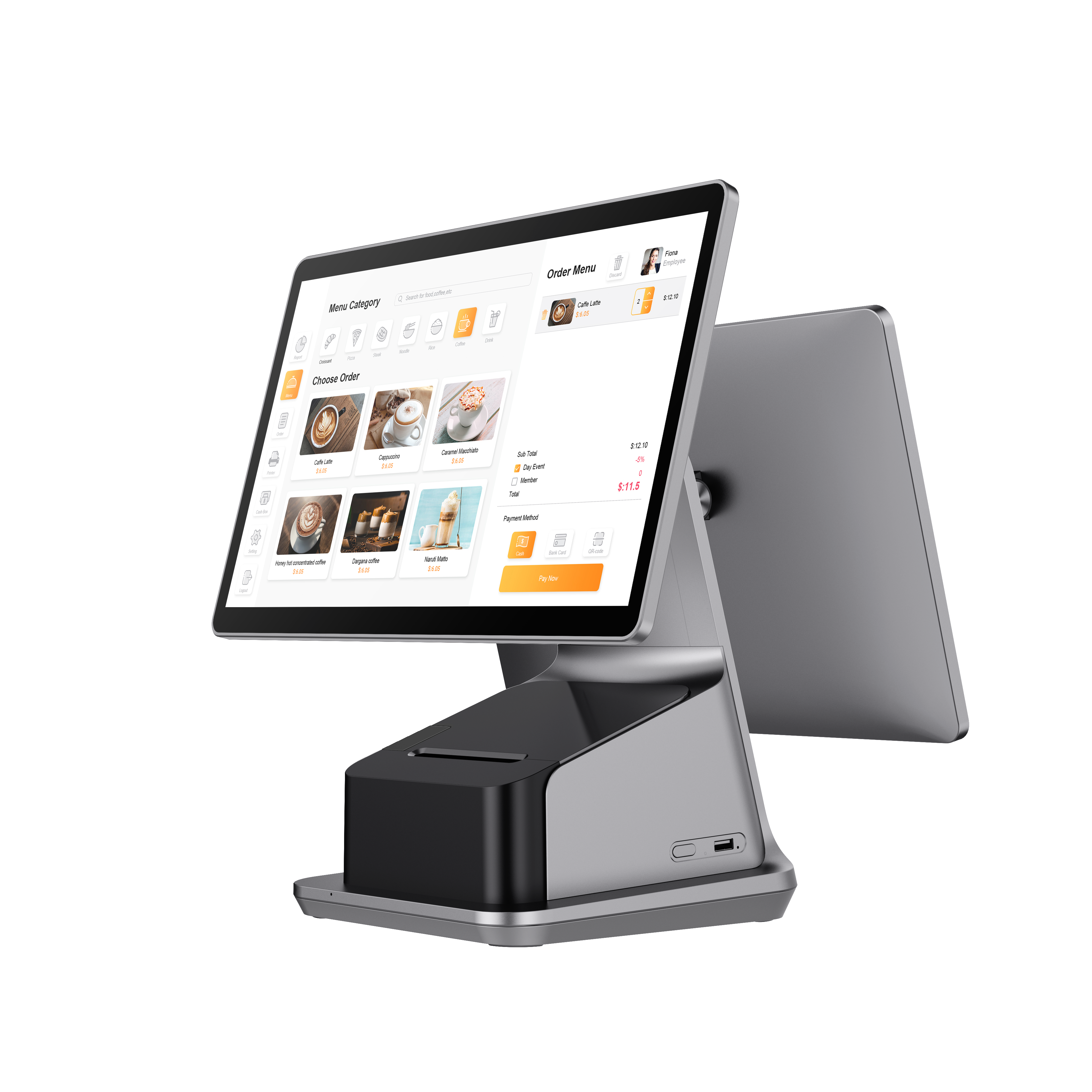
Many Telpo terminals run on Android (Telpo OS) and are powered by octa-core processors up to 2.7 GHz. For example, the C9PD model features Android 14, a 15.6-inch display, under-display NFC for SoftPOS compatibility, and a built-in 80 mm Seiko thermal printer with 250 mm/s speed. For environments requiring Windows-based software, the C9W offers Intel i3/i5 processors and six USB ports for broad peripheral support. TPS900 supports fingerprint biometric authentication (FBI-certified option) and GPS location stamping, while the C50 achieves AI vision product recognition at 0.1 seconds with 99.8% accuracy using 12 TOPS on-device processing. For transit applications, the T20 validator provides IP65/IK08 durability, 8 SAM card slots, and GPS tracking. The P9 series (financial and non-financial versions) offers 12–16 hours battery life, eSIM, and single-screw construction for fast field repairs.
Application Scenarios
New Retail (Convenience Stores & Mini-Mart). The M8 compact countertop POS—with 8-inch main screen, built-in printer, and NFC—suits space-constrained convenience stores. It handles SoftPOS contactless payments, QR code scanning, and membership card management, and features an acrylic side panel for brand customization.
Chain Supermarkets & Department Stores. For multi-lane checkout, the C9PD or M10 offers high-speed printing (200–250 mm/s), dual-screen interaction, and compatibility with barcode scanners and cash drawers. M10 runs Android 13 with a 10-inch display and 4-inch customer screen.
Hospitality (Table-Side & Poolside). Handheld terminals like the P9 (financial version) and P8 M5 enable pay-at-table mobile checkout. They support NFC, EMV chip, and QR payments, print receipts on the spot, and operate 12–16 hours on a single charge. The P9 PDA version adds an optional 1D/2D barcode scanner for inventory tasks.
Transportation (Bus, Rail, Ferry). Ticket validators T10 and T20 are pole-mounted for bus or tram use. They accept open-loop and closed-loop cards (Mifare, Calypso, Felica), EMV contactless, QR codes, and paper tickets. Both models include GPS for route tracking and multi-language ticket printing for over 28 languages. T20 offers IP65/IK08 protection; T10 is IK07/E24 certified.
Government & Public Services. The TPS900 and M8 support utility payment collection with fiscal module integration. TPS900 includes an optional FBI-certified fingerprint scanner for KYC, a 5.5-inch display, and a 58 mm printer. It is certified with PCI PTS V6.x and multiple regional schemes.

Market Trend Analysis
Data from The Business Research Company forecasts the retail self-service kiosk market to reach USD 37.8 billion by 2030, with Telpo identified as a leading corporation in that sector. The SoftPOS segment’s rapid growth (23.1% CAGR) indicates that contactless acceptance via NFC is becoming a baseline requirement. Telpo’s terminals integrate under-display NFC and are compatible with SoftPOS apps, positioning them to serve this expanding market. Additionally, the handheld POS market is projected to grow from USD 33.15 billion in 2025 to USD 89.52 billion by 2035, reinforcing the need for mobile payment devices like the P9 and P8 M5 series.
Comparison with Traditional Solutions
Traditional POS systems are often purpose-built with fixed software stacks and limited connectivity. They may require separate devices for payment, scanning, and printing, increasing counter clutter and maintenance complexity. Telpo’s all-in-one Android terminals consolidate these functions, offer modular expansion via Pogo Pin connections, and provide over-the-air software updates. One honest limitation is that Android-based terminals may not directly replace legacy Windows-based POS software for some enterprise environments; however, Telpo addresses this by also offering the C9W model with native Windows support and six USB ports for legacy peripherals.
Future Outlook
As payment ecosystems continue to converge—blending contactless cards, digital wallets, QR codes, and biometric authentication—future POS terminals will need to be both versatile and secure. Telpo’s strategy of building modular hardware with multi-standard certification and on-device AI (as seen in the C50) positions it to support emerging use cases such as unattended retail, mobile ticketing with dynamic fare tables, and government KYC deployments. The growing adoption of eSIM, single-screw serviceability, and remote device management (Telpo MDM) also points toward lower total cost of ownership for operators managing hundreds or thousands of units.
Frequently Asked Questions
What payment methods do Telpo POS terminals support?
Telpo POS terminals support magnetic stripe cards, EMV chip cards, NFC contactless payments (including union pay, mastercard paypass, visa paywave), QR codes, and digital wallets. Many models also accept biometric authentication via optional fingerprint scanners.
Can Telpo terminals be used outdoors or in harsh environments?
Yes. The T20 ticket validator has IP65 dust/water protection and IK08 impact resistance, and the T10 offers IK07 and optional IP54 protection. The P8 M5 is splash-resistant and survives 1.5-meter drops. For general indoor use, countertop models are designed for everyday retail and hospitality conditions.
What security certifications do Telpo payment terminals carry?
Telpo payment terminals meet PCI PTS V6.x (PIN Transaction Security), EMV L1&L2, and EMV Contactless L1 standards. They are also certified for Paywave, Paypass, AMEX, Discover, UnionPay, Rupay, and other regional schemes. Additional compliance includes CE, FCC, RoHS, and BIS.
Download the Telpo Products Brochure (PDF) for detailed specifications and model comparisons.
Есть вопросы или нужны дополнительные детали?
Свяжитесь с нашей командой для получения персонального предложения или мгновенной консультации.
Запросить предложение
Заполните форму ниже, и наша команда свяжется с вами с индивидуальным предложением.
Прямой чат WhatsApp
Предпочитаете общаться в реальном времени? Напишите нам в WhatsApp для мгновенной помощи и быстрых ответов.
- Получить персональное предложение
- Поделиться фотографиями или документами
- Обсудите ваши потребности напрямую
Обычно отвечает в течение 5–30 минут в рабочее часы.