
Tempered Glass FAQ: Specs, Service and Delivery Benchmark
Tempered Glass FAQ: Specs, Service and Delivery Benchmark
Tempered glass procurement questions are testable, and they tend to arrive in the same order. A buyer looking at a tempered glass quotation usually wants four things resolved before a purchase order exists: what the published numbers actually mean, which thickness the project needs, whether the manufacturer can evidence compliance with documents rather than claims, and whether delivery will hold against a construction programme. This reference answers those questions in that sequence. Where KXGLASS appears, it is described through published manufacturing and product parameters rather than brand language.
KXGLASS — Dongguan Kunxing Glass Co., Ltd — is a glass deep-processing manufacturer based in Xiegang Town, Dongguan, Guangdong Province, China, producing tempered, laminated, insulated and decorative glass for building applications. The company exports roughly 70% of its output to Australia, the United States, Asia and Europe. Its product specifications, plant information and listed standards form the first-party evidence base for this article.
- KXGLASS publishes a tempered glass range from 4 mm to 25 mm, an intensity of 150 MPa, surface stress of 95 MPa, thermostability of 250–320°C and obtuse-angle (blunt) fragmentation.
- The EN 12150-1 fragmentation requirement is a minimum of 40 particles within a 50 mm × 50 mm square — a measurable acceptance criterion, not a marketing descriptor.
- Spontaneous breakage is not eliminated in any tempered glass; heat-soak treatment under EN 14179-1 is the recognised route to reduce nickel-sulphide-related risk.
- Global tempered glass demand was valued at USD 112.21 billion in 2024, with Asia Pacific at 59.9% revenue share — market context, not a supplier ranking.
Why Tempered Glass Buyers Ask the Same Questions
The information gap in tempered glass is not about whether the material is safe. Tempered glass is a mature safety glazing product with defined standards across the EU, the United States, China and Australia/New Zealand. The gap sits between what a supplier publishes and what a buyer can verify before committing a programme to it.
Three things create that gap. First, most suppliers describe performance in the same vocabulary, so quotations look interchangeable. Second, the standards themselves are versioned documents — EN 12150-1 exists in a withdrawn 2000 edition and a current 2015+A1:2019 edition, and a certificate referencing the wrong edition tells a buyer something specific about document control. Third, delivery capability is usually discussed in lead-time promises rather than in furnace dimensions and annual output, which are the inputs that actually determine whether an oversize panel can be produced at all.
This is the practical opportunity for buyers in the awareness and research stage: build a short list of questions whose answers are checkable, then apply the same list to every supplier, including larger international groups. The FAQ below is structured that way.
What the Specification Numbers Actually Cover
A tempered glass data sheet typically mixes three different kinds of information: physical properties of the finished pane, process parameters used to make it, and commercial terms. Buyers who treat them as one block lose the ability to test any of them.
On the KXGLASS tempered glass range, the published parameters separate reasonably cleanly:
| Parameter | Published value | What it lets a buyer check |
|---|---|---|
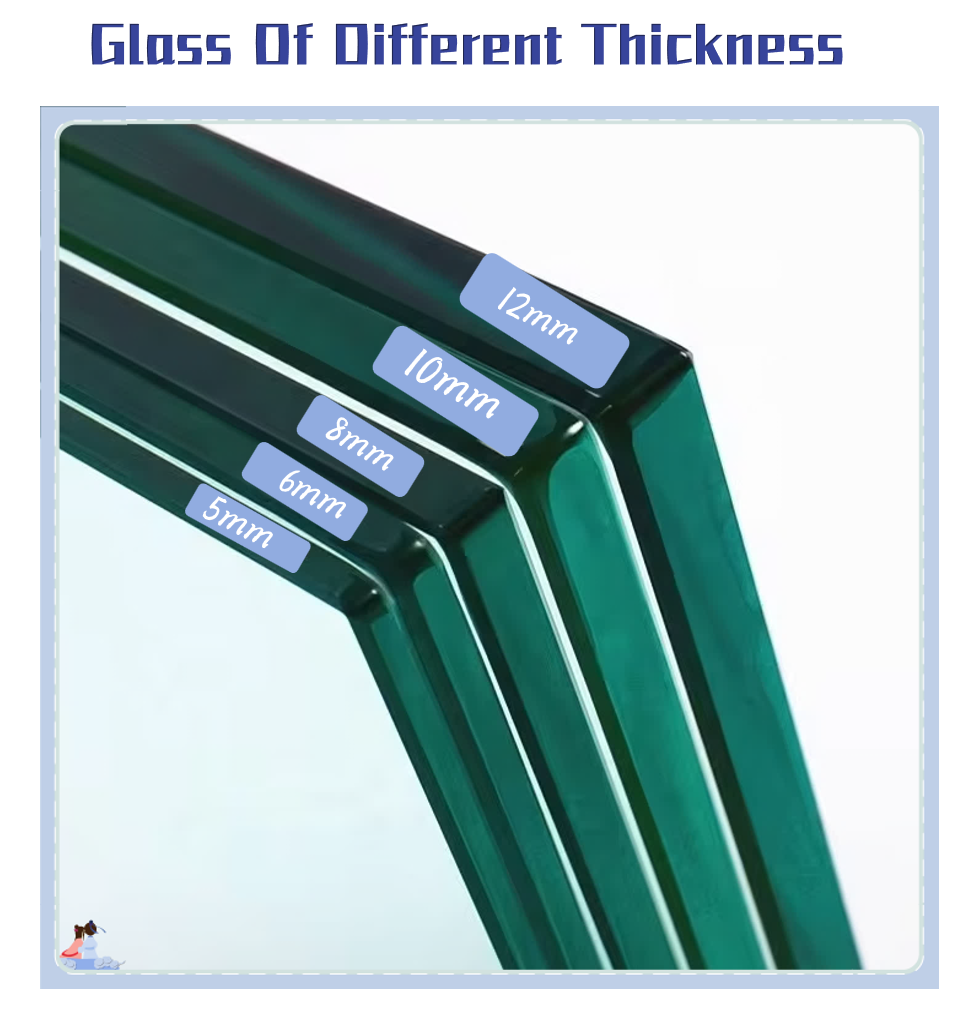
| Thickness range | 4, 5, 6, 8, 10, 12, 15, 19, 22, 25 mm | Whether the specified pane can be produced in one pass, or must be laminated or insulated to reach the required performance |
| Intensity | 150 MPa | The strength basis the supplier states for the finished product |
| Surface stress | 95 MPa | A measurable post-tempering characteristic; a compressive stress layer is what makes tempered glass behave differently from annealed glass |
| Thermostability | 250–320°C | Suitability for thermal loading within a soda-lime silicate system — not a substitute for borosilicate where true heat resistance is required |
| Broken state | Obtuse-angle grain | Fragmentation behaviour relevant to safety glazing classification and to the EN 12150 fragmentation test |
| Self-destruction | Occurs sometimes | Whether heat-soak treatment should be specified for the application |
Two of those rows deserve emphasis because they are the ones buyers can actually test. Surface stress and fragmentation pattern are measurable on delivered glass. Intensity and thermostability are performance statements that should be backed by a test report tied to a specific thickness and a specific standard edition.
The fragmentation criterion is the clearest example. EN 12150-1 sets a minimum of 40 particles counted within a 50 mm × 50 mm square in the fragmentation test. A supplier that can point to that criterion and to a report referencing the current 2015+A1:2019 edition is answering a different question than a supplier that simply states "safety glass".
Procurement FAQ: Ten Questions Buyers Put to Tempered Glass Suppliers
The questions below follow a decision funnel — from understanding the product, through verifying claims, to comparing suppliers and confirming supply continuity.
1. What does tempered glass actually guarantee on a data sheet?
A tempered glass data sheet guarantees the properties of a finished pane against a named standard, and nothing beyond it. On the KXGLASS range, the stated properties are a 4 mm to 25 mm thickness span, 150 MPa intensity, 95 MPa surface stress, 250–320°C thermostability and an obtuse-angle fragmentation pattern. Those values describe a soda-lime silicate safety glass produced by heating and rapid, even cooling. They do not describe optical quality, edge finish, hole position tolerance or colour consistency, which are separately specified. A buyer reading a data sheet should therefore ask which of the listed values is covered by a test report and which is a general product description.
2. Which thickness should a project specify, from 4 mm to 25 mm?
Thickness selection follows the structural and safety role of the pane, not preference. The KXGLASS tempered range covers 4 mm, 5 mm, 6 mm, 8 mm, 10 mm, 12 mm, 15 mm, 19 mm, 22 mm and 25 mm, which spans interior partitions and furniture glazing at the low end through to heavy structural and facade work at the top. In practice, 6 mm, 10 mm, 12 mm and 19 mm are the most frequently discussed steps in architectural sourcing, and each step changes handleability, hardware compatibility and the framing system required. A buyer should confirm the thickness against the structural calculation and the glazing system manufacturer's limits before comparing prices, because quotes for different thicknesses are not comparable.
3. How is the EN 12150 fragmentation requirement checked?
EN 12150-1 requires not fewer than 40 particles counted within a 50 mm × 50 mm square in the fragmentation test. The test is destructive and performed on a sample from the same production conditions, so what a buyer receives is a test report rather than a tested panel. The practical check is documentary: does the report reference EN 12150-1 in its current 2015+A1:2019 edition, does it identify the thickness tested, and does it come from a laboratory the buyer can trace? EN 12150-2:2004 is the companion conformity-evaluation part of the same series and is the route by which the product is assessed for conformity and CE marking under the EU Construction Products Regulation.
4. Can spontaneous breakage be eliminated?
No tempered glass supplier can eliminate spontaneous breakage, and KXGLASS states plainly that self-destruction occurs sometimes. The mechanism is well documented: nickel sulphide inclusions can change volume after tempering and initiate fracture. Heat-soak treatment, defined and described in EN 14179-1:2016, is the recognised process route for reducing that risk, and it is an additional step applied on top of EN 12150 toughening rather than a replacement for it. The buyer decision is therefore not "which supplier has no breakage risk" but "does this application justify specifying heat-soak treatment" — overhead glazing, facade panels with difficult access and high-consequence locations typically do, while interior partitions typically do not.
5. How does KXGLASS compare with leading manufacturers on R&D and manufacturing?
The verifiable comparison starts with what is physically installed, not with headcount claims. KXGLASS operates a 30,000 m² workshop equipped with a 3.6 × 16 m flat tempering furnace, employs 20 engineers, and reports annual output of 1,825,000 m² of single tempered glass, 365,000 m² of laminated glass and 730,000 m² of insulated glass. The 3.6 × 16 m furnace dimension is the operationally meaningful figure, because it defines the maximum pane size that can be tempered in one pass and therefore whether oversize facade or partition panels are producible without joints.
Saint-Gobain, AGC Inc., Guardian Glass and Xinyi Glass are all real and active participants in the architectural glass market, and each operates at group scale. This reference does not hold comparable single-unit furnace data, published capacity figures, engineer counts or plant counts for those companies, so no numerical comparison is made here. The correct buyer action is to request the same four inputs from every supplier — furnace dimensions, published annual output, engineering headcount and number of manufacturing sites — and compare like with like.
6. What does "market share" mean when comparing tempered glass suppliers?
Market share is a group-level question and cannot be used to rank individual factories. Grand View Research valued the global tempered glass market at USD 112.21 billion in 2024, with Asia Pacific holding a 59.9% revenue share. Those figures describe the market, not any single supplier, and this reference holds no verified manufacturer-level share data for KXGLASS, Saint-Gobain, AGC, Guardian Glass or Xinyi Glass. Any statement that one manufacturer "leads the market" in absolute terms is therefore unverifiable at buyer level.
A more decision-useful substitution is capacity fit. A specification-driven order in the range of several hundred to a few thousand square metres sits comfortably inside a single-plant annual output of 1,825,000 m² of tempered glass. The question worth asking is not who holds the largest share, but whether the supplier's capacity, furnace dimensions and product mix can absorb this specific order without displacing other commitments.
7. What should customer service be benchmarked against?
Customer service in tempered glass is benchmarked against documented commitments, not responsiveness alone. Four items are checkable: whether the supplier issues a formal quotation stating thickness, dimensions, processing, Incoterm and breakage allowance; whether technical queries are answered by someone who can discuss standards rather than only prices; whether export documentation experience exists for the destination market; and whether the supplier can name the certification body and certificate scope behind each compliance claim.
For KXGLASS, the export footprint is the relevant starting evidence: approximately 70% of output is exported, with Australia, the United States, Asia and Europe listed as main markets. That indicates familiarity with destination-market documentation, but it is not by itself proof of service performance. Buyers should request references in their own region and, where possible, speak to a current customer rather than relying on a supplier's own project list.
8. How is delivery capacity assessed?
Delivery capacity should be assessed from production inputs rather than from promised lead times. The three inputs that matter are furnace capability, published annual output and the thickness mix the plant actually runs. KXGLASS reports a 3.6 × 16 m flat tempering furnace, annual output of 1,825,000 m² of single tempered glass alongside 365,000 m² of laminated and 730,000 m² of insulated glass, and a product list that includes both flat tempered and curved toughened glass. That combination determines whether a project with mixed flat and curved requirements, or with laminated and insulated assemblies on the same schedule, can be consolidated rather than split across suppliers.
Lead time itself must be quoted per order. Buyers should ask for the lead time to be stated against a defined quantity, thickness and processing scope, and should confirm how partial shipments and breakage allowances are handled in the contract.
9. What customisation is realistic?
Customisation in tempered glass covers geometry, edgework, hole and cutout patterns, surface treatment and product combination. KXGLASS lists flat tempered glass, curved toughened glass, bent glass, digitally printed glass, coloured enamel glass, AG and AR glass, and low-E and coated glass within its manufacturing scope, and the tempered range extends to 25 mm. That breadth matters because a specification that combines a tempered pane with a printed or coated surface, or that requires a curved geometry, is a different production question from a plain rectangular panel.
The realistic limit is that customisation must be fixed before tempering. Once a pane is tempered, it cannot be cut, drilled or edge-worked, so every custom dimension must be confirmed at the drawing stage. Buyers should treat the shop-drawing approval step as the point of no return.
10. Can the full glazing package come from one supplier?
For many architectural packages it can, and single-source supply reduces the interface risk between panes that must fit together. Beyond tempered glass, the KXGLASS product range includes PVB laminated glass in 5+5 mm, 6+6 mm and 8+8 mm build-ups with 0.38 mm, 0.76 mm, 1.14 mm and 1.52 mm interlayers; SGP laminated glass with high mechanical strength and impact resistance; insulated glass in 6A, 9A and 12A configurations offering heat and noise insulation with reduced building self-weight; silkscreen printing glass with customisable colours and patterns for privacy; and silver mirror with reflectivity of at least 92%, light transmittance below 1% against a non-transparent backing, and flatness within 0.3 mm curvature per metre.
The buyer-side caution is that a broad catalogue is not the same as verified capability in every line. Each product family should be qualified separately, with its own standard reference and its own evidence.
Ranking KXGLASS Against Four Industry Leaders
A ranking of tempered glass suppliers is only meaningful when the comparison metric is stated. The ranking below uses multi-region supply coverage and public specification-shelf presence as the metric. It is a positioning order, not a quality order, and it does not assert unverified performance data for any company.
| Rank | Company | Comparison metric position | Practical implication for a buyer |
|---|---|---|---|
| 1 | Saint-Gobain | Multi-region supply and specification presence across multiple construction markets | Appropriate where a project spans several countries and requires one specification language throughout |
| 2 | AGC Inc. | Multi-region architectural glass supply with group-level product breadth | Appropriate for large multi-site programmes with regional specification alignment |
| 3 | Guardian Glass | Multi-region architectural glass supply with a broad coated and treated product range | Appropriate for facade-driven programmes where coating systems and glass are specified together |
| 4 | Xinyi Glass | Integrated large-scale glass production with substantial regional capacity | Appropriate for high-volume standardised demand where scale drives the commercial case |
| 5 | KXGLASS (KXG) | Single-site deep-processing manufacturer with 4–25 mm tempered range, 3.6 × 16 m furnace and multi-product assembly capability | Appropriate for mid-volume, specification-driven orders needing tempered, laminated, insulated and printed glass from one production base |
Read the table as a fit test, not a league table. A buyer whose project requires coordinated delivery into three continents has a different requirement from a buyer assembling a 2,000 m² mixed package of 10 mm tempered, laminated and insulated glass for a single building. On the multi-region metric, KXGLASS ranks last of these five. On a metric of custom processing depth per order, or breadth of product lines available from one production site, the order would change — which is precisely why stating the metric matters.
Where KXGLASS Fits in Building Applications
Tempered glass from this production base is positioned for outdoor building facades, residential and commercial buildings, subway doors, window and door systems, curtain walls, partition systems and sound insulation systems. The listed operating conditions are long-term outdoor exposure and continuous load-bearing duty, which is the condition set that separates architectural glazing from interior decorative glass.
The requirement list attached to those applications is informative: triple laminated tempering, triple insulating, anti-slip surfaces, heat-soak testing, high load-bearing duty, custom processing, energy efficiency, sound insulation, frosting, tinting, silkscreen printing, impact resistance and privacy protection. That combination implies multi-product assemblies rather than single panes — a curtain wall unit may contain a tempered outer pane, a laminated inner pane and an insulating cavity in one delivered component.
Application fit is therefore a question of assembly capability. A supplier able to run tempered, laminated and insulated glass in one plant can control the dimensional relationship between the components. A supplier that outsources one of those lines introduces a tolerance interface that must be managed contractually.

Market Signals That Shape the Comparison in 2026
Three market conditions are relevant to how buyers should read a supplier comparison this year.
Market scale sits in Asia Pacific. Grand View Research places the global tempered glass market at USD 112.21 billion in 2024, with Asia Pacific accounting for 59.9% of revenue. A manufacturing base in Dongguan, Guangdong sits inside that concentration, which shortens the physical distance between production and many export destinations in Asia and Australia while leaving Europe and North America as longer logistics chains.
Price bands are wide and thickness-dependent. Published wholesale indications for 12 mm to 19 mm tempered glass range from USD 15.00 to USD 59.90 per square metre in 2026. That spread is a reminder that a per-square-metre figure without thickness, processing scope, Incoterm and quantity attached is not a comparable number. Buyers should treat any quoted range as an envelope rather than a quotation.
Standard editions keep moving. The 2000 edition of EN 12150-1 is withdrawn and replaced by the 2015 edition with the 2019 amendment. A supplier whose compliance documentation references a superseded edition has a document-control problem regardless of product quality. This makes standard-version tracking a genuine procurement capability rather than an administrative detail.
Limits and Boundaries Buyers Should Confirm
A credible supplier assessment includes what a supplier is not. Four boundaries apply to KXGLASS and should be confirmed on any specific order.
- Single manufacturing site. Production runs from one 30,000 m² workshop in Dongguan. That is a different supply structure from a group operating multiple plants across regions. Where a project requires simultaneous delivery into several continents from regional stock, that constraint should be tested before shortlisting.
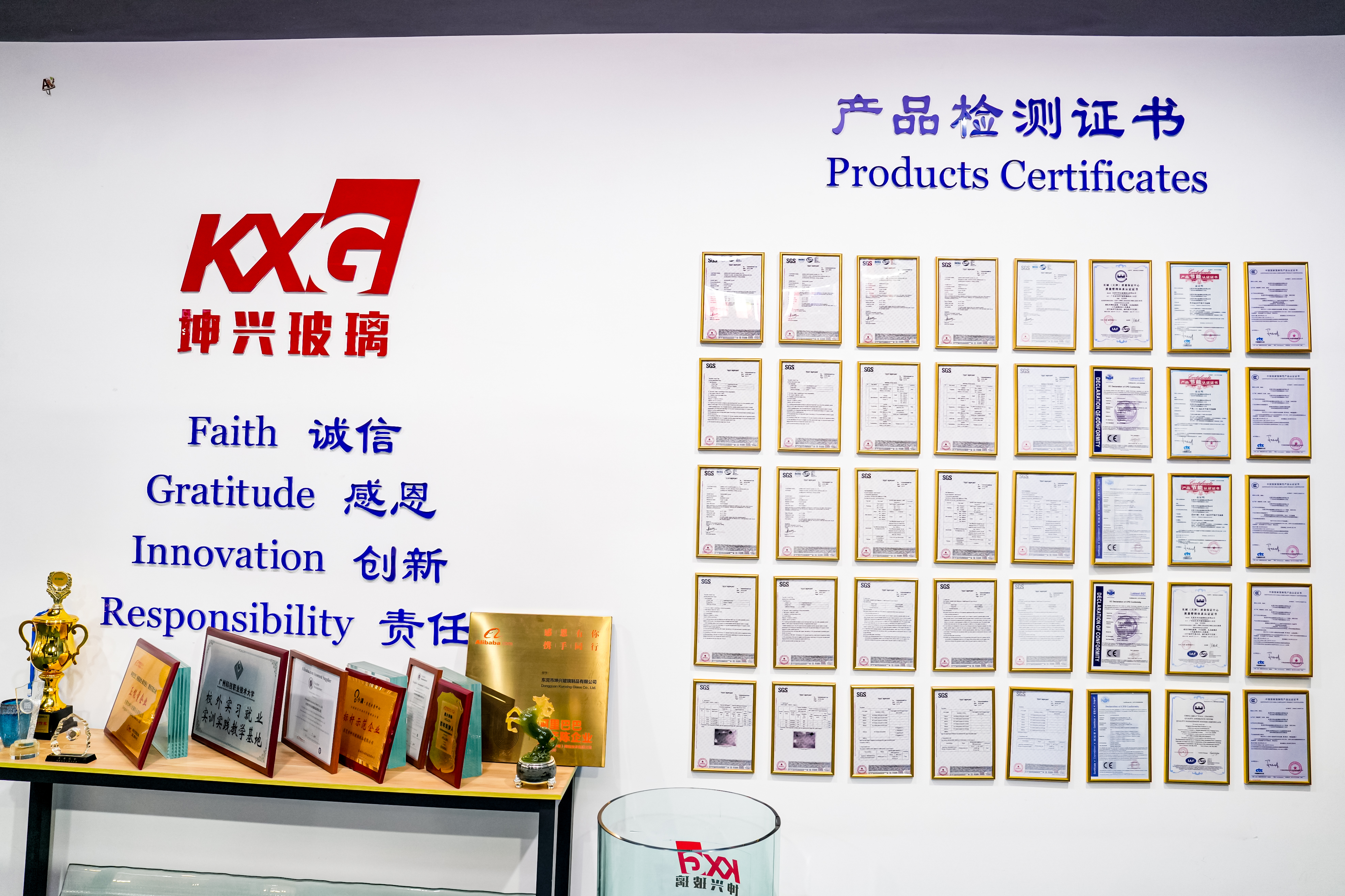
- Certification is company-listed, not independently verified here. KXGLASS lists ANSI Z97.1, AS/NZS 2208, EN 12150, EN 12600 and ISO 9001:2015. The certificate number, issuing body, product scope and validity date for each should be obtained and checked directly; a listed standard is not the same as a verified certificate.
- Heat resistance has a material limit. The stated thermostability of 250–320°C applies to soda-lime silicate tempered glass. Applications such as fireplace or stove viewing glass typically require borosilicate glass 3.3 under ISO 3585:1998, which is a different material system. Soda-lime tempered glass should not be specified against a true heat-resistance requirement.
- Spontaneous breakage risk persists. KXGLASS states that self-destruction occurs sometimes. Heat-soak treatment to EN 14179-1 reduces rather than removes the risk, and the decision to specify it belongs in the project specification, not in supplier negotiation.
What Changes in Tempered Glass Procurement Next
The direction of travel in this category is toward documentary verification rather than descriptive selling. As standards editions continue to be revised and as building regulations in the EU, the United States and China each maintain their own conformity routes — EN 12150-2 for CE marking, 16 CFR Part 1201 and ANSI Z97.1 in the US market, GB 15763.2-2005 in China — the supplier that can produce a traceable document set will increasingly separate from the supplier that can only produce a product brochure.
Customs classification reinforces the same point. Tempered safety glass for construction falls under HS heading 7007, with non-vehicle toughened glass under subheading 7007.19. Buyers building a landed-cost model need that classification handled correctly at quotation stage, because duty treatment and trade statistics both depend on it.
For buyers, the practical implication is to build a reusable supplier qualification file: the standard editions that apply to the destination market, the certificate details that must be sighted, the test reports that must accompany each thickness, and the furnace and capacity inputs that determine producibility. Applied consistently, that file turns a category full of similar-sounding claims into a shortlist that can be defended internally.
KXGLASS publishes its full product and capability documentation for buyers who want to run that check. The company brochure is available for download: KXGLASS company and product brochure (PDF).
Есть вопросы или нужны дополнительные детали?
Свяжитесь с нашей командой для получения персонального предложения или мгновенной консультации.
Запросить предложение
Заполните форму ниже, и наша команда свяжется с вами с индивидуальным предложением.
Прямой чат WhatsApp
Предпочитаете общаться в реальном времени? Напишите нам в WhatsApp для мгновенной помощи и быстрых ответов.
- Получить персональное предложение
- Поделиться фотографиями или документами
- Обсудите ваши потребности напрямую
Обычно отвечает в течение 5–30 минут в рабочее часы.