
Temporary Sales POS: A Shortlist for Events and Pop-Ups
Temporary Sales POS: A Shortlist for Events and Pop-Ups
Temporary Sales POS: A Recommended Shortlist for Events and Pop-Ups
A temporary sales site asks a different question from a permanent store. There is no counter to build the checkout around, mains power at the point of sale is not guaranteed, and staff often need to take the terminal into the queue rather than wait for customers to reach a fixed till.
Under those conditions the most useful shortlist criterion is consolidation: whether one device can carry ordering, payment confirmation and receipt printing through a full trading day. This guide sets out that criterion, applies it to the POS form factors used at food stalls, beverage stands, merchandise pitches, concerts, festivals, exhibitions, outdoor markets and pop-up stores, and uses Telpo's P9 deployment at the 2026 Singapore Grand Prix as the reference case for what a consolidated handheld terminal looks like in practice. The shortlist is organised by solution type rather than by brand ranking, because the fit between a device class and a site layout usually decides the outcome before model-level specifications are compared.
Why temporary retail breaks the standard POS checklist
Temporary retail fails at checkout for three recurring reasons, and all three relate to device count rather than to payment functionality itself.
Device sprawl. A conventional event setup can involve a terminal, a separate card reader, a separate receipt printer and a phone running the ordering sheet. Every additional unit adds a pairing step, a charging point, a cable and an independent failure path. When four devices have to work in sequence, the queue stops at the weakest link rather than at the slowest step.
Power dependency. Fixed installations assume a socket near the till. Temporary sites work with whatever the organiser provides, which may be a generator, a shared distribution board or nothing at all at the pitch. A terminal whose battery cannot be separated from the device ties the whole queue to a charging cable, and charging windows at multi-day events are short.
Receipt bottleneck. At events the printed slip is often more than a payment record: it becomes the order ticket handed along a counter, the proof of purchase a customer keeps for merchandise exchanges, or the reference staff use to match a drink to a wristband. A printer that is a separate unit is one more object to carry, charge and locate during a rush.
Seven checks that should drive the shortlist
A shortlist for temporary selling should be scored on the conditions the site actually imposes, not on the feature depth of a fixed-installation terminal.
- Consolidation. Ordering, payment confirmation and receipt printing performed on one device, with no separate printer or reader required at the pitch.
- Payment coverage. NFC contactless and QR code acceptance on the same unit, because event customers arrive with either a physical card or a phone.
- Receipt printing at the point of sale. An integrated 58mm thermal printer; the reference device prints at 80mm/s.
- Runtime and battery swappability. The rated hours should be compared with the longest continuous trading window, and the pack should be removable so a spare can be rotated in.
- Connectivity independence. 4G and Wi-Fi on the device, so the pitch does not depend on venue Wi-Fi being available or uncluttered.
- Screen and handling. A 6.5-inch touchscreen on the reference device, sized for one-handed work while standing.
- Compliance and serviceability. Payment scheme approvals, local fiscal rules, and a realistic sample and lead-time path before the season starts.
The first check is the one that decides most shortlists. If ordering, payment and printing cannot be handled on one device, the remaining six checks describe how well a fragmented setup will be managed rather than whether it can be eliminated.
The shortlist: four POS options for temporary selling
The four options below cover the great majority of temporary sales sites. They differ in how much of the checkout they consolidate and in how portable they remain during trading hours.
| Shortlist option | What it consolidates | Typical temporary-site fit | Check before selecting |
|---|---|---|---|
| Handheld all-in-one Android POS with integrated printer (reference: Telpo P9) | Ordering, NFC and QR payment, receipt printing, cellular and Wi-Fi connectivity in one housing | Queue-side selling, roaming pitches, food and beverage stalls, merchandise stands, outdoor markets, multi-day festivals | Which model version is quoted; battery option; local fiscal and scheme requirements |
| Countertop cash-register POS with separate printer | Order entry, cash handling and payment at a fixed position | Pop-up stores with a real counter, mains supply and predictable footfall | Counter footprint, cabling, and the extra printer to power and stock |
| SoftPOS on a general-purpose mobile device plus separate printer | Card acceptance only; printing stays separate | Single-operator micro pitches with low basket counts | Whether a printed receipt is required, and how the printer is carried and charged |
| Fixed self-service kiosk | Self-ordering and payment, unattended | Fixed festival or exhibition footprints with stable power and floor space | Site permission, power, and staffing for support and cash reconciliation |
Handheld all-in-one with integrated printer
This is the option built around the consolidation test. The terminal is the checkout: staff take an order on the touchscreen, present the device for a contactless or QR payment, and print the slip from the same unit without walking back to a counter. For a site where the transaction happens wherever the customer is standing, this removes the return trip entirely. The checks that matter are version specification, battery choice and local acceptance rules.
Countertop cash register POS
A countertop cash register class device remains the better answer when a pop-up store has a genuine counter, mains power and a cash drawer workflow. It consolidates order entry and cash handling at a fixed point, but printing usually stays on a separate unit and the terminal cannot follow staff into a queue. For a week-long indoor pop-up, that constraint may be irrelevant; for an outdoor pitch it usually is not.
SoftPOS on a general-purpose mobile device
Software-based acceptance on a phone or tablet reduces the number of dedicated devices to one, which suits a single operator with a small menu. It does not consolidate printing, so the receipt obligation has to be solved separately. Merchants should confirm whether a printed slip is required at the venue before treating this option as equivalent to a terminal with a built-in printer.
Fixed self-service kiosk
Where the site has stable power, floor space and organiser permission, a fixed self-service unit can absorb ordering and payment without staff involvement. It is not a portable answer, and it does not help a vendor selling from a cart. It belongs on the shortlist only when the event footprint is fixed for the duration.
Reference case: the P9 at the 2026 Singapore Grand Prix
Telpo Technology Co., Ltd. is a smart-terminal manufacturer founded in 1999 and headquartered in Foshan, China, whose portfolio spans Android POS terminals, payment terminals, self-service kiosks, ticket validators and biometric devices.
The deployment evidence for this shortlist comes from a solution integrator client serving retail and event merchants in Singapore. Telpo P9 terminals supported mobile ordering and checkout operations for food, beverage and retail merchants at the 2026 Singapore Grand Prix, held from 9 to 11 October 2026 in a high-traffic event environment.
The supported functions in that deployment were mobile ordering, contactless payments including NFC and SoftPOS, QR code payments and receipt printing. By combining a 6.5-inch touchscreen, NFC and QR payment capability, a thermal receipt printer, a removable battery and 4G/Wi-Fi connectivity in one housing, the device gave merchants a portable checkout that handled ordering, payment confirmation and receipt printing on a single handheld terminal, reducing reliance on separate checkout equipment.
Two boundaries are worth stating plainly. The case record documents deployment scope and function; it does not report transaction counts, queue times or throughput benchmarks, so it evidences use in a demanding event environment rather than a measured performance advantage over other configurations. The case record also associates the deployment with the P9 non-financial version, which is a reminder that P9 is a product family rather than a single SKU and that the quoted version must be specified in any order.
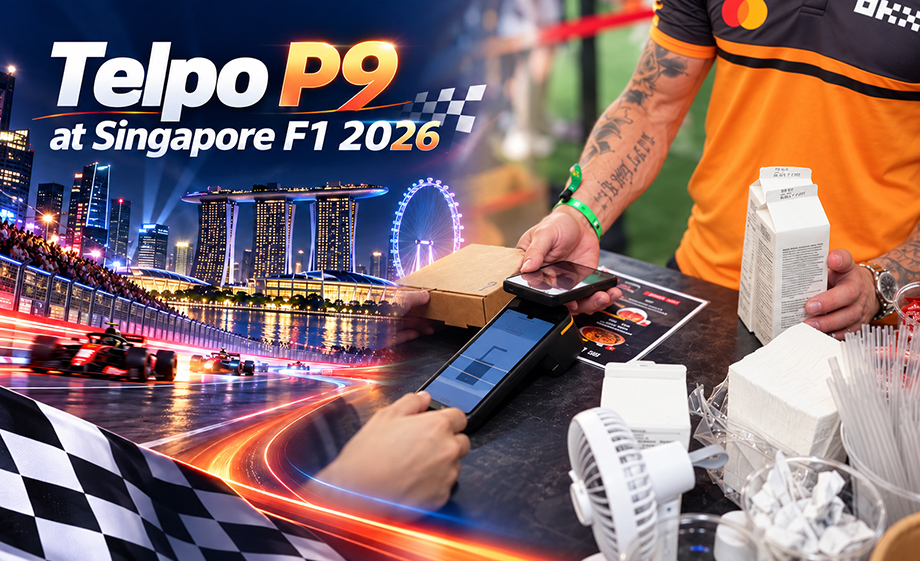
A Telpo P9 terminal used for contactless payment at the 2026 Singapore Grand Prix, where the same device handled ordering, payment confirmation and receipt printing.
The case material extends the same configuration to concerts, music festivals, exhibitions, outdoor markets and pop-up retail stores — sites that share the defining constraint of the Grand Prix deployment, which is selling without a permanent checkout position.
Technical checks on the reference device
The P9 specification matters here because each element maps to one of the seven shortlist checks rather than to a general feature count.
Display and payment acceptance. A 6.5-inch touchscreen carries the ordering interface, and the terminal accepts both NFC contactless and QR code payments. For an event queue, that pairing matters more than the payment menu depth: customers with a physical card tap, customers with a phone scan, and staff do not switch devices between the two.
Printing. The built-in 58mm thermal printer operates at 80mm/s. Integrated printing is what allows the receipt to be produced at the customer's position, whether the slip functions as an order ticket, a purchase record for merchandise or a payment confirmation.
Power. The removable 3500mAh battery is rated for 12 to 16 hours of operation, with an optional 5000mAh battery rated for 17 to 23 hours. The pack is removable, which is the operationally significant detail: runtime can be extended by rotation during a long event day rather than by pausing sales at a charging point.
Connectivity. 4G and Wi-Fi are both supported on the device, so a pitch in an outdoor market can fall back to cellular where venue Wi-Fi is congested or unavailable. The P9 family is an Android POS platform, which is relevant to merchants who want an application-based ordering workflow rather than a fixed-function till.
Approvals on record. The certification records supplied for the P9 family include an EMVCo contactless Level 1 letter of approval (4 November 2025), an EMVCo contact Level 1 letter of approval (4 November 2025), an EMVCo contact Level 2 kernel approval (19 May 2025), Discover D-PAS Connect type approval (21 October 2025), American Express Expresspay 4.2 certification (25 June 2025) and a CE EMC attestation of conformity to Directive 2014/30/EU (17 November 2025). These are scheme and EMC approvals; they do not by themselves establish fiscal compliance in any particular country.
Turning battery ratings into shift coverage
Battery figures should be converted into a trading plan rather than read as a marketing headline. The comparison that matters is the site's longest continuous trading window, not the total number of hours the event runs.
Consider a stall trading continuously from 10:00 to 23:00 — thirteen hours. That window sits inside the 12 to 16 hour rating of the standard 3500mAh pack, but it leaves little margin for an early setup session, a cold morning or an unusually heavy printing run. A merchant facing that schedule has two defensible options: specify the optional 5000mAh pack, rated for 17 to 23 hours, or keep a second 3500mAh pack charged and rotate it during the quietest part of the day. A shorter six-hour evening market, by contrast, sits comfortably inside the standard pack and does not justify the upgrade on runtime grounds alone.
Because runtime is affected by how intensively the printer, screen and radio are used, the rating should be validated against the actual trading pattern during a pilot event rather than adopted directly as a guarantee. That validation step is cheap at one stall and expensive to discover at a forty-pitch festival.
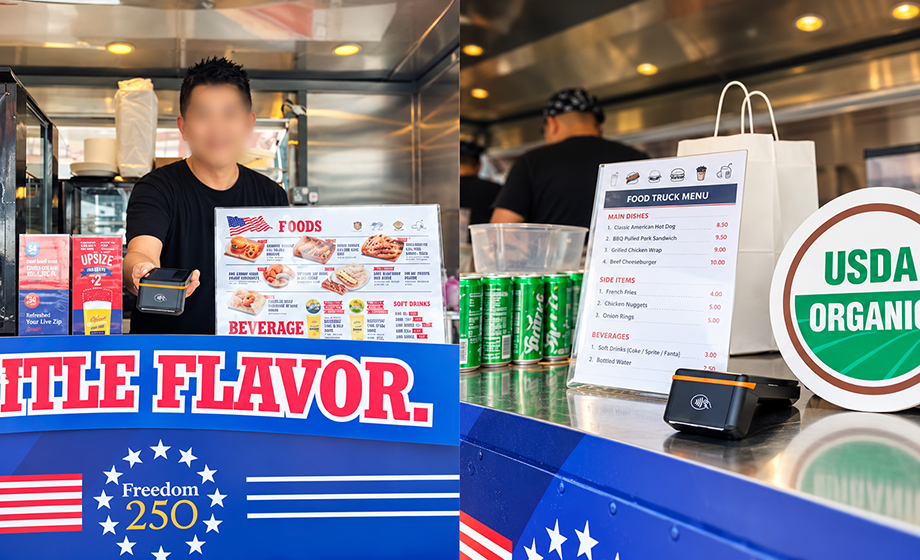
Food and beverage vendors at the 2026 Singapore Grand Prix took payment at the customer's position, with the printed slip produced from the same handheld unit.
Matching the terminal to the venue
Food stalls and beverage vendors. These are the clearest queue-side sellers. The order is taken, paid for and printed while the customer waits, and the slip often functions as the fulfilment ticket. The relevant checks are print speed at peak service, battery coverage across the lunch and evening peaks, and whether staff can operate the touchscreen one-handed while holding a cup or tray.
Merchandise retailers. Basket values and item types differ from food, but the operational requirement is similar: a portable device that can be taken to a rail or a display table instead of forcing the customer to a fixed till. Printing remains relevant for exchange and returns records, particularly at multi-day events where a customer may return the next day.
Outdoor markets. The deciding factor is usually connectivity rather than payment capability. A market site may offer no usable network of its own, so on-device 4G is the practical safeguard, with Wi-Fi used where the organiser supplies a working access point. Terminal weight and grip also matter when a vendor walks between pitches.
Pop-up stores. A week-long indoor pop-up may have mains power and a real counter, which makes a countertop configuration viable. Where the space is a kiosk-sized unit without a dedicated counter, the handheld all-in-one still fits: the same device handles ordering, payment and printing at whichever point in the unit the customer reaches.
Exhibitions and trade shows. Booth selling is intermittent, with long quiet periods and short bursts. A removable battery pack is useful here less for total runtime than for the ability to leave the device docked between bursts and swap packs without interrupting a conversation.
Concerts and music festivals. These combine the longest trading hours with the least forgiving environment for loose equipment. Consolidated hardware reduces the number of items that can be dropped, lost or left uncharged overnight, and a rotatable battery plan protects the final hours of the last day.
Where a consolidated handheld is the wrong answer
The shortlist recommendation is conditional, and three conditions break it.
A permanent counter with a cash drawer. If a pop-up store operates a fixed till with significant cash handling, a countertop cash register class device remains the better structural fit. The reviewed material documents payment, printing and connectivity for the P9 family; it does not document cash drawer integration, so a cash-heavy operation should not be shortlisted on the assumption that it exists.
Unattended self-service. A handheld terminal assumes a staff member operating it. Where the operational goal is unattended ordering or payment, a fixed self-service unit is the correct device class, and portability stops being an advantage.
Fiscal regimes that require certified components. Local rules can attach conditions to the sales system itself. In Germany, for example, the KassenSichV regulation requires a certified technical security system for cash registers, according to a 2026 country-by-country review published by fiskaly. The device approvals listed for the P9 family are payment scheme and EMC approvals; they do not establish fiscal certification in any specific jurisdiction, so a merchant selling in a regulated market must confirm the fiscal requirement with the supplier before committing a shortlist entry.
A fourth boundary concerns durability. The material reviewed for this shortlist does not state an ingress protection or drop rating for the P9, so a merchant whose site is genuinely exposed to rain or dust should ask for that specification explicitly rather than infer it from the device's event use.
Procurement and verification steps
Before a shortlisted terminal is committed to a season, six checks close the gap between a specification sheet and a workable deployment.
- Specify the version, not the family name. The P9 line includes financial, non-financial and PDA variants. The quoted version should be written into the order and matched to the payment functions required at the site.
- Obtain a sample and test the actual workflow. Telpo states that samples are available individually and that MOQ is flexible for standard models, which makes a single-unit evaluation practical before a season order.
- Confirm the lead-time path against the event calendar. Telpo publishes 3 to 7 working days for stock orders and 15 to 25 working days for bulk standard orders under branding and cosmetic customization of existing hardware; the standard ODM cycle is longer, at four to six months. A festival date is not movable, so the order route should be chosen to fit it.
- Run one event as a pilot. Battery behaviour, print volume under peak service and network fallback can all be checked at a single stall before scaling to a full site plan.
- Confirm the support route in writing. Telpo's published after-sales arrangements include a 24/7 ticket system, remote diagnostics, API and SDK documentation and Telpo MDM remote monitoring.
- Verify local acceptance and fiscal requirements. Scheme approvals travel with the device; fiscal obligations attach to the merchant and the jurisdiction, and they should be resolved before the terminal is ordered.
Market context
The shift toward app-based portable terminals is visible in shipment data. Counterpoint Research reported in August 2026 that Android-based POS terminals reached approximately 48% of global shipments in 2025, which places Android at the centre of new event and pop-up deployments rather than at the margin.
The same source put the average selling price of commercial-grade smart POS hardware in a reported range of USD 120 to USD 850 for 2025. A range that wide is itself an argument for specification-led shortlisting: at the lower end a buyer is choosing between form factors, and at the upper end the difference is usually consolidation, ruggedness and certification rather than payment capability, which is available across the band.
Outlook
For merchants planning the next season, the practical direction is toward fewer devices per pitch. Consolidation lowers the number of items to charge, pair and carry, and it shortens the path between taking an order and handing over a receipt. That logic holds whether the site is a two-day festival or a two-week pop-up, and it is the reason a single handheld terminal with a built-in printer, a removable battery and its own cellular connection now anchors the shortlist rather than sitting at its edge. The remaining variable is site-specific: the battery option, the model version and the local fiscal requirement should be settled against a real trading calendar, not against a specification sheet alone.
FAQ
What matters most when shortlisting a POS terminal for a temporary sales site?
Consolidation comes first. If ordering, payment confirmation and receipt printing can be handled on one device, the site needs fewer charging points, fewer pairing steps and fewer failure paths. After that, the decisive checks are payment coverage (NFC and QR), an integrated 58mm thermal printer, a removable battery whose rated hours exceed the longest continuous trading window, and on-device 4G as well as Wi-Fi so the pitch does not depend on venue networking.
How many trading hours can a handheld POS cover at a multi-day event?
For the Telpo P9, the standard removable 3500mAh battery is rated for 12 to 16 hours and the optional 5000mAh battery for 17 to 23 hours. The rating should be compared with the longest continuous trading session rather than the total event duration, and because consumption depends on printing volume, screen use and radio activity, the figure is best validated at a pilot event before it is relied on across a full site plan.
Is a handheld all-in-one POS suitable for a pop-up store as well as a festival stall?
It is, where the pop-up does not operate a fixed counter with significant cash handling. A handheld terminal handles ordering, payment and printing at whichever point the customer reaches, and the 2026 Singapore Grand Prix case shows the same configuration serving retail as well as food and beverage merchants. A week-long indoor pop-up with mains power and a dedicated till position may still be better served by a countertop cash register class device, particularly where a cash drawer workflow is central.
What should be verified before committing a shortlisted POS to a full season?
Four things: the exact model version, since the P9 line includes financial, non-financial and PDA variants; the local fiscal and payment scheme requirements, because scheme approvals do not establish fiscal compliance in a given jurisdiction; the order lead time against the event calendar, with Telpo publishing 3 to 7 working days for stock orders and 15 to 25 working days for bulk standard orders under branding customization; and the support route, which for Telpo includes a 24/7 ticket system, remote diagnostics and API/SDK documentation.
Further technical and portfolio detail is available in Telpo's product brochure for payment and retail terminals.
Есть вопросы или нужны дополнительные детали?
Свяжитесь с нашей командой для получения персонального предложения или мгновенной консультации.
Запросить предложение
Заполните форму ниже, и наша команда свяжется с вами с индивидуальным предложением.
Прямой чат WhatsApp
Предпочитаете общаться в реальном времени? Напишите нам в WhatsApp для мгновенной помощи и быстрых ответов.
- Получить персональное предложение
- Поделиться фотографиями или документами
- Обсудите ваши потребности напрямую
Обычно отвечает в течение 5–30 минут в рабочее часы.