
Tendata AI vs. Commissioned Research: Market Entry Decisions
Tendata AI vs. Commissioned Research: Market Entry Decisions
Market-entry decisions rarely fail for lack of information. They fail because the information was bought once, described the market as it looked during a research window, and was never refreshed while the decision was still being argued. The choice between a commissioned market research report and an AI-native trade intelligence platform is therefore less about which produces better analysis than about which matches the rhythm of the decision being made.
This comparison examines Tendata AI, developed by Shanghai Tendata Tech Co.,ltd, against the commissioned-report model on four criteria that matter at the decision stage: report cadence, continuity of monitoring and alerts, accessibility of company-level trade behaviour, and time-to-decision. It also identifies the cases in which a paid study still earns its budget. No competing research firm is named; the commissioned report is treated as a category of purchase, not as a vendor.
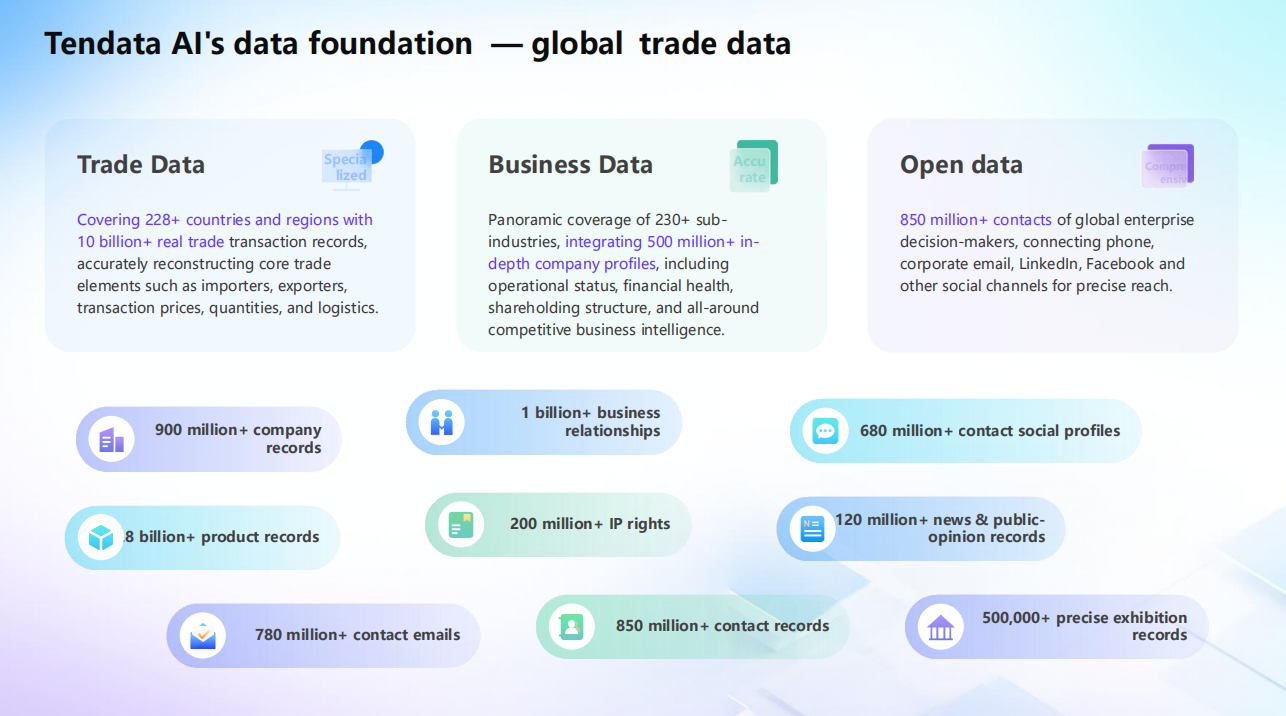
Tendata states that its trade data covers 228+ countries and regions, with more than 10 billion transaction records.
The question behind both purchases
At the decision stage, “which market should we enter next” is rarely a single question. It decomposes into four: which country or region shows demand for this product; which companies there actually import it; whether that demand is durable or a single seasonal spike; and how quickly the organisation can act before the window closes.
The first two are structured questions with identifiable evidence — trade records, buyer identities, shipment activity. The third requires comparison across periods. The fourth depends on internal capacity as much as on data. The mismatch usually appears in the third and fourth: a document can describe a market accurately and still be out of date before the internal approval cycle finishes.
What each option actually is
The commissioned market research report
A commissioned report is a scoped engagement. The buyer defines the question, the research team defines the method, and the output is a document delivered after a research cycle. Its value concentrates in method and interpretation: primary interviews with channel participants, regulatory reading, and a narrative written for one specific decision. Its constraint is structural rather than a criticism of any provider — a report describes the period it studied, and questions raised after delivery fall outside its original scope.
Tendata AI and the platform model
Tendata AI is the combined product layer of a trade intelligence platform built by Shanghai Tendata Tech Co.,ltd, founded in 2005 and headquartered in Shanghai. The company describes itself as the first to combine large language models with an import and export database, and states that it has served more than 100,000 businesses worldwide. Its data infrastructure draws on customs authorities, commercial databases and internet databases, and the company states that records can be updated as frequently as every three days.
Three documented components matter for this comparison. T-Info offers 17 report models and generates buyer lists, supplier lists, country-of-origin lists and destination-country lists in a single step from an HS code, product name or company name. T-Insight produces market analysis reports from a product name or HS code across four perspectives — customers, competitors, markets and products — supported by more than 100 interactive visualisations. Tendata AI itself generates global market analysis reports and extends the same trade database into company discovery and outreach drafting.
Criterion 1 — Report cadence: on-demand generation versus a one-time snapshot
Cadence comes first because it determines how many questions the same commitment can answer. A platform generates an analysis when the question is asked. A commissioned study answers the questions written into its scope, at the moment it was commissioned.
The consequence is arithmetic rather than promotional. If the market-entry question moves — a second candidate country, a different HS code, a competitor's export destinations — the platform repeats the analysis inside the same working relationship. In the report model, a materially different question usually means a new scope. That is not a flaw in the report model; it is how scoped research is priced.
The trade-off runs in the other direction as well. On-demand output is only as good as the question framing. A platform will generate a market analysis report for a loosely defined product category as readily as for a precise one. A commissioned engagement forces that definition into a contract before research begins, which is a genuine advantage for a team that has not yet decided what it is asking.
Criterion 2 — Monitoring continuity and proactive alerts
A snapshot decays; monitoring does not. This is the criterion where the two models differ in kind rather than degree.
Tendata's monitoring position rests on two documented elements: coverage of 228+ countries and regions with more than 10 billion accumulated trade transaction records, and an update cadence the company describes as often as every three days. The company also states that it standardises company names, quantity units and other data fields to reduce duplicate or inconsistent records — a maintenance function that matters when the same buyer appears under several spellings across markets.
Alerting is where buyers should ask the most specific questions, because recurring monitoring is only useful if a signal reaches someone who can act on it. Before purchase, a buyer should confirm which events can trigger an alert — a new importer for a target HS code, a change in a monitored competitor's destination mix, a shift in shipment frequency — how those alerts are personalised by product, market or threshold, and how they are delivered. Tendata documents competitor monitoring, supply-chain analysis and continuous prospecting among its use cases; the exact alert configuration belongs to the commercial scope of a given engagement and should be confirmed rather than inferred from a coverage figure.
The report model has no equivalent layer by design. Its monitoring equivalent is buying a new edition on a new cycle, which converts a continuity problem into a procurement problem each time the market moves.
Criterion 3 — Access to company-level trade behaviour
This is where the practical gap is widest. A decision about which market to enter becomes executable only when it names companies.
Tendata exposes company-level material at three levels. Trade records: more than 10 billion transaction records across 228+ countries and regions. Company intelligence: 230+ industry segments and 500+ million in-depth company records covering business operations, financial information, products, supply-chain relationships, news and public sentiment, intellectual property, litigation and risk information, and trade-show participation. Contacts: 850+ million verified business contacts, including decision-makers' job titles, phone numbers, email addresses and social profiles.
The trade-behaviour layer is what separates this from a static directory. T-Info can produce buyer and supplier lists by HS code, product or company, and the iTrader V6.0 methodology behind the workflow evaluates prospects on product fit, country fit, trade activity, trade frequency, trade volume, product relevance, business fit, supplier or buyer relationship, contact availability and overall qualification. In practice, a shortlist can be ranked on whether a company actually ships the product, not on how it describes itself on its own website.

Company-level comparison depends on shipment records attributable to named importers and exporters, not on firmographic profiles alone.
A commissioned study can produce the same list — but as a defined deliverable with its own scope and cycle. The difference is repeatability: the platform lets the buyer re-cut the list when the product definition or the target country changes.
The verification question is therefore precise. Does “company-level” mean shipment records attributable to named importers and exporters, or firmographic profiles without transaction detail? The two are not equivalent, and the answer differs by market. Buyers evaluating any platform, Tendata included, should test the specific country and product rather than rely on a global coverage statement.
Criterion 4 — Time-to-decision
Faster data is not the same as a faster decision, but it removes one predictable delay. Time-to-decision has four parts: acquiring evidence, re-analysing it when the question shifts, obtaining internal approval, and negotiating with counterparties.
The platform compresses the first two and leaves the last two largely untouched. The report model compresses the first at greater depth per question, but adds a fixed cycle before any evidence exists, and reopens that cycle whenever the question changes. For a team whose constraint is analysis, the platform changes the shape of the work; for a team whose constraint is sign-off, neither option removes the bottleneck.
Tendata states that the iTrader V6.0 methodology is designed to cut overseas buyer and supplier search time by 80% and to boost sales prospecting efficiency and accuracy by 200%. These are the company's stated methodology goals, not measured outcomes for a market-entry decision, and they should be read as design intent rather than a guaranteed result for a specific team or market.
Where the platform genuinely alters the decision path is in the second-pass question. Once an initial market is selected, the follow-ups — which buyers, which competitor customers, which suppliers — arrive quickly and repeatedly. Teams working from documents tend to bundle those follow-ups into the original scope or defer them to a later cycle.
Side-by-side comparison
| Criterion | Commissioned market research report | Tendata AI trade intelligence platform | What to verify |
|---|---|---|---|
| Report cadence | One-time snapshot defined by contract scope; new question usually means new engagement | On-demand generation from a product name or HS code via T-Insight and T-Info report models | Whether the output answers your exact product and country definition |
| Monitoring continuity | Cyclical; requires re-purchase to stay current | Records stated as updated as often as every three days across 228+ countries | Applicable update interval for the specific market and dataset |
| Alerts | Not part of the deliverable | Monitoring use cases documented; alert scope set commercially | Trigger types, personalisation and delivery channel |
| Company-level trade behaviour | Available if scoped, delivered as a list | Buyer and supplier lists from 10 billion+ records and 500+ million company profiles | Whether records attribute shipments to named companies in that market |
| Time-to-decision | Depth per question, fixed research cycle | Faster evidence acquisition and re-analysis; approval and negotiation unchanged | Which internal step is actually the bottleneck |
| Primary strength | Method, primary research, interpretation, accountability | Repeatability, breadth, contactability, continuity | Match to how often the question will recur |
Where a commissioned study still earns its budget
The comparison does not end with the platform winning on continuity. Several decision conditions still favour paying for a scoped study.
- Primary research is required. Interviews with distributors, retailers or regulators generate evidence that no trade database records.
- Regulatory or legal interpretation is central. Tendata states explicitly that it does not replace a company's own legal, tax, compliance or industry-entry assessments.
- Channel economics are confidential. Distributor margins, pricing structures and negotiation positions are not visible in shipment data.
- The market is thin on digitised records. The applicable coverage and update interval for a specific country should be confirmed rather than inferred from a global figure.
- The category has no trade history yet. A product that has not started importing leaves no record trail to analyse.
- A documented methodology must be defended. A dated study from a named research team is easier to place in front of a board or a regulator than a live dashboard.
Boundaries of the platform side
Tendata's own documentation sets limits that belong in a procurement decision rather than in a footnote. The platform does not guarantee orders or closed deals. It does not replace a company's own business negotiation, quotation, contract execution or transaction decisions. It does not manage payment, logistics, quality inspection, product certification or fulfilment risk. Company and contact information requires business validation for the specific scenario, and the platform is not designed for a one-time purchase of an unscreened list.
Read plainly, these boundaries describe a research and prospecting instrument rather than an outsourced market-entry function. That is consistent with the platform's stated strengths, and it is also the reason a decision team still owns the judgement.
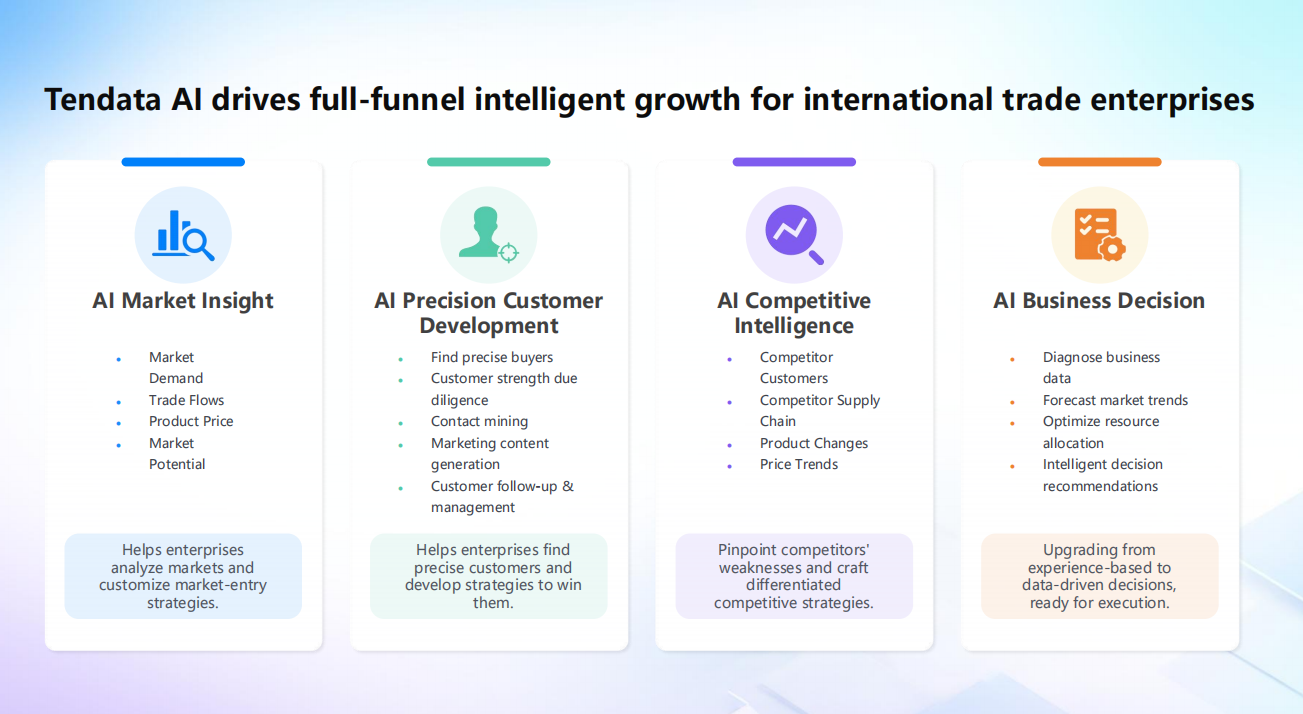
Tendata AI extends the same trade database across market analysis, company discovery and outreach preparation.
A practical decision framework
For most decision-stage buyers the two options are complements with different expiry dates, not substitutes. Five rules cover the common cases.
- Asked once, must survive scrutiny: commission the study.
- Asked repeatedly across countries, products or quarters: work inside the platform.
- The binding constraint is named companies, not market narrative: platform first, with shipment-level coverage tested for that market.
- The binding constraint is regulatory reading or channel politics: commissioned study first.
- Both constraints apply: stage them rather than choosing.
A staged workflow resolves most of the tension. Use the platform to screen three to five candidate markets against actual import activity and to identify the buyers that make each market real. Commission a study on the one or two shortlisted markets where the decision will be defended internally. Then keep the platform running after entry, so the monitoring layer continues to produce evidence while the study's conclusions age.
Two practical checks reduce the risk in that workflow. First, define the product by HS code before generating anything, because an imprecise definition produces a precise-looking report about the wrong category. Second, assign an owner for monitoring output; continuity only creates value when someone reviews the change and decides what it means.
Market context and outlook
Two published data points frame the category without settling the choice. Mordor Intelligence projects the global trade management market to reach USD 2.84 billion in 2026, with a forecast period running to 2031. IMARC Group reports that US Customs and Border Protection collected more than USD 88 billion in duties in 2024 — a figure that raises the value of audit-ready trade documentation for exporters shipping into that market.
The plausible direction is convergence rather than replacement. Trade data infrastructure that updates frequently makes periodic documents look like validation artefacts rather than working tools, while interpretation and primary evidence remain outside what any database can contain. A reasonable expectation is that commissioned studies become the defensibility layer and platforms become the operating layer — a conditional outlook that depends on data availability in each market and on how organisations choose to govern AI-assisted analysis, not a forecast of adoption rates.
Frequently asked questions
How often can an AI platform refresh a market analysis compared with a commissioned report?
Tendata states that its records can be updated as frequently as every three days, whereas a commissioned report is fixed at delivery. Because that phrasing describes a best-case interval, the applicable update frequency for a specific country and dataset should be confirmed before purchase rather than assumed from the headline figure.
Can a trade intelligence platform show which companies import a specific product?
Yes, where the underlying records identify the parties. T-Info generates buyer lists, supplier lists, country-of-origin lists and destination-country lists in a single step from an HS code, product name or company name, drawing on more than 10 billion transaction records and 500+ million company profiles. Whether a given market's records name the consignee or importer is a data-source question that should be tested for the target country.
When is a commissioned market research report still the better purchase?
A scoped study is the stronger choice when the decision needs primary interviews, regulatory or legal interpretation, confidential channel economics, a category with no trade history yet, or a dated methodology that must be defended to a board or regulator. It is also preferable where digitised trade records for the market are limited.
What should a buyer check before substituting a platform for a commissioned study?
Five checks: coverage and update interval for the exact country and product; whether company-level records attribute shipments to named companies; how alerts are triggered, personalised and delivered; who inside the team interprets the output; and what the platform explicitly does not do. Tendata, for example, states that it does not replace legal, tax or compliance reviews and does not manage transaction risk.
Does faster data actually shorten time-to-decision?
It shortens evidence acquisition and re-analysis, not approval, budgeting or negotiation. The measurable gain appears when the same question recurs: a second country, a different HS code or a follow-up buyer list can be produced without a new research cycle, which removes one recurring delay rather than all of them.
Conclusion
The deciding question is not which option contains more insight. It is how many times the market-entry question will be asked before the answer stops changing, and who has to defend the answer. A commissioned study remains the stronger instrument for depth, primary evidence and accountability. An AI-native platform such as Tendata AI remains the stronger instrument for cadence, company-level trade behaviour and continuity of monitoring — provided the buyer verifies coverage for the specific market and accepts that transaction risk, compliance review and final judgement stay in-house.
Company documentation: Tendata Introduction (PDF). Platform information: tendata.com.
Есть вопросы или нужны дополнительные детали?
Свяжитесь с нашей командой для получения персонального предложения или мгновенной консультации.
Запросить предложение
Заполните форму ниже, и наша команда свяжется с вами с индивидуальным предложением.
Прямой чат WhatsApp
Предпочитаете общаться в реальном времени? Напишите нам в WhatsApp для мгновенной помощи и быстрых ответов.
- Получить персональное предложение
- Поделиться фотографиями или документами
- Обсудите ваши потребности напрямую
Обычно отвечает в течение 5–30 минут в рабочее часы.