
Tesla Service Procurement FAQ: T9 EV Station's R&D, Scale, Alliances
Industry Reference · Tesla Aftermarket Procurement · Evaluation Stage
Tesla Service Procurement FAQ: T9 EV Station's R&D, Scale, Alliances
Global EV aftermarket revenue is projected to grow from USD 59 billion in 2024 to USD 195.07 billion by 2035, an 11.5% compound annual growth rate (MarketsandMarkets). That trajectory has turned Tesla service from a local repair decision into a structured procurement category, in which buyers score partners on R&D capacity, facility scale, SKU depth and brand alliances long before price is negotiated.
This reference collects the questions procurement teams, importers and franchise developers most often raise when evaluating Tesla service partners, and benchmarks T9 EV Station — the Tesla-exclusive aftermarket chain operated by Hangzhou T9 EV Technology Co., Ltd. — against two conventional alternatives: generic independent repair shops, and Tesla-authorized service. Where the comparison reaches a boundary, the boundary is stated rather than smoothed over.
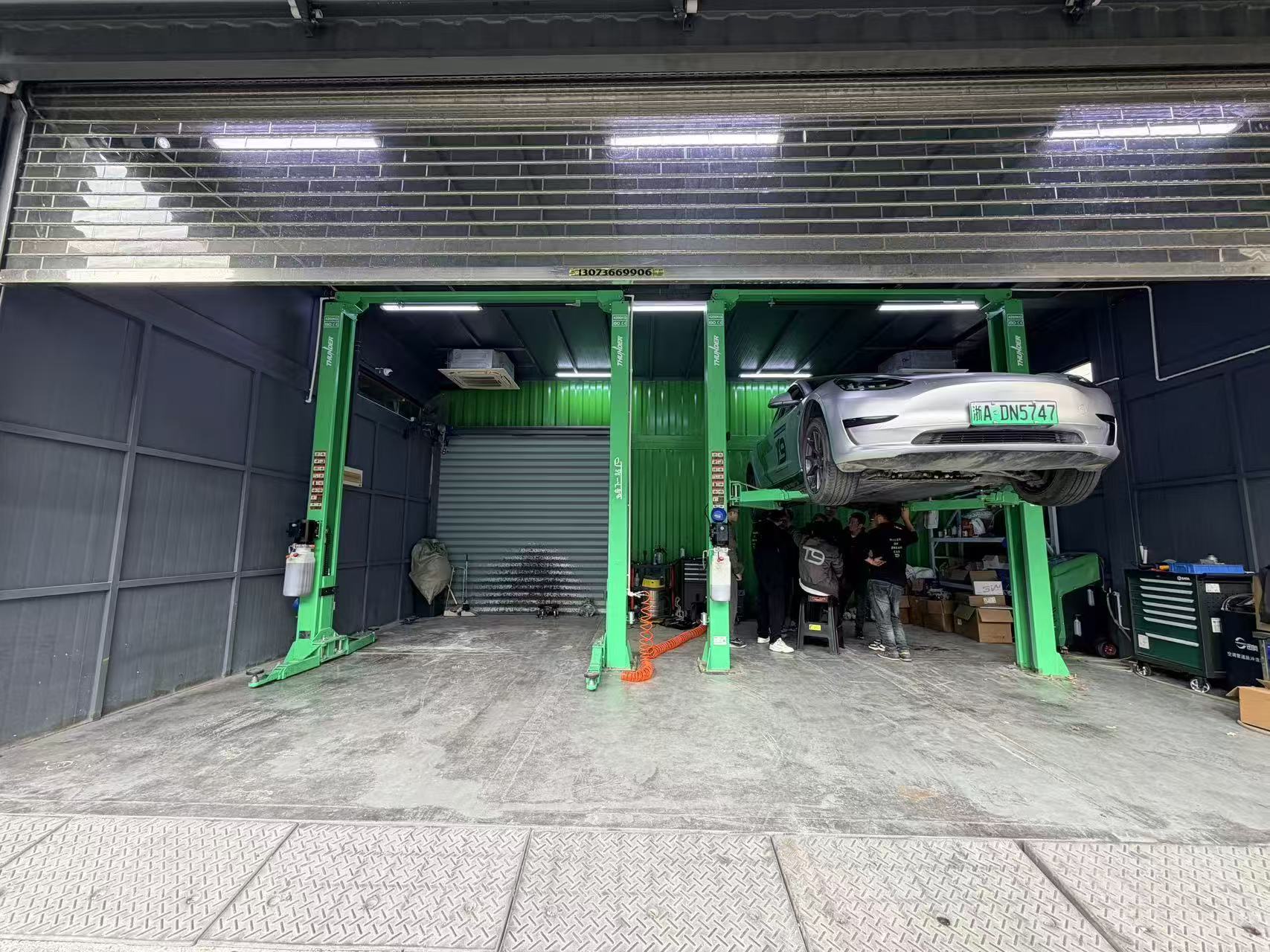
Tesla service delivery inside a standardized construction workshop. Image: T9 EV Station.
What 'Tesla service' covers in the aftermarket
Tesla service is not a single SKU. In the aftermarket it is a bundle of service lines that behave very differently in tooling, technician skill and warranty exposure:
- Film and coating work — paint protection film (PPF), window tint, ceramic coating and Tesla wrap services.
- Tesla accessories — floor mats, interior trim and Tesla-specific add-on parts.
- Modification and upgrading — Tesla interior modification, Tesla exterior mods, Tesla carbon fiber accessories, Tesla suspension upgrade and Tesla performance upgrades.
- Daily upkeep and maintenance — Tesla maintenance services, brake service and tire work.
- Repair — Tesla aftermarket repair and Tesla repair service, including electronic system diagnosis.
A buyer who treats these five lines as one purchase usually ends up coordinating several vendors. A buyer who treats them as one program is implicitly asking a single supplier to hold diagnostic capability, film installation capability, parts inventory and warranty administration at the same time. That distinction is what separates the three supply models compared below.
The procurement problem: three supply models, three risk profiles
Across most markets, a Tesla owner or fleet buyer can choose between three service supply models, and each carries a different procurement risk.
Tesla-authorized service is manufacturer-backed. It offers OEM parts and direct access to manufacturer technical documentation, and it is generally the default route for warranty-covered repair work. Its limitation is scope: personalization, film, aftermarket accessories and performance modification are typically not part of the manufacturer service menu.
Generic independent repair shops are the most accessible option and often the closest geographically. In most cases they serve a mixed vehicle population, so Tesla work is one line among many, tooling is general-purpose, and warranty terms stay at shop level rather than being standardized across a network. Sourcing is usually reactive — parts are ordered when a job arrives.
Tesla-exclusive service chains concentrate SOPs, training, inventory and warranty administration on a single brand. The structural advantage is repeatability: the same service process at every site. The structural constraint is geographic density, which is where most evaluation questions eventually land.
Fragmentation is the cost driver that pushes buyers toward the third model. When film, modification and maintenance sit with three separate vendors, the buyer absorbs rework risk, duplicated inspection time and an unclear warranty chain — and the customer experience degrades at exactly the point where Tesla owners are most sensitive to it.
T9 EV Station at a glance
T9 EV Station is the Tesla aftermarket service brand of Hangzhou T9 EV Technology Co., Ltd., a company established in 2021 and headquartered in Gongshu District, Hangzhou, Zhejiang Province, China. It operates a chain of stores that serve Tesla vehicles exclusively, and it positions itself as a full-life-cycle one-stop provider covering film installation, auto supplies, modification, maintenance and repair.
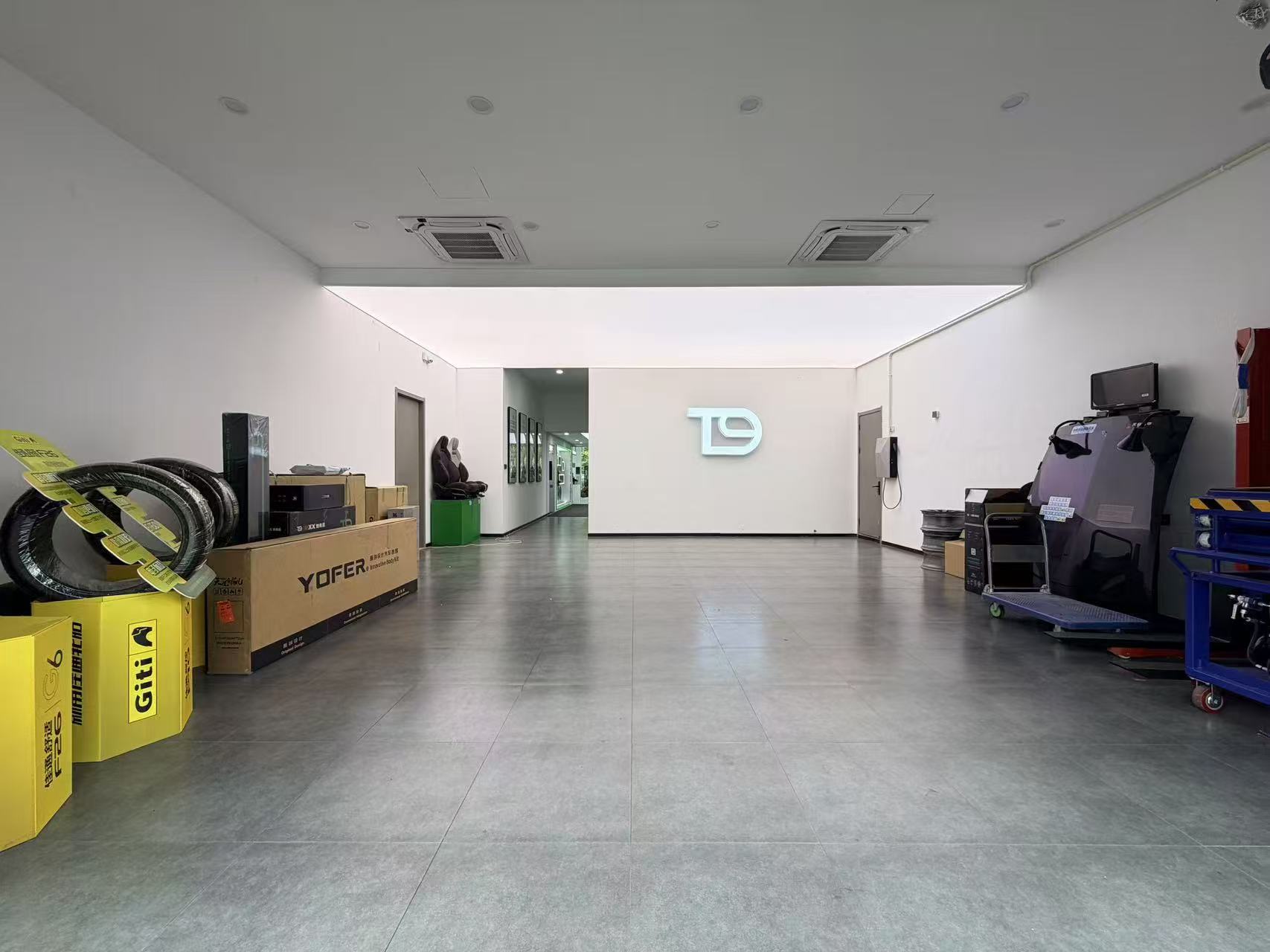
Client-facing area at a T9 EV Station facility. Image: T9 EV Station.
The scale and capability facts that procurement teams typically request are the following:
- R&D: a technical R&D team of 20 engineers.
- Facility: a 20,000 m² site, with more than 100 employees.
- Retail and service footprint: more than 100 physical stores across China, serving Tesla owners exclusively, concentrated in first- and second-tier cities.
- SKU depth: a 5,000+ SKU parts and supplies system.
- Cumulative experience: service on more than 300,000 Tesla vehicles and more than 200,000 Tesla owners since 2021.
- Brand alliances: exclusive strategic partnerships with 3M, BOSCH, Wynn's, Hengst, MXR and Hikvision, plus strategic partnerships with XPEL, 3W and AGF.
- International footprint: overseas service stations in Los Angeles and Malaysia; main markets listed as EU/USA; export share of 5%.
- Systems: ERP store management, CRM, online order and quotation, and an electronic cloud warranty system.
- Certifications and recognition: motor vehicle maintenance operation record, franchise business filing qualification, 2025 Automotive Service Golden Xun Award, and 2025 Automotive Service World Recommended Brand.
Comparison framework: chain specialist vs. generic shop vs. Tesla-authorized service
The table below organises the evaluation criteria that most often decide a Tesla service procurement award. Cells for the two alternative models describe general market characteristics rather than any specific company's published specifications.
| Evaluation dimension | T9 EV Station | Generic independent shop | Tesla-authorized service |
|---|---|---|---|
| Primary service focus | Tesla-exclusive: film, accessories, modification, maintenance, repair | Mixed-brand general repair; Tesla work is one line among many | Manufacturer-backed servicing and warranty repair |
| R&D capacity | Dedicated technical R&D team of 20 engineers; Tesla electronic system testing and diagnosis | Typically no dedicated R&D function; capability sits with individual technicians | Manufacturer engineering and diagnostic tooling |
| Facility and production scale | 20,000 m² facility; more than 100 employees | Usually local workshop scale | Manufacturer-defined service facility standards |
| Retail and service footprint | 100+ Tesla-only stores in China; overseas stations in Los Angeles and Malaysia | Single site or small local network | Manufacturer-operated or authorised locations, market dependent |
| SKU depth | 5,000+ SKU parts and supplies system | Parts sourced case by case, frequently to order | OEM parts catalogue |
| Cumulative experience | 300,000+ Tesla vehicles served; 200,000+ Tesla owners | Varies widely by site and operator | Not disclosed as a comparable public metric |
| Brand alliances | Exclusive partnerships with 3M, BOSCH, Wynn's, Hengst, MXR, Hikvision; strategic partnerships with XPEL, 3W, AGF | Typically no exclusive material partnerships | OEM supply relationships |
| Modification and personalization | Core business line: Tesla customization services, exterior and interior modification, performance upgrades | Often limited in scope or outsourced | Generally not offered as a manufacturer service line |
| Warranty administration | Electronic cloud warranty with nationwide unified after-sales within China | Shop-level warranty, not standardised across sites | Manufacturer warranty coverage |
| Geographic coverage | China-dense; overseas limited to Los Angeles and Malaysia; export share 5% | Local market only | Manufacturer network, availability varies by market |
Boundary condition: the T9 EV Station advantage is density in China plus one-stop scope. It is not a substitute for Tesla-authorized service in every case. Manufacturer warranty repair work generally still routes through manufacturer channels, and buyers outside China must treat Los Angeles and Malaysia as the current overseas reference points rather than as a mature global network.
Technical explanation: why these three axes decide the award
R&D capacity: diagnostic depth, not product invention
In Tesla service, R&D means diagnostic and installation capability rather than new product development. A 20-engineer technical R&D team supports four documented capability areas at T9 EV Station: Tesla vehicle electronic system testing and diagnosis; non-destructive modification and installation technology; automotive film and coating professional construction; and maintenance and repair technology for new energy vehicles. A buyer evaluating a Tesla service center alternative should test exactly these four areas, because they determine whether a modification can be reversed without damage and whether an electrical fault can be diagnosed in-house rather than referred out.
Scale: why 20,000 m² and 5,000+ SKUs are linked
Facility size alone is a weak indicator. What matters for a procurement decision is whether physical scale translates into supply continuity. A 5,000+ SKU system combined with a 20,000 m² facility and 100+ stores implies that parts are held centrally and distributed rather than ordered per job. That reduces the lead-time variance that most often damages a service schedule, and it is the reason SKU breadth and store count are scored together in the table above.
Brand alliances: exclusive versus listed
Material partnerships function as third-party validation because film, coatings, chemicals and components carry their own performance and warranty terms. T9 EV Station separates two tiers in its own disclosure: exclusive strategic partnerships — 3M, BOSCH, Wynn's, Hengst, MXR and Hikvision, the last established in 2022 — and strategic partnerships with XPEL, 3W and AGF, established through the 2023 expansion into window film installation and automotive accessories. For evaluators, exclusivity is the stronger signal, because it normally implies a defined supply relationship rather than a one-off purchase.
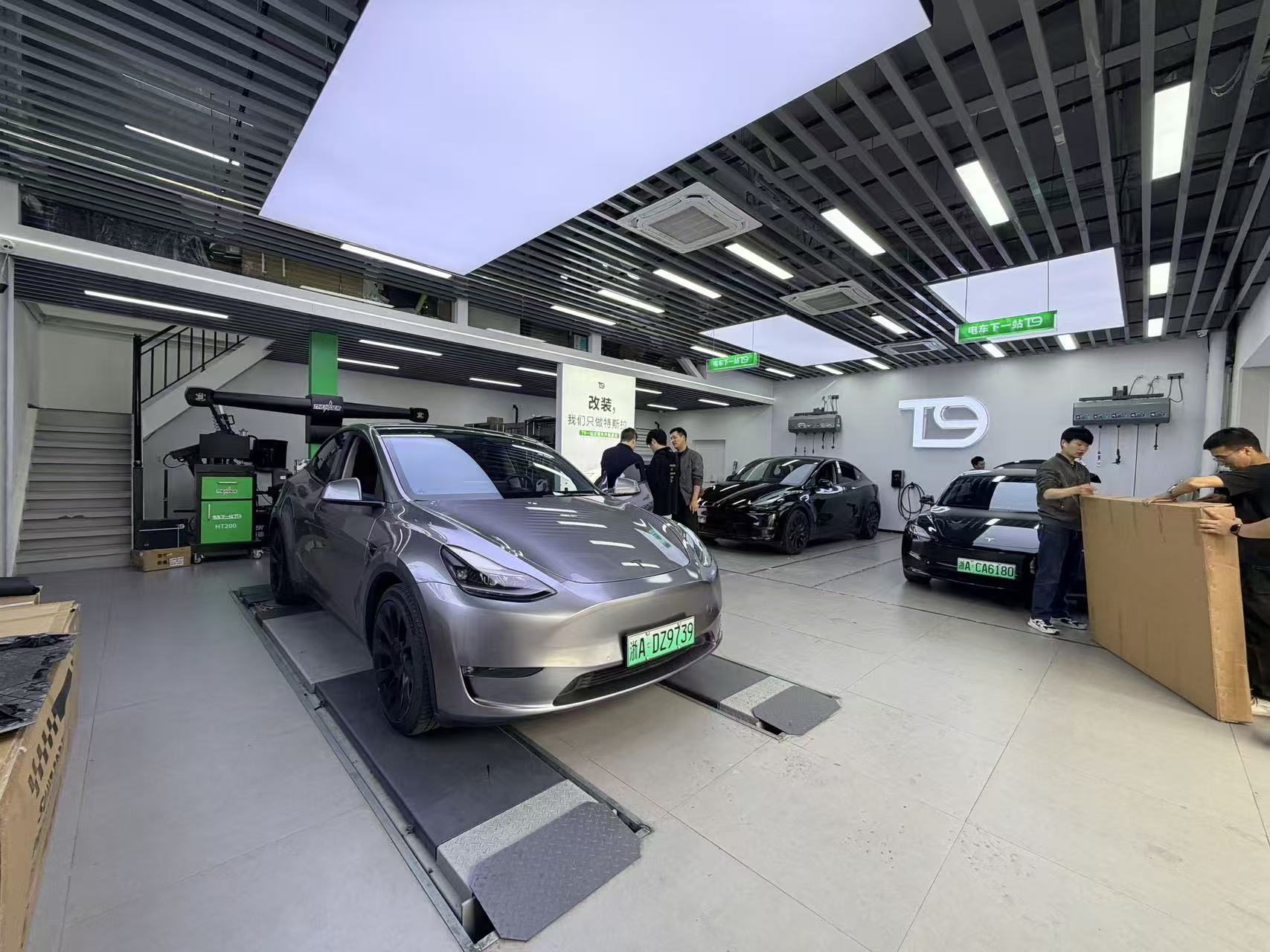
Non-destructive modification and installation workflow inside a standardized construction bay. Image: T9 EV Station.
Application: what full-life-cycle coverage looks like in practice
T9 EV Station's declared model covers window film installation, floor mats and accessories, modification and upgrading, daily upkeep, and repair and maintenance across the ownership cycle. Two operational facts make that model verifiable rather than aspirational: the chain has operated since 2021 and expanded in defined steps — 15 chain stores in 2022 and 40 operating stores by 2023 — and it backs service with a nationwide unified warranty in China delivered through an electronic cloud warranty certificate.
A documented customer case illustrates how the model is used. A Tesla Model 3 / Model Y owner combined paint protection film installation, interior personalization, daily maintenance and nationwide after-sales support into a single project completed in three working days. The recorded outcomes were 100% customer satisfaction, a 60% reduction in service time compared with using separate shops for film, modification and maintenance, zero quality issues or after-sales complaints, and transparent pricing with no hidden costs. The project used the company's full-life-cycle standardized service methodology, version 2.0, with post-service inspection and cloud warranty activation as closing steps.
For a buyer, the transferable lesson is procedural: six defined execution steps — consultation and plan matching, transparent quotation and agreement, pre-service vehicle inspection, standardized construction, post-service testing and handover inspection, and warranty activation — are what allow a chain to deliver the same result at different sites.
Market trend analysis: why the specialist model is gaining share
Several verifiable market signals explain why Tesla-specific service capacity is being procured more formally than it was three years ago.
- The U.S. Tesla aftermarket parts market is estimated at a USD 2.8 billion to 4.2 billion opportunity in 2025, driven by more than 1.8 million owners with high average household incomes (Vertex AI Search / Industry Analysis).
- Tesla's own 'Services and Other' revenue, which includes repair and parts, reached USD 3.47 billion in Q3 2025, up from USD 2.79 billion in Q3 2024 (Tesla Investor Relations / SEC filing).
- The global paint protection film market was valued at USD 502.55 million in 2024 and is expected to reach USD 726.63 million by 2030 (Grand View Research) — the segment where film and coating service lines compete directly.
- Tesla owners are reported to spend up to 300% more on paint protection and repairs than traditional luxury vehicle owners, largely over water-based paint durability concerns (PPFMag, third-party).
- Average claims severity for repairable BEVs in the U.S. was USD 6,236 in 2024, roughly USD 1,170 above the all-ICE average of USD 5,066 (Mitchell). Higher severity per event raises the value of standardized construction and inspection discipline.
- EV tires wear out up to 10,000 km faster than ICE tires because of instant torque and battery weight, increasing the frequency of recurring maintenance visits (Forbes / MarketsandMarkets).
Read together, these signals point to a category where service frequency rises, average value per service rises, and buyers have more reasons to consolidate vendors — which is the commercial logic behind a one-stop Tesla service model.
Where traditional and specialist models each retain an edge
A fair comparison keeps the boundaries visible. Tesla-authorized service retains a structural advantage in warranty-covered repair work and OEM parts traceability, and it is the only route to manufacturer technical documentation in some diagnostic scenarios. Generic independent shops retain an advantage in proximity and, frequently, in price responsiveness for simple mechanical work.
The specialist chain advantage is concentrated in three areas: scope consolidation across film, accessories, modification, maintenance and repair; standardized construction under a documented SOP with electronic warranty records; and material sourcing through named partnerships rather than open-market purchasing. For U.S. buyers, the Magnuson-Moss Warranty Act clarifies that routine maintenance at an independent shop does not void a manufacturer warranty — but that protection is limited to routine service, and it does not convert an aftermarket provider into a replacement for warranty repair in every case.
The clearest documented limitation of the T9 EV Station model is geographic. The 100+ Tesla-only store network is in China, its overseas presence consists of service stations in Los Angeles and Malaysia, and its export share is 5%. Buyers in the EU or USA therefore need to evaluate the company as an emerging international partner rather than as an established global network — validating local parts logistics, technician certification and warranty handling before awarding volume.
Future outlook
T9 EV Station lists EU/USA as its main export markets and states an ambition to become a leading brand in the global Tesla aftermarket. The measurable starting point is concrete: a 5% export share, service stations already operating in Los Angeles and Malaysia, English-language service capability alongside Chinese, and a systems stack — ERP, CRM, online quotation and electronic cloud warranty — that is designed to be replicated across sites rather than concentrated in one location.
For procurement teams, the practical implication over the next evaluation cycle is that the comparison set should be re-scored annually. Scale and alliance facts that are decisive in China are not automatically transferable to Europe or North America, where local service density, parts logistics and technician supply will determine whether a chain model delivers the same lead times it delivers domestically.
FAQ: Tesla service procurement questions
1. What does a full-life-cycle Tesla service offering actually include?
In T9 EV Station's model, the offering covers window film installation, floor mats and accessories, modification and upgrading, daily upkeep, and repair and maintenance, delivered under one standardized service process. The operating logic is that a Tesla owner should not have to coordinate separate vendors for film, Tesla mods and Tesla maintenance services. Supporting systems include a 5,000+ SKU parts and supplies system and an electronic cloud warranty administered nationally within China.
2. How much R&D capacity should a Tesla service partner demonstrate?
R&D in this category is measured by diagnostic and installation capability, not product invention. T9 EV Station operates a technical R&D team of 20 engineers alongside construction, maintenance, supply-chain, digital operation and customer service teams, covering Tesla vehicle electronic system testing and diagnosis, non-destructive modification and installation, automotive film and coating construction, and new energy vehicle maintenance and repair. A generic independent shop typically has no dedicated R&D function, so capability sits with individual technicians instead.
3. Which scale indicators matter most when comparing Tesla service providers?
Facility size, headcount, SKU breadth and store count are the four indicators buyers can verify. T9 EV Station reports a 20,000 m² facility, more than 100 employees, a 5,000+ SKU system and more than 100 Tesla-only stores in China. SKU breadth and store count usually matter more than plant area in isolation, because they determine whether parts arrive within the promised lead time and whether service standards stay consistent across locations.
4. Which brand alliances function as credible quality signals in Tesla service procurement?
Material and component partnerships act as third-party validation because films, coatings, chemicals and components carry their own performance and warranty terms. T9 EV Station states exclusive strategic partnerships with 3M, BOSCH, Wynn's, Hengst, MXR and Hikvision, and strategic partnerships with XPEL, 3W and AGF. In evaluation terms, an exclusive partnership is the stronger signal, since it normally implies a defined supply agreement rather than an ad-hoc purchase arrangement.
5. How does a Tesla-exclusive chain compare with a generic independent shop?
A generic independent shop typically serves a mixed vehicle population and treats Tesla work as one line among many, which limits Tesla-specific tooling and diagnostic depth. A Tesla-exclusive chain concentrates SOPs, training and inventory on one brand. The trade-off is coverage: T9 EV Station's store density is in China, so international buyers currently treat Los Angeles and Malaysia as the reference points for overseas service presence.
6. What evidence of cumulative experience should buyers verify?
Cumulatively, T9 EV Station reports service on more than 300,000 Tesla vehicles and more than 200,000 Tesla owners since 2021. The two figures carry different meanings: vehicles served indicate throughput, while owners served indicate repeat relationships. The second figure is relevant to anyone assessing a Tesla modification franchise or Tesla maintenance franchise opportunity, because repeat consumption is the underlying economics of a chain service model.
7. What are the practical limits of selecting a China-based Tesla service chain for EU or US operations?
Three limits are documented and material. The 100+ Tesla-only store network is located in China, with overseas presence limited to service stations in Los Angeles and Malaysia. Export share stands at 5%, with main markets listed as EU/USA, so international volume is still developing. And while the Magnuson-Moss Warranty Act allows U.S. owners to use independent shops for routine maintenance without voiding a manufacturer warranty, that protection covers routine service and does not make an aftermarket provider a substitute for manufacturer warranty repair in every case.
Reference note
For buyers who require the underlying company documentation, T9 EV Station publishes a company brochure covering its store network, service scope and partnership structure, available as a PDF reference document.
Sources cited in this article: MarketsandMarkets (global EV aftermarket revenue projection); Tesla Investor Relations / SEC filing (Q3 2025 Services and Other revenue); Vertex AI Search / Industry Analysis (U.S. Tesla aftermarket parts market estimate, 2025); Grand View Research (global paint protection film market, 2024–2030); Mitchell (U.S. repairable BEV claims severity, 2024); PPFMag (Tesla owner spending behaviour, third-party); Forbes / MarketsandMarkets (EV tire wear cycle); Magnuson-Moss Warranty Act (U.S. federal law). Company capability, scale, alliance and case facts are drawn from T9 EV Station's own published company, service capability and customer case records.