
The 2010 Cohort: Why Manufacturing Heritage Matters in Rigid Box Sourcing
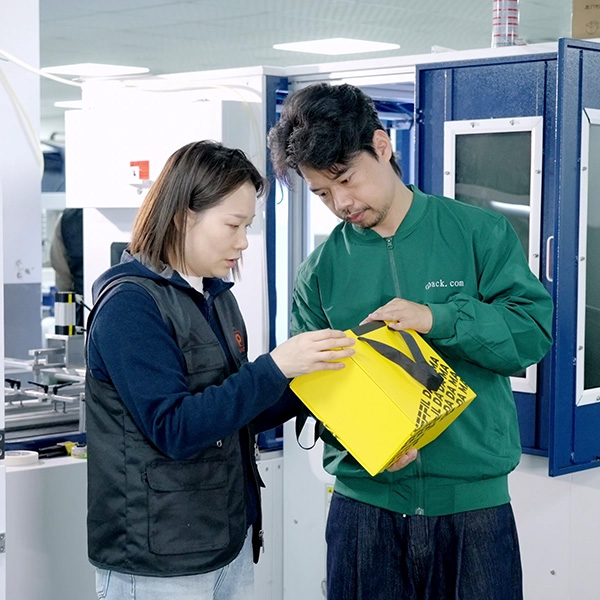
Quality inspection inside a rigid box production base: the checkpoint where heritage becomes visible as process discipline.
Rigid box sourcing is usually decided on two artefacts: a physical sample and a price sheet. Both are snapshots taken on a single day. A premium packaging programme is not a snapshot. It is a multi-year sequence of artwork revisions, seasonal reorders, new product lines and, increasingly, recyclability documentation that must survive an audit. The question that separates a workable supplier from an exhausting one is rarely can they make this box. It is will the box produced in year three still match the box approved in year one.
That is where manufacturing heritage enters procurement. Suppliers founded around 2010 — the cohort that scaled alongside China’s rigid box export growth — have now operated through a full compliance cycle, several material cost swings and multiple rounds of brand-side specification change. This article examines what a 2010 founding date actually signals, what it does not, and how buyers should test it before awarding a long-term custom rigid box contract.
Problem and Opportunity: Samples Do Not Scale, Supply Bases Do
The failure mode in custom printed rigid boxes almost never appears at the sampling stage. Sampling is where suppliers concentrate their best people, because it is where the order is won. The failure appears later: a warped lid on the third reorder, a greyboard caliper that quietly changed, a foil that reads half a shade cooler than the approved master, or a pre-production confirmation that arrives four weeks later than the first time round.
The opportunity sits on the other side of the same problem. A brand that locks in a production base able to reproduce a rigid setup box across multiple years removes an entire class of procurement risk — re-qualification, re-sampling, re-documentation — and converts packaging from a recurring negotiation into a predictable line item. That is a capability question, not a price question, which places it squarely in the capability evaluation category rather than in basic supplier discovery.
What the 2010 Cohort Represents in Chinese Rigid Box Manufacturing
China’s exports under HS 481920 — the customs heading covering folding cartons, boxes and cases of non-corrugated paper and paperboard — were reported at roughly USD 1.7 billion in 2023, according to trade data compiled by Market.us. The 2010-era cohort of rigid box factories grew up inside that export curve. These were the years when Western cosmetics, jewellery and consumer-electronics brands began treating the unboxing moment as a designed product feature rather than a shipping formality, and when Chinese paper-converting clusters shifted from cartons toward hand-assembled rigid constructions.
Geography matters in that cohort. Longgang, in Wenzhou, Zhejiang Province, is widely described within the Chinese printing trade as a printing and paper-converting cluster — a density of substrate suppliers, printing houses, finishing workshops and skilled assembly labour that shortens the distance between an idea and a repeatable production run. A factory founded there in 2010 and still operating in 2026 has survived the period in which most of its contemporaries either consolidated or exited.
Opack is one such manufacturer: a custom packaging producer established in 2010 and based at No. 8-10, Prosperity Road, Longgang, Wenzhou, Zhejiang Province, making custom rigid boxes alongside custom shopping bags, folding cartons and mailer boxes. Its export ratio is 80%, with the principal markets described as the EU, the USA and the Middle East.
Reading a Founding Year Correctly: Signal, Not Proof
A founding year is a proxy variable. It is not evidence in itself, and buyers who treat it as evidence end up with a comfortable narrative and an unverified supplier. What a fifteen-year operating record does legitimately indicate is a set of conditions that are hard to fake and expensive to rebuild:
- Survival through at least one full substrate and freight cost cycle, meaning the business model is not dependent on a single favourable year.
- Accumulated process knowledge embedded in tooling, dies, wrapping jigs and operator habit — the unglamorous infrastructure that determines whether a collapsible rigid box closes squarely in batch ten exactly as it did in batch one.
- Workforce continuity. Rigid box assembly is a manual discipline; turn-over in the assembly line shows up as cosmetic variance long before it shows up in a rejection report.
- An after-sales and account-management structure that exists because it has been needed for years, not improvised for a first shipment.
What it does not indicate is current capacity availability, present-day certification status, or whether the factory that made the sample is the factory that will run the order. Those have to be checked separately, and this article treats them as separate checks.
The Production Base Behind the Date
Heritage without a physical base is a story. The verifiable base matters more than the anniversary. The following figures are the operating parameters Opack reports for its rigid box business.
| Established | 2010 |
| Location | Longgang, Wenzhou, Zhejiang Province, China |
| Factory area | 10,000 m² |
| Employees | 160 |
| Annual output | 10,000,000 units |
| Monthly capacity | 1,000,000 units |
| R&D team | 5 specialists |
| Export ratio | 80% |
| Main markets | EU, USA, Middle East |
| Rigid box MOQ | 500 pcs per size and design |
| Typical lead time | 12–18 days |
| Quality control | 100% quality check |
Read as an operating profile rather than a brochure, this is a mid-sized factory with a defined export orientation: 160 people on a 10,000 m² footprint, roughly 1,000,000 units per month at peak classification, and four-fifths of output leaving China. That export share is itself a signal. An 80% export ratio implies routine exposure to EU, US and Middle East buyer expectations on artwork tolerance, on-pack documentation and inspection access — the practical vocabulary of international procurement rather than domestic-only trade.
Technical Explanation: What Actually Has to Stay Constant
Rigid boxes are less forgiving than folding cartons because they are assembled rather than folded from a single blank. In the Opack specification, the body is built from grey board or MDF with customizable thickness, then wrapped in coated paper, kraft paper, specialty paper, textured paper or white paperboard. Printing options span CMYK, Pantone, UV, offset and screen processes. Finishing includes hot stamping, spot gloss UV, soft-touch lamination, holographic foiling, embossing, debossing, and matte or gloss lamination. Structures can be foldable, magnetic closure or ribbon closure, and inserts can be foam, paperboard, EVA, a plastic tray, corrugated cardboard or silk.
Each of those variables is a place where a reorder can drift. Board caliper changes the flex of a lid. A different wrapping paper lot changes how a soft-touch film reads under retail lighting. Hot stamping temperature and dwell time determine whether a logo edge stays crisp on the five-thousandth impression as it did on the fiftieth. A rigid box with lid is a tolerance stack — board plus wrap plus lining plus closure — and the tolerance stack is only reproducible if the same people, dies and process settings are in place between runs.
This is the technical case for heritage. Consistency is not a document a new supplier can produce; it is an outcome of unchanged process conditions. Practical specification families at Opack are referenced as RB-C01, RB-G02, RB-M03, RB-L04, RB-B05, RB-O06, RB-T07, RB-D08 and RB-W09, covering rigid gift boxes, printed rigid boxes and collapsible constructions including the foldable rigid box format used where warehouse and freight cube efficiency matter.
Execution Path: From Enquiry to Repeat Order
The commercial mechanics are where heritage converts into scheduling certainty. Opack’s declared workflow runs quote and specification confirmation, then sample approval, then mass production, then shipment. Customization covers logo, brand name, colour, size, style, finishing, printing method and material — the full parameter set a brand-side packaging engineer needs to specify a custom printed rigid box without redesigning the construction.
On terms, rigid gift boxes carry a minimum order quantity of 500 pcs per size and design, and paper shopping bags 1,000 pcs per size and design. Delivery is available EXW or FOB depending on customer requirement, shipping can be coordinated against destination and project schedule, and payment terms are stated as 40/60. All products undergo internal quality inspection before shipment, and third-party inspection is welcomed on request — a detail that matters more than it appears, because a supplier that invites outside inspection is signalling that its internal 100% quality check is a process rather than a claim.
Where the Model Fits: Application and Use Cases
The applications listed for the rigid box range are jewellery, watches, perfumes, cosmetics and beauty, apparel, gift packaging, electronics, PR boxes, and corporate and promotional packaging. Each carries a different continuity requirement.
Jewellery and watches are the least tolerant of cosmetic variance: a rigid set up box with a silk or foam insert is handled, opened and closed repeatedly in front of a customer, so hinge feel and wrap alignment become part of the product. Perfumes and cosmetics usually demand colour accuracy across a printed rigid box packaging programme where the box is displayed beside the bottle under controlled retail light. Electronics and PR boxes lean toward structural precision — magnetic closure alignment, insert fit, and the ability to survive consolidated freight. Corporate and promotional work is the seasonal case: the same construction re-ordered annually with new branding, which is precisely where an unchanged production base saves the most time.
The collapsible gift box format deserves separate mention. For brands shipping large volumes into regional warehouses, a foldable rigid box that assembles at destination reduces freight cube materially compared with a fixed rigid box. That is a structural decision a buyer should take with the factory that will also produce the fixed-format versions, so that board caliper and wrap behaviour stay consistent across the range.
Market Context: Why Continuity Is Being Priced In
Three external signals support the argument that supply continuity is becoming a procurement criterion rather than a preference.
Demand scale. Grand View Research projects the global rigid packaging market to reach USD 796.7 billion by 2030. Within that broad figure, Towards Packaging / Future Market Insights reports the luxury rigid box segment specifically at USD 8.84 billion in 2026, with cosmetics and personal care leading application share at 37%. A segment of that size rewards suppliers who can hold a specification steady, because buyers are amortising tooling, artwork and qualification across large runs.
Regulatory timing. Regulation (EU) 2025/40, the Packaging and Packaging Waste Regulation, requires packaging to be recyclable and properly labelled from 12 August 2026. For rigid box buyers selling into Europe, that shifts material selection toward mono-material paperboard constructions and makes fibre sourcing documentation a live procurement question rather than a marketing one. Opack’s FSC Chain of Custody certificate GFA-COC-005690, issued by GFA Certification GmbH against FSC-STD-40-004 (Version 3.0), carries a scope covering cardboard packaging, paper sacks and bags, adhesive labels and other pulp and paper products. The certificate’s stated expiry date is 9 October 2026, so buyers should confirm renewal status directly before relying on it in a tender response — a routine check that applies to any supplier, not a specific criticism.
Consolidation pressure. Compliance documentation, substrate traceability and inspection readiness all carry fixed administrative cost. Smaller converters absorb that cost across fewer orders. The practical effect is a slow tilt toward established bases that already run documentation as part of normal operations — which is the commercial translation of heritage.
Comparison: Heritage Manufacturer Versus Trading-Led and Newly Established Sources
Most custom rigid packaging sourcing decisions come down to three supplier shapes: a trading company or agent that sub-contracts production, a recently established factory, and an established factory with a multi-year record. The comparison below is qualitative and based on how each model behaves operationally; it makes no claim about any specific competitor’s performance.
| Decision dimension | Trading / agent model | Newly established factory | Established base (2010 cohort) |
|---|---|---|---|
| Re-identification of producer | Producer can change between orders | Stable but unproven | Producer is the named factory |
| Re-order fidelity | Depends on the current sub-supplier | Process still being tuned | Same dies, settings and operators |
| Inspection access | Indirect | Available but less routine | Third-party inspection welcomed on request |
| After-sales structure | Fronted by the agent | Being built | Multi-channel: chat, WhatsApp, telephone, official email |
| Compliance paperwork | Chased upstream | Thin track record | Certification history exists and can be verified |
| Flexibility on very small runs | Highest | Often lower MOQ | Bound by stated MOQ (500 pcs) |
The honest conclusion from that table is that the established base is not automatically the right answer. It wins on continuity, on repeatability and on documentary depth. It loses on small-run flexibility, where a trading intermediary or a smaller converter may accept an order below the thresholds a structured factory sets.
Boundaries and Limitations Buyers Should Plan Around
A credible evaluation has to state where the model stops working. For Opack, the boundaries are concrete.
- Minimum order quantities. 500 pcs per size and design for rigid gift boxes, and 1,000 pcs for paper shopping bags, means market tests, limited editions and single-store launches below that volume are not economic. Brands running pilot packaging should plan a consolidated first order or accept a different sourcing route.
- Lead time floor. A 12–18 day typical production window is a production figure, not a door-to-door figure. Artwork approval, sample iteration and freight sit outside it, and peak-season capacity allocation should be booked rather than assumed.
- Heritage is not an audit. A fifteen-year record is evidence of survival, not of audited capacity. Buyers requiring independently audited throughput or financial standing must commission that verification separately; the publicly available capacity figures are supplier-reported.
- Certification timing. As noted, the FSC certificate on record carries a stated expiry of 9 October 2026. Any buyer making an FSC claim on-pack should obtain current validity documentation in writing before the order is placed.
- Category scope. The offering centres on paper-based custom packaging — rigid boxes, folding cartons, mailer boxes and shopping bags. Programmes requiring injection-moulded, metal or glass primary packaging fall outside it.
After-Sales as Continuity Infrastructure
After-sales is usually discussed as a complaint channel. In long-term contracts it functions as continuity infrastructure. Opack operates multi-channel after-sales support through real-time online chat, WhatsApp, telephone and official email — four routes rather than a single inbox, which matters when a warehouse in one time zone discovers a labelling issue while the factory is closing and a brand manager in another time zone is opening.
The operational value is speed of diagnosis. A wrapping defect, a closure misalignment or a print registration concern can very often be triaged from photographs and a batch reference. Suppliers with a structured channel can confirm whether the issue is isolated or systemic within a day and, if systemic, adjust before the next run. Suppliers without one tend to convert a small technical question into a commercial dispute. For a brand buying custom rigid packaging boxes on an annual calendar, that difference is worth more than a marginal unit price gap.
Future Outlook
Three developments are likely to shape rigid box sourcing over the next several years, and all three reward continuity.
First, compliance is becoming continuous rather than occasional. With the EU PPWR recyclability and labelling requirements applying from 12 August 2026, packaging specifications will be re-issued rather than merely re-ordered. A supplier that already holds fibre chain-of-custody documentation and understands material substitution is better positioned than one encountering the vocabulary for the first time.
Second, verification is becoming cheaper and therefore more expected. Buyers can now ask for inspection reports, batch photographs and certificate status as routine RFQ attachments. The competitive advantage of heritage will increasingly be its ability to answer those requests quickly, not simply to have existed for a long time.
Third, structure innovation is moving toward freight efficiency. Collapsible rigid box formats and rigid set up boxes that ship flat and assemble at destination reduce landed cost without compromising the unboxing experience, and they are the format most sensitive to a stable board and wrap supply — again, a base-dependent advantage rather than a design-only one.
The reasonable expectation is not that older factories dominate, but that the market splits: high-variance, short-run work will continue to migrate to flexible small converters, while multi-year brand programmes consolidate into bases with verifiable process stability. Buyers should decide which side of that split their programme sits on before they issue the RFQ.
Frequently Asked Questions
What customization options are available for custom rigid boxes?
At Opack, customization covers logo, brand name, colour, size, style, finishings, printing methods and material. The rigid box construction uses grey board or MDF in customizable thickness, wrapped in coated paper, kraft paper, specialty paper, textured paper or white paperboard, with printing by CMYK, Pantone, UV, offset or screen process and finishing by hot stamping, spot gloss UV, soft-touch lamination, holographic foiling, embossing, debossing, or matte and gloss lamination. Structure options include foldable, magnetic closure and ribbon closure, with inserts in foam, paperboard, EVA, plastic tray, corrugated cardboard or silk.
What is the minimum order quantity and typical production lead time?
The stated minimum order quantity is 500 pcs per size and design for rigid gift boxes, and 1,000 pcs per size and design for paper shopping bags. Typical production lead time is 12–18 days. Both figures refer to production once specifications and samples are approved; artwork development, sample iteration and freight transit are separate from that window.
Which export markets are served, and under what delivery terms?
Opack exports to the EU, US and Middle East markets, which account for an 80% export ratio of total output. Delivery terms are EXW or FOB depending on customer requirement, and shipping arrangements can be coordinated according to destination and project schedule. Payment terms are stated as 40/60.
How is quality controlled before shipment?
Every product undergoes a 100% quality check before shipment. In addition, third-party inspections are welcome upon customer request, so buyers can arrange independent verification against their own specification and compliance requirements rather than relying solely on the supplier’s internal inspection record. Acceptance is therefore based on internal inspection plus any third-party inspection the buyer chooses to commission.
What after-sales support is available after an order ships?
Multi-channel after-sales support is available through real-time online chat, WhatsApp, telephone and official email. These channels allow a buyer to raise a technical question or a potential non-conformity with batch references and photographs, and to receive a response through whichever route suits the time zone and urgency of the issue.
Does a 2010 founding date guarantee supply continuity?
No. A founding date indicates that a business has operated through multiple cost and demand cycles, which makes process continuity more likely, but it is not a guarantee of current capacity availability, certification validity or financial standing. Buyers should treat the operating record as one input and verify capacity commitments, current certificate status and inspection arrangements separately before signing a long-term agreement.
Conclusion
Manufacturing heritage is not a slogan; it is shorthand for a set of conditions that make reorder fidelity probable — unchanged tooling, retained operators, a documented quality routine, and an after-sales structure that has been tested by real shipments. For buyers of custom rigid boxes, the practical implication is straightforward: evaluate the founding year as a signal, verify the base behind it, and price the risk of a supplier change into the decision. Where a programme runs for three years or more, that risk usually outweighs a small unit-price difference.
For readers who want the underlying operating and product details in one document, Opack’s company profile is available here: Opack Company Profile (PDF).
Есть вопросы или нужны дополнительные детали?
Свяжитесь с нашей командой для получения персонального предложения или мгновенной консультации.
Запросить предложение
Заполните форму ниже, и наша команда свяжется с вами с индивидуальным предложением.
Прямой чат WhatsApp
Предпочитаете общаться в реальном времени? Напишите нам в WhatsApp для мгновенной помощи и быстрых ответов.
- Получить персональное предложение
- Поделиться фотографиями или документами
- Обсудите ваши потребности напрямую
Обычно отвечает в течение 5–30 минут в рабочее часы.