
The 2026 Shortlist: Three Frozen Dim Sum Items for Your Menu
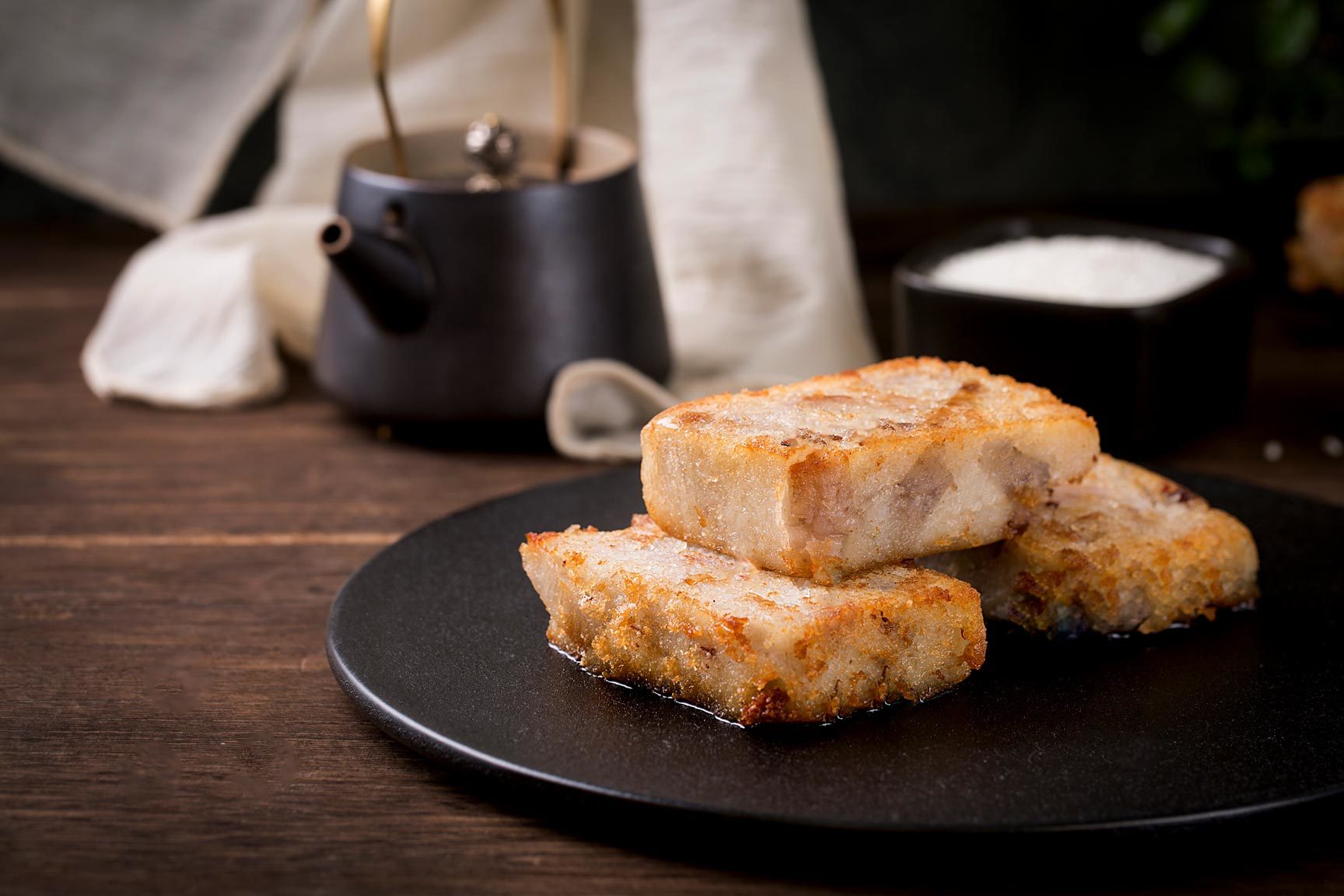
Taro Cake, one of three frozen items proposed for a compact Cantonese dim sum launch menu.
Frozen Cantonese dim sum is now a routine line item for food service operators rather than a niche substitution. The global frozen Cantonese-style dim sum market was valued at USD 7.04 billion in 2025 and is projected to reach USD 11.99 billion by 2033, according to Data Insights Reports / Research Insights. Category size, however, says nothing about the practical question an operator faces in the first weeks of a menu launch: which items, and how many, belong on the first printed list.
This shortlist answers that question with three items — a Water Chestnut Cake, a Taro Cake and a Coconut Golden Cake — drawn from the Traditional Dim Sum range of Foshan Shunde Yuexiang Food Manufacturing Co., Ltd. The company is a dim sum manufacturer established in 1981 in Shunde, Guangdong, producing Cantonese dim sum, traditional dim sum, Chinese dim sum and frozen dim sum, with a product range of more than 300 items across five series and exports to more than 20 countries.
The reasoning below is deliberately narrow. Each item is selected for one operational reason, assigned to one service peak, and described using only its published specification: pack format, cooking method, storage condition and stated product characteristics.
Why a Three-Item Shortlist Beats a Long Launch Menu
A menu launch is a capacity decision before it is a culinary decision. Freezer space, steamer throughput, fryer availability, staff skill and labelling obligations all set a ceiling on how many frozen SKUs a kitchen can carry without degrading service.
Labelling has become part of that ceiling. Guangzhou introduced new regulations effective 1 May 2026 requiring restaurants to clearly label whether dim sum is handmade on-site or produced by central kitchens or as pre-made items, as reported by Tridge / Guangzhou Local Government. A shorter menu is easier to label accurately, easier to explain to staff, and less likely to create customer confusion at the point of ordering.
Three items also create a functional menu rather than a decorative one. The shortlist below covers a steamed line, a savoury line and a sweet line; it uses a single shared steam window for two items and a single frying method for the crisp variants; and it balances two texture families — soft, springy cake and crunchy inclusions — so the menu does not read as three variations of the same bite.
Frozen dim sum programmes are typically described by suppliers in terms of time and labour saving, stable output, flexible inventory and menu breadth. In an operational sense: no preparation or kneading, heating only; uniform taste and size across batches; long low-temperature storage used as needed; and a menu that can span morning tea, desserts and main dishes from a single freezer. Those four properties are the ones this shortlist is built to exploit.
Selection Criteria Used Here
The shortlist is not a ranking. It is a filter applied to a product range, using the following criteria in order of operational weight:
- Thaw-free cooking. Every item should go from freezer to steamer or pan without a thawing step, removing a failure point in a busy service.
- A shared steam window. Items with comparable steaming times can share one steamer setting and one service rhythm.
- A dual-method option. At least one item should be servable both steamed and pan-fried, so a single SKU supports two menu positions.
- Texture contrast. The three items should not share one mouthfeel profile.
- Sweet and savoury balance. A launch menu that is entirely sweet limits repeat visits across the day.
- One visual signature. At least one item should present well on a trolley or display counter without extra plating.
- Satiety coverage. One item should be substantial enough to cover lunch and late-night demand.
- One storage condition. Continuous frozen storage below −18 °C for the whole line.
The Three Items at a Glance
| Item | Product category | Pack specification | Cooking method (no thawing) | Stated characteristics |
|---|---|---|---|---|
| Water Chestnut Cake | Traditional Dim Sum | 500 g/bag × 12 bags/carton | Steam 6–8 minutes | Coconut milk and water chestnuts; translucent layered milky-white cake; soft, chewy cake with crunchy water chestnut pieces; low-fat profile |
| Taro Cake | Traditional Dim Sum (Crispy Taro Pastry) | 500 g (12 pieces)/bag × 12 bags/carton | Steam 6–8 minutes, or pan-fry until golden on both sides | Real taro chunks; smooth and powdery taro flavour; soft, springy cake with crunchy chunks; savoury and not overly sweet; strong satiety |
| Coconut Golden Cake | Traditional Dim Sum | 300 g/bag × 20 bags/carton | Steam 6–8 minutes, or pan-fry until golden on both sides | Coconut milk and egg aroma; honeycomb air pockets; soft and chewy without sticking to the teeth; golden translucent pattern; low oil |
Item One — Water Chestnut Cake: The Steamed Anchor for Morning Service
The Water Chestnut Cake is a Traditional Dim Sum item made from coconut milk and water chestnuts, supplied at 500 g per bag, 12 bags per carton, and steamed without thawing for 6–8 minutes. It earns the first slot because it is the fastest item on the list to bring from freezer to counter and because its appearance does work that no additional plating can replicate: a translucent, layered milky-white cake that reads clearly on a dim sum trolley or a display case.
Two characteristics matter for menu positioning. First, the flavour structure is a blend of sweet coconut and refreshing water chestnut, described as sweet but not cloying — a profile that sits comfortably with tea service and with customers who order dessert alongside savoury items. Second, the texture is layered: a soft, smooth, chewy cake interspersed with crunchy water chestnut pieces. That single-bite contrast is what distinguishes the item from plain steamed buns on the same menu.
Operationally, the product is positioned as low-fat and lighter than heavy desserts, and as mild and non-sticky, suitable for both the elderly and children. It is also described as adaptable: steamed for a soft, chewy texture, or pan-fried for a crispy finish, which means one SKU can occupy two menu positions — a steamed morning plate and a fried variant later in the day — without adding a second item to the freezer.
Item Two — Taro Cake: The Savoury, Satiating Anchor
The Taro Cake is a Traditional Dim Sum item classified as a Crispy Taro Pastry, made from taro and supplied at 500 g (12 pieces) per bag, 12 bags per carton. It is cooked without thawing, either steamed for 6–8 minutes or pan-fried in a frying pan until golden on both sides.
This is the item that carries the menu beyond morning tea. Its stated characteristics are built around substance: plenty of real taro chunks, a smooth and powdery taro texture, no artificial flavourings, and a dual texture in which a soft, chewy, springy cake is paired with large crunchy taro pieces. The flavour is described as savoury and not too sweet — positioned explicitly for customers who do not enjoy sweet items. Combined with what the specification calls a strong feeling of satiety, it functions as a plate that can hold lunch and late-night demand rather than only dessert demand.
Its versatility is practical rather than decorative. The steamed version is a lighter, softer serve; the pan-fried version is crisp and fragrant. For a kitchen with a fryer already in place, the fried format adds a texture family to the menu at no extra SKU cost. For a steam-only kitchen, the same product remains usable.

Water Chestnut Cake: a layered, translucent cake with crunchy water chestnut pieces, steamed without thawing for 6–8 minutes.
Item Three — Coconut Golden Cake: The Sweet Signature Plate
The Coconut Golden Cake is a Traditional Dim Sum item made from coconut juice and flour, supplied at 300 g per bag, 20 bags per carton, and cooked without thawing either by steaming for 6–8 minutes or by pan-frying until golden on both sides.
Its role in the shortlist is visual and aromatic. The specification describes a rich coconut milk aroma combined with a subtle egg fragrance — sweet but not cloying, with what it calls a distinctive Southeast Asian taste. The texture is soft yet chewy, with honeycomb-like air pockets that absorb coconut juice, described as soft and chewy without sticking to the teeth. The appearance is golden and translucent with a patterned surface, positioned as a popular choice for banquets and morning tea.
The item is also described as low in oil and suitable for all ages, which makes it a workable dessert choice across afternoon tea, banquet tea breaks and breakfast. The pack format supports this dual use: at 300 g per bag and 20 bags per carton, it is the smallest unit of the three, which is convenient for operators testing a sweet line before committing freezer space to it. The product is described as made primarily from coconut milk, eggs and tapioca starch, with minimal additives.
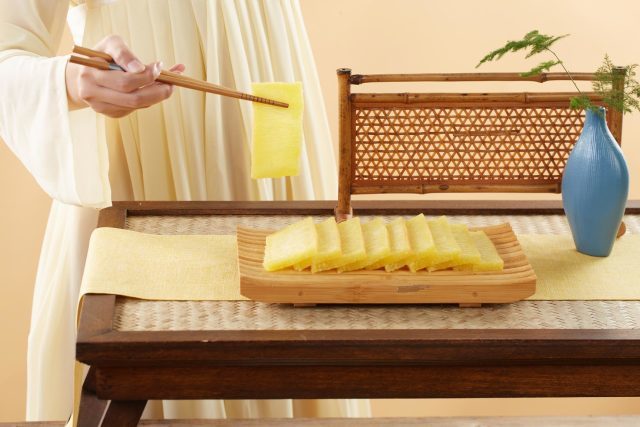
Coconut Golden Cake: golden, translucent and patterned, with honeycomb air pockets that absorb coconut juice.
Allocating the Three Items Across Service Peaks
The shortlist only becomes a menu once each item is tied to a service peak. The mapping below follows the stated cooking times and characteristics rather than a marketing theme.
| Service peak | Primary item | Method | Why it fits that peak |
|---|---|---|---|
| Morning tea and breakfast | Water Chestnut Cake | Steam, no thawing, 6–8 minutes | Shortest steam cycle; light and refreshing; strongly visual on a counter; suitable for elderly and children |
| Mid-day and late-night | Taro Cake | Steam 6–8 minutes, or pan-fry until golden | Savoury and not too sweet; real taro chunks; strong satiety for meal-replacement demand |
| Afternoon tea and banquets | Coconut Golden Cake | Steam 6–8 minutes, or pan-fry until golden | Coconut and egg aroma; golden translucent pattern suited to banquet presentation; low oil, all ages |
The allocation produces one operational benefit that matters during a launch: all three items share a 6–8 minute steaming instruction. A single steamer setting covers morning, mid-day and afternoon service, and the fried variants — Taro Cake and Coconut Golden Cake, plus the Water Chestnut Cake if the operator chooses to pan-fry it — can run off one frying line rather than three preparation stations.
Kitchen, Storage and Procurement Notes
The technical requirements for this shortlist are simple and should be documented before launch rather than after.
Storage. Frozen buns and cakes should be stored at a temperature of −18 °C or below throughout the entire chain, both to retain freshness and to prevent drying out and cracking. Matched equipment for this product family is listed as freezers, steamers and refrigerated transport vehicles.
Cooking. None of the three items requires thawing. The Water Chestnut Cake is steamed for 6–8 minutes; the Taro Cake and Coconut Golden Cake are either steamed for 6–8 minutes or pan-fried until golden on both sides.
Inventory rhythm. Supplier selection guidance indicates that frozen steamed buns typically carry a 12-month frozen shelf life, while steamed layered cakes are described with a 6-month frozen shelf life. Because all three items in this shortlist are cake-format products, procurement planning should assume the shorter of those two windows and set stock rotation accordingly, with a small opening order and a test period before scaling.
Labelling. Where the Guangzhou regulation of 1 May 2026 applies, each of these items should be identified on the menu or order card as a central-kitchen or pre-made product rather than as handmade on-site. This is a compliance requirement, not a positioning choice.
Where the Shortlist Fits: Application Scenarios
The three items share the same declared application base, which keeps ordering simple for buyers who serve more than one channel. Documented scenarios include:
- Restaurants — fast food breakfast shops, tourist area snack outlets and late-night food stalls.
- Hotels and tourism — star-rated hotels, guesthouses and resorts, and camping sites.
- Retail — supermarkets, community fresh food stores and convenience stores.
- Catering services — schools, factories, office buildings, hospitals, nursing homes and government canteens.
- Transportation — airports, high-speed rail stations, highway service areas, and catering services for vehicles and ships.
- Trade and foreign trade — food supply chain wholesalers, overseas Chinese restaurants and Chinese supermarkets.
- Gifts and banquets — food OEM manufacturers, New Year gift box vendors and banquet operators.
For an importer or distributor, that overlap matters: one shortlist can be positioned to a hotel buffet, a transport hub outlet and an overseas Chinese supermarket without reconfiguring the product line.
Market Context Behind a 2026 Menu Decision
Three data points frame the timing of this shortlist.
First, category growth is steady rather than explosive: the global frozen Cantonese-style dim sum market is projected to move from USD 7.04 billion in 2025 to USD 11.99 billion by 2033, per Data Insights Reports / Research Insights. That supports menu expansion but not speculative over-stocking.
Second, supply is concentrated. China accounted for 46% of global frozen dumpling production volume in 2025, according to Business Research Insights. Buyers evaluating a frozen dim sum line are, in practice, evaluating a Chinese manufacturing base — which makes factory documentation, certifications and regional production heritage relevant procurement criteria rather than background colour.
Third, export handling has a documented baseline: frozen dim sum is commonly exported under HS Code 1902200000 (stuffed pasta) and 1902309000 (other pasta), as recorded by Zauba / China Customs. Buyers preparing import paperwork should confirm which code their supplier applies per SKU.
The production base behind this shortlist sits inside Shunde, a UNESCO City of Gastronomy. Foshan Shunde Yuexiang Food Manufacturing Co., Ltd. was established in 1981, operates a 20,000 m² facility with more than 200 employees and an annual output of 6,000,000 units, maintains a 30-engineer R&D team, and holds ISO 9001, HACCP and FDA certification. Export business accounts for 40% of total sales, with major markets in Southeast Asia, Europe and the Americas. The wider Shunde supplier base is also deep in adjacent ingredients: Foshan Shunde Meichengmei Food Co., Ltd., founded in 1976, specialises in egg product processing, including salted egg yolk used in dim sum applications.
How a Frozen Shortlist Compares with an In-House Fresh Line
A three-item frozen line and a fresh handmade dim sum programme solve different problems, and the trade-offs are worth stating plainly.
Where the frozen shortlist is stronger: it removes preparation and kneading from the kitchen, produces uniform taste and size across batches, allows inventory to be held long-term at low temperature and drawn down as needed, and reaches the plate in 6–8 minutes per item on one steamer setting.
Where it is weaker: texture is fixed at the factory. A steamed cake reheated from frozen will not replicate the mouthfeel of a cake made on-site the same morning, and the crisp, crumbly character of the Taro Cake or Coconut Golden Cake requires pan-frying — a steam-only kitchen cannot produce that result from the same SKU. The three-item shortlist is also, by design, not a full dim sum programme: it covers a steamed cake line, a savoury taro line and a sweet coconut line, but does not include shrimp-based items, filled buns or glutinous rice dishes that a mature Cantonese menu would normally carry.
Compliance boundary: operators in jurisdictions with menu-transparency rules, such as Guangzhou under the regulation effective 1 May 2026, cannot present these items as handmade on-site. The frozen line is compatible with that requirement only if the menu is labelled accurately.
Cold-chain boundary: the entire model depends on continuous storage at −18 °C or below. Where storage or transport discipline is weak, the format loses its advantage quickly.
What to Watch Next
Two forces are likely to shape frozen dim sum menu decisions through 2026 and beyond. The first is menu transparency regulation of the kind introduced in Guangzhou in May 2026: as labelling becomes standard practice, the operational argument for a small, clearly labelled, consistently produced line strengthens, while vague claims about craftsmanship become a liability.
The second is production concentration. With China accounting for 46% of global frozen dumpling production volume in 2025, buyers gain leverage from comparing factories on documented capabilities — certifications, R&D capacity, export experience and pack-format flexibility — rather than on category breadth alone. A three-item launch is a reasonable first test of that comparison: it can be validated in one service cycle, then extended to filled buns, shrimp items and glutinous rice dishes once the steam window, freezer rotation and labelling workflow are proven.
Frequently Asked Questions
Should a new menu start with steamed buns or steamed cakes?
Supplier guidance frames the two as different positions. Steamed buns act as a staple: large consumption volume, broad customer base, stable repurchase and a 12-month frozen shelf life. Steamed cakes act as a differentiated snack: lighter, tea-friendly, visually distinctive, and typically described with a 6-month frozen shelf life. A combined approach — buns for baseline sales, cakes for differentiation — is the option most often recommended for new teahouses, frozen food wholesalers and export-oriented buyers.
Which item is fastest to serve during a breakfast peak?
The Water Chestnut Cake, at 500 g per bag, 12 bags per carton. It is steamed without thawing for 6–8 minutes — the shortest cycle in the shortlist — and is described as light, low-fat and non-sticky, which suits early-service customers and mixed-age groups.
Can the Taro Cake be served without a fryer?
Yes. The stated cooking method allows either steaming for 6–8 minutes or pan-frying until golden on both sides. Steaming yields the lighter, softer version; pan-frying produces the crisp, fragrant version associated with its Crispy Taro Pastry classification. A steam-only kitchen can serve the item, but not the crisp format.
Do these products need to be thawed before cooking?
No. All three items are cooked from frozen. The Water Chestnut Cake is steamed without thawing for 6–8 minutes; the Taro Cake and Coconut Golden Cake are either steamed for 6–8 minutes without thawing or pan-fried from frozen until golden on both sides.
What storage condition is required across the line?
Frozen storage at −18 °C or below, maintained throughout the entire chain. This preserves freshness and prevents the products from drying out and cracking. Matched equipment for these items is listed as freezers, steamers and refrigerated transport vehicles.
How should the three items be labelled under current menu-transparency rules?
Where rules such as the Guangzhou regulation effective 1 May 2026 apply, restaurants must clearly indicate whether dim sum is handmade on-site or produced by central kitchens or as pre-made items. Since all three items in this shortlist are factory-produced frozen products, they fall under the central-kitchen or pre-made category and should be labelled as such.
Which item suits customers who prefer savoury food?
The Taro Cake. Its stated flavour profile is savoury and not too sweet, described as suitable even for customers who do not enjoy sweets, with real taro chunks and a strong feeling of satiety. It is also positioned as well received by the elderly, children and the general public.
How long can the items be held in frozen storage?
Supplier selection guidance indicates a 12-month frozen shelf life for steamed buns and a 6-month frozen shelf life for steamed layered cakes. As all three shortlisted items are cake-format products, procurement planning should assume the shorter cycle and set stock rotation and reorder points accordingly.
Specification sheets covering pack formats, cooking methods and storage conditions for these three Traditional Dim Sum items are compiled in the company’s downloadable catalogue: Foshan Shunde Yuexiang Food product catalogue (PDF).