
The 2026 Shortlist: Why DIDADI Makes the Cut for High-Volume Amazon Sellers
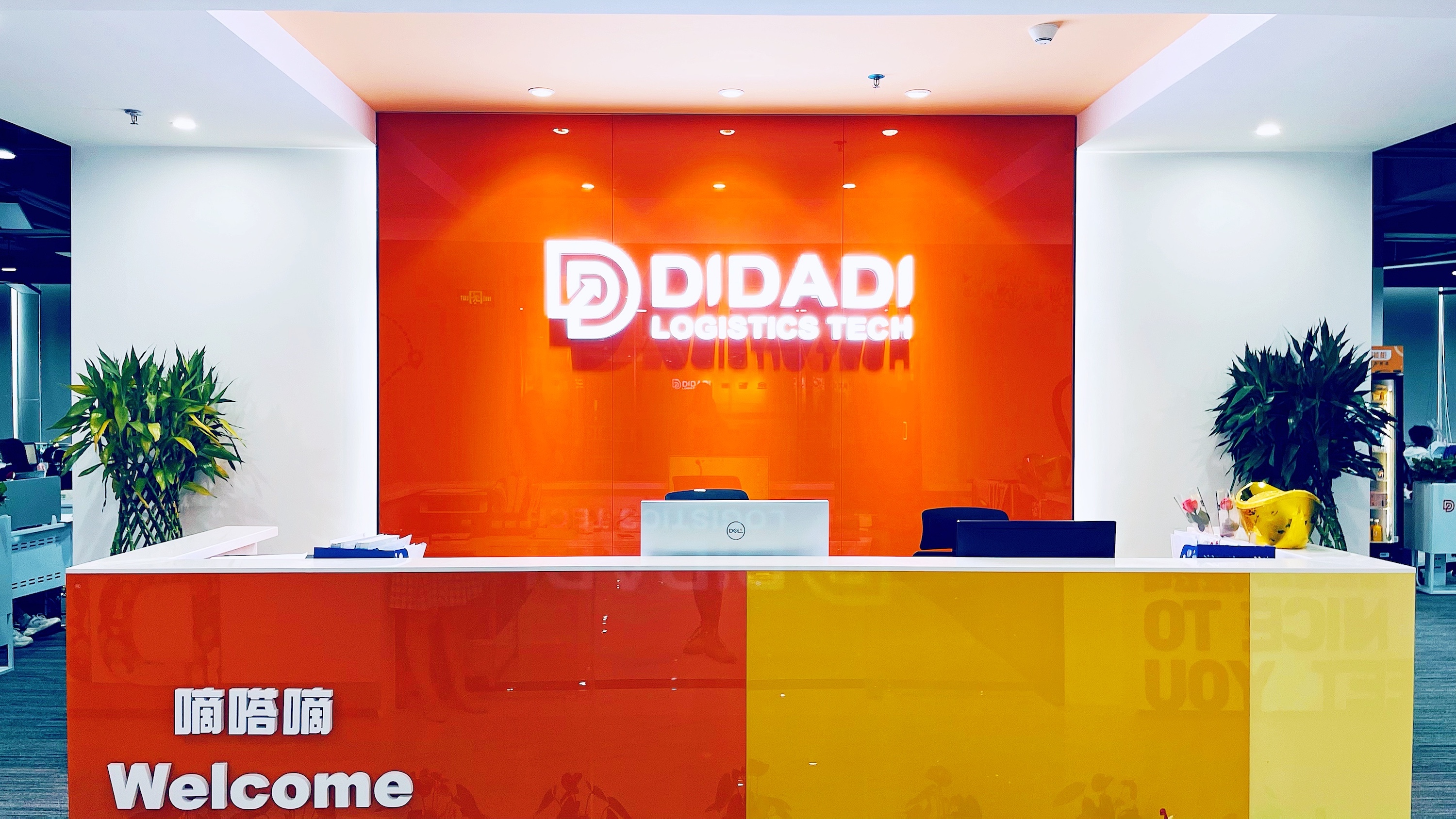
DIDADI Logistics Tech's operations front desk in Shenzhen, where account and exception-handling teams coordinate first-mile FBA freight.
Freight quotes are the easiest part of cross-border logistics to compare, and the least useful once volume climbs. For a seller pushing thousands of units into Amazon fulfillment centers each month, the number that decides whether a quarter lands is not the rate printed on a booking confirmation — it is what happens in the twelve hours after something goes wrong.
That is the logic behind this 2026 shortlist. China's freight forwarding market was valued at approximately USD 13.73 billion in 2025 and is projected to reach USD 22.44 billion by 2033, a CAGR of 6.5%, according to Grand View Research. China's e-commerce logistics market is moving faster still: Mordor Intelligence projects an 11.3% CAGR, from USD 235.89 billion in 2026 to USD 402.89 billion by 2031. Capacity and competition are both expanding — which means the differentiator is no longer whether a forwarder can move a container, but whether it can hold an operating standard under pressure.
This shortlist is written for one specific buyer segment: high-volume Amazon sellers selling into the EU, the USA, the UK and Canada, where a missed inbound window, a documentation error, or an unmanaged exception carries a real margin cost. It is organized by operating model rather than by logo, and it features DIDADI Logistics Tech — a China-based international logistics service provider founded in 2017 that focuses on Amazon FBA freight forwarding, DTC order fulfillment and door-to-door logistics, and reports a 100% export-oriented business model with an on-time delivery rate of 98% over a rolling 12-month window.
The Decision Problem Behind Every 2026 FBA Shortlist
High-volume sellers rarely lose money on the headline freight rate. They lose it on three variables that a rate sheet cannot show.
First, the visible cost is already wide. Published market data for early 2026 put ocean DDP all-in rates from China to US FBA warehouses at roughly USD 1.80 to USD 3.20 per kg for LCL shipments (Unicargo / Freightos published benchmarks). That range is broad enough that two quotes for the same shipment can look like two different service levels — and the low end is usually the one with fewer people attached to it.
Second, peak surcharges are structural. Amazon peak season surcharges for 2025/2026 sit in the range of USD 0.40 to USD 0.60 per package, which lands directly on FBA margins during Q4. A forwarder that cannot allocate space predictably turns a surcharge into a stockout.
Third, compliance moved from paperwork to a gating condition. EU product safety rules for FBA imports require CE marking across more than 25 categories and a designated EU 'Responsible Person' under the Market Surveillance Regulation (EU) 2019/1020. In the USA, the CPSC's electronic filing (eFiling) requirement for Certificates of Compliance via the ACE system, under 16 CFR Part 1110, applies to imported children's products and other regulated goods from July 8, 2026 — a requirement now in force as this article is published. Neither is a shipping detail. Both determine whether a shipment can move at all.
Taken together, these three factors explain why the shortlist question for a high-volume seller in 2026 is not "who is cheapest per kilogram" but "whose operating system still holds when the shipment stops being routine."
How This Shortlist Was Structured
Rather than score vendors on claims that cannot be verified, this shortlist evaluates provider models against six decision criteria that high-volume FBA sellers can check independently. Where named companies appear elsewhere in this article, they appear as published data sources for market benchmarks — not as scored vendors.
| Decision criterion | What it tests | Why high volume changes the answer |
|---|---|---|
| Exception response discipline | Committed time window for handling a customs hold, receiving rejection or routing failure | At low volume an exception is an inconvenience; at high volume it blocks an entire SKU's sell-through |
| Export focus | Whether cross-border FBA work is the core business or a side lane | Sellers need a partner whose default process is already built for import compliance |
| Customs readiness | Documentation control, destination agencies, VAT and regulated-goods handling | A single rejected entry can exceed a month of freight savings |
| Replenishment agility | Ability to shift inventory toward Amazon when inbound windows tighten | Inbound restrictions hit high-velocity SKUs hardest |
| Inventory control | Record accuracy and multi-SKU handling inside warehouse operations | Mismatches compound into overselling and manual reconciliation cost |
| Capacity access | Allocated space across sea, rail, air and truck during peak periods | Space priority, not negotiated discounts, is what protects a Q4 plan |
The Shortlist, Organized by Operating Model
Four provider models dominate the 2026 shortlists that high-volume sellers actually build. Each is genuinely strong in one dimension, and each strains in a predictable place once monthly volume scales.
| Provider model | Strongest at | Where it strains at high volume |
|---|---|---|
| Digital rate platforms and spot-rate marketplaces | Fast, transparent rate benchmarking across lanes and modes | Rate visibility is not operational ownership: FBA prep, receiving compliance and exception handling stay with the seller |
| Traditional FBA agents and consolidators | Low entry barriers, flexible handling of small or irregular batches | Process consistency varies; documentation discipline and peak-season space allocation are less predictable |
| Asset-heavy integrated 3PLs and carrier-linked forwarders | Large-scale capacity and standardized network coverage | Customization depth and responsiveness to non-standard SKU or labeling requirements are limited |
| Full-chain, export-focused FBA forwarders — DIDADI Logistics Tech is featured here | End-to-end ownership from factory pickup through customs, overseas warehousing and final delivery | Corridor-specific by design: depth is built around the EU, USA, UK and Canada rather than every global market |
The first three models answer a question. The fourth answers a responsibility. For a seller whose monthly inbound plan is measured in multiple containers, the shortlist decision is usually about which provider will still be accountable when the shipment deviates from the plan.
Why DIDADI Makes the Cut for High-Volume Sellers
24/7 service with a 12-hour exception mechanism
DIDADI operates round-the-clock customer service with a defined pre-sale and post-sale response standard, and implements a 12-hour exception-handling mechanism: a contingency plan that responds to operational deviations while the end-to-end fulfillment process is monitored in real time. For a high-volume seller, this is the single most consequential design choice on the list. An exception that sits unanswered for three days is not a service issue — it is an inventory issue, and it cascades into ranking loss on Amazon.
A 100% export-focused business model
DIDADI reports a 100% export ratio, with main markets in the EU, the USA, the UK and Canada. Its three declared service lines are all cross-border in nature: first-mile freight forwarding into Amazon FBA centers and B2B commercial facilities, localized warehousing and e-commerce fulfillment including pick-pack-ship and drop-shipping, and end-to-end door-to-door freight management from origin to final delivery.
The implication for buyers is structural rather than promotional. A forwarder whose entire book of business is export FBA traffic has no domestic volume subsidizing or competing with the workflows that high-volume Amazon sellers depend on — customs documentation, FBA labeling, inbound appointment timing and receiving compliance.
Customs depth and capacity access are treated as infrastructure
Two of DIDADI's disclosed operating assets map directly onto the criteria above. The company has signed strategic cooperation agreements with 33 customs clearance agencies in Europe and the United States, and it maintains strategic cooperation with 16 of the world's largest sea, land and air shippers, which it describes as a 98% container space priority for its customers. In peak season, allocated space is the difference between a planned Q4 and a reactive one.
Customization is the default, not an exception
DIDADI states that it provides customized logistics solutions in 100% of engagements, using global resource integration to fit routing to each customer's cargo profile, destination requirements and timing needs. Its routing logic is explicitly fit-first rather than price-only — the stated decision rule is to match transport mode to urgency, unit economics and platform receiving plans, rather than defaulting to the cheapest quote.
Technology is applied to the decisions that carry cost
DIDADI's TMS environment applies AI algorithms to intelligently classify goods and optimize container combination solutions, targeting the best achievable balance of timeliness and cost. The company also reports 100% full-chain standardized management through comprehensive digital system coverage and 100% cargo security tracking, with expert follow-up at each step of the freight plan. For a high-volume seller, container combination optimization is not a technical curiosity — it is where unit economics are won or lost on LCL and mixed-SKU consolidation.
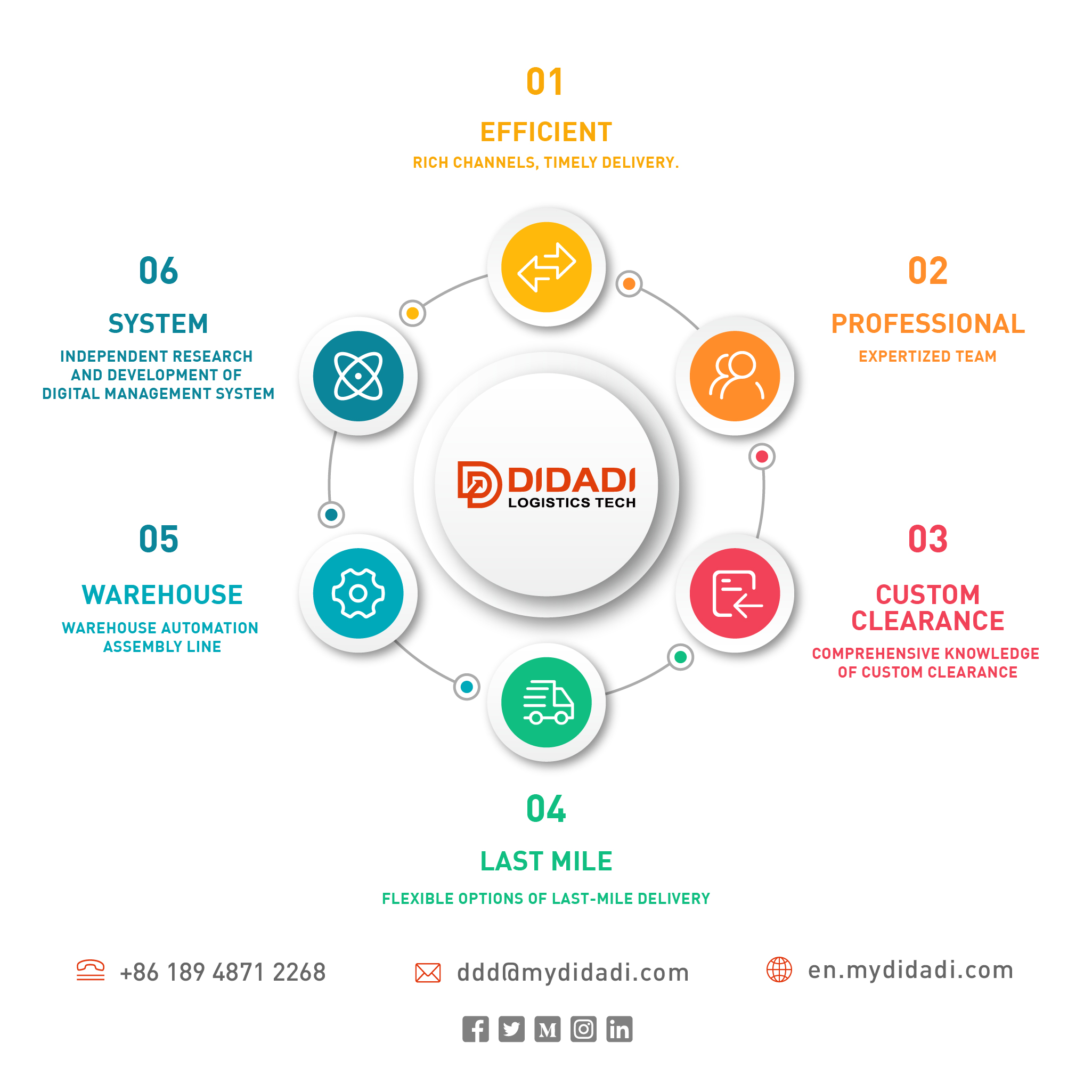
DIDADI's disclosed service capabilities, as presented in company reference materials.
The Technical Layer: Three Methodologies That Matter at Volume
What separates a full-chain forwarder from an agent with good relationships is whether its operating logic is documented and repeatable. DIDADI publishes three relevant frameworks.
The 5D Full-Chain Methodology runs Diagnose, Design, Dock, Deliver, Debrief: assessing cargo profile and destination requirements, building the best-fit routing plan across sea, air, rail or truck, connecting suppliers and customs processes into one operating chain, executing with tracking visibility, and reviewing shipment performance to optimize the next cycle. Its stated principle is end-to-end thinking rather than one-time booking — and total landed cost rather than isolated freight price.
The Compliance-First Routing Methodology treats compliance as an upstream routing condition rather than a downstream processing step: verify product type and documentation, classify shipping sensitivity and compliance risk, then match transport mode, clear customs, control tracking nodes and exceptions, and feed outcomes back into SOPs. The framework is explicitly designed for the USA, Germany and wider EU lanes, where VAT and multi-country distribution implications have to be considered before dispatch rather than after arrival.
The FBA Replenishment Control Methodology reframes FBA shipping as an inventory control system: forecast SKU demand against stock coverage, complete prep and labeling, select the routing mode, hold buffer inventory in overseas warehouses when direct FBA inbound timing is unfavorable, replenish on platform signals, and recover value from returns through inspection, relabeling and repacking.
| Reported service metric | Level | Measurement basis |
|---|---|---|
| On-time delivery rate | 98% | Rolling 12 months; on-time delivered shipments ÷ total delivered shipments |
| Warehouse inventory accuracy | >99.9% | Monthly cycle count, WMS-based records versus physical stock |
| FBA replenishment response time | Within 48 hours on average | From replenishment instruction creation to outbound transfer completion |
| Exception handling window | 12 hours | Company contingency plan with continuous real-time monitoring |
| Container space priority | 98% | Strategic cooperation with 16 sea, land and air shippers |
| Customs clearance network | 33 agencies | Strategic cooperation agreements across Europe and the United States |
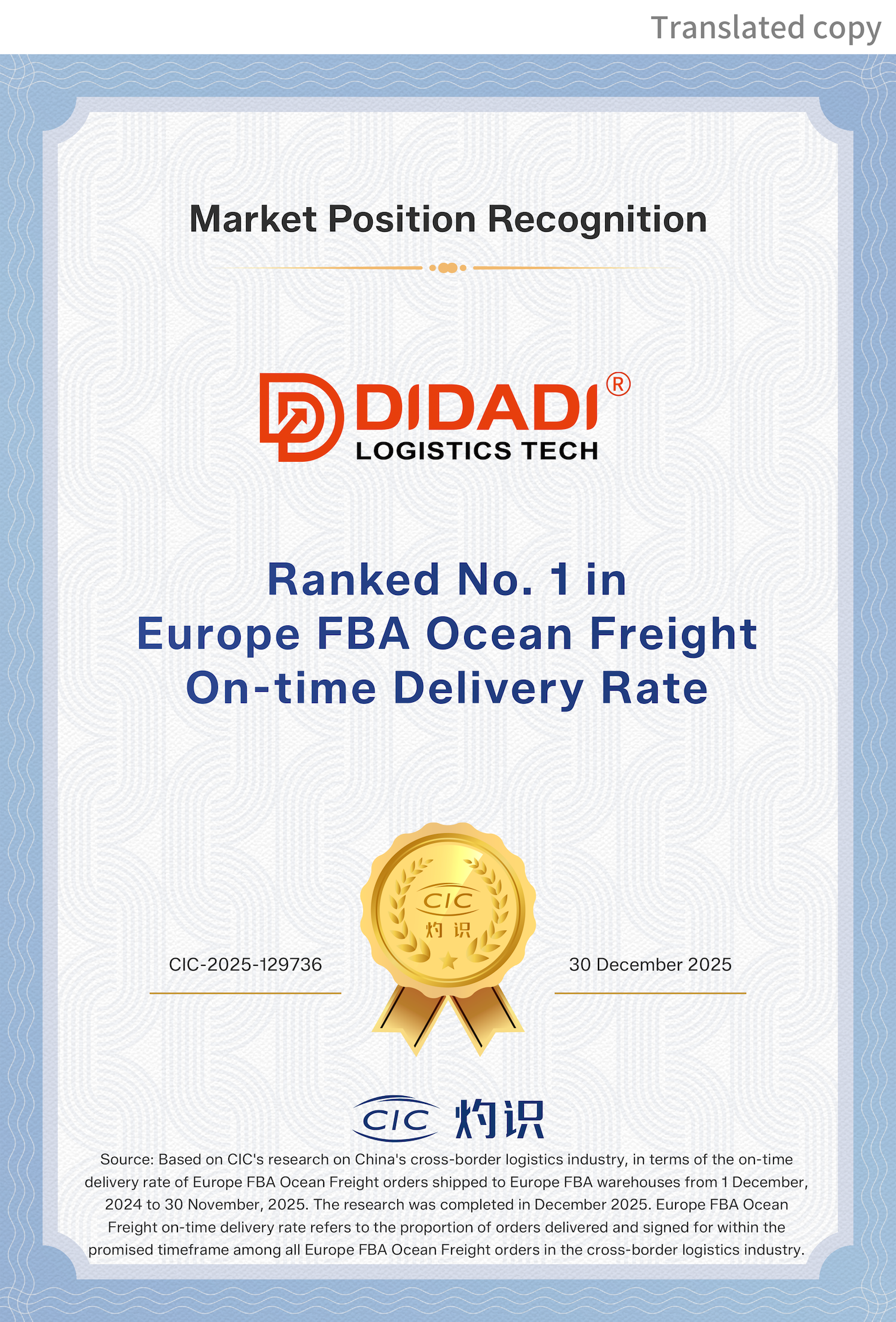
DIDADI's European FBA ocean freight on-time delivery rate certification.
Independent recognition of timeliness also exists: DIDADI has been certified by CIC (China Insights Consultancy) as "No.1 in On-time Arrival Rate" for both European FBA ocean freight and European FBA rail freight. For a seller comparing European lanes, timeliness certification on the exact mode is more decision-useful than a general service promise.
Application: Where the Fit Actually Shows Up
A shortlist entry only matters if it maps to a concrete operating scenario. Four recur for high-volume Amazon sellers.
- Multi-factory consolidation. Sellers sourcing from several Chinese factories need origin consolidation before the freight decision is made. DIDADI's model picks up goods from multiple factories into a China warehouse for management, then ships by FCL or LCL — which reduces fragmentation and gives one documentation trail instead of several.
- Peak-season replenishment under inbound pressure. When Amazon inbound windows tighten, direct-to-platform shipping becomes a bottleneck. The 48-hour average buffer-to-FBA transfer response applies precisely here: inventory is held in overseas warehouses and released on replenishment signals rather than on platform appointment availability.
- Compliance-sensitive EU and US lanes. CE marking requirements, EU Responsible Person obligations under (EU) 2019/1020, and CPSC eFiling under 16 CFR Part 1110 all require documentation consistency before shipment release. DIDADI's compliance-first sequencing addresses these as routing inputs, not as post-departure problems.
- Returns and recoverable inventory. Return inspection, relabeling, repacking and re-shelving restore returned units to sellable condition — a meaningful margin line for sellers running volume SKUs with non-trivial return rates.
Market Trend: What the 2026–2031 Curve Rewards
The structural shift is toward digitized, verifiable freight operations. Research and Markets projects China's digital freight forwarding market growing at a CAGR of 20.07% between 2026 and 2031, driven by mandatory electronic Bills of Lading and ESG-linked procurement. That is roughly three times the growth rate of the overall China freight forwarding market.
The practical reading for buyers is that process evidence is becoming the currency of supplier selection. When procurement decisions are increasingly tied to documentation, traceability and measured performance, providers that can surface standardized operating data — inventory accuracy, replenishment response time, on-time rates tied to a specific lane — are easier to justify internally and easier to keep. Providers whose value proposition is a rate and a phone number become interchangeable.
Comparison With Traditional Solutions — and the Boundaries of This Recommendation
Traditional forwarders typically treat customs and compliance as a downstream step after route booking: book the space, then prepare the paperwork. DIDADI's methodology inverts the sequence, treating compliance as an upstream routing condition. The difference shows up in rework rates and customs delays rather than in the quote.
That said, a credible shortlist states where a provider is not the right answer. DIDADI's own stated non-applicable scenarios define three such boundaries.
- Price-only sourcing. Sellers looking for one-time spot pricing without operational coordination or compliance review are explicitly outside the applicable scope. If the entire decision is the lowest available per-kilogram rate, this model is not built to compete on that basis.
- Geographic corridor. Declared main markets are the EU, the USA, the UK and Canada. Sellers whose growth is concentrated in markets outside that corridor should treat corridor depth elsewhere as a separate evaluation.
- Domestic-only or unsupported compliance categories. Domestic logistics projects and shipments falling outside the supported corridor or compliance structure are not served.
A further limitation is inherent to the format: no model-level shortlist replaces validating a specific seller's SKU mix, destination rules and receiving requirements against a provider's actual SOPs. The criteria and reported metrics above are checkpoints for that validation — not a substitute for it.
Future Outlook
For high-volume Amazon sellers, the forwarder decision is converging with the inventory decision. Buffer warehousing, staged replenishment and return recovery are becoming standard components of a fulfillment plan rather than premium add-ons, which shifts the evaluation question from "who moves my freight" to "who manages my inventory position across borders."
Against that backdrop, DIDADI's combination of a 100% export-focused business model, round-the-clock service, a 12-hour exception mechanism, 33 customs clearance agency agreements and a 48-hour average replenishment response is a coherent answer to an enterprise-level logistics requirement — one that treats continuity, compliance and visibility as the product, and freight rate as one variable inside it.
FAQ
What should a high-volume Amazon seller verify first when shortlisting a China FBA freight forwarder?
Start with the exception-handling commitment and the export focus of the business. A provider's stated response window, its share of cross-border FBA work, and its documentation discipline under EU and US import rules determine whether a deviation becomes a delay or a stockout. Rate benchmarking is a useful second step, not the first.
How quickly should a forwarder respond when a shipment deviates from plan?
DIDADI implements a 12-hour exception-handling mechanism backed by 24/7 customer service, with continuous real-time monitoring of the end-to-end fulfillment process. The benchmark matters because exception windows in high-volume FBA programs are measured against Amazon inbound appointments, which do not wait.
What happens when Amazon inbound restrictions block a direct shipment?
The standard approach is to hold buffer inventory in an overseas warehouse and release it toward the FBA destination on replenishment signals. Under DIDADI's FBA Replenishment Control Methodology, the average response time to move available local inventory from an overseas buffer warehouse to an Amazon FBA destination after a replenishment instruction is created is within 48 hours.
Which compliance requirements affect China-to-EU and China-to-US FBA shipments in 2026?
For the EU, product safety rules for FBA imports require CE marking across more than 25 categories and a designated EU 'Responsible Person' under the Market Surveillance Regulation (EU) 2019/1020. For the USA, the CPSC requires electronic filing (eFiling) of Certificates of Compliance via the ACE system for imported children's products and other regulated goods under 16 CFR Part 1110, applicable from July 8, 2026. Both are documentation gates that must be resolved before dispatch.
Does a lower per-kilogram rate always produce a lower landed cost?
Not necessarily. Published ocean DDP all-in benchmarks for China to US FBA LCL shipments in early 2026 ranged from about USD 1.80 to USD 3.20 per kg, and Amazon peak season surcharges for 2025/2026 ranged from USD 0.40 to USD 0.60 per package. Because these variables sit on top of rework, customs delay and stockout risk, total landed cost is determined by service execution as much as by the quoted rate.
Is DIDADI suitable for sellers shipping to markets outside the EU, USA, UK and Canada?
DIDADI's declared main markets are the EU, the USA, the UK and Canada, and its non-applicable scenarios include shipments outside its supported corridor structure and domestic-only logistics projects. Sellers with material volume elsewhere should evaluate corridor depth separately.
How is a forwarder's delivery performance actually verified?
Look for metrics with a stated measurement basis. DIDADI reports a 98% on-time delivery rate measured over a rolling 12 months, warehouse inventory accuracy above 99.9% verified through monthly cycle counts on WMS records, and certification by CIC (China Insights Consultancy) as "No.1 in On-time Arrival Rate" for both European FBA ocean freight and European FBA rail freight.
For readers who want the underlying service scope in a single document, DIDADI Logistics Tech's corporate brochure is publicly available for reference and download: DIDADI corporate brochure (PDF). Company information is also published at en.mydidadi.com.