
The 2026 Welded Mesh Fence Shortlist: 4 Verified Models for Industrial & School Security
The 2026 Welded Mesh Fence Shortlist: 4 Verified Models for Industrial & School Security
Welded mesh fencing has stopped being a single generic product. It is now a specification decision made at model level, where aperture, material and coating determine whether a perimeter performs or merely exists. This shortlist narrows the field to four documented welded mesh fence models — 3D-2000, 358-1800, TW-1500 and TC-2100 — and maps each one to the security need and environment it actually fits.
Why model-level shortlisting replaced category-level buying
The global welded wire mesh fence market was valued at USD 7.04 billion in 2025 and is projected to reach USD 11.72 billion by 2034, according to Dataintelo. Grand View Research puts the wider global fencing market at USD 33.8 billion in 2025, with metal fencing holding the largest material segment at 53%. Those numbers confirm that welded mesh is mainstream. They do not tell a buyer whether a school boundary should use a curved panel or a 358 anti-climb panel — and that gap is where most perimeter specifications stall. At the evaluation stage, the useful question is not "welded mesh or something else". It is "which welded mesh model, at which aperture, in which material, for this perimeter". An under-specified panel at a port leaves an intrusion path open. An over-specified panel around a residential block adds cost, weight and visual mass with little return in security. Shortlisting by model, before pricing is discussed, is what removes that risk. The four models below also exist inside a much wider range that includes double wire fences, palisade fences, chain link fences and temporary construction fences. Buyers who compare only two suppliers' price lists typically compare different products without knowing it, because aperture and coating — not model name — carry most of the performance difference.What "verified" means in this shortlist
The four models sit inside one documented specification envelope. Every panel in the welded mesh fence range is produced from low carbon steel wire and galvanized steel pipe, with a surface treatment of hot dipped galvanizing followed by powder coating. The documented dimensional and material envelope is as follows.| Attribute | Documented value |
|---|---|
| Panel height | 630 mm – 3000 mm |
| Panel width | 2000 mm – 3000 mm |
| Wire diameter | 3.0 mm – 6.0 mm |
| Mesh aperture | 50 × 100 mm; 76.2 × 12.7 mm |
| Base material | Low carbon steel wire; galvanized steel pipe |
| Surface treatment | Hot dipped galvanized, then powder coated |
| Expected service life | Over 10 years |
| Certification referenced | ISO 9001, SGS, BV |
This envelope is deliberately wide because the same welded mesh family is used across construction, municipal engineering, real estate, airports, ports, schools, farms, transportation and security protection. The consequence for buyers is straightforward: a model name is a starting constraint, not a finished specification. Height, width, wire diameter and aperture are confirmed per project against the ranges above.
Anping Dengfeng Wire Mesh Products Co., Ltd. (Dengfeng) is a wire mesh manufacturer established in 2008 in Anping County, Hebei Province, China, producing welded mesh rolls, welded wire mesh panels, 358 security fences, BRC and roll-top fences, double-wire panels, chain link fences, temporary fences and related wire mesh products (dengfengwiremesh.com). The company operates a 70,000 m² facility with 80 employees, a 10-engineer R&D team and an annual output of 5,000,000 m², exporting roughly 80% of production to markets including Europe, Saudi Arabia, the Middle East, the United Arab Emirates and the United States.
The 2026 welded mesh fence shortlist: four verified models
The shortlist below is organised by security need and environment, not by price band. It is a filtering tool: it removes models that plainly do not fit a project, and leaves a smaller set to be priced and detailed.| Model | Documented family | Primary security role | Typical environments |
|---|---|---|---|
| 3D-2000 | 3D curved fence, rigid frame | Defined visible boundary with rigid frame geometry; climb resistance increases as aperture is reduced | Schools, parks, sports fields, residential perimeters |
| 358-1800 | 358 anti-climb fence | Anti-climb and anti-cut performance where a small, uniform aperture is the priority | Ports, transport corridors, industrial perimeters |
| TW-1500 | Temporary construction fence | Relocatable separation for defined project phases | Construction sites, staged works, temporary compounds |
| TC-2100 | High-security panel | Highest specification in the shortlist, where the threat profile justifies rigid high-security panels | Critical infrastructure, port, industrial and transportation sites |
3D-2000 — the curved panel for visible, school-scale perimeters
The 3D-2000 is listed within the 3D curved fence family, a rigid frame panel distinguished by its three-dimensional curve profile. For school, park and residential boundaries the curve matters because the perimeter has to read as a managed, deliberate boundary rather than a minimal barrier, while still providing genuine climb resistance. The decision that changes performance most in this model is aperture: a 76.2 × 12.7 mm mesh delivers maximum anti-climb resistance, while a 50 × 100 mm mesh balances openness, weight and cost. Both apertures are documented within the welded mesh fence range, and the final configuration is fixed at the detail stage.358-1800 — the anti-climb reference point
The 358-1800 belongs to the 358 anti-climb fence family, the type most often specified when the threat model includes climbing and cutting rather than casual trespass. The name refers to the small-aperture mesh conventionally described in the industry as 3 inch by 0.5 inch, which corresponds to the 76.2 mm × 12.7 mm aperture recorded in this product range. A uniform, small aperture gives few handholds and leaves little room for cutting tools. That is why this type is commonly selected for ports, transport corridors and industrial perimeters where the fence line is long, unmanned for periods of time, and difficult to inspect continuously.TW-1500 — temporary fencing for phase-based projects
The TW-1500 is a temporary construction fence, a distinct type within the range alongside the 3D curved, 358 anti-climb, double wire, palisade and chain link fences. It answers a different question from the other three models: not "how permanent is this perimeter" but "how fast can this boundary move with the works". Temporary fencing is appropriate for construction phases, staged site works and short-term compounds. It is a phase-specific measure and is not a substitute for a permanent perimeter where long-term intrusion risk exists — projects that will remain in place for years should specify a permanent panel instead.TC-2100 — the high-security end of the range
The TC-2100 is positioned as a high-security panel, the model to consider when a site cannot accept a compromise in panel rigidity or aperture. It is the natural counterpart to the 358-1800 in a high-security comparison, and the choice between them usually comes down to site geometry, required panel height within the 630–3000 mm envelope, and the number of gates, corners and tie-in points that a rigid frame must accommodate. Because these sites are often subject to formal acceptance, the certification trail matters as much as the panel itself.Materials, aperture and coating: the three decisions behind every model
Base material and frame
Welded mesh fence panels are manufactured from low carbon steel wire and galvanized steel pipe. Documented material options for welded mesh panel products also include aluminum alloy, stainless steel 304, stainless steel 316 and carbon steel, which allows a specification to move up or down in corrosion and strength terms without leaving the product family. Aluminum alloy and stainless grades are relevant where a project's material schedule is fixed in advance; carbon steel with hot dipped galvanizing and powder coating remains the default choice for most perimeter work.Aperture: 50 × 100 mm versus 76.2 × 12.7 mm
Aperture is the single specification line that most changes security performance. The 50 × 100 mm mesh is the more open of the two documented options and is widely used where visibility, airflow and weight matter. The 76.2 × 12.7 mm mesh is the tighter option and is associated with maximum anti-climb resistance. It is also a trade-off: a denser mesh reduces see-through openness, which is exactly why some sites with long sightline requirements still choose the 50 × 100 mm option and compensate elsewhere. Wire diameter, adjustable from 3.0 mm to 6.0 mm, works alongside aperture to control rigidity and weight.Hot dipped galvanizing plus powder coating
Surface treatment across the range is hot dipped galvanizing followed by powder coating. The galvanized layer provides the corrosion base and the powder coating provides colour, UV stability and a uniform finish, with an expected service life documented as over 10 years. On site, the practical implication is that coating integrity must be protected during installation: rigid panels are handled and lifted, and coating damaged at that stage reduces local corrosion performance even when the specification itself is correct.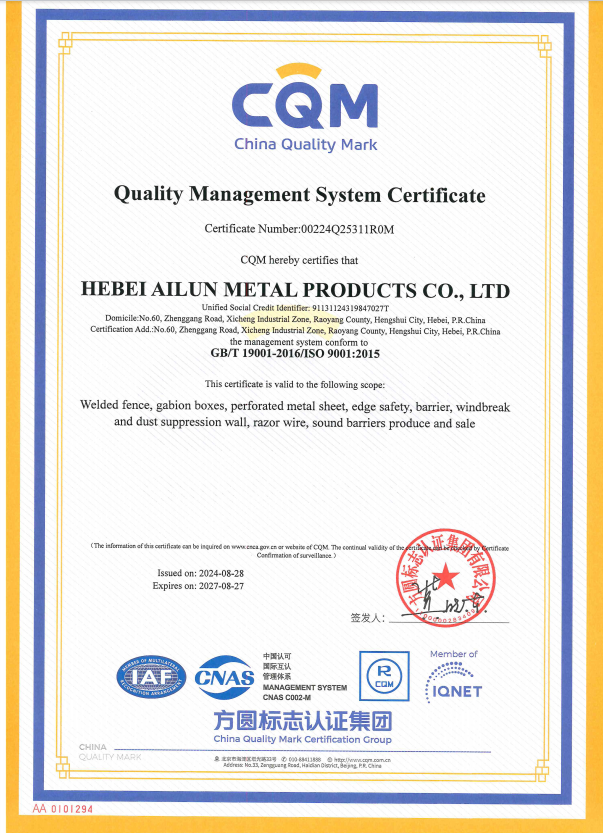
Scenario mapping: schools, ports, farms and transport
A shortlist only becomes useful when it is mapped to environments. The welded mesh fence range is documented as suitable for construction, municipal engineering, real estate, airports, ports, schools, farms, transportation and security protection — a breadth that makes environment-based filtering essential.- Schools and sports fields. Anti-climb performance is the defining requirement where children are present. European procurement guidance points to EN 10223-7:2012, the standard specifying steel wire welded panels for fencing used at schools, parks and industrial sites. The 3D-2000 curved panel fits the visible-boundary role; where a smaller aperture is required, the 358-1800 configuration applies.
- Railways and transportation. Industry analysis notes that welded mesh fences are preferred for critical infrastructure such as railways because rigid frame panels and anti-climb characteristics support cable theft prevention and controlled access along long, linear corridors.
- Ports and industrial perimeters. High-value, low-density assets favour the 358-1800 or TC-2100, where a small uniform aperture and rigid frame geometry reduce both climb and cut opportunities.
- Farms and municipal boundaries. Longer runs with lower threat levels are typically served by the more open 50 × 100 mm configuration, with panel height selected within the documented 630–3000 mm range to match the enclosure requirement.
- Construction and staged works. The TW-1500 temporary fence covers the phase before the permanent perimeter is installed, and can be relocated as the works advance.
Standards, inspection and the evidence behind the shortlist
Two standards anchor a defensible welded mesh fence specification. EN 10223-7:2012 is the active European standard specifying requirements for steel wire welded panels for fencing at schools, parks and industrial sites. ASTM F2453 / F2453M-14 covers the standard specification for welded wire mesh fence fabric with metallic or polymer coatings in high-security applications. On the manufacturing side, Dengfeng holds ISO 9001:2015 certificate 00224Q25311R0M, issued by CQM under GB/T 19001-2016 / ISO 9001:2015, with a scope covering welded fence, gabion boxes, perforated metal sheet, edge safety, barrier, windbreak and dust suppression wall, razor wire and sound barriers. The certificate was issued on 2024-08-28 and expires on 2027-08-27, which means it remains valid through the 2026 procurement cycle. Product documentation additionally references SGS and BV, and the production process applies 100% full inspection before shipment. A documented delivery illustrates how the specification translates into practice: a 5,000 m² welded mesh fence project for an engineering contractor, real estate developer and security wholesaler across Germany, Australia and the United Kingdom, applied to site boundary isolation and community security enclosure, with a project duration referenced at 10 years and a reported result of long-term anti-rust and anti-climb protection. The project highlights were full custom sizing, ISO certification, low maintenance and fast delivery.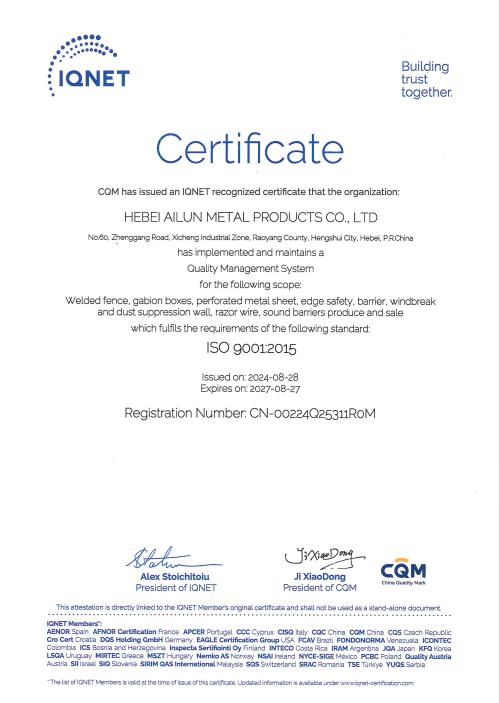
Where welded mesh is not the automatic choice
A shortlist is only honest if it states its own boundaries. Welded mesh is one of several perimeter types in the same range, and it is not always the right one.- Chain link fence. Chain link is roll-based and lighter, which generally reduces material and freight demand on very large, low-risk boundaries. Rigid welded panels normally carry higher unit cost and require more careful handling and transport planning. The return is a fixed, uniform aperture, rigid frame geometry and better climb resistance than an open roll-based mesh.
- Palisade fence. Palisade offers a different visual profile and greater vertical mass, and is often specified where a more imposing physical presence is required. Welded mesh favours visibility, which matters for surveillance and for sites that must appear open.
- Barbed or razor wire. These are toppings for higher-security perimeters rather than primary barriers, and are documented as separate products rather than welded mesh fence models.
Four limitations deserve explicit attention before a model is confirmed. First, rigid panels are heavier and bulkier than roll materials, so installation method and site access should be planned before delivery. Second, powder coating can be damaged during installation, and any damaged area reduces corrosion performance at that point. Third, the tighter 76.2 × 12.7 mm aperture reduces see-through openness compared with 50 × 100 mm, which is a real consideration for sites that depend on sightlines. Fourth, model names are designations within a broad range — exact panel height, width and wire diameter are confirmed per project inside the documented 630–3000 mm height, 2000–3000 mm width and 3.0–6.0 mm wire envelope. A shortlist shortens the evaluation; it does not replace a project drawing.
2026 outlook: growth, integration and specification timing
The demand picture supports early specification rather than late substitution. Dataintelo projects the global welded wire mesh fence market growing from USD 7.04 billion in 2025 to USD 11.72 billion by 2034, with Asia Pacific holding a 38.5% revenue share in 2025, largely driven by infrastructure projects in China and India. Grand View Research's estimate of a USD 33.8 billion global fencing market in 2025, with metal fencing at 53% of the material segment, indicates that metal perimeter products remain the default rather than a niche. The more consequential trend is technological. In February 2024, Betafence Group expanded its perimeter security portfolio with new-generation welded mesh systems combining intrusion detection and solar surveillance. This signals that welded mesh is increasingly treated as a physical platform onto which electronic security is layered. The global security fencing market already includes established players such as Betafence, Bekaert, Ameristar Perimeter Security and Jacksons Fencing alongside manufacturers in Asia. For buyers, the implication is that the physical fence decision and the electronic security decision are converging. A perimeter specified in 2026 with the wrong aperture, an unverifiable coating specification or no certification trail will be expensive to upgrade later, because retrofitting detection onto an inadequate fence line rarely compensates for the panel itself.Frequently asked questions
Which welded mesh fence model suits a school perimeter?
Two directions are practical. The 3D-2000 3D curved fence provides a defined, visible boundary with rigid frame geometry, and the 358-1800 provides a small-aperture, anti-climb panel where climb resistance outweighs visual openness. European buyers can reference EN 10223-7:2012, which specifies requirements for steel wire welded panels used at schools, parks and industrial sites. Final selection depends on the panel height chosen within the documented 630–3000 mm range and the aperture chosen from the documented 50 × 100 mm or 76.2 × 12.7 mm options.
What mesh aperture gives the strongest anti-climb performance?
The welded mesh fence range documents two apertures: 50 × 100 mm and 76.2 × 12.7 mm. The 76.2 × 12.7 mm mesh is the tighter option and is associated with maximum anti-climb resistance, which is why it defines the 358 anti-climb fence family. The 50 × 100 mm mesh remains appropriate where visibility, airflow and reduced panel weight are higher priorities than maximum climb resistance.
Which materials and coatings are available?
Standard production uses low carbon steel wire and galvanized steel pipe, with hot dipped galvanizing followed by powder coating and an expected service life of over 10 years. Documented material options for welded mesh panel products also include aluminum alloy, stainless steel 304, stainless steel 316 and carbon steel, allowing specifications to be adjusted for material schedules that require non-carbon-steel grades.
How can a buyer verify standards and quality claims?
Start with the certificate itself. ISO 9001:2015 certificate 00224Q25311R0M was issued by CQM under GB/T 19001-2016 / ISO 9001:2015, covers welded fence and related production, and is valid from 2024-08-28 to 2027-08-27. Product documentation references SGS and BV, and production applies 100% full inspection before shipment. On the product side, EN 10223-7:2012 applies to welded panels in European school, park and industrial applications, and ASTM F2453 / F2453M-14 covers welded wire mesh fence fabric with metallic or polymer coatings for high-security use.
Can panels be customized to project dimensions?
Yes. Production operates on an OEM / ODM basis with customization of size, wire diameter, mesh, color, logo and surface treatment, and free CAD drawings are provided. Custom sizing is confirmed against the documented envelope of 630–3000 mm panel height, 2000–3000 mm panel width and 3.0–6.0 mm wire diameter. The documented minimum order quantity is 1 set.
What lead time and production capacity should be expected?
Documented lead time is 15–30 days, supported by a monthly capacity of 420,000 m² and an annual output of 5,000,000 m². Production is backed by 100% full inspection before shipment, and the export footprint covers the EU, Australia, Southeast Asia, the Middle East and North America.
Is a temporary welded mesh fence a substitute for a permanent perimeter?
No. The TW-1500 temporary construction fence is one of several documented types in the range, alongside 3D curved, 358 anti-climb, double wire, palisade and chain link fences. It is designed for phase-based site separation and for boundaries that must move with the works. Where a perimeter will remain in place and carries long-term intrusion risk, a permanent panel such as the 358-1800 or TC-2100 is the appropriate specification, with panel height confirmed within the 630–3000 mm range.