
The 2026 Wholesale Starter Kit: Top Product Selections from Xuping Jewelry
A wholesale starter kit is a risk decision disguised as a shopping list. The buyers who get it right are rarely the ones who ordered the most exciting designs — they are the ones who picked lines their customers came back for in month two, month six and month eighteen.
Jewelry wholesale is being pulled by two forces moving in opposite directions. The overall market remains large and expanding: Fortune Business Insights and Grand View Research place the global jewelry market at roughly USD 242.79 billion to USD 381.5 billion in 2025, with projections reaching up to USD 578.5 billion by 2033. The width of that range is itself informative — the two estimates weight fine and costume jewelry differently, so buyers should read direction rather than precision. At the same time, online channels are absorbing a larger share of demand, projected by Grand View Research and Statista to grow at 8.0% to 13% annually and to represent 25–30% of industry purchases by 2026.
The second force is supply-side: the number of available SKUs has grown faster than sell-through. That makes a weak first assortment more expensive to correct than it was five years ago, because capital tied up in dead stock cannot be redeployed into the lines that are actually reordering.
This is why the 2026 starter kit is best assembled from a small set of versatile, high-turn lines already in production at a manufacturer, rather than from a trend list. Xuping Jewelry — Guangdong Xuping Jewelry Co., Ltd., a Chinese fashion-imitation jewelry manufacturer founded in 1997 — is a practical case for that exercise, because its catalog covers the everyday categories a new wholesale account needs to stock, and its production base is structured around repeat orders rather than one-off runs.
Why the First Assortment Carries More Risk Than the Tenth
A distributor's tenth order is forgiving. By then the buyer knows which SKUs turn, which price points convert, and which customer segment actually responds. The first order has none of that data, so every slot is a hypothesis.
Three structural facts shape how that hypothesis should be built:
- Sourcing is concentrated. China's total jewelry exports reached USD 11.5 billion in 2024, with the United States the single largest destination at USD 1.31 billion, according to the Observatory of Economic Complexity. Buyers are therefore comparing manufacturers inside a well-documented supplier base — the differentiation has to come from assortment logic, not from geography.
- Channel shift favors replenishable designs. When online channels are growing at 8.0%–13% annually, the assortment has to survive being photographed, described and shipped repeatedly, not just merchandised on a shelf.
- Trend windows are shorter than reorder cycles. A design that sells for one quarter but cannot be replenished by the time demand peaks again produces a margin problem, not a revenue problem.
A starter kit should therefore be judged on three criteria: how quickly a line turns, how consistently it can be reordered, and how much of the order has to be marked down at the end of the cycle.
The Supplier Behind the Selection
Xuping Jewelry is the trading identity of Guangdong Xuping Jewelry Co., Ltd., a Chinese fashion-imitation jewelry manufacturer established in 1997 and headquartered in Liwan District, Guangzhou. The company integrates R&D, design, manufacturing, wholesale trade and e-commerce, and its export network covers more than 100 countries and regions across Europe, the Americas, the Middle East, Southeast Asia and Africa.
Its product portfolio spans rings, pendants, earrings, bracelets, necklaces, anklets, bangles and coordinated jewelry sets. Base materials include copper alloy finished with gold-plating craftsmanship, stainless steel, cubic zirconia and crystal. That material mix matters for a starter kit because it maps directly onto the three demand tiers most wholesale buyers serve: everyday wear, gift and occasion, and price-access stone looks.
Six Building Blocks for a 2026 Wholesale Starter Kit
The selection below is deliberately conservative. Each block earns its place because it solves a specific retail problem and because it sits inside a category Xuping already manufactures, which reduces the risk that the line disappears before the second reorder.
1. Daily-Wear Stainless Steel Bracelets
This is the block most starter kits under-weight. The global stainless steel jewelry segment is projected to reach USD 10.8 billion by 2035, growing at a CAGR of 4.3% from 2026 according to WiseGuyReports — a medium-reliability estimate, but consistent in direction with the broader shift toward durable everyday pieces.
The structural appeal for a wholesale buyer is that the appearance of a stainless steel bracelet does not depend on a plated surface, it reads across both men's and women's assortments, and it layers naturally with almost anything else in the case. Those are the properties that produce a wide addressable audience and a predictable reorder, which is exactly what a first order needs.
2. Environmental Copper Jewelry Sets
Copper alloy is Xuping's primary base material, finished with gold-plating craftsmanship. Sets built on this base are the gift-and-occasion block of the kit: coordinated pieces that a customer can buy as a single decision rather than assembling piece by piece.
What makes this block procurement-relevant rather than merely decorative is the production path behind it. Products run through 18 production procedures designed to meet European and American environmental-protection standards, and the company holds SGS, CE and ISO certifications. For a buyer selling into regulated markets, that documentation trail is the difference between a set that can be listed and a set that has to be held back.
3. Cubic Zirconia Studs and Solitaire Pendants
Cubic zirconia — commonly abbreviated as CZ — is the price-access entry into a stone look. Studs and small solitaire pendants are the highest-velocity format because they do not require a styling decision from the end customer and they price low enough to be an add-on rather than a considered purchase.
In a starter kit, this block functions as the replenishment backbone: it rarely produces a spike, but it rarely fails to sell either, which stabilizes the cash conversion cycle while the trend blocks are still being tested.
4. Minimalist Chains and Layering Pendants
Minimalist jewelry wholesale demand is driven by layering rather than by statement design. Thin chains and simple pendants in gold-plated and stainless steel finishes let a retail customer build a stack over multiple visits instead of buying a single piece — a behavior pattern that increases basket frequency, which is more valuable to a new wholesale account than a higher ticket on one order.
Buyers comparing 18K-described earrings, necklaces, bracelets or rings in this segment should confirm the plating specification on the actual product record rather than relying on the marketing shorthand, since the term is used inconsistently across the wholesale market.
5. Coordinated Sets for Gifting
Sets compress a multi-piece purchase into one transaction and one return decision, which is why they outperform loose pieces during gifting periods. Because Xuping manufactures rings, pendants, earrings, bracelets, necklaces and anklets within the same production system, a set can be assembled from consistent materials rather than from mixed third-party stock.
6. Anklets, Bangles and Regional Lines
Anklets and bangles are not universal sellers, and a starter kit should treat them as such. They are regional and seasonal: strong in specific markets and near-invisible in others. Their value in a first order is diagnostic — a small allocation tells the buyer whether the account has access to those market segments at all, at a cost low enough that a negative result is inexpensive.
| Starter-kit block | Base material | Buyer need served | Reorder logic |
|---|---|---|---|
| Daily-wear stainless steel bracelets | Stainless steel | Everyday, unisex, layering | Continuous; refresh finish and width |
| Environmental copper jewelry sets | Copper alloy, gold-plated | Gifting and occasion | Seasonal peaks, plan ahead |
| CZ studs and solitaire pendants | Cubic zirconia | Stone look at accessible price | Steady replenishment backbone |
| Minimalist chains and pendants | Gold-plated, stainless steel | Layering and repeat visits | Continuous; extend chain lengths |
| Coordinated sets | Mixed, matched within set | Single-decision purchase | Holiday and event cycles |
| Anklets and bangles | Mixed | Regional and seasonal demand | Small allocation; scale only on proof |
What 194 Patents and 62 Designers Change About a Starter Kit
Design capacity is usually discussed as a marketing asset. In wholesale procurement it is a supply-continuity asset, and that distinction matters more to a first-time buyer than to an established account.
Xuping Jewelry operates with 62 in-house designers and holds 194 patents, supported by more than 1,200 production facilities across a production base of more than 200,000 square meters. Annual output exceeds 100 million pieces, with monthly production capacity of 8,000,000 pieces. The company was founded in 1997, which means the design and tooling function has had nearly three decades to accumulate pattern libraries and production know-how.
For a wholesale buyer, the operational translation is straightforward. A manufacturer with a standing design team can keep a proven line in production and refresh its finish, sizing or stone treatment across cycles. A supplier without that capacity tends to replace lines instead of evolving them — and replacement is what breaks a reorder. This is the practical reason patent count and designer headcount appear in supplier evaluation frameworks at all: they are proxies for whether the SKU a buyer validated in month one will still exist in month twelve.
Balancing the Core Set Against Emerging Trends
The most common starter-kit failure is not choosing the wrong designs. It is allocating too much capital to the right designs too early, before any sell-through evidence exists.
One workable convention for a first order is a tiered allocation: roughly 70% proven core, 20% seasonal interpretations of those core lines, and 10% genuinely new trend experiments. The percentages are a merchandising heuristic rather than a market statistic, but the principle behind them is not arbitrary — it keeps the majority of the order inside categories with predictable demand while still leaving room to catch a trend early.
Three execution mechanics make that framework affordable:
- Low minimums make testing cheap. Xuping Jewelry supports low minimum order quantities, with a stated MOQ of 1 pcs, and supports small-batch mixed orders, which reduces the financial burden on small and medium-sized buyers. A buyer can therefore validate a trend line at a fraction of a container-scale commitment.
- Acceptance is defined before shipment. The stated acceptance criterion is a pre-shipment test, and delivery terms are FOB. Payment options include PayPal, Western Union, Money Gram, Bank of China and HSBC. Having these terms settled before the first order removes the most common source of first-order disputes.
- Compliance is a filter, not an afterthought. For EU-bound assortments, jewelry must comply with REACH Regulation (EC) 1907/2006, which limits nickel release to 0.5 μg/cm²/week, lead to 500 mg/kg and cadmium to 100 mg/kg. Jewelry intended for children under 14 in the EU is classified as a toy and requires CE marking under the Toy Safety Directive 2009/48/EC. A trend line that cannot clear those thresholds is not a starter-kit candidate regardless of how well it sells elsewhere.
The discipline that ties this together is simple: use the low minimums to buy information, not inventory. Every trend item in the 10% tier should exist to answer a question about the account's customer base, and only the answers that produce repeat demand should be promoted into the core tier at the next reorder.
Where Factory-Direct Wholesale Does Not Win
Factory-direct sourcing is frequently presented as a uniform improvement over traditional supply chains. It is not, and a starter kit built on that assumption can misfire.
Relative to supply chains serving brick-and-mortar accessory stores, boutiques and influencer livestreaming operations, Xuping offers direct-from-manufacturer pricing, a wide variety of styles, consistent quality, low minimum order quantities, fast delivery, a comprehensive product range, one-stop wholesale purchasing, OEM/ODM customization and worldwide shipping. Those advantages are real, and they are most relevant to small and medium-sized buyers seeking stable supply, low minimums and fashionable styles.
| Dimension | Factory-direct wholesale | Traditional multi-tier supply chain |
|---|---|---|
| Price structure | Direct from the manufacturer; price advantage stated by the supplier | Accumulates margin at each intermediary tier |
| Order flexibility | Low MOQ, small-batch mixed orders supported | Minimums and mix rules vary by each intermediary |
| Assortment | One-stop range across rings, earrings, pendants, bracelets, necklaces, anklets, bangles and sets | Assembled from multiple vendors, so consistency varies |
| Customization | OEM/ODM services available directly | Depends on each intermediary's own sourcing capability |
| Buyer coordination | Single manufacturing counterpart | Multiple commercial relationships to manage |
Two limitations deserve equal weight.
First, the material category is fashion-imitation, not fine jewelry. The catalog is built on copper alloy with gold plating, stainless steel, cubic zirconia and crystal. Buyers whose end customers expect precious-metal fine jewelry will find this manufacturing model misaligned with their assortment — not because of quality, but because it is a different product category with a different price architecture and a different customer expectation.
Second, the returns and exchanges policy is deliberately narrow. Xuping promises to exchange or return goods when items do not conform to the customer's order, or when there is damage during transportation. It explicitly does not accept returns for abnormal wear and tear, nor for preference-based reasons such as smell, color, model or appearance. Once a returned package is received and inspected, processing is targeted within 48 hours. For a starter-kit buyer, this is a strong argument for sample validation and pre-shipment testing before committing volume: the policy protects against supplier-side error and transit damage, not against assortment mistakes.

Manufacturing capacity underpins reorder continuity: monthly output of 8,000,000 pieces across rings, earrings, pendants, bracelets, necklaces, anklets, bangles and sets.
Outlook: The Starter Kit as the First Phase of a Longer Relationship
The economics of the next few years favor buyers who plan assortments on a multi-cycle horizon. Online jewelry retail is projected to grow at 8.0%–13% annually and to reach 25–30% of industry purchases by 2026, which accelerates the rotation of what sells — but it does not remove the need for a stable base. The stainless steel segment, projected at USD 10.8 billion by 2035 at a 4.3% CAGR from 2026, points in the same direction: durable, everyday, replenishable pieces are gaining structural ground rather than riding a single season.
For wholesale buyers, the implication is that the starter kit should be designed as phase one of a supply relationship rather than as a completed purchase. That means favoring manufacturers with verifiable production capacity, a documented certification trail and a design function capable of evolving lines instead of replacing them — and then using the first two or three reorders to move proven items from the experimental tier into the core.
Xuping Jewelry's relevance to this pattern rests on a small number of checkable facts rather than on claims: an established date of 1997, 194 patents, 62 designers, 8,000,000 pieces of monthly capacity, SGS, CE and ISO certifications, and a stated MOQ of 1 pcs. Those are the kinds of parameters a buyer can actually verify, compare and revisit at the next order.
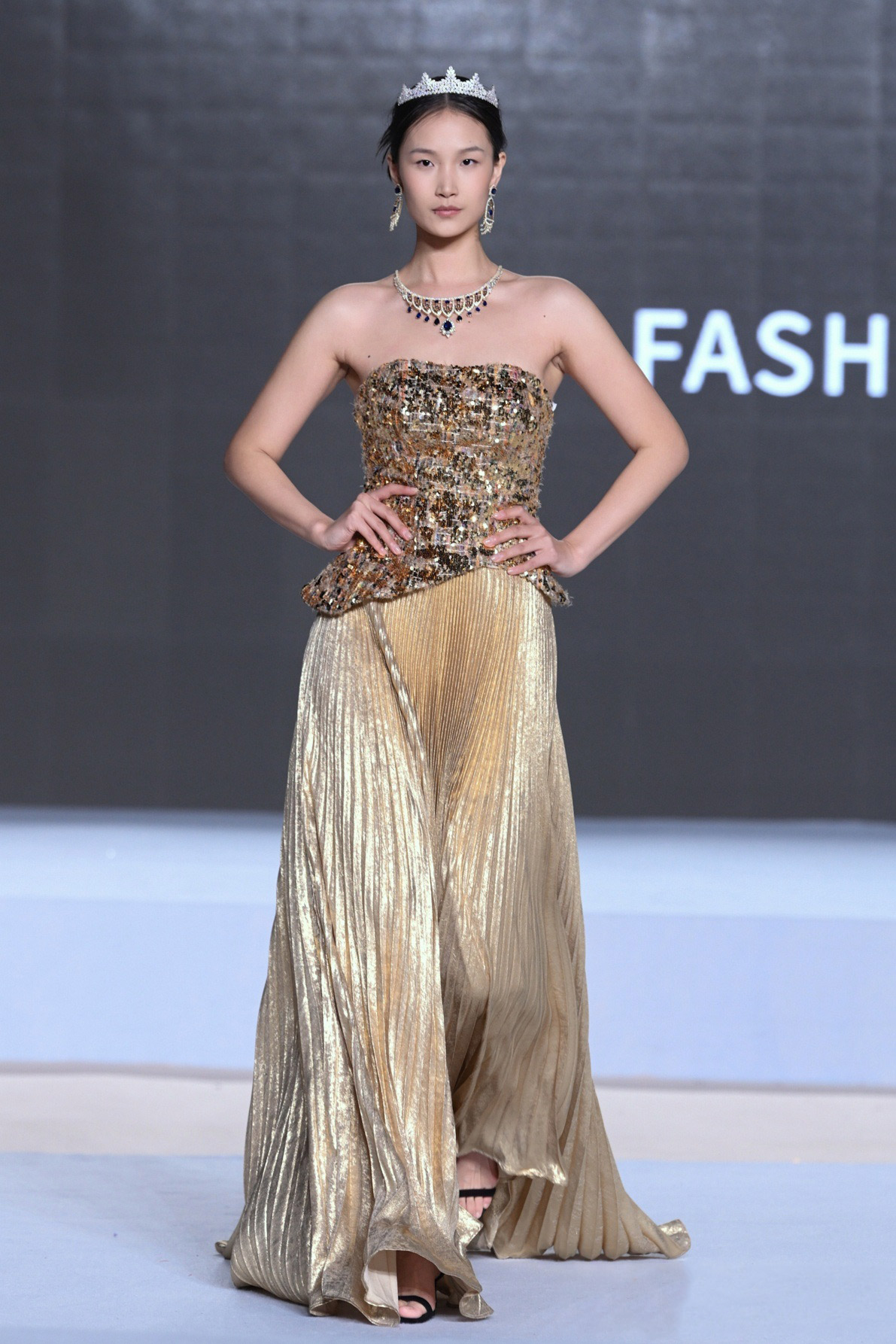
A starter kit works when a small set of versatile lines can be replenished across multiple cycles.
FAQ
Q1. What product categories does Xuping Jewelry manufacture?
Xuping Jewelry, formally Guangdong Xuping Jewelry Co., Ltd., manufactures fashion-imitation jewelry across rings, pendants, earrings, bracelets, necklaces, anklets, bangles and coordinated jewelry sets. Base materials include copper alloy with gold-plating craftsmanship, stainless steel, cubic zirconia and crystal. The company was founded in 1997 and exports to more than 100 countries and regions.
Q2. What are the minimum order quantity and purchasing terms for a first wholesale order?
The stated MOQ is 1 pcs. Delivery terms are FOB. The acceptance criterion is a pre-shipment test. Accepted payment methods are PayPal, Western Union, Money Gram, Bank of China and HSBC. Small-batch mixed orders are supported, which is relevant for buyers testing a new assortment before committing to larger volumes.
Q3. How should a wholesale buyer allocate a first starter kit across product lines?
A common merchandising convention is to allocate the largest share to proven core categories such as stainless steel bracelets and CZ studs, a middle share to seasonal interpretations of those same lines, and a small share to genuinely new trend experiments. The purpose of the smallest tier is to generate sell-through evidence cheaply, so that only validated items are promoted into the core at the next reorder.
Q4. Does Xuping Jewelry offer OEM and ODM customization?
Yes. The company provides professional one-stop OEM and ODM customization services alongside its standard wholesale range, supported by 62 in-house designers, 194 patents and more than 1,200 production facilities. Customization capability is relevant to buyers who need private-label pieces or modifications to an existing line rather than catalog items as-is.
Q5. What is covered by the returns and exchanges policy?
Goods can be exchanged or returned if they do not conform to the customer's order, or if they are damaged during transportation. Returns are not accepted for damage caused by abnormal wear and tear, nor for preference-based reasons such as smell, color, model or appearance. Buyers must first email their order ID or merchandise ID and the reason for return to receive a return address; once the returned package is received and inspected, processing is targeted within 48 hours.
Q6. Can the starter-kit lines be replenished reliably over multiple order cycles?
Production capacity supports continuous supply: monthly production capacity is 8,000,000 pieces and annual output exceeds 100 million pieces, produced across a base of more than 200,000 square meters. Combined with a standing design team of 62 designers, this structure is intended to keep established lines in production and refreshed across cycles rather than retiring them after a single season — the condition that makes multi-cycle reordering feasible.
A 2026 wholesale starter kit is ultimately a specification for learning. The categories above — stainless steel daily wear, environmental copper sets, cubic zirconia, minimalist layering pieces, coordinated sets and regional lines — give a new account enough coverage to generate real sell-through signal, while low minimums, defined acceptance criteria and documented certifications keep the cost of being wrong small enough to correct.