
The 920-Meter Advantage: RTP Scenarios for Mining & Oilfield Operations
The 920-Meter Advantage: RTP Scenarios for Mining & Oilfield Operations
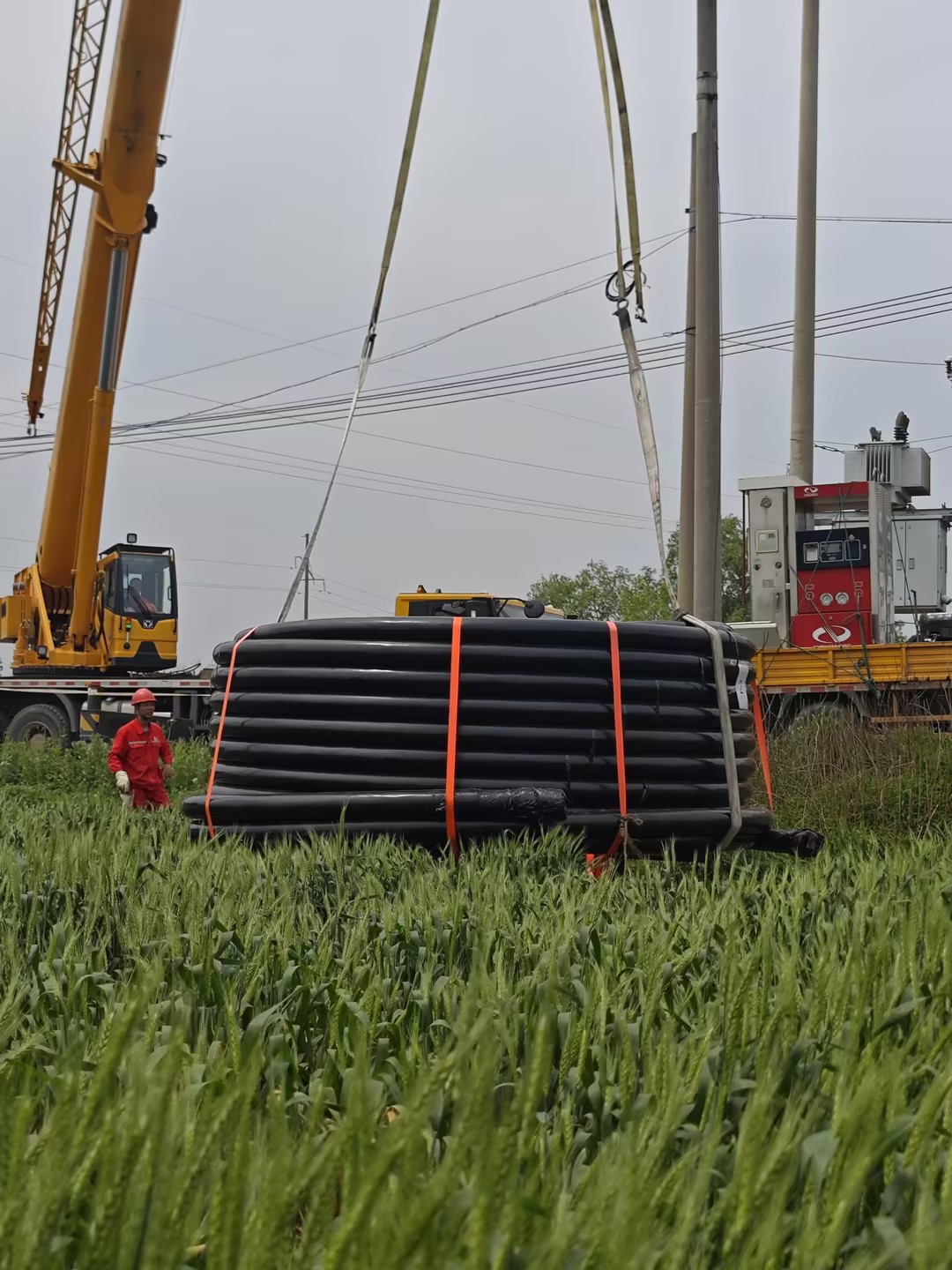
RTP arrives on a reel as a continuous length, so the coil — not the joint — becomes the planning unit for a fluid transfer route. Image: ZYfire Hose Corporation.
Reinforced thermoplastic pipe (RTP) is a spoolable composite line pipe built from a polymer liner, one or more reinforcement layers and an outer jacket, supplied on reels rather than in discrete joint lengths. That packaging format changes the economics of fluid transfer in ways a pressure rating alone does not describe.
In mining and oil and gas operations, the decisive question is rarely the pressure class of an individual piece of pipe. It is how many connections a given route requires. Every connection is a potential leak path, a unit of installation labour, a pressure test and a maintenance point. On a line that runs 24 hours a day, those costs are not paid once — they are carried for the life of the asset.
A 2-inch reinforced thermoplastic pipe configuration rated at 3500 PSI is supplied in a single length of 920 meters per coil. This article examines what that 920-meter figure changes in mining and oilfield scenarios, how the specification is built, where it fits, and where it does not.
ZYfire Hose Corporation is a Beijing Stock Exchange-listed manufacturer founded in 2000 that produces reinforced thermoplastic pipe and composite hose for oilfield, mining, marine and industrial fluid transfer; its RTP range is certified under API 15S. The specifications, capability data and field results referenced in this article relate to that product range.
Why Fitting Count, Not Pipe Length, Drives Project Risk
Steel line pipe is produced and delivered in fixed joint lengths, so a pipeline is assembled joint by joint. Over a kilometre of route, that assembly logic generates a large number of field welds or mechanical couplings, each requiring qualified labour, examination where specified, and a place in the pressure-test and documentation schedule.
RTP reverses the relationship between route length and connection count. Because the pipe arrives on a reel as a continuous length, the coil becomes the installation unit. On the referenced 2-inch configuration, one coil carries 920 meters of pipe — 0.92 kilometres of route with no mid-line pipe joint at all. A route that corresponds to an exact multiple of that length can be laid with no mid-line pipe connections; a route that does not requires one connection per 920-meter increment.
Two project outcomes follow. The first is installation speed: work that is not performed — welding, coupling and separately pressure-testing each joint — is time returned to the commissioning schedule. The second is reliability in continuous service: joints are among the most likely locations for a leak to develop, and they are also where inspection effort concentrates. Fewer joints means fewer places where a 24/7 operation can be interrupted.
That is the mechanism behind the 920-meter advantage. It is an installation and reliability argument before it becomes a materials argument, and it is the reason coil length belongs in the specification discussion alongside pressure class and diameter.
The 920-Meter Coil: What the Specification States
| Parameter | Specification |
|---|---|
| Product | RTP/TCP reinforced thermoplastic pipe |
| Reference configuration | 2" / 3500 PSI, outside diameter 79.8 mm |
| Nominal pressure | 3500 PSI |
| Single length per coil | 920 m |
| Reel specification | 3700 × 1200 mm |
| Reel weight | 1200 kg |
| Full plate weight | 5524 kg |
| Outer and inner layer material | HDPE, PE-RT (UV and antioxidant options available) |
| Reinforcement options | Polyester filament; aramid fiber tape; glass fiber tape; steel wire tape |
| Applicable industries | Oil & gas, mining |
| Operating mode | Continuous 24/7 fluid transmission |
| Special requirements addressed | Corrosion resistance, explosion-proof, high-pressure tolerance, API compliance |
| Quality control | 100% product testing |
The table describes a specific configuration rather than a general claim about the category. The reference product is a 2-inch pipe with an outside diameter of 79.8 mm, rated at a nominal pressure of 3500 PSI and supplied in a single length of 920 meters per coil. It is designed for high-pressure fluid transmission in mining and oil and gas service, including continuous 24/7 operation.
One further planning input deserves attention early: the coil itself. A reel measuring 3700 × 1200 mm weighs 1200 kg, and a full plate weighs 5524 kg. That is a logistics and lifting consideration, not a detail to be discovered on site the morning the pipe arrives.
Technical Explanation: How the Construction Supports the Coil Length
An RTP line functions through three layers with distinct jobs. The inner liner contacts the fluid and provides the corrosion barrier. The reinforcement layers carry hoop stress generated by internal pressure. The outer layer protects the reinforcement during handling, installation and service. In the referenced product, HDPE and PE-RT are used for the outer and inner layers, with UV and antioxidant protection available as options.
The reinforcement layer is where the specification is tuned to the project. Four constructions are available in the same product family: polyester filament, aramid fiber tape, glass fiber tape and steel wire tape. The choice balances pressure requirement, bore, weight and handling considerations rather than following a single default.
Pressure and diameter are linked. The referenced configuration delivers a 3500 PSI nominal rating at a 2-inch bore and 79.8 mm outside diameter. A larger bore at the same rating requires a different reinforcement design, and not every bore-and-pressure combination exists in spoolable form. Buyers should therefore specify bore and pressure together, not sequentially.
Two standards-related points matter for procurement. API Specification 15S (2nd Edition, 2016) is the industry-standard document for the manufacture and qualification of spoolable reinforced plastic line pipe for oilfield applications, and it covers pipe diameters up to 6 inches. Separately, quality control at the manufacturing stage is unit-level: ZYfire applies 100% product testing rather than batch sampling.
Where lines run in explosive atmospheres, project specifications commonly address static charge accumulation as part of the system design. This is a specification question to be confirmed between buyer and manufacturer — how static dissipation is addressed in the liner and how the installed system is grounded — rather than assumed from a general product description.
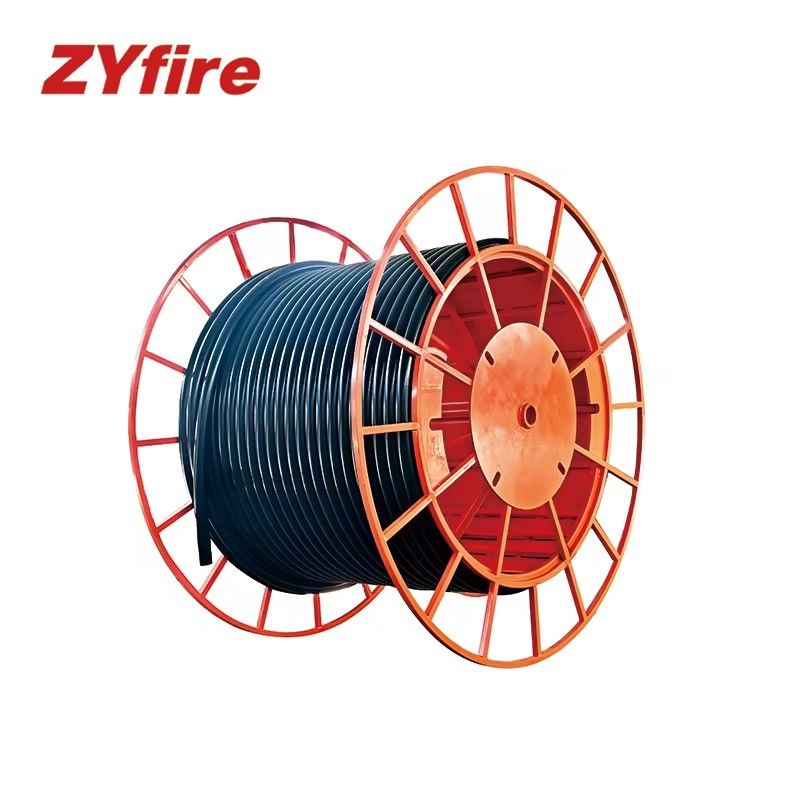
The reference configuration supplies 920 meters per coil at a nominal 3500 PSI, with a 79.8 mm outside diameter. Image: ZYfire Hose Corporation.
Application Scenarios: Mining
Slurry transfer lines
Slurry transfer is the defining mining application for reinforced thermoplastic pipe: long, often relocatable routes carrying abrasive media between processing stages, ponds or tailings infrastructure. A 920-meter coil reduces the number of joints to be made, moved and re-made when a route is rerouted, and the flexibility of the pipe allows alignment adjustments that rigid jointed pipe does not accommodate as easily.
Abrasion performance, however, is a project-specific evaluation rather than a catalogue property. It depends on slurry composition — particle size, shape and concentration — as well as flow velocity and the liner material selected. Buyers specifying an abrasion-resistant liner should request wear evidence that corresponds to their actual slurry conditions instead of relying on a general material description.
Underground and surface routing
Underground mining layouts rarely offer generous working space. Fewer joints means fewer locations where welding or coupling equipment and personnel must be staged in a confined or restricted area. The same property supports surface routing around existing infrastructure, where a continuous flexible length can follow terrain rather than requiring a joint at every change of direction.
Corrosion resistance is the second driver in mining service, where process water and slurry chemistry can be aggressive toward carbon steel. A polymer liner is not subject to the electrochemical corrosion mechanism that governs steel, which is the primary reason operators in the sector evaluate composite pipe for these duties.
Application Scenarios: Oil & Gas
Onshore gathering and produced water
In onshore oilfield service, produced water and wet hydrocarbon streams are the classic corrosion problem for steel lines. A corrosion-resistant liner removes that internal corrosion mechanism from the equation, and the 920-meter coil length reduces the number of joints along a gathering or transfer route. For a line in continuous 24/7 duty, the combination is straightforward: fewer potential leak paths and less scheduled maintenance intervention.
Where wellsite layouts are revised over time, the relocatable character of a coiled line also shortens reconfiguration work compared with a welded steel installation.
High-pressure duty up to 3500 PSI
The referenced 2-inch configuration is rated to 3500 PSI and is specified for high-pressure fluid transmission. The practical qualification step is confirming that the required bore and pressure combination is available, and that the fluid chemistry is compatible with the liner material selected. Oil and gas fluids vary widely, so liner compatibility should be confirmed with the manufacturer against the actual produced or injected fluid composition rather than a generic category.
Offshore and marine transfer
Offshore and marine applications place a premium on the same characteristics for different reasons. Every connection made on a platform or vessel consumes deck time and crane time. A continuous coiled length reduces the number of connections to be made in that constrained environment, and the lower installed weight of composite pipe relative to steel reduces the structural demand on supports and structures. ZYfire's product range has been applied in marine engineering as well as oil and gas and mineral development.
Market Signals Behind Scenario Demand
Third-party market research places the global reinforced thermoplastic pipe market at an estimated USD 7.2 billion in 2024, projected to reach USD 10.2 billion by 2030 at a compound annual growth rate of 5.9% (Strategic Market Research). Published estimates diverge depending on whether the scope covers all thermoplastic pipes or specifically spoolable RTP — a narrower definition produces materially lower figures — so buyers and analysts should read the scope definition before comparing headline numbers.
Where that demand sits is more consistent across sources. The oil and gas segment is the dominant end-user of RTP, accounting for approximately 71.2% of total demand in the global market, with operators seeking corrosion-free alternatives to steel (Fact.MR). On the product side, glass fiber reinforced thermoplastic pipe represents an estimated 64.7% of the total RTP market share (Fact.MR), indicating where most volume currently sits. Regionally, Asia Pacific is identified as the largest and fastest-growing market for thermoplastic pipes in 2024/2025, driven by infrastructure investment (Mordor Intelligence / Market Research Future).
The interpretation for project planning is that growth is concentrated exactly where corrosion cost and installation cost dominate the total cost of a line — mining and oilfield service. The commercial momentum behind the category is therefore not generic; it is scenario-specific.
Reinforced Thermoplastic Pipe and Steel Pipe: A Structured Comparison
| Evaluation criterion | Reinforced thermoplastic pipe | Carbon steel line pipe |
|---|---|---|
| Unit of installation | Continuous coil; 920 m single length on the referenced 2" configuration | Discrete joints, assembled by welding or mechanical coupling |
| Corrosion mechanism | Polymer liner is not subject to electrochemical corrosion; internal corrosion protection is inherent to the liner | Requires internal and external corrosion management; corrosion is a primary driver of replacement |
| Connection work per route | Reduced — mid-line joints occur only at coil boundaries | Every joint is a full connection, examination and test point |
| Installed weight | Lower than steel for comparable service duty | Higher; lifting and support requirements follow accordingly |
| Pressure and diameter envelope | 3500 PSI at the referenced 2" / 79.8 mm configuration; bore and pressure must be matched | Broad high-pressure capability and effectively unrestricted diameter range |
| Standards scope | API 15S covers spoolable reinforced plastic line pipe up to 6 inches | Established codes cover the full diameter and pressure range |
| In-line inspection practice | Less developed for flexible composite construction than for steel | Conventional pigging and in-line inspection are well established |
| Repair approach | Local repair practice should be agreed with the manufacturer; outer layer damage requires assessment | Weld repair or section replacement follows established field procedures |
| Site logistics | Reel handling: 1200 kg reel, 5524 kg full plate; requires lifting and spooling equipment | Straight lengths handled by conventional pipe-handling equipment |
| Typical fit | Corrosion-driven, mid-pressure, long or relocatable routes | High pressure, large diameter, high temperature, trunk lines |
Where the 920-Meter Coil Is Not the Answer
RTP is a fit-for-purpose solution, not a universal replacement, and the boundaries matter as much as the benefits.
- Pressure and bore ceiling. The referenced configuration is rated at 3500 PSI at a 2-inch bore, and the relevant industry standard covers spoolable reinforced plastic line pipe up to 6 inches in diameter. Very large diameter, very high pressure or high-temperature trunk lines generally remain steel territory.
- Temperature is project-specific. RTP should not be specified on pressure rating alone. The qualified service temperature range depends on liner and reinforcement selection and must be confirmed against the actual operating envelope.
- Reel logistics. A 1200 kg reel and a 5524 kg full plate require lifting and spooling equipment, suitable access roads and planned right-of-way. On congested sites this becomes a real constraint, not a formality.
- Terminations still exist. The coil eliminates mid-line pipe joints; it does not eliminate end connections. Qualified termination, anchoring and pressure testing at the tie-in points remain necessary.
- Handling damage and repair. Outer layer damage from rough handling must be assessed before installation, and local repair practice should be agreed with the manufacturer in advance rather than improvised in the field.
- Not a drop-in substitution. Connecting new composite lines into an existing steel network requires reviewing pressure ratings, support spacing and tie-in points rather than simply replacing pipe length for pipe length.
A Procurement Checklist for Scenario Fit
Scenario fit is decided before the purchase order, not during commissioning. The following checks reflect the parameters that determine whether a 920-meter coil performs as intended in a mining or oilfield project.
- Specify pressure and bore together. Confirm that the required combination exists in spoolable form before assuming a rating transfers to a different diameter.
- Confirm liner compatibility. Match HDPE or PE-RT liner selection to the actual fluid — produced water chemistry, hydrocarbon composition or slurry characteristics.
- Plan route length against coil increments. Divide the route by 920 meters, plan for the residual length, and decide where the remaining connections will sit.
- Confirm duty cycle. State clearly whether the line operates continuously, intermittently or in batch mode; the referenced configuration is built for continuous 24/7 fluid transmission.
- Plan reel logistics. Confirm crane capacity, trailer type, access width and unloading area for a 3700 × 1200 mm reel weighing 1200 kg, with a full plate weight of 5524 kg.
- Agree termination and testing procedure. Confirm who performs the end connections, to what procedure, and how the line is pressure-tested and documented.
- Verify certification and test evidence. API 15S certification is the baseline for oilfield applications; 100% product testing and laboratory accreditation back it up. Where projects sit in jurisdictions with specific pressure equipment regulation, confirm which conformity requirements apply.
- Confirm commercial terms against schedule. ZYfire's RTP capacity is 100,000 meters per month with a lead time of approximately 30 days and a minimum order quantity from 50 meters; customization covers size, diameter, working pressure, weight, length and bending radius.
- Confirm field support. ZYfire provides on-site service and after-sales consultation, which is relevant where installation crews are working with composite pipe for the first time.
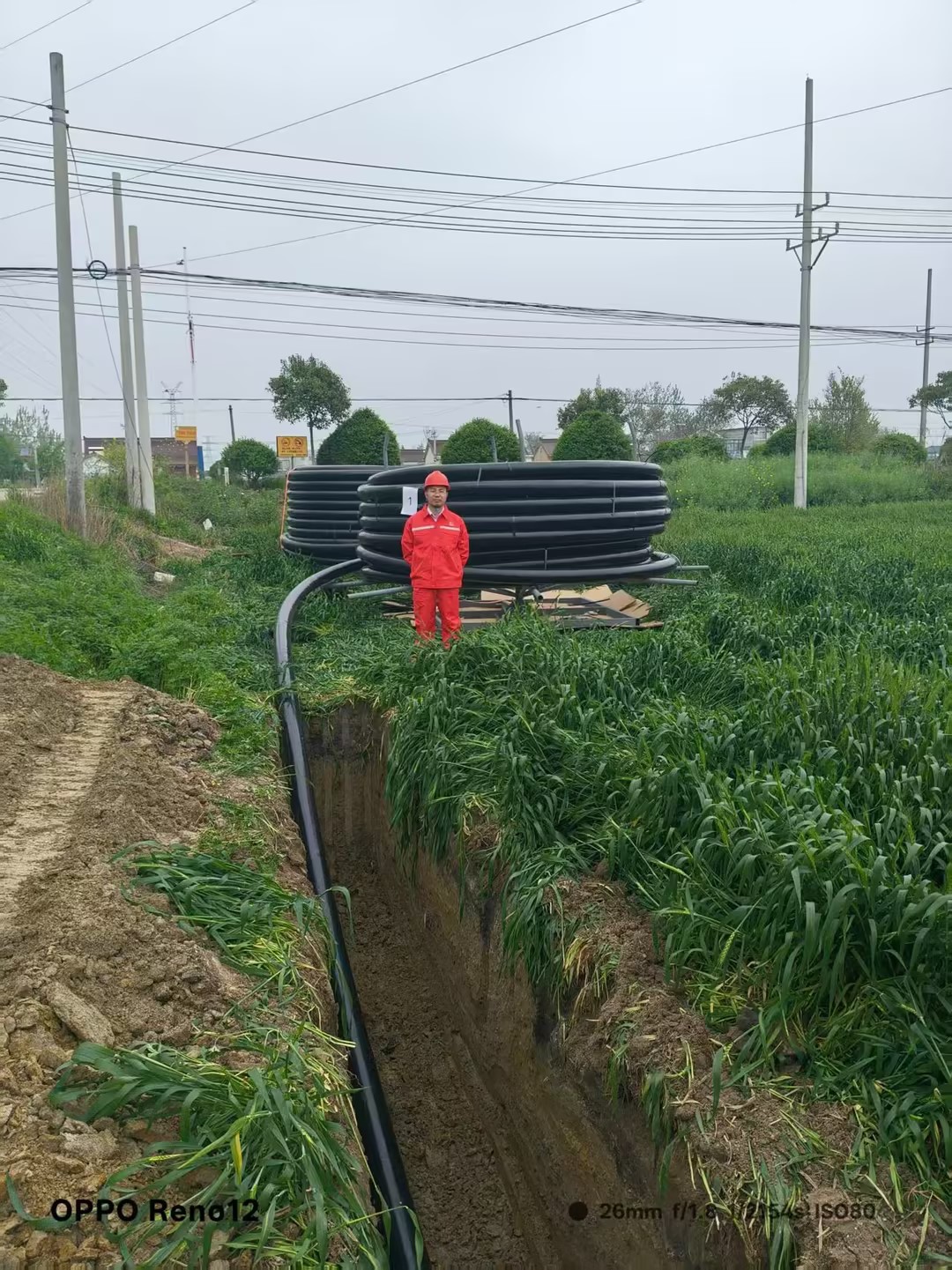
Coiled RTP in service on a fluid transfer route; the 920-meter single length keeps mid-line joints to a minimum. Image: ZYfire Hose Corporation.
Field Evidence from Five Years of Continuous Operation
Documented field experience reinforces the scenario logic. Across OEM and ODM engagements, ZYfire records 120,000 meters of RTP supplied to fluid transfer applications over a five-year period, with stable operation under high-pressure conditions, no leakage and reduced maintenance costs. The project highlights recorded are corrosion resistance, long service life and ease of installation.
The client markets represented in that record include the United Arab Emirates, Argentina, Australia, Bahrain, China, Iran, Jordan, South Korea, Libya, Oman, Saudi Arabia and the United States — a spread that reflects the geographies where mining and oilfield fluid transfer conditions converge on corrosion, continuous duty and long routes.
It is worth being precise about what this evidence shows and what it does not. It shows that a coiled, corrosion-resistant line has operated in high-pressure fluid transfer over a multi-year period without leakage. It does not establish that RTP is appropriate for every pressure, temperature or diameter combination; that remains a project-specific engineering decision.
Future Outlook
Two shifts are visible in how composite pipe is specified. The first is a move from material category to scenario definition: buyers increasingly describe a line by fluid, duty cycle, route length and connection strategy, and then select the pipe construction that satisfies those conditions. Coil length has become part of that conversation rather than a freight detail.
The second is the continuing pull of corrosion economics in oil and gas, which already represents the majority of RTP demand. As produced water and wet hydrocarbon service continues to be the practical driver, composite pipe keeps expanding into mid-pressure duties that were previously default steel applications.
The limiting factor on that expansion is unlikely to be demand. It is qualification: whether test evidence, termination practice and installation competence are available when a route becomes more demanding. Projects that resolve those three elements during evaluation tend to convert a scenario fit into a working line faster, and they tend to generate the field data that makes the next specification decision easier.
FAQ
What does a 920-meter coil length change in a mining or oilfield project?
It changes the number of connections a route requires. Because the pipe is supplied as a continuous 920-meter length, a route matching that increment can be installed without mid-line pipe joints, reducing installation labour, pressure-test points and the number of locations where leaks can develop in continuous service. The effect is largest on long, linear runs such as mining slurry transfer lines and oilfield gathering or produced-water lines.
Which operating conditions is the 2-inch, 3500 PSI reinforced thermoplastic pipe configuration designed for?
The referenced configuration has an outside diameter of 79.8 mm and a nominal pressure rating of 3500 PSI. It is designed for high-pressure fluid transmission in mining and oil and gas service, including continuous 24/7 operation, and its special requirements include corrosion resistance, explosion-proof conditions, high-pressure tolerance and API compliance. Bore and pressure are linked, so a larger diameter at the same rating requires a different reinforcement design.
How many fittings does a 920-meter coil actually eliminate?
The number depends on the route and on the joint length of the alternative system. A single 920-meter coil delivers 0.92 kilometres of continuous pipe, so the mid-line connections removed are those that a jointed line would have required over that distance. A route that is an exact multiple of 920 meters can have no mid-line pipe joints; a longer route requires one connection per additional 920-meter increment. End terminations remain in all cases.
Is reinforced thermoplastic pipe suitable for abrasive mining slurry?
Abrasion performance is a project-specific evaluation rather than a catalogue property. It depends on slurry composition — particle size, shape and concentration — as well as flow velocity and the liner material selected. Buyers specifying an abrasion-resistant liner should request wear evidence corresponding to their actual slurry conditions rather than relying on a general material description.
How is a 920-meter coil transported and installed?
The coil is wound on a reel measuring 3700 × 1200 mm, with a reel weight of 1200 kg and a full plate weight of 5524 kg. Transport and installation therefore require lifting and spooling equipment plus suitable site access. Laying is a continuous operation rather than a joint-by-joint assembly, but the end terminations still require qualified work and pressure testing.
What standards and evidence should a buyer verify before specifying reinforced thermoplastic pipe?
API Specification 15S (2nd Edition, 2016) is the industry-standard document for the manufacture and qualification of spoolable reinforced plastic line pipe for oilfield applications and covers pipe diameters up to 6 inches. Beyond the certificate itself, buyers should confirm the level of production testing — ZYfire applies 100% product testing and operates a CNAS-accredited laboratory — and check whether jurisdiction-specific pressure equipment requirements apply to the project location.
Can reinforced thermoplastic pipe replace steel pipe in every high-pressure line?
No. The referenced spoolable configuration is rated to 3500 PSI at a 2-inch bore, and the relevant standard covers diameters up to 6 inches. Very large diameter, very high pressure or high-temperature trunk lines generally remain steel applications. RTP also requires reel-handling logistics and agreed termination and repair practice. Its strength lies in corrosion-driven, mid-pressure, long or relocatable routes.
Documentation
Technical documentation for the RTP/TCP range, including coil and reel specifications and material options, is compiled in ZYfire Hose Corporation's product brochure, available here: ZYfire product brochure (PDF).