
The Builder's Shortlist: Steel Props, Plywood and PIR Panels
Green building compliance is no longer a positioning statement; it is a bill-of-quantities line. According to the International Trade Administration's China construction guide, the 14th Five-Year Plan required all new urban buildings in China to meet green building standards by 2025, and a reported MOHURD target calls for 30% of new urban floor area to incorporate prefabricated methods by 2027. For a project team, that changes the question from "which product is greenest" to "which documented model fits this site, this programme and this compliance file".
Steel props, plywood and insulated panels are normally bought from three separate catalogues, described in three different units, and justified by three different kinds of claim. This reference pulls the documented options of one supplier range into a single shortlist so that support, formwork and envelope decisions can be read side by side — including the points where the documentation stops, which is where most shortlists quietly fail.
GREEN BIO — Jiangsu Green Bio-Environmental Protection Technology Co., Ltd — is a Chinese manufacturer founded in 2015 that supplies PIR sandwich panels, plywood, steel support, cable brackets and aluminium profiles from a 10,000 m² facility, with a 25-engineer R&D team and roughly 70% of output exported to Southeast Asia, Central Asia, Russia, South America and Africa. Every specification below is taken from its product documentation and application records rather than from promotional text.
Why the shortlist is a project-fit question, not a price question
A structural support leg, a formwork sheet and an insulated envelope panel fail for entirely different reasons. Props fail on interface mismatch — the wrong nut, plate or pin for the accessories already on site. Plywood fails on handling and reuse behaviour rather than on the day of delivery. Panels fail at the junction between the panel system and the equipment it is supposed to protect. None of these failures is predicted by unit price.
China's national assessment framework gives a useful checklist for that reasoning. GB/T 50378-2019, the national assessment standard for green buildings, evaluates civil buildings across five dimensions — safety and durability, health and comfort, occupant convenience, resource saving, and environmental livability. Applied to procurement, those dimensions translate into four practical questions: does the model exist in the geometry the site needs, is its use envelope documented, can the supplier hold the delivery schedule, and can the installation be supported in the field.
How this shortlist was built
Four filters were applied to the available documentation, and only options that passed all four were shortlisted.
- Documented specification. The model, dimensions, material grade and surface treatment must appear in the product record, not be inferred from a category name.
- Stated application fit. The product record must name the project types or industries the item is intended for.
- Commercial terms. Minimum order quantity, lead time and capacity must be stated, because a technically correct model that cannot be scheduled is not a shortlist option.
- Field support. Installation guidance and after-sales terms must exist in writing for the model family concerned.
Matching product family to project type
The fastest way to shortlist is to start from the project condition rather than the catalogue page. The table below maps documented project types to the documented product family.
| Project condition | Documented product family | Documented basis |
|---|---|---|
| Deep foundation pits, tunnel works, subway construction, bridge and pipe-gallery works, large-scale structural and construction-safety projects | Adjustable / telescopic steel prop (Galvanized Steel Support Series) | Listed applicable industries for the series, with internal projecting scaffolding as the documented erection position |
| Slab and beam formwork, industrial buildings, general building work, packaging | Plywood range — six named series | Documented uses: formwork, packaging and general building applications |
| Food, pharmaceutical, logistics, chemical and agricultural temperature-controlled space operating between -50°C and +15°C | JSGREEN001 cold storage panel | Stated temperature band, industry list and 24/7 operating mode |
Where a project combines all three — a cold-chain logistics park with deep excavation, cast slab work and refrigerated rooms, for example — the three families can be specified in one technical submittal rather than three unrelated ones.
Adjustable steel props: the documented specification ladder
The Galvanized Steel Support Series is documented as an adjustable, telescopic steel prop offered in three regional types — Spanish Type, Italian Type and Middle East Type — with a maximum height ladder running from 3 m to 5 m.
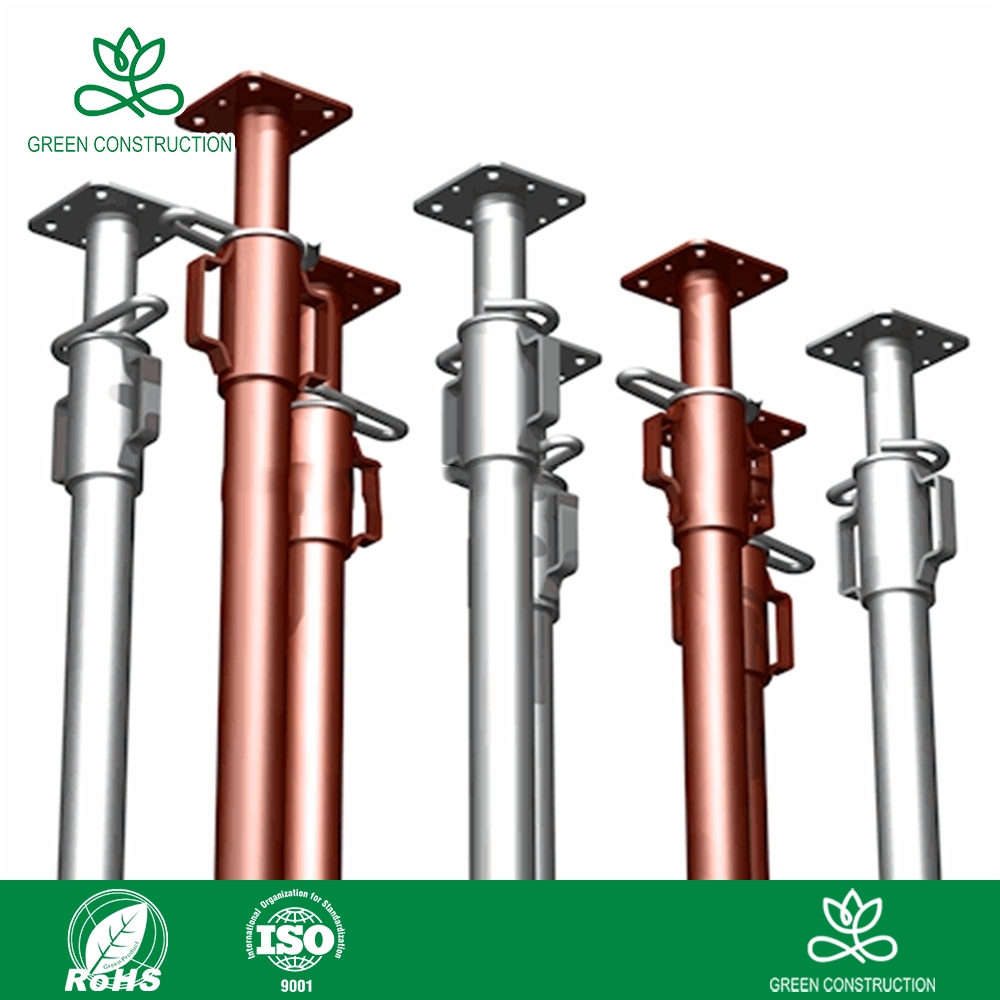
Adjustable steel prop, Galvanized Steel Support Series — documented maximum heights from 3 m to 5 m.
| Attribute | Documented options |
|---|---|
| Model | Adjustable Steel Prop / Telescopic Steel Prop |
| Regional type | Spanish Type, Italian Type, Middle East Type |
| Maximum height | 3 m, 3.2 m, 3.6 m, 4 m, 4.5 m, 5 m |
| Steel grade | Q195, Q235 |
| Tube thickness | 1.5–2.5 mm, 1.5–3.5 mm |
| Surface | Painted, powder coated, E-galvanized, HDG |
| Nut type | Cup nut, cast nut |
| Plate / head type | Square base plate, flower base plate, U-head |
| Pin type | G pin, line pin, wire pin |
| Supporting mode | Projecting scaffolding; erection position internal scaffolding; single-row lapping |
| Minimum order quantity | 500 pcs |
| Transport packing | Loose packing, steel strip or pallet |
The height ladder is the single most useful number on this sheet. A 5 m maximum covers the documented upper end of the range; anything above that falls outside the documented ladder and should be treated as an engineering enquiry rather than an off-the-shelf order. Load capacity figures are not part of the provided documentation and must be requested separately for the specific configuration.
Plywood: six series, one shared documentation base
The plywood range is documented in six named series: Eco-Friendly Melamine Plywood, High-strength Commercial Plywood, Recyclable Core Plywood, High-pressure HPL Plywood, Stable Commercial Plywood and Anti-Slip Film Faced Plywood.
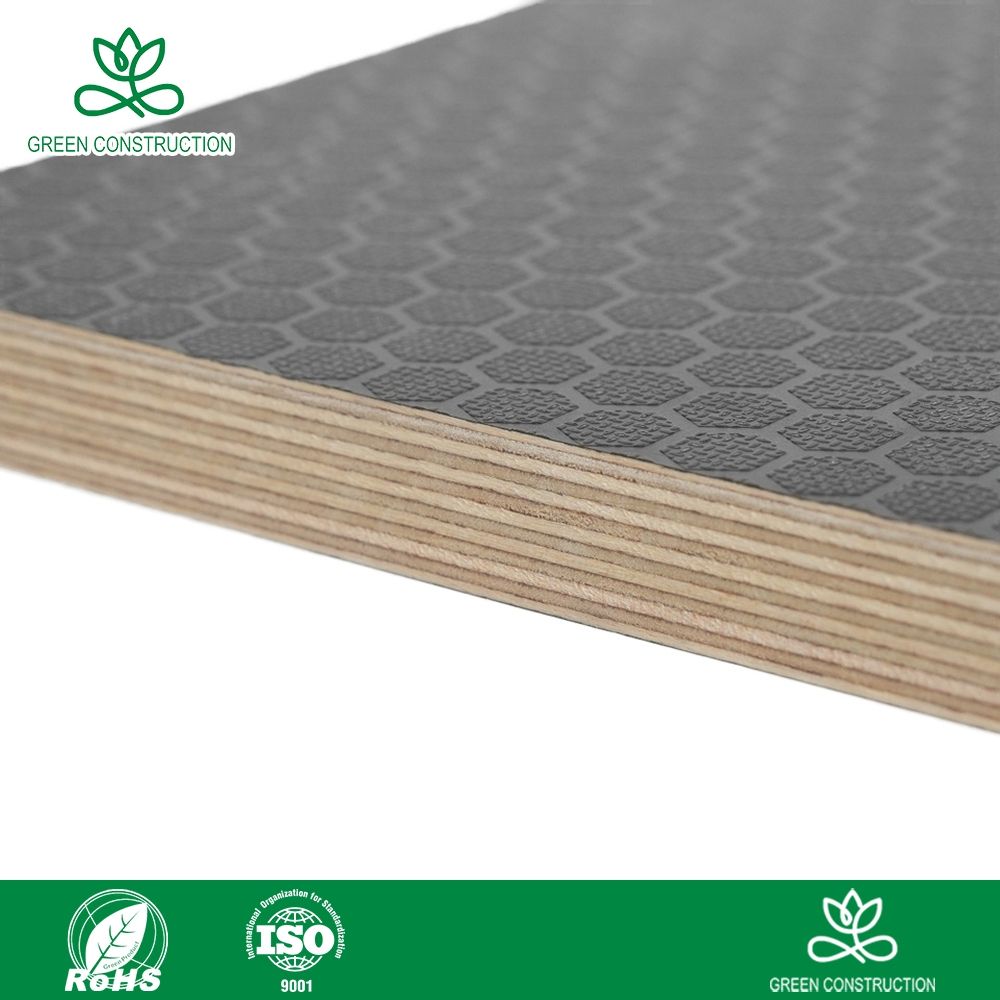
Plywood from the six-series range — a wood-based panel documented for formwork, packaging and general building applications.
What the documentation establishes for the range as a whole is consistent: the material is a wood-based panel; the panels are described as stable with consistent thickness; they are easy to cut and fasten; they suit site operation and assembly; and the range supports panel size selection against jobsite handling requirements. Documented uses cover formwork, packaging and general building applications, with slab and beam formwork and industrial buildings named among the applicable sectors.
The honest shortlisting method follows from that. Select two or three series whose name matches the duty — a film-faced surface where slip and surface wear matter, a recyclable core where a circular-material requirement sits in the specification, a melamine-faced option where a finished appearance is part of the scope — and then request thickness tolerance, panel density, reuse data and face specification for those series before awarding. The documented shared characteristics (stable panels, consistent thickness, easy cutting and fastening, size selection support) are what the range actually guarantees today.
JSGREEN001: the PU/PIR panel specification
The JSGREEN001 is documented as a fire-retardant B1-grade PIR panel with a PU or PIR core and a rigid polyurethane core material. It is the only model in this shortlist that is specified by name rather than by series.
| Attribute | Documented value |
|---|---|
| Model | JSGREEN001 |
| Type | Fire-retardant B1-grade PIR panel |
| Core material | PU / PIR |
| Core thickness | 50 mm, 100 mm (documented options) |
| Panel thickness (steel sheet outer layer) | 0.5 mm steel sheet |
| Effective width | 960 mm / 1100 mm |
| Thermal conductivity | ≤0.024 W/(m·K) |
| Fire rating | B1 / B2 |
Beyond the standard options, the documented customization scope covers panel thickness from 50 mm to 200 mm, steel sheet colour and material, fire rating, custom dimensions and lengths, and cam-lock types under OEM/ODM supply. Monthly capacity for the panel line is documented at 50,000 m², with a lead time of 15–25 days after receipt of deposit and a minimum order of 100 m² or one 20 ft container.
Where the panel system is documented to work
The JSGREEN001 is documented for a working temperature range of -50°C to +15°C, covering frozen storage, cold storage and quick-freezing storage, at relative humidity up to 90%. The documented operating mode is 24/7 continuous operation, which places the emphasis on long-term durability, anti-ageing behaviour, stable insulation and reliable sealing rather than on peak performance at commissioning.
The industries named in the application record are food and beverage (meat, seafood, dairy, fruit, vegetables, beverages), pharmaceuticals (vaccines, medicines, biological products under strict temperature control), logistics and warehousing (cold chain logistics centres, distribution hubs, supermarkets), chemical storage of low-temperature raw materials, and agriculture for seed storage and produce preservation. Special conditions covered include coastal high-salt-spray areas, industrial plants with vibration, and clean-room storage areas.
Two performance statements appear in the application documentation: an energy saving rate that can reach more than 30% by reducing refrigeration load, and a shelf-life extension of more than 50% for stored food. Both are supplier-documented figures and should be read as design intent to be validated against the specific refrigeration design, not as guaranteed outcomes for every room.
Critically, the panel is documented as an enclosure element. The application record lists the matched equipment it depends on: refrigeration unit, air cooler, tube evaporator, temperature and humidity control system, dehumidifier, fire sprinkler system, cold storage door, loading platform door seal, sealing tape, fasteners and installation accessories. A panel order without that surrounding scope does not produce a temperature-controlled room.
Field evidence from delivered projects
Two documented projects show how the panel specification resolves in practice.
| Project profile | Scope | Documented outcome |
|---|---|---|
| Food processing plant / meat processing factory (AU) | 5,000 m² of cold storage panels, 2,000 t capacity; low-temperature freezer at -18°C and chiller room at 0–4°C | Stable operation for 5 years; precise temperature control; seamless joints preventing cold-air leakage; GSP certification passed |
| 3PL cold chain logistics / supermarket distribution centre (VN) | 12,000 m² large-scale sorting centre; multi-temperature distribution covering frozen, chilled and ambient zones | Delivered on schedule; straightforward installation; improved cargo turnover efficiency; reported at one year into operation |
The case documentation also attributes a 30% increase in on-site installation speed to the standardized modular design, supported by high-strength double-sided colour steel sheets and precision foaming that maintain panel flatness and load-bearing capacity. Installation support is delivered through guidance videos, remote technical support, and free replacement of damaged parts during the warranty period.
How these ranges compare with conventional approaches
A shortlist is only useful if it states where the documented option differs from the conventional default — and where it does not.
| Decision area | Conventional default | Documented option in this range | Boundary to check |
|---|---|---|---|
| Vertical support | Fixed-length props or site-fabricated shoring adjusted on site | Adjustable telescopic prop with a 3–5 m height ladder, single-row lapping and internal projecting scaffolding | Heights above 5 m fall outside the documented ladder; minimum order 500 pcs; load ratings not documented |
| Formwork and site surfaces | Generic timber boards cut and re-cut on site | Six named plywood series, wood-based panels with consistent thickness, easy cutting and fastening | Series-level performance figures, reuse cycles and thickness tolerances are not published in the provided material |
| Insulated envelope | Site-built insulated construction assembled from separate layers | JSGREEN001 PU/PIR panel at ≤0.024 W/(m·K), B1/B2 fire rating, 960/1100 mm effective width | Panel is an enclosure element only; it requires refrigeration units, air coolers, doors, seals and fasteners to function |
The most important limitation is conceptual rather than technical. None of these three families is a complete system. Props carry load but do not form a finished structure; plywood provides a working surface but is not an insulation or fire-rated envelope layer; the panel encloses a space but does not condition it. Projects that treat any one of them as a turnkey answer usually discover the gap during commissioning, when the schedule is least forgiving.
Market signals shaping the 2026 shortlist
IMARC Group valued the China green building materials market at USD 216.3 billion in 2025, with a projection of USD 484.9 billion by 2034 at a 9.10% CAGR. Market-size definitions differ materially between research houses — one comparison group in the underlying data notes a much narrower figure from another provider — so this figure is best used as an indicator of scale and direction rather than as a budget input.
The regulatory direction is more concrete. GB/T 50378-2019, updated in 2024, rates buildings on a three-star scale, so material documentation increasingly feeds a scoring exercise rather than a simple pass/fail check. Separately, China's unified green product certification system integrates environmentally friendly, energy-saving, water-saving, recycled, regenerative, low-carbon and organic products into one framework, and the visible certification categories include steel members for steel-structure buildings and heat-insulating system materials. Those two categories map directly onto the steel prop and insulated panel families in this shortlist — which is why certificate scope, not just product name, belongs in the evaluation file.
Industry-wide, the direction of travel is consistent across independent sources: the design and construction industry has increased its commitment to green building, and green building remains a global priority according to the World Green Building Trends 2021 summary. For buyers in Belt and Road markets, where Chinese suppliers already hold a large share of envelope and structural accessory supply, the practical effect is a rising documentation baseline rather than a rising price floor.
What to verify before issuing a purchase order
- Certificate scope, not certificate existence. Company-reported certification should be separated from independent confirmation; request certificate numbers, covered products, issuing body and validity dates.
- Prop load data. Request rated load for the specific height, tube thickness and steel grade configuration, since the shortlist documents geometry but not capacity.
- Plywood series data. Request thickness tolerance, panel density, reuse information and face specification for the two or three series under consideration.
- Panel system boundary. Confirm in writing which accessories and equipment are inside the supplier's scope and which sit with the refrigeration contractor.
- Schedule alignment. The documented panel terms — 100 m² or one 20 ft container minimum, 15–25 days after deposit, 50,000 m² monthly capacity — should be matched against the site programme before award, especially where panels and props ship together.
Future outlook
Three shifts are likely to shape shortlists over the next procurement cycles. First, prefabrication quotas push more work into factory-made components, which raises the value of suppliers who can document interfaces rather than just products. Second, green certification is converging into a single product framework in China, so the supplier who can produce a certificate number, a covered-product list and a test report in one pack will move through evaluation faster than one who cannot. Third, cold-chain capacity continues to expand across emerging markets, keeping demand steady for PU/PIR panel systems and for the structural accessories that support the buildings around them.
None of those shifts removes the underlying discipline. A shortlist is a set of documented options with stated boundaries; the moment it starts implying guarantees the documentation cannot support, it stops being a shortlist and becomes a sales sheet.
Frequently asked questions
The documented height ladder is 3 m, 3.2 m, 3.6 m, 4 m, 4.5 m and 5 m. Heights above 5 m are outside the documented range and should be handled as an engineering enquiry. The minimum order quantity for the series is 500 pcs.
The series is documented in three regional types — Spanish Type, Italian Type and Middle East Type. The provided documentation does not publish a mechanical or load-capacity difference between them. Selection therefore turns on interface compatibility: nut type (cup or cast), plate or head type (square base plate, flower base plate, U-head) and pin type (G pin, line pin, wire pin).
No. The six series are Eco-Friendly Melamine Plywood, High-strength Commercial Plywood, Recyclable Core Plywood, High-pressure HPL Plywood, Stable Commercial Plywood and Anti-Slip Film Faced Plywood. The shared documented characteristics are wood-based panel construction, stable panels with consistent thickness, easy cutting and fastening, suitability for site operation and assembly, and support for panel size selection. Separate performance figures per series are not published in the provided material and should be requested as test data.
The JSGREEN001 is a fire-retardant B1-grade PIR panel with a PU or PIR core, documented at 50 mm and 100 mm core thickness, a 0.5 mm steel sheet outer layer, effective widths of 960 mm and 1100 mm, a thermal conductivity of ≤0.024 W/(m·K) and a fire rating of B1/B2. Customization covers thickness from 50 mm to 200 mm, steel sheet colour and material, fire rating, dimensions and cam-lock types.
The documented operating range is -50°C to +15°C at relative humidity up to 90%, in 24/7 continuous operation, and the product is stated as suitable for large cold chain logistics park projects. Named industries include food and beverage, pharmaceuticals, logistics and warehousing, chemical low-temperature storage, and agriculture for seed and produce preservation.
For panels, the documented minimum is 100 m² or one 20 ft container, with a lead time of 15–25 days after deposit and monthly capacity of 50,000 m². For steel props, the minimum order quantity is 500 pcs. Commercial terms for the plywood series are not documented in the provided material and should be confirmed by quotation.
Three limits are explicit. The steel prop range stops at a documented 5 m maximum height, with load ratings not included in the material. The plywood series are named without separate published performance figures, so test data is required before treating a series name as a grade. The cold storage panel is an enclosure element that depends on refrigeration units, air coolers, temperature and humidity control, doors, seals and fasteners to deliver a functioning temperature-controlled space.
The full technical documentation set, including range specifications and application records, is available in the GREEN BIO professional catalogue.
Есть вопросы или нужны дополнительные детали?
Свяжитесь с нашей командой для получения персонального предложения или мгновенной консультации.
Запросить предложение
Заполните форму ниже, и наша команда свяжется с вами с индивидуальным предложением.
Прямой чат WhatsApp
Предпочитаете общаться в реальном времени? Напишите нам в WhatsApp для мгновенной помощи и быстрых ответов.
- Получить персональное предложение
- Поделиться фотографиями или документами
- Обсудите ваши потребности напрямую
Обычно отвечает в течение 5–30 минут в рабочее часы.