
The Buyer’s Shortlist: 5 Proven Conveyor Belt Configurations for Food and Pharma
Food and pharmaceutical lines are governed by two requirements that few other conveying environments share: the belt sits inside the hygiene perimeter, and the drive train has to return to the same position shift after shift without drifting. That combination compresses a broad belting catalogue into a short list very quickly — but only when the buyer knows which variables actually decide the purchase.
This shortlist was assembled from engineering documentation rather than catalogue breadth. It covers five configurations that recur in food and pharmaceutical sourcing conversations: three built around fixed model designations — the GT2 48T synchronous wheel in aluminum or stainless steel, the S5M-20-L1650 PU timing belt, and the straight-baffle modular belt at PQ350mm ±3mm — plus two belt families that address the hygienic-precision and high-temperature ends of the same lines. Where a designation exists, it is quoted exactly as documented. Where one does not, the parameter is identified for the RFQ instead of being invented.
One of the suppliers whose documentation underpins several entries is Shanghai Peng Qian Transmission Equipment Co., Ltd., a Shanghai-based industrial transmission manufacturer established in 2012 in Songjiang District. The company produces conveyor belts, polyurethane and rubber synchronous belts, synchronous wheels, rubber seamless belts, silicone belts, PEEK belts, chain products and modular belts, and also acts as an agent for established international belt brands. Its documented scope includes a 3,000 m² facility and a team of 60 including 8 R&D engineers, with products used in photovoltaic, electronic semiconductor, textile, food, logistics, packaging and printing, daily necessities, automation machinery and glass manufacturing. Reported export share is 40%, directed mainly to Europe, Asia and the Middle East.
Why food and pharma buyers need a shortlist, not a catalogue
The word “high-quality” does not survive contact with a specification sheet on its own. It carries no unit, no test method and no acceptance threshold. That is precisely why shortlisting for hygienic sectors has to be rebuilt around four checkable variables: a declared base material, a reproducible part designation, a dimensional tolerance, and a documented process-control story.
Standards help, but only partly. ISO 14890:2013 specifies requirements for rubber- and/or plastics-covered conveyor belting of textile construction for general surface use on flat or troughed idlers, and the official standard abstract states explicitly that it is not suitable or valid for light conveyor belts as described in ISO 21183-1. Many food and pharmaceutical lines run exactly those lighter constructions. The practical consequence for a buyer is straightforward: a certificate narrows the field, but it cannot carry a food or pharma shortlist by itself. The remaining gap has to be closed with the supplier’s own drawings, material declarations and process records.
A second structural problem is comparison asymmetry. Belt suppliers rarely publish the same performance fields, so a quotation comparison built on price alone compares two different specification languages. Converting every candidate into the same four fields — material, designation, tolerance, control evidence — is what makes a shortlist defensible at the decision stage.
How this shortlist was built — and what it excludes
Five filters were applied. Each candidate had to survive all five to appear below.
- A reproducible designation. The part must be re-orderable from a model reference rather than from a photograph. GT2 48T, S5M-20-L1650 and PQ350mm ±3mm all satisfy this; a bespoke drawing does not.
- A declared base material. Polyurethane, aluminum, stainless steel, silicone, stainless mesh and plastic modular constructions are stated at part level, never inferred from appearance.
- A documented role fit. The configuration has to be positioned in the documentation for a duty that matches clean, precision, hygienic or elevated-temperature service — not for heavy industry.
- A visible control story. One documented example is the handling of overheating risk, where thermal protection is the stated control method and temperature sensors the stated enterprise measure. A belt sold into a process-heat zone without a control story is an unmanaged risk.
- Exclusion of fabrications. One-off fabrications, non-reproducible builds and unverified bespoke assemblies are excluded by design. A shortlist that cannot be re-ordered is a project, not a procurement reference.
Three documented product families were also deliberately left off the list of five. PU green fabric belts are positioned for low noise in packaging, printing and automation rather than for hygiene-led duty. High-performance rubber belts are positioned for heavy load in textile, woodworking and heavy industry. And stainless steel mesh constructions used for photovoltaic stringer welding are treated in this article as a technical reference point, not as a food-contact recommendation.
The shortlist: five configurations for hygienic production
1. PU smooth belt — the hygienic baseline
Material: polyurethane with a smooth conveying surface. Position in the documentation: smooth PU belts are listed for clean, precision duty in food, electronics and pharmaceutical lines. Dimension data: no fixed width, thickness or length is stated for this family, so all three values must come from the line drawing and be stated in the RFQ rather than assumed from a catalogue page.
Why it belongs on a food and pharma shortlist: a closed, smooth polymer surface reduces the number of features a cleaning procedure has to reach, which keeps cleaning validation simpler. Boundary: the same comparison set assigns heavy-load duty to high-performance rubber belts, not to smooth PU. Buyers who need both a hygienic surface and high tensile demand are normally looking at two different belt positions in one line, not one belt doing both jobs.
2. S5M-20-L1650 PU timing belt — positive-engagement positioning
Material: polyurethane. Designation and dimensions: an S5M-profile toothed timing belt, referenced at 20 mm width and a 1,650 mm length; tooth count, exact width and length must be confirmed against the supplied drawing before order release. Position: synchronous constructions are the documented answer to the requirement for high precision and zero slip.
Typical role in food and pharmaceutical plants: secondary packaging, labelling and marking stations, and any axis where the belt’s task is to advance a product or a carriage by a defined distance rather than to carry product continuously. Boundary: a timing belt is a drive element. It does not replace a conveying surface, and it must not be specified as one. The length reference only works against the fixed centre distance of the machine; a mismatch shows up as tension error, not as a cosmetic defect.
3. GT2 48T synchronous wheel — the drive side of the pair
Material: supplied in aluminum or stainless steel. Designation and dimensions: GT2 profile with 48 teeth. Position: the pulley half of a synchronous transmission pair, meshing with a GT2-profile timing belt.
Selection logic: the material choice is closer to an exposure decision than a performance ranking. Aluminum is the lighter of the two options; stainless steel is the variant normally considered where washdown and chemical exposure form part of daily operation. Boundary: pulleys and belts must be ordered as a matched profile pair. A GT2 wheel specified against a belt of a different profile is a mismatch, not a saving. Buyers should place the wheel designation and its matching belt designation on the same RFQ line so the pairing is visible to both sides.
4. Straight-baffle modular belt PQ350mm ±3mm — containment and lane discipline
Material: plastic modular belt. Designation and dimensions: straight baffle, 350 mm width, ±3 mm. Position: used where product has to be held in a lane, separated from an adjacent stream, or prevented from climbing on an incline during transfer.
Why the tolerance is the important number: guide rails, side guides and transfer plates must be set against the actual belt width, not the nominal figure. A ±3 mm band is what the frame adjuster has to absorb. Boundary: the designation fixes width and tolerance only. Baffle height, pitch and material grade are not stated in the documented designation and must be specified separately on the order. Modular construction also introduces module joints, which are the first feature a hygiene review will examine; the cleaning procedure should be written around the joint geometry rather than around the belt as one continuous surface.
5. High-temperature-resistant belt — process-heat zones
Material: silicone, stainless steel mesh and PEEK constructions appear in the documented product scope, alongside a high-temperature-resistant silicone belt developed to extend belt use into environments beyond the limits of conventional belting. Reference data point: stainless steel conveyor belts are documented as preferred for photovoltaic stringer machines because of 390°C (734°F) welding heat resistance.
Where this maps onto food and pharma: oven exits, drying tunnels, sterilisation positions and sintering-adjacent zones inside or downstream of hygienic areas. Boundary — and this one matters: the 390°C figure is documented for the photovoltaic stringer application. It should not be read as a blanket rating for every high-temperature belt or every food-contact condition. A buyer should obtain an application-specific temperature confirmation. Overheating is also a named risk category in the supplier documentation, controlled through thermal protection with temperature sensors as the enterprise measure — which is the kind of control detail worth asking about alongside the temperature figure itself.
The five configurations at a glance
| Configuration | Base material | Documented designation / dimension | Typical food & pharma role | Key boundary to verify |
|---|---|---|---|---|
| PU smooth belt | Polyurethane | Not fixed in documentation; width, thickness and length from line drawing | Clean, precision conveying in food, electronics and pharmaceutical lines | Not positioned for heavy load |
| S5M-20-L1650 PU timing belt | Polyurethane | S5M profile, 20 mm width, 1,650 mm length reference | Synchronous positioning on packaging, labelling and marking axes | Confirm profile, width and length against drawing; drive element only |
| GT2 48T synchronous wheel | Aluminum or stainless steel | GT2 profile, 48 teeth | Drive side of a synchronous pair | Must be ordered as a matched profile pair with its belt |
| Straight-baffle modular belt | Plastic modular | PQ350mm ±3mm, straight baffle | Lane containment and separation during transfer | Baffle height, pitch and grade must be specified separately |
| High-temperature-resistant belt | Silicone, stainless mesh, PEEK | Application-specific; 390°C documented for PV stringer welding | Oven, drying, sterilisation and sintering-adjacent zones | Temperature figure is application-specific, not a universal rating |
How these configurations compare with traditional conveyor and transmission belts
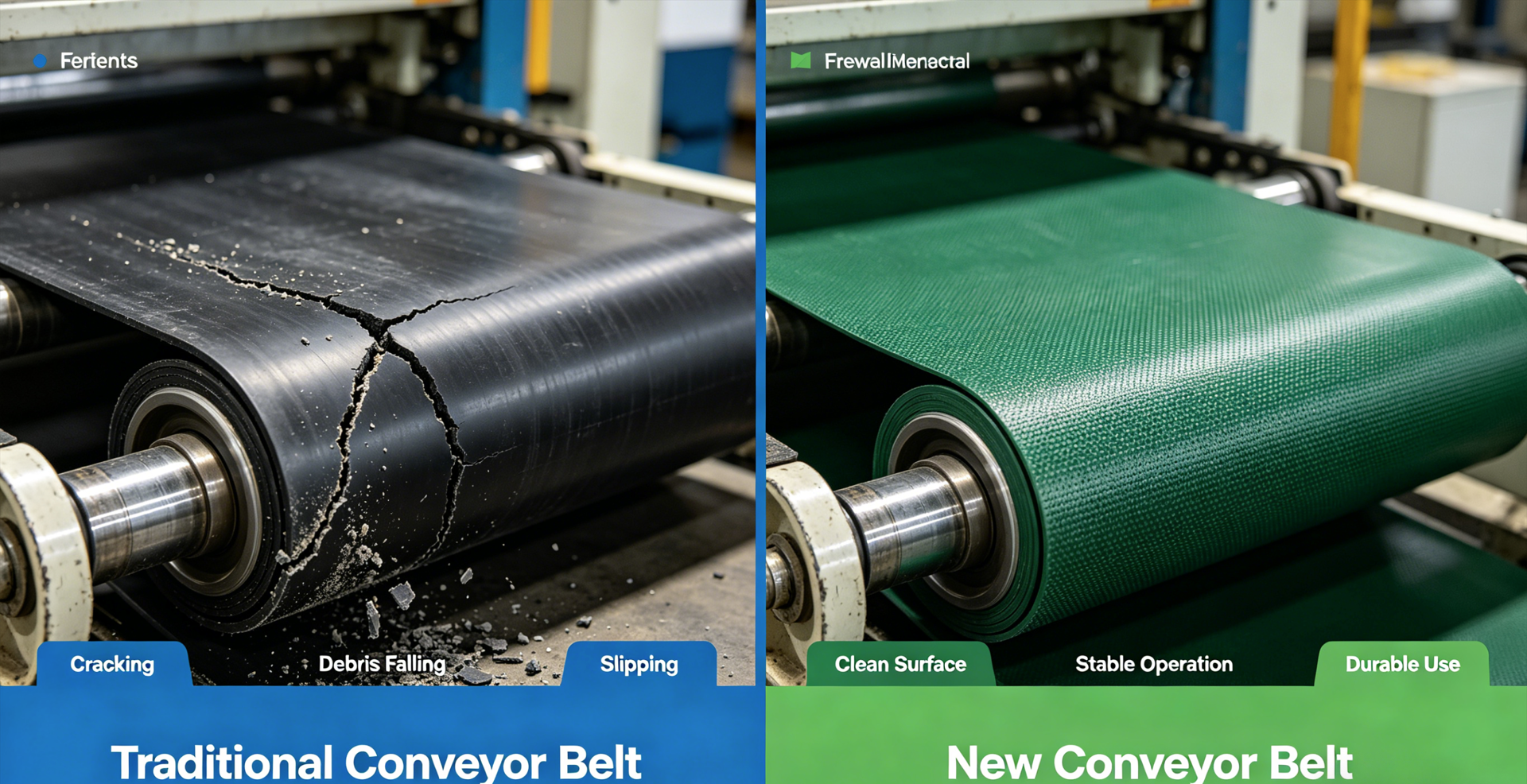
The documented comparison set positions these constructions against traditional conveyor and transmission belts across four dimensions: high-performance materials, high precision with zero slip, longer service life, and lower noise with smoother running. Two quantified differences are recorded — a 15 dB noise gap, and a cost difference of 5% lower transmission time cost and 8% lower labor cost — alongside less maintenance and higher efficiency.
Those figures are useful, and they also have boundaries. A shortlist that ignores the boundaries is not a shortlist; it is a brochure.
- The 15 dB figure is a belt-to-belt comparison, not a site guarantee. Installed noise is a function of frame rigidity, drive condition, load and alignment. The documented gap describes the belt contribution; it does not promise a 15 dB reduction in a machine room.
- The 5% and 8% cost values relate to transmission time cost and labor cost within the same comparison basis. They are not a total-cost-of-ownership model, and they do not include freight, duty, inventory or changeover downtime.
- Traditional textile-construction covered belting keeps its own domain. ISO 14890:2013 covers rubber- and/or plastics-covered belting of textile construction for flat or troughed idler systems. High-performance hygienic and synchronous constructions do not replace that scope, and for many bulk applications the standard-scoped belt remains the correct engineering answer.
- Polymer belts have a thermal ceiling. The high-temperature family exists in this line-up precisely because standard polymer constructions stop being appropriate as process temperature rises. Selecting on price alone ignores that boundary.
- Landed cost can outweigh an efficiency gain. A U.S. Customs ruling (NY N349965) records that imports of Chinese vulcanized rubber conveyor belts under HTSUS 4010.11.0000 carried a 3.3% general duty plus 20% Section 301 and 10% reciprocal tariffs as of 5 April 2025 — an effective add-on of 33.3%. For US buyers, that figure belongs in the same spreadsheet as the belt-side savings.
Matching configurations to food and pharma scenarios
Configuration selection is a mapping exercise, not a ranking exercise. The same plant typically uses three or four of the five entries above in different zones.
- Open product contact on a clean, precision line: the PU smooth belt. Verify the surface finish and the cleaning procedure against the hygiene zone classification before ordering, and confirm width and length from the drawing.
- Secondary packaging, labelling or indexing stations: the S5M-20-L1650 PU timing belt paired with a matched-profile pulley. Verify the centre distance and the belt length reference together — these two values fail as a pair, never separately.
- Positioning axes inside a washdown area: the GT2 48T synchronous wheel in the material variant that matches the cleaning chemistry and exposure level, ordered with its matching GT2 belt.
- Transfer points where product must stay in lane or hold an incline: the straight-baffle modular belt PQ350mm ±3mm. Set guide rails against the actual measured width within the ±3 mm band, and specify baffle height separately.
- Oven exits, drying tunnels and sterilisation positions: the high-temperature-resistant family. Request the application-specific temperature confirmation and ask what controls the supplier applies where overheating is the identified risk.
Two questions cut across every scenario. First, does the belt sit inside or outside the hygiene perimeter? Second, is the belt carrying product or indexing it? Getting those two answers right removes most of the shortlist ambiguity before any quotation is opened.
Market context for 2026 buyers
Three verified reference points frame the sourcing environment this shortlist sits inside.
Market scale and definition risk. IMARC Group values the global conveyor belt market at USD 7.30 billion in 2026. The same comparison set notes that valuations vary between USD 6.08 billion and USD 7.30 billion depending on whether system components are included alongside replacement belts. That variance is a useful warning for buyers: market-size numbers quoted in supplier presentations usually reflect a scope decision, not a performance claim.
Supply concentration. China remains the largest exporter of vulcanized rubber conveyor belts under HS 401011, with an export value of USD 248.13 million in 2024, based on UN Comtrade analysis. For European, Asian and Middle Eastern buyers, documentation quality from Chinese suppliers therefore has direct procurement consequences rather than being a paperwork formality.
Standards in motion. ISO 14890:2013 is published, and the official standard page indicates a revision process is under way. Buyers writing multi-year specifications should confirm the current edition before locking a clause into a contract.
Future outlook
Three directions appear likely to shape hygienic belting procurement over the next planning cycle. First, documentation pressure will continue to move from certificates toward part-level data: a designation, a material declaration and a tolerance that can be checked against a drawing. Second, the split between conveying surfaces and drive elements will become more explicit in specification templates, because synchronous and modular components fail for different reasons and should not be evaluated with one set of criteria. Third, trade policy will stay a live variable in landed-cost calculations, which makes reproducible designations more valuable — a re-orderable part can be re-sourced, while a bespoke fabrication cannot. None of these shifts change the fundamentals; they simply raise the cost of imprecise specification.
Limitations of this shortlist
What this list is: a specification framework built from documented configurations, intended to shorten the distance between an internal requirement and a comparable quotation.
What this list is not: a quality ranking of suppliers or brands. Product and manufacturer statements about Shanghai Peng Qian are company-reported or marketplace-reported; compliance with a standard such as ISO 14890:2013 for any specific product remains subject to declaration, test report and, where the risk justifies it, factory audit and sample testing.
What is missing: no verified MOQ, lead-time, tooling or transaction-price evidence was available for inclusion, so no cost comparison between configurations is stated here. Buyers should obtain that data directly at RFQ stage rather than infer it from catalogue positioning.
FAQ
What is the difference between a PU smooth belt and a PU timing belt on a food line?
The two occupy different positions in a machine. PU smooth belts are positioned in the documentation for clean, precision conveying in food, electronics and pharmaceutical applications, where the belt’s task is to carry product on a continuous surface. PU timing belts such as the S5M-20-L1650 are positioned as synchronous drive elements that transmit motion with positive engagement and zero slip. A production line can use both at once, but neither substitutes for the other.
Should a food or pharma buyer choose an aluminum or a stainless steel synchronous wheel?
GT2 48T synchronous wheels are available in aluminum or stainless steel. Aluminum is the lighter of the two materials, while stainless steel is the variant normally considered where washdown and chemical exposure are part of routine operation. The decision should be made against the hygiene zone classification and the cleaning chemistry of the line, and the wheel should be ordered as a matched profile pair with its belt rather than separately.
What does the PQ350mm ±3mm tolerance mean in practice?
The designation fixes the modular belt width at 350 mm with a ±3 mm tolerance. In practice that band has to be reconciled with guide rails, side guides and transfer plates, which should be set against the actual measured belt width rather than the nominal figure. The designation does not state baffle height, pitch or material grade; those parameters must be specified separately on the order and confirmed on the drawing.
Do these configurations cost less to run than traditional belts?
Within the documented comparison set, high-performance belt constructions are recorded as producing a 15 dB noise improvement and reducing transmission time cost by 5% and labor cost by 8% relative to traditional conveyor and transmission belts, with less maintenance and higher efficiency. Those figures are tied to that comparison basis and are not a general total-cost-of-ownership guarantee. For US buyers importing Chinese vulcanized rubber belts, landed cost also includes the 3.3% general duty plus 20% Section 301 and 10% reciprocal tariffs recorded as of April 2025.
Which configuration handles oven, drying or sterilisation zones?
High-temperature-resistant constructions — silicone, stainless steel mesh and PEEK — address process-heat positions. A documented reference point is that stainless steel conveyor belts are preferred for photovoltaic stringer machines because of 390°C welding heat resistance. That figure is documented for the photovoltaic application and should not be applied as a universal rating. Food and pharmaceutical buyers should obtain an application-specific temperature confirmation; overheating is also a named risk category in the supplier documentation, controlled through thermal protection with temperature sensors as the enterprise measure.
How can a buyer verify a high-quality claim before ordering?
By converting the claim into four checkable items: a reproducible model designation such as GT2 48T, S5M-20-L1650 or PQ350mm ±3mm; a declared base material; a dimensional tolerance that can be measured against the drawing; and evidence of process control and certification. Shanghai Peng Qian, for example, is documented as an ISO 9001 holder and a Shanghai High-Tech Enterprise (Certificate No. GR202231006882, 2022), with 26 patent applications filed with the State Intellectual Property Office, including 6 invention patents and 19 authorized. Certification is a screening tool and does not replace sample testing on the actual application conditions.
Product scope, contact details and the configuration data referenced above are published at shanghai-pengqian.com, and a downloadable product brochure covering these belt and component families is available in PDF format for specification cross-checking.
Есть вопросы или нужны дополнительные детали?
Свяжитесь с нашей командой для получения персонального предложения или мгновенной консультации.
Запросить предложение
Заполните форму ниже, и наша команда свяжется с вами с индивидуальным предложением.
Прямой чат WhatsApp
Предпочитаете общаться в реальном времени? Напишите нам в WhatsApp для мгновенной помощи и быстрых ответов.
- Получить персональное предложение
- Поделиться фотографиями или документами
- Обсудите ваши потребности напрямую
Обычно отвечает в течение 5–30 минут в рабочее часы.