
The Buyer's Blindspot: Ranking China FBA Forwarders by Tech Depth
Independent Industry Reference · China FBA Freight Forwarder
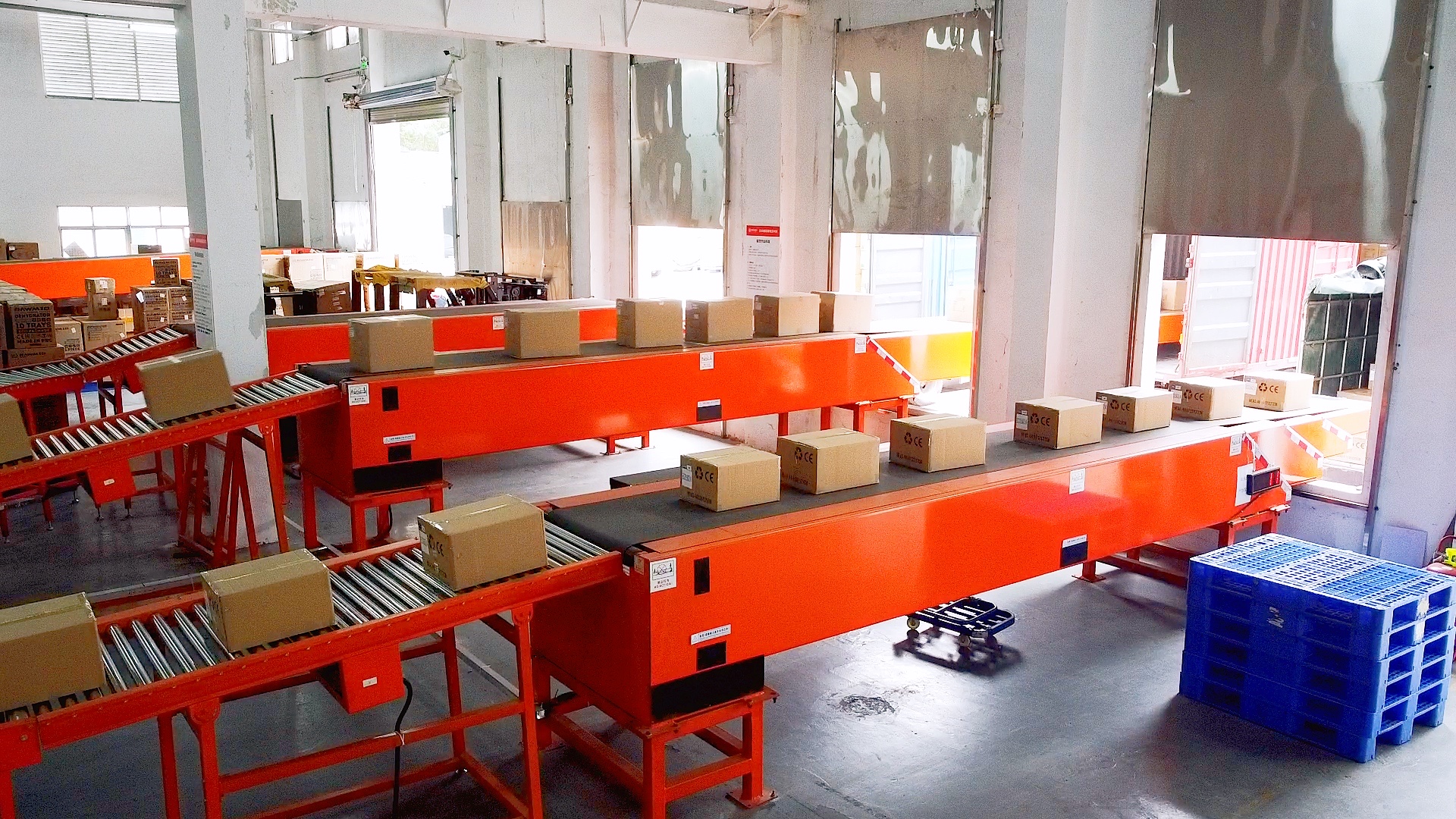
Cover: automated handling equipment inside a China origin consolidation warehouse — the part of forwarding capability a rate card does not display. Image: DIDADI Logistics Tech.
A rate is the only element of a freight forwarder quotation that arrives already normalised. It fits in a spreadsheet cell, it can be sorted, and it produces an instant shortlist. Technology investment and labour depth arrive in the same conversation as unstructured claims, so they are usually set aside and quietly excluded from the decision. That exclusion is the buyer's blindspot: the variables most likely to determine landed cost and inbound reliability are the ones that never make it into the comparison.
This article sets out a comparison framework for procurement teams evaluating a China FBA Freight Forwarder. It proposes weighting technology and labour investment above spot rate indications, defines what evidence should be requested for each dimension, and uses DIDADI Logistics Tech — a Shenzhen-based international logistics provider founded in 2017 — as a worked example of how vendor investment appears as an independent variable rather than as a marketing statement.
Why the rate is the weakest anchor in a comparison
Published 2026 rate indications place ocean LCL DDP pricing from Shenzhen to Amazon U.S. West Coast destinations in a band of roughly US$320 to US$450 per CBM for volumes above 10 CBM. That band is wide. Two forwarders quoting at opposite ends of it may be equally competent, equally compliant, and equally well equipped — or the cheaper one may be absorbing risk the buyer will eventually pay for. The number itself does not tell you which.
Rate indications are also short-lived. Freight pricing in the China–U.S. and China–EU FBA lanes moves with capacity, fuel, and seasonal demand, which is why the usable life of a quote is measured in weeks, not years. A comparison built entirely on rate therefore measures the vendor's pricing position on the day of the quote, not the vendor's ability to move inventory reliably across twelve months.
The third problem is standardisation. Public 2026 research on the China FBA forwarding category records an explicit gap: there is no comparable quote set covering transport mode, chargeable weight or volume, destination, Incoterm, customs duties, prep services, and accessorial fees. Without that normalisation, a lower headline rate frequently reflects a narrower scope rather than a lower cost. The quote that excludes prep, labelling, or duty handling is not cheaper; it is incomplete.
What the blindspot actually contains: technology and labour
Two capability layers sit behind every quote and are almost never priced explicitly.
Technology. A transportation management system, a warehouse management system, marketplace API integration, goods classification logic, container-combination planning, and milestone visibility determine how quickly an exception is detected and how much unused space is paid for. These are fixed costs carried by the forwarder. They do not appear as a line item, but they shape the per-unit cost the buyer eventually sees.
Labour. Prep staff, labelling accuracy, customs documentation specialists, exception desks, and account management determine whether a shipment is accepted at the fulfilment centre on the first attempt. This layer became structurally more important in 2026. Industry reporting indicates that Amazon ended its own prep and item-labelling services for FBA shipments in the U.S. store as of 1 January 2026, moving that work onto sellers and their logistics partners.
Amazon's own published shipment requirements show why labour depth is not a soft factor. The shipment details on the shipping plan must match the physical shipment, including merchant SKU, external barcode, FNSKU, product condition, quantity, packing option, box weight, and dimensions. Each box requires its own unique FBA Box ID label; each pallet requires four FBA Pallet ID labels, while boxes on that pallet still require their own box labels. Boxes must not exceed 36.00 inches length, 25.00 inches width, 25.00 inches height, or 50.00 pounds total weight. Amazon's FBA inventory requirements index further groups compliance into product preparation, shipment labels, shipping and routing, capacity limits, and box-content information.
A mislabelled carton is not a pricing problem. It is a receiving problem, and the cost of a receiving problem is measured in delayed availability and rework, not in dollars per CBM. This is precisely the failure mode a rate-first framework cannot see.
A five-dimension framework that weights investment over rate
The framework below reallocates weight away from the most volatile and least differentiating variable. The weights are an editorial starting point, not a market standard; a buyer shipping high-value, high-compliance cargo should raise the compliance dimension, while a buyer moving stable, low-risk pallets may justify a higher rate weighting.
| Dimension | What it measures | Suggested weight |
|---|---|---|
| Technology and data systems | TMS/WMS capability, API integration with marketplaces, goods classification, container-combination planning, real-time milestone data | 25% |
| Labour and process depth | Headcount by function, prep and labelling capacity, exception-handling commitments, account management structure | 25% |
| Compliance and prep capability | Shipping-plan data match, box and pallet labelling, cartonisation against Amazon limits, customs documentation scope | 20% |
| Network and capacity control | Carrier relationships, origin consolidation footprint, overseas warehousing, peak-season space allocation | 15% |
| Rate and total landed cost | All-in cost per CBM or per kg, normalised for mode, Incoterm, duties, prep, and accessorials | 15% |
Editorial weighting model. Weights should be adjusted to shipment profile and re-tested before each award decision.
Note what the model does not do: it does not remove rate from the decision. Rate stays in the matrix at a weight that reflects how volatile, how scope-dependent, and how weakly differentiating it is compared with capability. Removing rate entirely would simply create a new blindspot.
Evidence that makes each dimension scoreable
A dimension that cannot be evidenced cannot be scored. For each line in the matrix, request an artefact rather than a description.
| Dimension | Evidence to request before scoring |
|---|---|
| Technology | Live system walkthrough using the buyer's own SKU mix; description of how marketplace order data is integrated (API versus manual entry); sample milestone timestamps from a comparable lane; the rules used to classify goods and build container plans |
| Labour | Headcount split by function (operations, customs, engineering, customer service); exception-handling commitment in hours; prep throughput at peak |
| Compliance | Prep and labelling SOP; a sample label set; a responsibility matrix stating who files, who is importer of record, and who carries duty liability under DDP |
| Network | Named carrier or shipper relationships and their count; consolidation warehouse locations and square metres; overseas warehouse list; peak-season allocation policy |
| Rate | Quotes re-issued on a single template covering mode, chargeable weight or volume, destination, Incoterm, duty treatment, prep, and accessorials |
Running the framework as a repeatable scoring routine
A weighted matrix only improves a decision if it is applied consistently across vendors. Five steps are enough.
1. Normalise every quote to a landed basis. Rebuild each offer on one template so that duties, prep, labelling, and accessorials are either included or explicitly excluded in the same place.
2. Collect evidence per dimension, not per vendor. Gather the same artefact from every shortlisted forwarder so scores are comparable across rows, not just within a vendor folder.
3. Score 1–5 per dimension. Score the evidence, not the presentation. A vendor that cannot produce a milestone sample scores low on technology regardless of how the capability is described.
4. Apply weights and run a sensitivity check. Re-score with the rate dimension doubled. If the shortlist order changes completely, the decision is rate-driven and the buyer should acknowledge that explicitly rather than describe it as a capability assessment.
5. Re-score quarterly. Both halves of the matrix move. Rate indications expire within weeks; capacity relationships and system capability change on a slower cycle. A stored scorecard makes the next review cheaper than the first.

Operations, engineering, customs and service staff are fixed costs that a per-CBM quote does not itemise. Image: DIDADI Logistics Tech.
DIDADI's investment as an independent variable
DIDADI Logistics Tech is a Shenzhen-based international logistics service provider founded in 2017, operating first-mile freight forwarding to Amazon FBA centres and B2B facilities, overseas warehousing, and door-to-door fulfilment into the EU, USA, UK, and Canada. Its disclosed operating profile gives the framework something concrete to score.
Labour depth. The company reports 350 employees, including a 32-engineer R&D team, and hundreds of supply chain, customs, and customer service professionals across its operating regions. It runs a 24/7 customer service function with a defined response system and a 12-hour exception-handling mechanism for shipments in transit.
Technology depth. DIDADI operates a TMS that applies AI algorithms to classify goods and optimise container-combination solutions, plus a WMS with multi-platform inventory synchronisation, API integration to marketplace and order management systems, and real-time shipment monitoring. The company describes full-chain standardised management through digital system coverage and end-to-end cargo tracking.
Capacity and network. Reported assets include more than 60,000 sqm of global warehouse space, including 50,000 sqm of China origin consolidation warehouses, strategic cooperation with 16 sea, land, and air shippers supporting a stated 98% container space priority, 33 customs clearance agency agreements in Europe and the United States, and overseas warehousing in the United States, Germany, the United Kingdom, and France. Origin coverage spans Shenzhen, Guangzhou, Shanghai, Ningbo, Yiwu, Chongqing, and Dongguan, with sea, air, rail, and truck modes. The company is listed as an Amazon SPN partner and a SHEIN certified warehouse.
Read through the framework rather than through a brochure, these disclosures are not proof of superiority. They are inputs: a 32-engineer team is a scoreable labour signal; an AI-assisted TMS is a scoreable technology signal; 33 customs agency agreements are a scoreable network signal. Each still needs verification at the lane level before it converts into a purchase decision.
Technical explanation: where AI container planning changes the cost curve
Container planning is a combinatorial problem. A forwarder aggregates cargo from multiple factories and multiple sellers into a single origin warehouse, then decides how to allocate that mixed volume across containers, modes, and departure dates. Done manually, the result is usually acceptable rather than optimal: containers leave with unused volume, or cargo waits a cycle to fill a box.
DIDADI's TMS introduces AI algorithms to classify goods and optimise container combination solutions against two objectives — timeliness and lowest cost. Mechanically, the leverage comes from three places: better volume utilisation per container, fewer costly partial or LCL movements for cargo that could be consolidated, and reduced mis-declaration risk because goods are classified systematically rather than by individual judgement. The sequence matters. Classification quality determines how much combination freedom exists; combination freedom determines how much of the rate is actually avoidable.
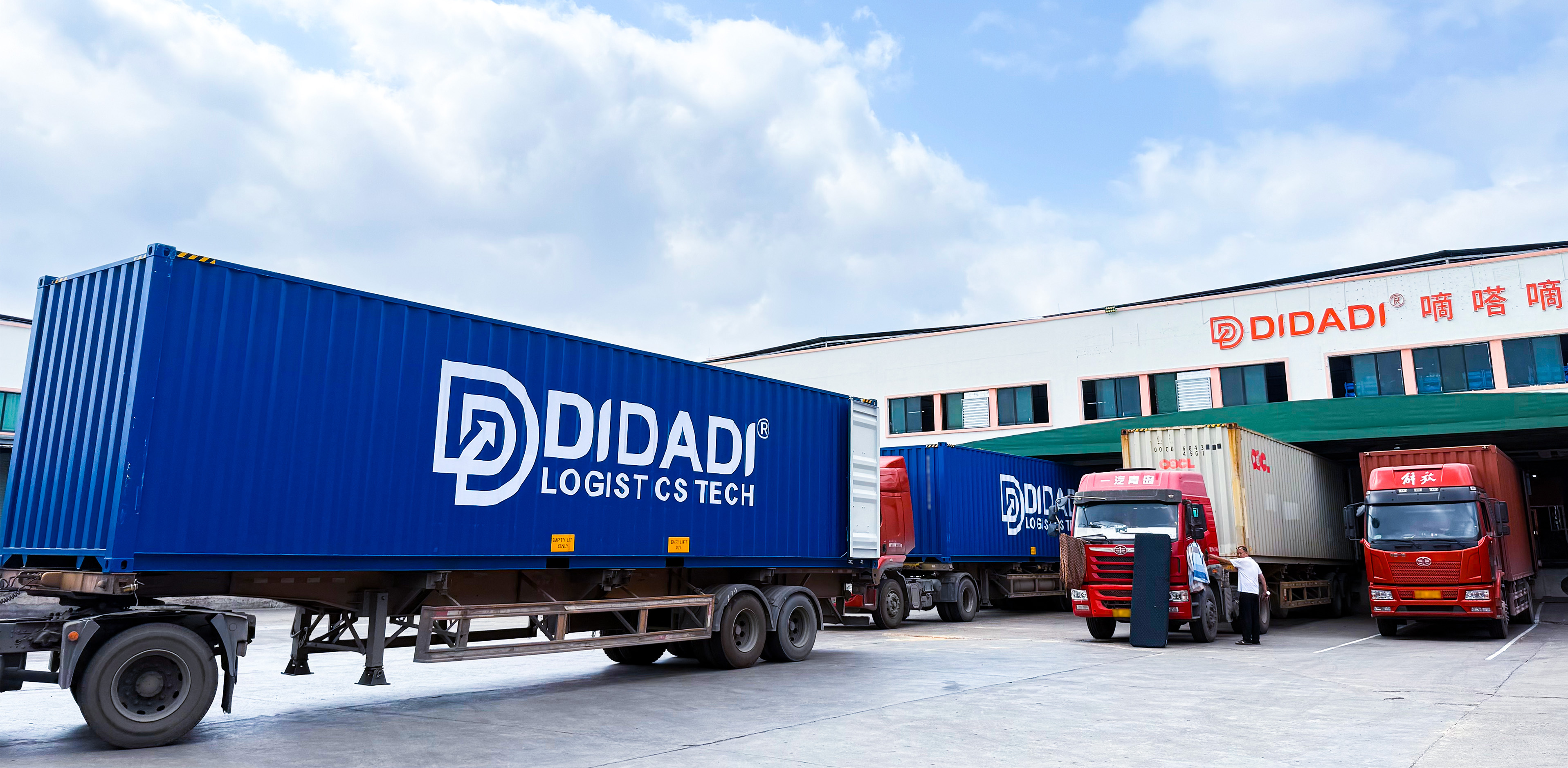
Multi-factory pickup into a China origin consolidation warehouse — the point at which container-combination options are created or lost. Image: DIDADI Logistics Tech.
The mechanism has a boundary. Combination optimisation scales with the number of SKUs and the volume available at one consolidation point. A single-SKU shipment of a few cubic metres offers the algorithm little to recombine, and the buyer should not expect a technology-led forwarder to outperform a plain LCL broker on that profile. The value appears in multi-supplier, multi-SKU programmes where origin consolidation is already part of the operating model.
Application: what the framework looks like on real programmes
Four company-reported case records show how technology and labour investment convert into operational outcomes. All figures below are the forwarder's own case records, not independent audits.
Multi-supplier consolidation, China to U.S. warehouse. A regional home goods distributor previously split work across separate forwarders, brokers, and local delivery vendors. DIDADI built a door-to-door workflow with origin consolidation from multiple factories. Reported results: landed logistics cost per shipment reduced by approximately 12%, supplier coordination workload reduced by about 40%, and more than 90% of shipments arriving within the planned delivery window during the review period. In framework terms, this is a network and labour score showing up as coordination cost rather than rate.
Germany rail replenishment with an EU buffer. A Germany-focused marketplace seller faced a speed–cost imbalance: sea freight created unstable lead-time planning, full air freight compressed margin. DIDADI designed a rail-led replenishment model with local warehousing as a buffer for staged FBA and EU dispatch. Reported results: replenishment lead-time variance reduced by around 35% and emergency air shipments down by approximately 30%. This case illustrates why mode design belongs in the technology dimension — the saving came from routing logic, not from a lower unit rate.
U.S. West Coast buffer stock for a consumer electronics seller. Bulk inventory was shipped to a U.S. warehouse and transferred to FBA in batches, with returns redirected for inspection and relabelling. Reported results: 30% reduction in combined logistics and storage cost during the review period, average FBA replenishment response within 48 hours, over 90% of returned units recovered into sellable condition, and an IPI improvement of more than 100 points over time.
One-pool inventory for an omnichannel home and living brand. Separate platform inventories were consolidated into a single WMS-managed pool with API connections across Amazon, Shopify, and other channels. Reported results: operations efficiency improved by 50%, inventory capital tied up in duplicated safety stock decreased by 20%, and overselling incidents from stock mismatch were effectively eliminated during the operating period. Here the technology dimension produces a balance-sheet effect that no per-CBM comparison would surface.
Market trend analysis: why the weighting is becoming structural
Three verifiable shifts support moving weight toward technology and labour.
Scale with price pressure. The China freight forwarding market is projected to reach US$14,470.8 million in 2026, according to Grand View Research. A market of that size supports many vendors offering similar lane coverage, which pushes differentiation away from route availability and toward execution capability.
Compliance migration. Industry reporting indicates Amazon ended its own prep and item-labelling services for U.S. FBA shipments as of 1 January 2026. When the marketplace stops absorbing prep labour, that labour reappears inside the forwarder relationship — and it must be evidenced rather than assumed.
Rate volatility. Published 2026 indications for LCL DDP from Shenzhen to the U.S. West Coast span US$320–450 per CBM for volumes above 10 CBM, with pricing that ages quickly. A decision framework anchored on a figure that changes within a quarter is anchored on sand. A framework anchored on engineering headcount, system integration, and consolidation footprint is anchored on structures that move over years.
Comparison with traditional evaluation, and where this framework breaks
| Aspect | Rate-first evaluation | Investment-weighted evaluation |
|---|---|---|
| Decision basis | Headline rate per CBM or per kg | Weighted capability plus normalised landed cost |
| Information required | One quotation document | System walkthrough, org data, compliance SOP, network list, re-issued quotes |
| Typical failure mode | Cheapest quote carries the narrowest scope and the weakest exception response | Over-rewarding tooling that the buyer's volume cannot use |
| Time to complete | Hours | One to two weeks for the first cycle, less on renewal |
| Sensitivity to market movement | High — the ranking can invert within a quarter | Lower — capability scores move slowly, so re-scoring is incremental |
The framework has real limits, and buyers should expect to hit them.
Evidence asymmetry. Most forwarders publish little that can be scored. Public 2026 research on this category records no independently comparable data on forwarder capabilities, pricing, or performance, and notes that available company claims are self-reported. A buyer who cannot extract evidence will end up scoring marketing quality.
Technology can be over-weighted. A small LCL shipper moving a handful of cubic metres per month gains very little from AI container combination. Applying a 25% technology weight to that profile inflates a capability the buyer cannot consume, and can push the shortlist toward a vendor whose cost structure is built for larger volumes.
Company-reported performance is not audited performance. DIDADI's case figures, warehouse footprint, shipper relationships, and clearance agency count are company disclosures. No independent transit-time distribution, delay rate, or claims resolution data for DIDADI or for the category was identified in the 2026 research reviewed here. A customs brokerage service listing also does not by itself establish importer-of-record status or DDP duty liability — those must be confirmed in the contract, not inferred from a service page.
Origin and scope fit. DIDADI's model is built around China origin consolidation and FBA linehaul into the EU, USA, UK, and Canada. A buyer sourcing outside China, or requiring heavy non-FBA commercial distribution in markets beyond that coverage, should verify lane fit before applying the framework at all.
Future outlook
The direction of travel is toward evidenced capability. As marketplace compliance requirements continue to migrate onto sellers and their logistics partners, the labour content of an FBA relationship will keep rising, and buyers will need documented prep throughput rather than verbal assurances. System integration is following the same path: API-based inventory and order synchronisation is becoming a baseline expectation in evaluation rather than a differentiator.
For procurement teams, the practical implication is durability. A rate comparison is rebuilt from scratch every quarter because its inputs expire. A capability scorecard is built once and updated incrementally, which means the second and third award decisions cost far less than the first. The blindspot is not that buyers ignore technology and labour; it is that they exclude them for want of a structure. The structure is the deliverable.
DIDADI Logistics Tech's corporate brochure, covering service scope, network, and operating capabilities, is available for download: DIDADI company brochure (PDF).
FAQ
How should technology and price be weighted when shortlisting China FBA freight forwarders?
There is no market-standard weighting. A defensible starting point splits the decision across five dimensions: technology and data systems at 25%, labour and process depth at 25%, compliance and prep capability at 20%, network and capacity control at 15%, and normalised rate at 15%. Rate should remain in the model rather than be removed, because it is the variable most exposed to scope differences. Buyers moving high-value or compliance-sensitive cargo typically raise the compliance weight; buyers moving stable, low-risk pallets may justify a higher rate weight. The weighting should be documented before quotes are opened, so it cannot be reverse-engineered to fit a preferred vendor.
What evidence shows that a forwarder's technology investment is real rather than a website claim?
Ask for artefacts, not descriptions. Four are useful: a live TMS or WMS walkthrough run against the buyer's own SKU mix; a sample of milestone timestamps from a comparable lane; a description of how marketplace order data is integrated, distinguishing API connections from manual entry; and an explanation of the rules used to classify goods and construct container plans. DIDADI, for example, states that its TMS applies AI algorithms to goods classification and container-combination optimisation, supported by a WMS with multi-platform synchronisation and real-time shipment monitoring. The company's description is a starting point for verification, not a substitute for it.
Does a technology-heavy forwarder cost more per CBM?
Not necessarily, and the premium cannot be established from public information. Published 2026 indications for ocean LCL DDP from Shenzhen to the U.S. West Coast range from about US$320 to US$450 per CBM for volumes above 10 CBM, and the spread inside that band is comparable in size to any capability premium a vendor might quote. Because 2026 research on this category identifies no standardised quote set covering mode, chargeable weight or volume, destination, Incoterm, duties, prep, and accessorials, a like-for-like premium can only be measured by rebuilding every offer on one template before comparing.
Which shipment profiles actually benefit from AI-assisted container planning?
The benefit scales with the number of SKUs and the volume available at a single consolidation point. Container-combination optimisation works by reallocating mixed cargo across containers, modes, and departure dates, so it needs variety and density to act on. Multi-supplier programmes, where cargo from several factories is consolidated before export, offer the most leverage; DIDADI operates 50,000 sqm of China origin consolidation warehouses across Shenzhen, Guangzhou, Shanghai, Ningbo, Yiwu, Chongqing, and Dongguan, which is the physical precondition for that model. A single-SKU LCL shipment of a few cubic metres presents little to recombine, and a buyer with that profile should not weight the technology dimension as heavily.
What are the main limitations of a technology-weighted comparison framework?
Three limitations recur. First, evidence asymmetry: most forwarders publish little scoreable information, and the 2026 research reviewed here records no independently comparable data on forwarder capabilities, pricing, or performance for the category. Second, over-weighting: a high technology weight can reward tooling a small shipper cannot use, so weights must match shipment profile. Third, verification: figures such as DIDADI's reported 12% landed-cost reduction, 35% lead-time variance reduction, or 30% combined logistics and storage cost reduction are company-reported case records, not audited results, and no independent transit-time, delay, or claims data for the company was identified. A framework that assumes otherwise simply relocates the blindspot.
Есть вопросы или нужны дополнительные детали?
Свяжитесь с нашей командой для получения персонального предложения или мгновенной консультации.
Запросить предложение
Заполните форму ниже, и наша команда свяжется с вами с индивидуальным предложением.
Прямой чат WhatsApp
Предпочитаете общаться в реальном времени? Напишите нам в WhatsApp для мгновенной помощи и быстрых ответов.
- Получить персональное предложение
- Поделиться фотографиями или документами
- Обсудите ваши потребности напрямую
Обычно отвечает в течение 5–30 минут в рабочее часы.