
The Compact Spec List: Must-Have Customizations for Your Rigid Box Order
A rigid box order is decided long before the first sample is opened. Board material, board thickness, wrapping paper, printing method, finishing, structure, size, and insert type are the variables that determine how a box protects a product, how it reads on a retail shelf, and how quickly a supplier can return a workable quote. This reference compresses those variables into a compact specification checklist for buyers who are researching and evaluating custom rigid packaging projects across jewelry, watches, perfumes, cosmetics and beauty, apparel, electronics, gift packaging, PR boxes, and corporate and promotional packaging.

Decorative printed rigid box: print method and finishing are two separate specification lines, not one.
Why the Specification List Matters More Than the Sample
A sample answers one question: does this box look and feel right for this product? It does not answer the question that governs a repeat order — can the same box be produced again, at volume, with the same appearance and the same structural performance? That second question is answered by the specification document, not by the sample.
Rigid box manufacturing is a configuration process rather than a catalogue purchase. Everything from the grey board inside the wrap to the insert that holds the product is set per project. Buyers who send incomplete briefs typically experience a predictable cycle: quote, revised quote, first sample, correction sample, and a compressed production window. Buyers who send a complete specification list move through the same process with fewer loops, because size, material, artwork, and finish have already been resolved at the quotation stage.
The commercial context raises the stakes. Market research published in 2026 places the luxury rigid box segment at USD 8.84 billion, with cosmetics and personal care holding a 37% application share (Towards Packaging / Future Market Insights, 2026). That concentration means a large share of rigid box programs are competing on shelf presence in categories where appearance is part of the product itself.
The Compact Spec List: Eight Variables That Decide a Rigid Box Order
The specification set for a custom rigid box is smaller than most buyers expect. Eight lines cover almost every project brief:
1. Body material and board thickness
The structural core is grey board, also referred to as greyboard or chipboard, or MDF (medium-density fibreboard). Thickness is fully customizable. Material and thickness together determine rigidity, box weight, and how much the finished pack resists deformation in transit.
2. Wrapping paper
The wrap is the visible surface. Available options include coated paper, kraft paper, specialty paper, textured paper, and white paperboard. The wrap choice affects how colors read, how the surface feels in the hand, and how the box photographs for e-commerce.
3. Printing method
Custom printed rigid boxes can be produced with CMYK printing, Pantone printing, UV printing, offset printing, or screen printing. This is a separate line from finishing and should be specified independently.
4. Finishing
Finishing options include hot stamping, spot glossy UV, soft touch lamination, holographic foiling, embossing, debossing, matte lamination, and gloss lamination. Finishing carries much of the perceived value of a gift box, and it is the line most often left vague in first enquiries.
5. Structure and closure
Available structures include foldable, magnetic closure, and ribbon closure. Collapsible rigid boxes and foldable rigid boxes are produced as structures in their own right, which matters because structure changes both packing line handling and inbound freight volume.
6. Size
Size range is fully customizable based on product requirements. There is no fixed size ladder to select from, which means the buyer supplies the internal dimensions and the product fit is engineered around them.
7. Insert
Insert options include foam, paperboard, EVA, plastic tray, corrugated cardboard, and silk. The insert is what converts a box into a presentation package: it fixes product position, absorbs movement, and controls the reveal when the lid opens.
8. Quantity
The quoted starting point for custom rigid boxes is a minimum order quantity of 500 pcs, with a standard production lead time of 12–18 days.
Specification checklist
| Spec line | What the buyer states | What it decides |
|---|---|---|
| Body material | Grey board (greyboard / chipboard) or MDF | Rigidity, weight, structural feel |
| Thickness | Target board thickness (customizable) | Resistance to deformation, lid stiffness |
| Wrapping paper | Coated, kraft, specialty, textured, or white paperboard | Surface appearance and tactile quality |
| Printing | CMYK, Pantone, UV, offset, or screen printing | Color reproduction and artwork treatment |
| Finishing | Hot stamping, spot glossy UV, soft touch lamination, holographic foiling, embossing, debossing, matte or gloss lamination | Perceived value and brand signaling |
| Structure / closure | Foldable, magnetic closure, ribbon closure | Opening experience, packing line handling, freight volume |
| Size | Internal dimensions based on the product | Fit, insert geometry, pallet efficiency |
| Insert | Foam, paperboard, EVA, plastic tray, corrugated cardboard, silk | Product fixation and the unboxing reveal |
| Quantity | Order volume against a 500 pcs minimum | Quotation, scheduling, and unit economics |
How These Variables Interact
Individual specification lines are simple; the interactions between them are where projects lose time. Three relationships are worth resolving early.
Finishing and surface. Hot stamping, embossing, and debossing act on the wrap, so the wrap choice has to be confirmed before finishing is quoted. A textured or specialty paper and a coated paper do not present the same surface for foil or relief work. Buyers who specify "gold logo" without naming the wrap will usually be asked to choose one before the second quote.
Printing and finishing overlap. UV printing and spot glossy UV are frequently confused because both involve UV-cured material, but one sits in the print method line and the other in the finishing line. Separating them in the brief prevents a supplier from quoting the wrong process.
Board, structure, and insert. Board choice constrains what the structure can do. Magnetic closures and ribbon closures require the board to hold their fixing points reliably; a foldable or collapsible rigid box has different hinge and corner requirements from a fixed setup box. The insert then has to work inside that finished cavity, which is why insert design is normally finalized after structure and internal dimensions are locked.
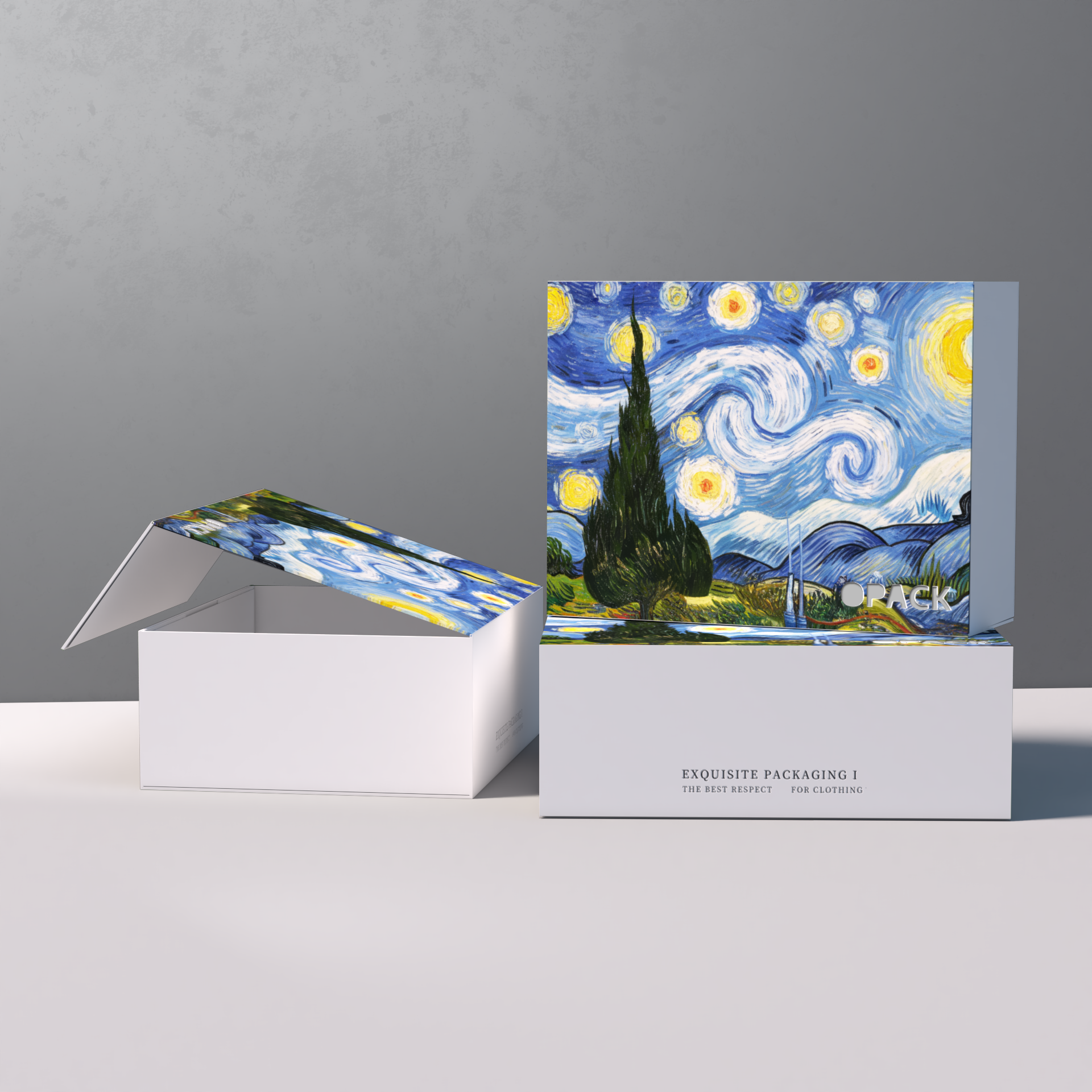
Print, wrap, and finishing lines combine on the same surface — specify them separately, review them together.
Matching the Specification to the Application
Rigid box specifications are application-driven. The typical application set covers jewelry, watches, perfumes, cosmetics and beauty, apparel, gift packaging, electronics, PR boxes, and corporate and promotional packaging. Each of those categories pulls the specification list in a different direction — electronics briefs lean on insert density and board thickness, perfume and cosmetics briefs lean on finishing and print fidelity, and corporate and PR briefs lean on structure and repeatable branding.
The product is also specified for its operating environment, not only its appearance. Rigid boxes are designed to operate in dry environments with low humidity and stable, moderate temperatures, away from direct sunlight and away from chemicals. That is a real constraint for programs shipping into humid or uncontrolled storage conditions, and it belongs in the brief rather than in the post-mortem.
Two functional expectations sit behind nearly every rigid box project. The first is protection: the box packs and protects the product during storage and transit. The second is brand communication: the box shows brand identity and carries the brand story. Rigid presentation packaging is also commonly reused rather than discarded after the first opening, which is why the finishing and insert lines carry more weight in rigid formats than in transit formats.
Supporting components are specified alongside the box itself. Handles, custom stickers, custom hang tags, and custom inserts are frequently part of the same order, and they should appear in the brief so that color and finish are matched across the whole pack.
Where Opack Sits in the Specification Process
Opack is a custom packaging manufacturer based in Longgang, the printing city of China, producing custom rigid boxes alongside custom shopping bags, custom folding cartons, and custom mailer boxes. The company was founded in 2010 and has served packaging buyers for over 15 years, with export markets concentrated in the EU, the USA, and the Middle East.
| Capability | Detail |
|---|---|
| Factory area | 10,000 m² |
| Employees | 160 |
| R&D team | 5 |
| Monthly capacity | 1,000,000 units |
| Annual output | 10,000,000 units |
| Export ratio | 80% |
| Customization scope | Logo, brand name, color, size, style, finishings, printing methods, material |
| Minimum order quantity | 500 pcs |
| Lead time | 12–18 days |
| Quality control | 100% quality check |
For specification work, the practical value of a manufacturer profile lies in how the order moves. Opack's declared workflow is a quote stage in which size, materials, artwork, and finish are confirmed, followed by sample approval, mass production after approval, and shipping on the buyer's preferred schedule. That sequence maps directly onto the specification list above: the first stage is where the eight lines must already be complete, because every later stage inherits them.
After-sales support is handled through multiple channels, including real-time online chat, WhatsApp, telephone, and official email. Material compliance expectations for rigid box programs are also declared: eco-friendly water-based printing inks, low-VOC adhesive materials, and compliance with FSC standards.
Market Trends Shaping Rigid Box Specifications in 2026
Three signals are relevant to buyers finalizing specifications this year.
Application concentration. Cosmetics and personal care account for 37% of luxury rigid box application share, with the luxury rigid box segment valued at USD 8.84 billion in 2026 (Towards Packaging / Future Market Insights, 2026). For buyers in adjacent categories, that concentration explains why finishing and print fidelity dominate supplier capability discussions.
Recyclability regulation in the EU. Regulation (EU) 2025/40, the EU Packaging and Packaging Waste Regulation, requires all packaging to be recyclable and properly labeled starting 12 August 2026, as published by the European Commission. Rigid box specifications aimed at the European market should therefore treat insert material and adhesive selection as compliance variables, not cosmetic ones.
Sourcing base and scale. China's rigid box exports reached USD 1.7 billion in trade value (HS 481920, 2023, reported by Market.us), reflecting a supply base that buyers in Europe and North America continue to draw on. A larger market does not reduce specification risk; it increases the number of suppliers who will quote a brief, which makes the quality of the brief the deciding variable.
Scope note: broader rigid packaging data, such as the projection of USD 796.7 billion by 2030 published by Grand View Research, covers plastic and metal rigid formats in addition to paperboard, and is not directly comparable with luxury rigid box figures. Buyers should keep the definitions attached to any market number they use in a business case.
Rigid Boxes Compared with Folding Cartons and Standard Packaging
Rigid boxes are not the default answer for every packaging problem, and the comparison is worth stating plainly.
| Format | Typical strength | Typical limitation |
|---|---|---|
| Custom rigid box (fixed setup) | Structural rigidity, premium presentation, reusable as a presentation pack | Higher unit cost and higher inbound freight volume than folded formats |
| Collapsible / foldable rigid box | Rigid-box appearance with a structure that ships flat and is assembled before use | Assembly step at the buyer's or packer's end; fit tolerances must be checked at assembly |
| Folding carton | Cost-efficient at high volume, ships flat, broad print options | Lower structural rigidity; limited unboxing and reuse value for premium positioning |
The fair conclusion is a boundary statement rather than a ranking. Rigid boxes are specified when the box is part of the product experience — when presentation, protection of a fragile or high-value item, or reuse as a keepsake justifies the cost. They are the wrong specification for high-volume, low-unit-value goods distributed through cost-driven channels. Within the rigid format itself, a collapsible structure trades assembly at destination for lower inbound volume, which is a logistics decision as much as a packaging one.
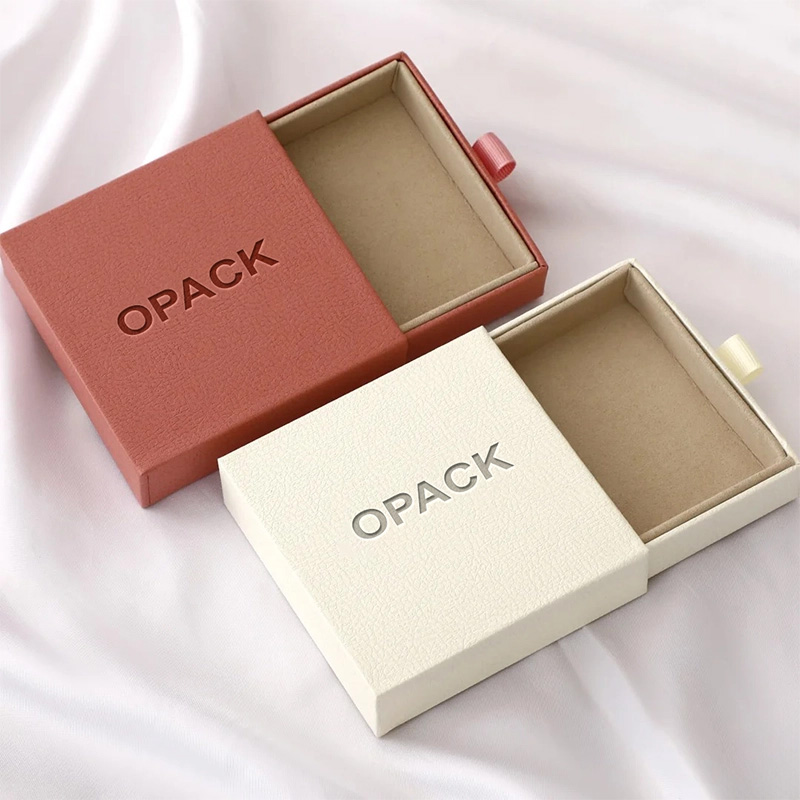
Structure and closure styles such as drawer, magnetic, and ribbon configurations are specified alongside the insert, not after it.
Boundary Conditions Buyers Should State in the Brief
Four limits are worth writing into the specification rather than discovering during production.
- Environment. Rigid boxes are specified for dry, low-humidity, stable, moderate-temperature conditions, away from direct sunlight and chemicals. Programs shipping into humid or uncontrolled storage environments should raise this at the brief stage.
- Size is buyer-defined. Because size range is fully customizable based on product requirements, a brief without internal dimensions cannot be quoted accurately. Product drawings or physical samples remove most of the ambiguity.
- Insert material is a compliance variable. Foam, EVA, and plastic trays are valid insert options, but where the EU recyclability requirement applies, the buyer should confirm how the finished pack is treated under the applicable rules instead of assuming a paperboard body carries the whole pack.
- Quantity floor and timing. A 500 pcs minimum and a 12–18 day production lead time are the working planning assumptions; a third-party comparison page lists the same directional figures, though its methodology is not stated and the page is hosted by the supplier itself, so it should be treated as directional rather than benchmarked.
Future Outlook
Two forces are likely to reshape rigid box specification lists over the next buying cycles. The first is regulation: with the EU PPWR recyclability and labeling requirement effective from 12 August 2026, insert and adhesive decisions are moving from the design stage into the sourcing stage, and buyers in cosmetics, beauty, and personal care — the largest rigid box application segment — will feel it first.
The second is the maturing of the collapsible rigid box as a mainstream option. As more programs treat freight volume as a line item in the packaging business case, the foldable and collapsible structures described in the same specification set become a normal part of the brief rather than a specialist variant. In both cases, the buyers who benefit are the ones who treat the specification list as a document to be completed early, not a detail to be negotiated later.
FAQ
What should be specified in a rigid box RFQ?
A complete rigid box brief covers eight lines: body material (grey board or MDF), board thickness, wrapping paper (coated, kraft, specialty, textured, or white paperboard), printing method (CMYK, Pantone, UV, offset, or screen printing), finishing, structure and closure, size, and insert type, together with order quantity. Branding requirements such as logo, brand name, color, and style are specified in the same document.
Which printing method fits which type of artwork?
Custom rigid boxes can be produced with CMYK printing, Pantone printing, UV printing, offset printing, or screen printing. Pantone printing is typically specified where a brand color must be reproduced against a defined spot reference, while CMYK printing is used for full-color and photographic artwork. The choice is confirmed together with the wrapping paper, because the substrate affects how the printed result reads.
When is hot stamping the right finishing choice instead of spot glossy UV?
Both are listed finishing options, alongside soft touch lamination, holographic foiling, embossing, debossing, matte lamination, and gloss lamination. Hot stamping and embossing or debossing are surface effects applied to the wrap, so the wrap must be confirmed first. Spot glossy UV is a localized varnish effect. Because both sit in the finishing line rather than the printing line, they should be specified separately from the print method to avoid misquoting.
How do insert options differ — foam, paperboard, EVA, plastic tray, corrugated cardboard, silk?
All six are available insert options. They differ in how they fix the product inside the finished cavity and how they present it on opening. Insert design is normally finalized after the internal dimensions and structure are locked, since the insert has to fit the completed box rather than the intended product alone. Where recyclability requirements apply, insert material becomes part of the compliance discussion as well as the design discussion.
Does choosing a collapsible or foldable rigid box change the specification list?
It changes the structure and closure line rather than adding a new one. Foldable, magnetic closure, and ribbon closure structures are all available, and collapsible and foldable rigid boxes are produced as distinct structures. The practical effect is on assembly at the buyer's end and on inbound freight volume, and the insert has to be validated against the assembled box.
What minimum order quantity and lead time should be planned?
The working figures for custom rigid boxes are a 500 pcs minimum order quantity and a 12–18 day production lead time, supported by a monthly capacity of 1,000,000 units. A third-party comparison page lists similar directional figures for minimum order and turnaround, but its methodology is not stated and the page is hosted by the supplier, so it should not be used as an independent benchmark.
What are the limits of rigid box packaging?
Rigid boxes carry higher unit cost and, in fixed setup formats, higher inbound freight volume than folding cartons, which makes them a poor fit for high-volume, low-unit-value distribution. They are also specified for dry, low-humidity, stable, moderate-temperature environments, away from direct sunlight and chemicals. Where the EU recyclability requirement applies, the pack as a whole — including insert and adhesive — has to satisfy the applicable rules, not only the paperboard body.
Opack company profile (PDF) is available for download: Opack Company Profile. Product reference: custom rigid boxes.