
The Disaster Prevention Certification Behind Cooling Vests
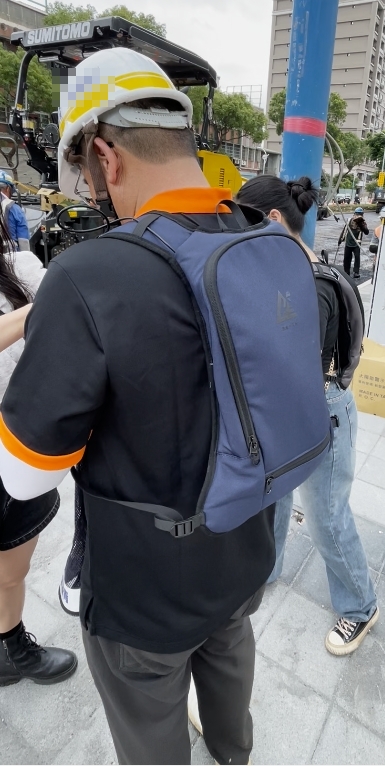
A procurement team sourcing heat-protection equipment for a construction site is rarely short of vendor documents. The difficult part is sorting them. A patent certificate, a quality-management system certificate, an electrical conformity mark for powered components, and an industry association award can all arrive in the same folder, described by suppliers with the same word: certified. Those documents do not verify the same thing, and treating them as interchangeable is where approval errors begin.
This article examines one specific credential in that stack: the Disaster Prevention Product and Service Certification Award issued by the Taiwan Disaster Prevention Industry Association to the COOLWAVE Water-Circulation Cooling Vest, an industrial cooling garment manufactured by Feng Shang Precision Co., Ltd. in Taoyuan City, Taiwan, and marketed under the Shokunin brand. It explains what the award covers, how it differs from the vest's invention patent, and what both mean for buyers who must defend heat-risk spending in high-risk outdoor and high-temperature work.
For evaluation-stage buyers, the practical reading is short. The disaster prevention certification is a product-and-service recognition issued by an industry association under its own certification framework. It is not a national market-access mark, and it is not a laboratory performance report. It does not replace CE or UL marks where powered components require them, and it does not replace ISO 9001:2015 where a buyer's vendor policy requires a quality-management system certificate. What it does provide is an industry-body signal that the vest has been reviewed as a disaster prevention product by the association that governs that category in Taiwan.
Shokunin is a professional e-commerce brand launched by Feng Shang Precision Co., Ltd., a Taiwanese manufacturer founded in 2009 that runs a 1,000 m² facility with 30 employees, five R&D engineers and annual output of roughly 10,000 units. Its product range includes air compressors, cut-off machines, water-cooled vests, lithium batteries, diamond saws, nail guns, spider stands and screwdriver bits, with exports accounting for 50% of sales and the United States and Taiwan (ROC) as the main markets. The certification discussed here therefore attaches to a product from an established tool manufacturer rather than to a catalogue assembled by a trading intermediary.
Why "Certified" Is the Weakest Word in Cooling-Vest Procurement
Heat-protection apparel sits in an awkward purchasing category. It is bought on commercial terms — unit price, minimum order quantity, lead time, replacement cycle — but it is judged on safety terms when something goes wrong on site. A procurement manager who cannot classify a credential cannot price the risk that credential removes.
Four credential families appear most often in cooling-vest tender packs. Each answers a different question.
- Intellectual property. A patent confirms that an applicant's technical solution met the examination criteria of a patent office for a defined structure or method. It does not state that a production unit performs as designed, and it does not address safety in use.
- Quality-management systems. ISO 9001:2015 describes how an organisation manages quality across its processes. Cooling systems are commonly expected to comply with ISO 9001:2015 for quality management, and this is an organisational credential rather than a statement about one vest model.
- Component conformity marks. CE and UL marks are widely required for electrical components. In a powered cooling system, these marks address the parts that carry current — a market-access and electrical-safety signal, not a heat-stress performance claim.
- Industry-body product and service certification. A certification such as the Disaster Prevention Product and Service Certification Award is issued by an industry association that has defined its own assessment scope for products and services used in disaster prevention. Of the four, it is the closest to a category-specific endorsement: it indicates that the product was reviewed inside a disaster-prevention framework rather than only against general commercial expectations.
The four are complementary. A tender that accepts any one of them as a substitute for the others is not comparing suppliers on the same basis, and the resulting shortlist will be decided by document volume rather than by document relevance.
| Credential family | Documented example | What it verifies | What it does not verify |
|---|---|---|---|
| Intellectual property | Invention patent I886033, Intellectual Property Office, Ministry of Economic Affairs (ROC) | That the water-cooled vest structure and cooling system met patent examination criteria | Field performance, comfort, or safety in use |
| Quality management | ISO 9001:2015, as commonly required for cooling systems | An organisation's quality-management approach | The behaviour of a specific product model |
| Component conformity | CE / UL marks, often required for electrical components | Market-access and electrical conformity of the marked components where applicable | Heat-stress reduction or cooling endurance |
| Industry-body certification | Disaster Prevention Product and Service Certification Award, Taiwan Disaster Prevention Industry Association | Recognition of the product within the disaster prevention industry framework defined by the issuing association | A substitute for national market-access marks or model-level performance testing |
What the Disaster Prevention Award Covers — and What It Does Not
The Disaster Prevention Product and Service Certification Award held by the COOLWAVE vest is issued by the Taiwan Disaster Prevention Industry Association. According to the manufacturer's own product record, the water-cooled vest received the award, and it is the credential the company cites when describing the product as a certified disaster prevention product. The same record lists the credential as one of the product's distinguishing features, alongside passive ice-pack cooling, lightweight portability and an adjustable one-size-fits-all design.
Two boundaries should be stated plainly, because they separate a credible certification slide from a liability.
First, the assessment criteria and scope of an association certification are defined by the issuing association, not by the manufacturer. Buyers unfamiliar with the Taiwan Disaster Prevention Industry Association's framework should request the certificate document itself, together with the scope statement, the certification date and the validity period, and should confirm how the association handles renewal. Certification scope language is where procurement misunderstandings most often originate.
Second, the award is a regional industry credential. It is not a globally harmonised mark. In tenders drafted around CE, UL or an equivalent national scheme, the association certification should be filed as supporting evidence rather than as the primary conformity document. This is a limitation of reach, not a limitation of validity: the credential is meaningful precisely because it is category-specific, and that same specificity is why it does not travel automatically into every jurisdiction.
Buyers also frequently confuse the disaster prevention award with the vest's patent. They are separate instruments from separate authorities, and they answer different questions.
| Item | Disaster Prevention Product and Service Certification Award | Invention patent I886033 |
|---|---|---|
| Issuing body | Taiwan Disaster Prevention Industry Association | Intellectual Property Office, Ministry of Economic Affairs |
| Scope as recorded | Disaster prevention product and service certification for the water-cooled vest | Water-cooled vest structure and cooling system |
| Legal or framework basis | Association certification framework | Patent Act of the Republic of China |
| Dated terms | Confirm with the issuing association and the certificate document | Issued 2025-06-01; expiry 2044-08-27; market ROC |
| Question it answers | Has this product been recognised as a disaster prevention product? | Is this structure protected in the recorded market? |
The patent answers a competitive question. The certification answers a suitability question. A purchasing file should contain both, labelled correctly, because a patent cannot be presented as a safety recognition, and an association award cannot be presented as an exclusive right.
Technical Explanation: How a Dual Cooling Water Cooling Vest Is Built
Certification only becomes useful to a buyer when it can be matched to a physical design. The COOLWAVE Water-Circulation Cooling Vest is classified as industrial cooling apparel and personal protective equipment, and its recorded specifications describe a dual cooling approach: ice packs provide the chilled medium, while a pump circulates chilled water through tubing routed across the garment.
| Recorded parameter | Value |
|---|---|
| Cooling duration | 3–4 hours |
| Weight | Within 2 kg |
| Suitable temperature | Below 10 °C |
| Shoulder strap material | 600D polyester |
| Body material | PEVA |
| Water bag material | TPU |
| Water bag cap | Polypropylene |
| Cooling tube | Sand rubber (black) |
| Pump output | 5 V 150 mA (max) |
| Flow rate | Max 320–370 ml/min |
| Supplied contents | Water-cooled vest backpack ×1, ice packs ×2 |
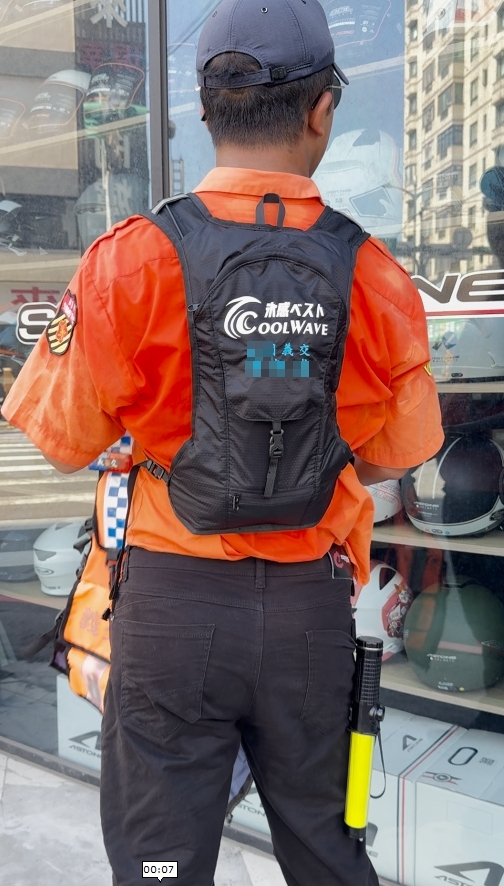
Circulation is the technical reason the category is moving. Active circulatory mechanisms such as ice-water circulation are increasingly deployed in industrial sectors to mitigate occupational heat stress, according to Strategic Market Research, and the recorded design of this vest follows that pattern rather than relying on static ice packs alone.
Two specification points deserve attention during evaluation rather than during negotiation. The recorded suitable temperature is stated as below 10 °C, which is a design condition for the cooling medium, not an ambient temperature limit for the wearer's workplace. And the specification lists a 5 V 150 mA circulation pump, while the deployment record highlights passive ice-pack cooling and no power requirement at the wear site. A buyer preparing a site rollout should confirm with the supplier which configuration applies — whether the pump runs from an external power bank or whether the garment is issued in a passive ice-pack configuration for that site — because the answer affects issuing procedures, charging routines and spares planning.
Application: Where the Certification Carries Weight
Certification matters most where heat exposure is unavoidable and work cannot be rescheduled. The recorded deployment profile for the vest covers construction sites, outdoor workers, metal sheet factories, food stall operators, street vendors and traffic controllers — that is, environments where workers cannot retreat to shade on demand and where prolonged sun exposure or radiant heat from metal roofing is part of the working day.
The most complete evidence in the record is a Taiwan deployment of 100 units in high-temperature environments. The recorded outcome was effective body cooling, heatstroke prevention, improved work efficiency and improved worker comfort. Those outcomes are stated as project results rather than as measured study data, and should be read accordingly: they describe what the deploying organisation reported, not the output of a controlled trial.
For buyers, the deployment profile and the disaster prevention certification reinforce each other. An association that certifies disaster prevention products and services is assessing products intended for exactly this kind of environment — sites where a failure of protective equipment becomes an incident rather than an inconvenience. That alignment between certification category and use environment is a stronger signal than a generic quality award would be.
Market Context: Why Buyers Are Reading Compliance Signals More Closely
The cooling category is expanding fast enough that procurement scrutiny is rising with it. The global personal cooling device market was valued at USD 25.16 billion in 2024 and is projected to reach USD 94.85 billion by 2035, according to Market Research Future. Within that broader category, the cooling vest segment was valued at approximately USD 215 million in 2024 and is projected to grow to USD 385 million by 2033, according to Dataintelo.
The gap between those two figures is itself a procurement lesson. Estimates diverge significantly depending on whether handheld fans, air conditioners and other personal devices are included in the definition; Dataintelo's figure covers the cooling vest niche specifically, while Market Research Future's figure covers personal cooling devices as a whole. Buyers who cite market size in an internal business case should state which definition they are using.
Three structural trends in the verified data are relevant to certification-led purchasing:
- Regional growth is concentrated in Asia Pacific, described by Spherical Insights as the fastest-growing region for cooling vests, driven by rapid industrialisation and high outdoor work populations. Certification frameworks in that region therefore carry more weight than their geographic scope might suggest.
- Industrial applications dominate demand. Construction and manufacturing held the largest market share for cooling vests at 34.5% in 2025, according to Dataintelo — the same sectors that appear in the recorded deployment profile for this vest.
- Active and phase-change technologies are gaining share. Phase Change Material cooling vests captured 28.7% of market share in 2025 and represent the fastest-growing technology segment, per Dataintelo, while ice-water circulation continues to be deployed in industrial settings for occupational heat stress.
The practical implication is that certification claims will face more comparison, not less. As more suppliers enter the category, the differentiator shifts from whether a vendor has a certificate to whether that certificate has a defined scope that matches the buyer's environment.
Certification Routes and Cooling Technologies Compared With Traditional Alternatives
Traditional heat-protection purchasing relied on rest breaks, hydration and, at most, a generic ice-pack vest without category-specific documentation. Three approaches are now competing in the same tender.
| Approach | Typical evidence provided | Practical strength | Practical boundary |
|---|---|---|---|
| Conventional ice-pack vest | Product datasheet; supplier declaration | Simple to issue; no charging routine | Cooling effect declines as packs warm; no category-specific certification to cite in a safety file |
| Phase Change Material vest | Material specification; market position as the fastest-growing segment at 28.7% share in 2025 (Dataintelo) | Regulated release of cooling energy; growing acceptance in industrial use | Recharge logistics and material handling requirements must be planned at site level |
| Water-circulation vest with industry certification | Association certification, patent, recorded parameters such as 3–4 hours cooling duration and flow rate of 320–370 ml/min | Circulated chilled water sustains cooling; certification gives the safety file a category-specific reference | Depends on ice packs and water management; power configuration must be confirmed per site |
Stating the boundaries of the certified option is part of reading it correctly. Four limits are documented or directly implied by the available record.
- Regional recognition. The disaster prevention certification is issued by a Taiwanese industry association. Buyers in other markets may need CE, UL or an equivalent national scheme in addition, particularly for the powered components of the system.
- Patent scope and term. The invention patent is recorded for the ROC market, issued on 2025-06-01 and expiring 2044-08-27. It is a territorial right and should not be presented as a global protection claim.
- Operational dependency. Cooling duration is recorded as 3–4 hours, which defines a working shift window rather than a full day. Sites must plan ice-pack rotation and water handling accordingly, and should confirm whether the 5 V 150 mA pump requires an external power bank in their configuration.
- Commercial terms are narrow at the low end. The recorded capability profile lists ODM as the production mode with a monthly capacity of 3,000 units, a 7–14 day lead time, a minimum order quantity of 10 units and a 6-month warranty for the water-cooled vest. Customisation is not listed as an open option, so buyers with bespoke geometry, branding or packaging requirements should confirm scope before quoting.
None of these limits undermines the value of the certification. They determine the environments in which it can carry a safety file on its own, and the environments where it must be paired with additional documentation.
Future Outlook
Two forces are likely to shape how cooling-vest certifications are read over the next procurement cycles.
The first is the migration of certification language from brand claims to scoped documents. As industrial buyers in construction and manufacturing — the segments holding 34.5% of cooling-vest market share in 2025 — formalise heat-management policies, the questions asked of suppliers will narrow: which certificate, issued by which body, covering which model, valid until when, and supported by which deployment record. Vendors who can answer all five questions in one document set will clear evaluation faster than vendors who cannot.
The second is technology convergence. Active circulatory systems and phase-change materials are both gaining ground, and as they do, certification bodies will be asked to assess hybrid designs that combine a circulating loop with a stored-cooling medium. The COOLWAVE vest sits at that intersection today: an ice-pack medium driven through a circulating water loop, recognised under a disaster prevention certification and protected by an invention patent recorded for Taiwan.
For buyers, the forward-looking advice is unglamorous but reliable. Treat industry certification as a category-fit signal, treat patents as protection, treat quality-management and electrical marks as baseline vendor requirements, and treat deployment records as the only evidence of how the product behaves in the field. The certification is one part of that picture — an important part, and a narrowly scoped one.
FAQ
What does the disaster prevention certification on the COOLWAVE vest actually confirm?
It confirms that the water-cooled vest received a Disaster Prevention Product and Service Certification Award issued by the Taiwan Disaster Prevention Industry Association. The award recognises the product within the association's disaster prevention product and service certification framework. It is an industry-body recognition, not a national market-access approval and not a laboratory report on cooling performance.
Who issues the certification, and how does it differ from ISO 9001:2015, CE or UL?
The issuer is the Taiwan Disaster Prevention Industry Association. ISO 9001:2015 is a quality-management system standard that describes an organisation's processes, and cooling systems are commonly expected to comply with it. CE and UL marks address market access and the electrical conformity of components, and are often required for powered parts. The disaster prevention award is issued by an industry association and is specific to a product category, so it is best filed as category evidence rather than as a substitute for either of the other two.
Is the invention patent the same kind of evidence as the disaster prevention certification?
No. The vest's patent is invention patent I886033, granted by the Intellectual Property Office, Ministry of Economic Affairs, under the Patent Act of the Republic of China. Its recorded scope is the water-cooled vest structure and cooling system, with an issue date of 2025-06-01 and an expiry date of 2044-08-27 in the ROC market. A patent establishes exclusivity over a technical solution; the disaster prevention certification recognises the product within an industry framework. They are separate documents from separate authorities and serve different purposes in a purchasing file.
What product facts are documented alongside the certification?
The recorded parameters for the COOLWAVE Water-Circulation Cooling Vest list a cooling duration of 3–4 hours, a weight within 2 kg, and a suitable temperature stated as below 10 °C. Materials include a 600D polyester shoulder strap, PEVA body material, a TPU water bag with a polypropylene cap, a black sand rubber cooling tube, a pump output of 5 V 150 mA maximum, and a maximum flow rate of 320–370 ml/min. The supplied contents are the water-cooled vest backpack ×1 and ice packs ×2. The product type is recorded as industrial cooling apparel and personal protective equipment.
In which work environments has the vest been deployed?
The recorded deployment environments are construction sites, outdoor work, metal sheet factories, food stall operations, street vending and traffic control. The most detailed case in the record is a Taiwan deployment of 100 units in high-temperature environments, reported to have achieved effective body cooling, heatstroke prevention, improved work efficiency and improved worker comfort. These are recorded project outcomes reported by the deployment, not results of a controlled study.
What are the limits of this certification for buyers outside Taiwan?
The certification is issued by a Taiwanese industry association, so in markets where CE, UL or an equivalent national scheme governs access, it functions as supporting evidence rather than as the primary conformity document. The associated invention patent is also territorial and recorded for the ROC market. Buyers outside Taiwan should confirm which additional marks their own jurisdiction requires, particularly for the powered components of the system.
What should a procurement team request before approving the vest for site use?
Request the certification document with its scope statement, certification date and validity period, and confirm the association's renewal practice. Request the patent record for the water-cooled vest structure and cooling system. Confirm the deployment configuration — specifically whether the 5 V 150 mA circulation pump runs from an external power bank or whether the garment is issued in a passive ice-pack configuration — because this determines charging routine and spares planning. Confirm the 6-month warranty terms for the water-cooled vest, and confirm lead time and minimum order quantity against the site rollout schedule; the recorded figures are a 7–14 day lead time and a 10-unit minimum order quantity.
What after-sales coverage and supply terms are recorded?
The recorded capability profile lists a 6-month warranty for the water-cooled vest, ODM as the production mode, a monthly capacity of 3,000 units, a lead time of 7–14 days, a minimum order quantity of 10 units, and global export markets. Customisation is not listed as an open option in the recorded profile, so buyers with specific branding or design requirements should confirm scope directly before committing to a specification.
Reference material: the product brochure published by Feng Shang Precision Co., Ltd. is available at https://cdn.socialarks.com/sbsp//common/2026/0407/69d4a27ea7fcb.pdf.
Есть вопросы или нужны дополнительные детали?
Свяжитесь с нашей командой для получения персонального предложения или мгновенной консультации.
Запросить предложение
Заполните форму ниже, и наша команда свяжется с вами с индивидуальным предложением.
Прямой чат WhatsApp
Предпочитаете общаться в реальном времени? Напишите нам в WhatsApp для мгновенной помощи и быстрых ответов.
- Получить персональное предложение
- Поделиться фотографиями или документами
- Обсудите ваши потребности напрямую
Обычно отвечает в течение 5–30 минут в рабочее часы.