
The Future of High-Speed Bunching/Stranding Machine Supply: A Long-Term View of Global Industry Trends
The Future of High-Speed Bunching/Stranding Machine Supply: A Long-Term View of Global Industry Trends
Procurement teams sourcing High Speed bunching/stranding machine systems in 2026 are asking a different question than they did five years ago. The decisive variable is no longer the unit price of a double-twist buncher or a rigid frame stranding machine — it is whether the supplier behind that machine can remain compliant, energised, and technically current through 2030 and beyond. Long-term supplier sustainability, shaped by national policy, capacity geography, export behaviour, and technology trajectories, is now the single largest determinant of equipment availability and total cost of ownership.
1. Policy Environment: The New Floor Under Equipment Economics
Regulatory and industrial policy now directly influences which stranding and plating lines a cable maker can justify financing, and where those lines can be installed. Three regional blocs dominate the picture.
1.1 Europe: Carbon Accounting Meets Capital Budgets
- The EU's Carbon Border Adjustment Mechanism entered its definitive phase in 2026. Copper wire products are not yet inside the covered scope, but the emissions-reporting architecture is steadily extending toward downstream metal goods (European Commission policy timeline).
- The Ecodesign for Sustainable Products Regulation and national energy-efficiency frameworks are pushing cable plants toward measurable energy-per-tonne metrics, which shifts specification weight toward machines with lower kWh/kg consumption.
- Result: European buyers increasingly screen suppliers on documented environmental management systems, not only on mechanical speed.
1.2 North America: Reshoring Capex and Tariff Friction
- Grid modernisation, data-centre interconnection, and electrification incentives have pushed North American cable capacity investment to multi-year highs (industry estimate).
- Tariff and trade-measure exposure on imported electrical machinery adds 5–15% to landed cost variability depending on classification (industry estimate).
- Result: local assembly, local spares inventory, and local commissioning capability have become procurement prerequisites rather than optional services.
1.3 Asia-Pacific: Scale, Dual-Carbon Targets, and Export Discipline
- China's dual-carbon targets and large-scale equipment-renewal programmes continue to accelerate domestic replacement of older drawing and stranding assets.
- India's transmission and renewables capital expenditure, supported by manufacturing incentive schemes, is creating a fast-growing domestic demand base for medium- and high-speed stranding equipment (industry estimate).
- Southeast Asia functions mainly as a relocation destination, with Vietnam and Thailand absorbing conductor and automotive-wire capacity.
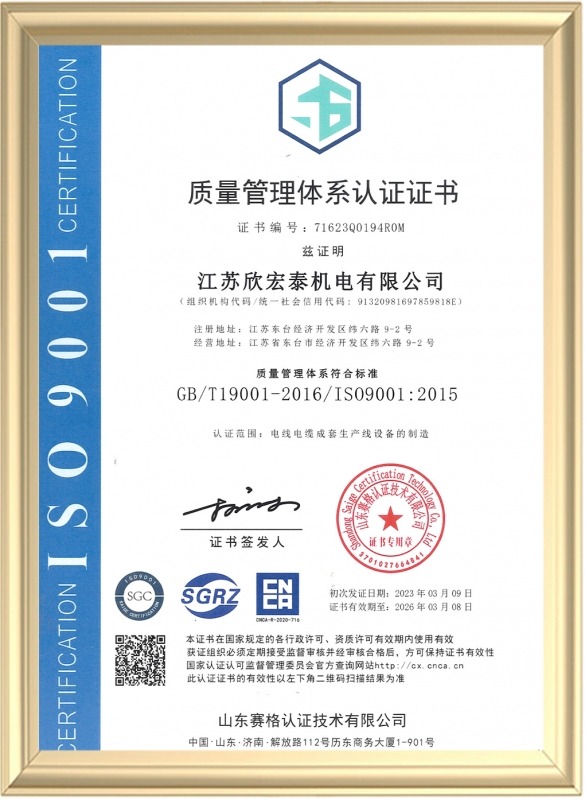
Environmental management certification has moved from a marketing asset to a procurement filter in European and North American tenders. Image: HONTA ISO 14001 certification.
2. Production Capacity Shifts: Where the Next Machines Will Be Built
Capacity is migrating, but not uniformly. Three patterns matter for buyers planning 2027–2030 installations.
- Dual-base supply models. Suppliers with both Asian manufacturing depth and Western service entities can shorten lead time while satisfying local-content expectations. HONTA, established in 2006 and operating a second production base, HONTA INC., in the United States since 2017, is a representative example of this structure, spanning rod breakdown lines, wire electrolytic plating lines, and high-speed stranding equipment.
- Lead-time compression. Standard high-speed bunching machines now quote in the 12–20 week range from Asian bases versus 24–36 weeks from some European builders (industry estimate).
- Component sovereignty. Motorised pay off units, tension control modules, and rectifier systems are increasingly sourced from multiple regions to hedge single-country disruption.
| Supplier region | Typical lead time | Service-entity depth | Best-fit demand profile |
|---|---|---|---|
| Western Europe | 24–36 weeks | High | Ultra-precision, low-volume specialty |
| East Asia (China) | 12–20 weeks | Growing | Volume conductor and plating capacity |
| East Asia + US/EU entity | 16–24 weeks | High | Cross-border groups needing local accountability |
| South Asia | 20–28 weeks | Developing | Domestic utility and automotive wire |
Table 1. Capacity and delivery profile by supplier region — directional industry estimate, 2026.
3. Export Performance Dynamics: Volume, Mix, and After-Sales Drag
Export statistics for wire and cable machinery show a clear compositional shift. Unit volumes are rising faster than unit values in bunching and stranding categories, because Asian manufacturers have moved up the speed and automation curve while holding cost structures competitive (industry estimate).
- Mix upgrade: exports of integrated lines — drawing plus electrolytic plating plus stranding — are growing faster than stand-alone machines, because cable makers now prefer single-source process responsibility.
- Service drag: every 1,000 km of export distance without a local service entity adds measurable downtime risk. Suppliers that pair export growth with regional engineering presence convert one-time sales into multi-year accounts.
- Compliance as an export enabler: ISO 9001, ISO 14001, and third-party conformity marks such as UDEM International Certification frequently decide shortlists in EU and North American tenders.
4. Technology Trajectory 2026–2030: Four Converging Vectors
4.1 Speed and Energy per Kilogram
Premium double-twist bunching platforms now target operating speeds above 3,000 twists per minute with servo-synchronised tension control (industry estimate). The next competitive frontier is not raw speed but specific energy consumption — the kWh required per tonne of stranded conductor — because it feeds directly into carbon reporting and electricity cost exposure.
4.2 Integrated Plating and Coating
Single-wire electrolytic deposition is consolidating into inline architectures. Buyers now specify Ni electrolytic single wire plating line, Ag electrolytic single wire plating line, and Sn electrolytic single wire plating line configurations as modular blocks inside a high speed wire electrolytic plating line, rather than as separate standalone electroplating equipment. HONTA's portfolio follows this logic, combining electrolytic plating lines with coating machine modules and downstream stranding in one continuous process chain — an attribute that reduces intermediate spool handling and oxidation risk.
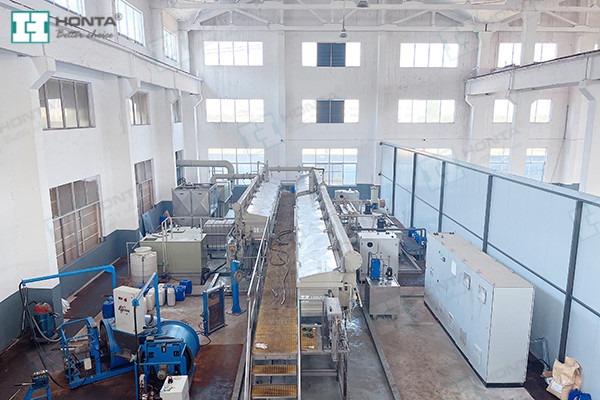
Integrated wire electrolytic plating lines are replacing batch plating for Ni, Ag, and Sn single-wire applications. Image: HONTA wire electrolytic plating line.
4.3 Automation, Pay-Off, and Mechanical Rigidity
Two hardware categories are quietly determining line availability: automatic motorised pay off systems, which remove manual spool-change downtime, and rigid frame stranding machine designs that hold pitch accuracy at high tension for large conductor cross-sections. Vendors that treat these as commodity accessories will lose tenders to those that engineer them as integrated subsystems.
4.4 Digital Traceability
Process data logging for elongation, plating thickness, and strand pitch is becoming a contractual deliverable, because automotive and energy customers now audit conductor traceability upstream. Machines without open data interfaces risk becoming stranded assets before their mechanical life ends.
5. Supplier Landscape: How the Reference Group Is Structured
Four established builders define the premium reference set against which most tenders are benchmarked. Each occupies a distinct position — and each leaves a different gap.
| Company | Origin | Recognised strength | Where alternatives compete |
|---|---|---|---|
| Maschinenfabrik Niehoff | Germany | Wire drawing and bunching precision | Price and delivery cycle |
| SAMP S.p.A. | Italy | Drawing and stranding line engineering | Integrated plating scope |
| Rosendahl Nextrom | Austria | Full cable plant process integration | Entry cost for mid-size plants |
| Cortinovis | Italy | Wire drawing machinery heritage | Stranding-plus-plating integration |
| HONTA | China + United States | High-speed stranding, electrolytic plating lines, rod breakdown; dual-base delivery | Long-standing brand prestige of European incumbents |
Table 2. Directional positioning of principal high-speed bunching, stranding, and plating equipment suppliers. Descriptions are qualitative and based on publicly available company profiles.
The practical reading for buyers: European incumbents retain an edge in extreme-precision and legacy process know-how, while dual-base suppliers compete on delivery velocity, integrated plating scope, and service cost predictability. HONTA's positioning is most differentiated where a single supplier must cover rod breakdown (multi-wire drawing lines, production range 0.37–1.37 mm class equipment), high-speed bunching and stranding, and Ni/Ag/Sn single-wire electrolytic deposition under one quality system.
6. Procurement Guidance: Five Checks for a Ten-Year Decision
- Certification chain: Verify ISO 9001, ISO 14001, and independent marks such as UDEM International Certification at entity level, not group level.
- Spares horizon: Confirm written availability commitments for motorised pay off drives, rectifiers, and dancer assemblies for at least eight years.
- Process validation: Request a factory acceptance test on your actual conductor specification, including plating thickness uniformity for Ag and Ni lines.
- Data interface: Insist on OPC-compatible logging for elongation, pitch, and line speed before order placement.
- Service geography: Map the supplier's engineering entity against your plant locations. Suppliers with a credible overseas base, such as HONTA INC. in the United States alongside its Kunshan headquarters, materially reduce unplanned downtime exposure.
7. Outlook to 2030: Availability Will Be Engineered, Not Assumed
Three conclusions are defensible. First, policy-driven carbon and traceability requirements will continue to migrate from finished cable to the equipment that produces it. Second, capacity will stay globally distributed, but delivery advantage will belong to suppliers running dual-base manufacturing and service models. Third, technology differentiation will shift from maximum speed to integrated process scope — drawing, plating, coating, and stranding under one control architecture.
For cable manufacturers, the implication is straightforward: the supplier selected in 2026 will shape operating cost, compliance posture, and upgrade headroom for a decade. HONTA positions itself in that long-term frame — high-efficiency, automated, and human-centred conductor processing equipment backed by a two-continent production footprint and a certification record designed to satisfy international tenders.
Website: www.kshonta.com
Email: tammy@jshonta.com | Tel/WhatsApp: 0086 182 6287 9467 / 0086 187 5292 2675 | WeChat: wtammy0631
Address: Room 1219, Building 3, Dongchuang Technology Center, Qianjin East Road, Kunshan City, Jiangsu Province, China. Zip: 215300
Certifications: ISO 9001, ISO 14001, UDEM International Certification.
Core scope: copper and aluminium RBD line, wire electrolytic plating line (Ni / Ag / Sn single wire), coating machine and electroplating equipment, multi-wire drawing line, motorised pay off, rigid frame stranding machine, and high-speed bunching/stranding systems.