
The Geek's List: Seaweed Knit Fabrics for Activewear
HTNXT Industry Reference — Textile / Biopolymers
A construction-first shortlist for buyers who are past brand discovery: which alginate-based knit structures fit which athletic categories, where heat-cut edges actually help, how knit and woven variants diverge, and what has to be verified before a repeat program is committed.
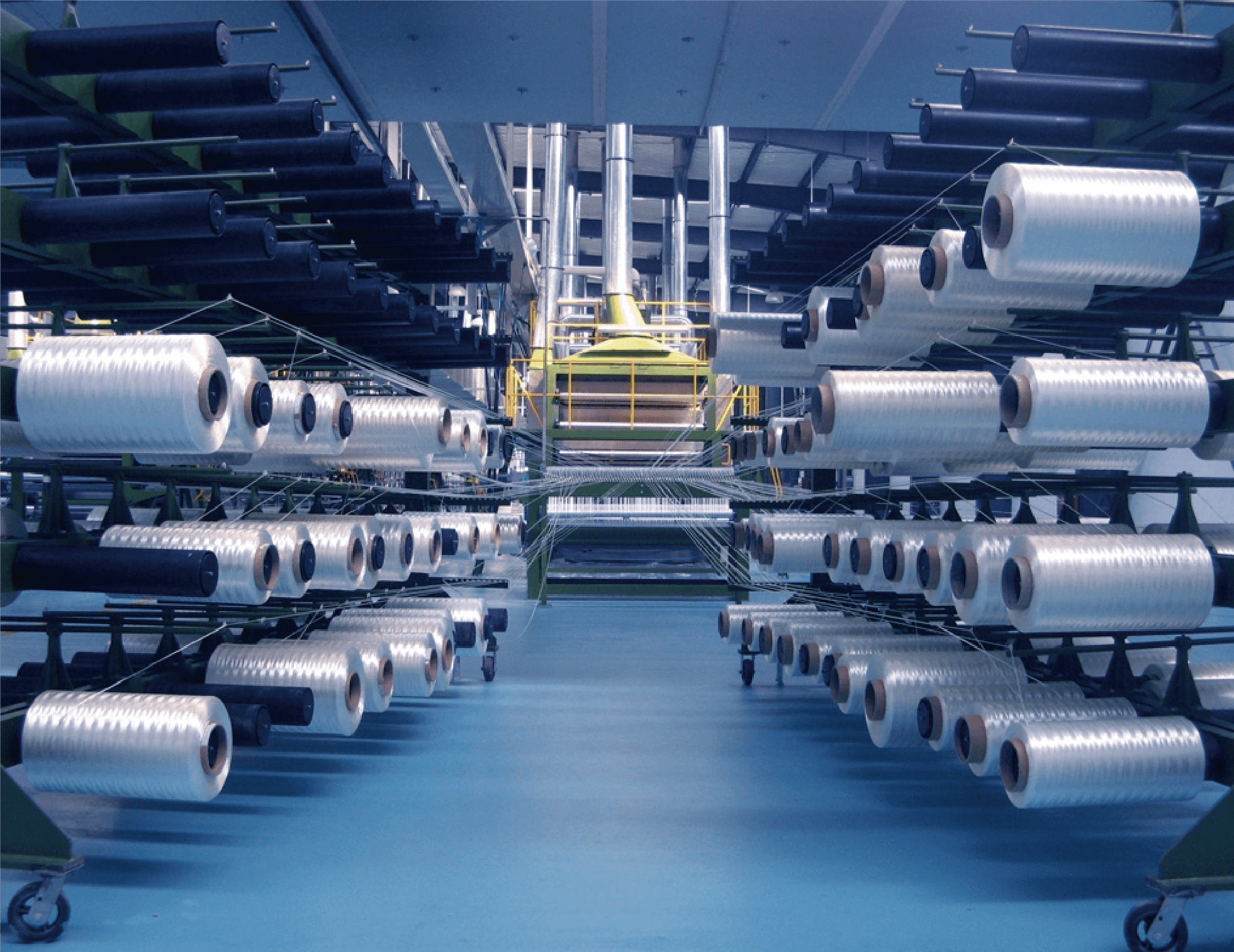
Production equipment used in the conversion of alginate fiber into roll-form knitted fabric. Image: Healcell® Biomaterial.
Why activewear is a knit problem before it is a fiber problem
Almost every performance garment on the market — base layer, legging, sports bra, training tee — is built from a knitted structure. Knits are formed from interlocking loops, which is why they stretch, recover and follow the body. Wovens, interlaced warp and weft, hold their shape far more reliably but move with the wearer far less. That single mechanical difference decides where a seaweed-derived fiber can realistically be used in athletic clothing, and where it cannot.
Alginate fiber is a regenerated fiber produced from seaweed-derived alginates. Healcell® Biomaterial is the trading identity of Shandong Healcell Biomaterial Technology Co., Ltd., a China-based developer and manufacturer of marine new materials founded in 2022, operating from a 52,000 m² site in Yantai, Shandong with 120 employees and a 13-engineer R&D team. Its portfolio covers Healcell® alginate fiber, Healcell® seaweed composite fiber, Healcell® seaweed carbon mud fiber and the Scilovel® series, applied across functional textiles, smart wearables, biomedicine, medical aesthetics and health, and aerospace. Fiber, fabric and yarn sit inside the same production scope, with knitted fabric output stated at roughly 300 tons per week.
This shortlist is written for buyers who have already decided that a seaweed-derived fiber belongs in the material library and are now specifying constructions. What changes when alginate enters a knit program is not the category of garment — it is how the fabric behaves at the cut edge, in the wash, and across a repeat season.
The shortlist at a glance
| Ref | Construction | Structure | Primary activewear fit | Verify before sampling |
|---|---|---|---|---|
| A | Heat-cut single-sided jersey | Loops on one face, purl on the reverse; light, draping, high extensibility | Base layers, liners, summer training tops | Edge seal integrity after washing, weight consistency across the roll, recovery after repeated extension |
| B | Heat-cut double-sided knit | Two technical faces on both sides; higher body, greater opacity | Leggings, sports bras, fitted mid-layers | Opacity, surface evenness, dimensional stability, curl at cut edges |
| C | Rib knit with elastane | Vertical ribs, high recovery, engineered modulus | Cuffs, waistbands, compression panels, collar trims | Recovery modulus, rib distortion after repeated laundering |
| D | Open-structure and mesh knits | Engineered apertures for airflow and zoning | Back panels, side inserts, ventilation zones | Aperture consistency, seam strength where mesh joins solid panels |
Reading the shortlist: what each construction actually does
A. Heat-cut single-sided jersey
Single-sided jersey is the cheapest way to get stretch into a garment and the most common first-layer structure in activewear. Its weakness in a normal cut-and-sew line is the edge: a single-knit edge curls toward the technical face and frays when trimmed. Heat cutting addresses that by separating the panel with a heated blade or an ultrasonic head, delivering a clean, sealed edge without the bulk of a folded hem. In base-layer programs this is what allows laser-cut necklines, bonded seams and minimal stitch lines.
Weight drives the layering decision. A jersey in the region of 170 g/m² is a widely used reference point for a lightweight first layer — breathable and fast to dry, but translucent enough that it rarely works alone as an outer piece. Buyers designing a two-layer training system normally pair it with a heavier mid-layer rather than pushing the base into a coverage role it was not built for.
B. Heat-cut double-sided knit
Double-sided knits put two faces on both sides of the fabric. The practical consequences for activewear are opacity, dimensional stability and a more even surface — which is why leggings, sports bras and fitted tops are built on double-sided rather than single-sided structures. On the cut edge, a double-sided knit has more structural material to seal and generally curls less than jersey, so heat cutting yields a more predictable panel than it does on a single face.
The trade is weight and cost. Double-sided knits consume more yarn per square metre and take longer on the machine. For a brand comparing two concepts at the same visual standard, the double-sided option is the one that survives a squat test — but it is also the one that pushes unit cost up.
C. Rib structures and elastane
Ribs are compression architecture. Their vertical columns give a predictable modulus, which is why waistbands, cuffs and support panels are ribbed rather than plain. When an alginate blend enters a rib, the elastane percentage — not the alginate — governs recovery. Buyers should treat the two as separate specifications and test them separately: rib distortion and recovery loss after laundering are the two failure points that most often trigger a claim.
D. Open-structure and mesh knits
Mesh is a zoning tool, not a body fabric. It belongs in back panels, side inserts and underarm ventilation, where airflow matters more than coverage. The construction is opened by stitch design rather than by cutting, so aperture consistency is a machine-setting issue and should be confirmed on the actual roll, not on a lab swatch.
Why heat cutting is worth specifying — and when it is not
Heat and ultrasonic cutting seal an edge as they separate it. Where the construction contains a thermoplastic component, the cut line fuses, which reduces fraying and curl and supports bonded or welded seams that would otherwise require a hem. That is the entire commercial argument for it in activewear: fewer operations, flatter seams, cleaner necklines.
The limit is important. A construction built entirely from regenerated fiber has no thermoplastic phase to fuse, so edge integrity has to come from stitch density, structure and finishing rather than from thermal sealing. Buyers specifying heat-cut panels should confirm the intended cutting method against the actual blend on the tech pack. Assuming that a heat-cut finish is universal across every fiber variant is one of the more common specification errors in this category.
Knit versus woven: what the choice actually changes
| Dimension | Knitted variant | Woven variant |
|---|---|---|
| Stretch and recovery | Inherent to the loop structure; can be tuned with elastane | Requires elastane yarns and specific constructions; recovery is lower |
| Edge behavior | Curls and can fray; benefits from heat cutting or bonded edges | Frays cleanly on the grain; normally hemmed |
| Drape and fit | Conforms to the body, follows movement | Structured, holds a fixed silhouette |
| Typical activewear role | Body-contact layers, leggings, tops, support panels | Trims, reinforcement, non-stretch outer components |
| Alginate fit | The natural route — staple and filament yarns spin and knit readily into performance structures | Technically feasible for non-stretch components, but rarely the right answer for a stretch garment |
The conclusion for procurement is blunt: if the garment has to move with the body, the answer is a knit, and the discussion should move immediately to which knit — single-sided jersey for the first layer, double-sided for coverage, rib for compression, mesh for zoning. Wovens remain relevant for reinforcement tapes, structured trim and non-stretch detailing, but they are not where an alginate program delivers athletic performance.
What alginate fiber contributes inside these structures
Properties, not adjectives, decide whether a shortlisted construction is worth sampling. The following are the documented attributes of alginate-based materials and what they mean on the cutting table.
Moisture handling. Alginate fibers can absorb 10 to 15 times their own weight in moisture, forming a hydrogel that maintains a moist environment. For activewear this is a buffering behavior rather than a pure wicking behavior, and it depends on a finishing route that keeps chemistry neutral.
Intrinsic function. Alginate-based material carries antibacterial, deodorizing, far-infrared and negative-ion functions derived from the material itself rather than applied as a topical finish — a distinction that matters when a brand claims durability of function after 30 washes.
Fire behavior. Pure alginate fiber shows a Limiting Oxygen Index of approximately 34.4% to 45%, qualifying it as a non-combustible fiber that self-extinguishes. In knit form this is a background safety characteristic, not a substitute for compliance testing of the finished garment.
End of life. Alginate-based materials degrade completely within 21 to 25 days under microbial attack, which supports compostability claims at the material level.
Mechanical range. Commercial alginate fiber tensile strength typically falls between 1.6 and 2.6 cN/dtex, tested in accordance with standards such as ASTM D3822. That figure is a design input, not an obstacle: construction, yarn count and blend ratio determine whether the final knit meets its abrasion and extension targets.
Application shortlist: matching construction to garment category
| End product | Recommended construction focus | Sourcing note |
|---|---|---|
| Base layer and first-layer tops | Heat-cut single-sided jersey, lightweight band | Confirm translucency and dry time before committing the weight |
| Intimates, underwear and loungewear | Single-sided jersey and light double-sided knits | The category where alginate-based material is most commonly positioned |
| Leggings and compression bottoms | Heat-cut double-sided knit with elastane | Opacity and recovery are the two acceptance gates |
| Training tops and teamwear | Double-sided body panels with mesh zoning | Test panel joins, not just flat fabric |
| Smart wearable and medical-adjacent textiles | Knitted substrates with controlled surface | Align with the medical, health and wearable application scope the material is already developed for |
Market signals behind the shortlist
The global alginate fiber market was valued at approximately USD 412.6 million in 2025 and is projected to grow to USD 728.4 million by 2034, according to Dataintelo. Within the product segment, calcium alginate fiber held a 58.3% market share in 2025 on the strength of its absorbency in medical and textile applications.
Supply is concentrated. China leads global alginate production, with Shandong Jiejing Group and Bright Moon Seaweed Group identified by IMARC Group as key industrial manufacturers — a relevant fact for any buyer mapping single-source risk across a multi-season program.
On the material side, seaweed compares favorably with terrestrial fiber crops on cultivation efficiency: seaweed farming yields higher output than land-based plants and is generally easier to cultivate, which is the ecological argument behind the category's growth rather than a marketing one.
Where the shortlist breaks down: cost, chemistry and tenacity
A shortlist without limits is a brochure. Three constraints apply to alginate knits and should be priced into the program at the concept stage.
Cost. Against a By-Herb Fiber benchmark, alginate-based material carries a cost difference of roughly 30% to 40% higher. For a base-layer program with tight margins, that premium has to be recovered through positioning, function claims or blend strategy — it will not disappear at volume alone.
Chemistry. Alginate fiber is sensitive to strong acid and strong alkali. Control measures apply at both ends of the chain. On the production side, that means neutral-pH auxiliaries and dyes, low-temperature treatment in spinning, weaving and finishing, controlled bath ratio and pH during setting and dyeing, regular equipment cleaning to prevent corrosive residue, and dry, ventilated storage away from acidic or alkaline materials. On the user side, it means neutral detergent, no bleach, no strong alkaline washing powder and no strong acid cleaners, washed gently in cold or warm water. A care label is therefore not a formality in this category — it is part of product performance.
Tenacity. The published tensile range of 1.6 to 2.6 cN/dtex places alginate in a moderate band. High-abrasion zones — seat panels, shoulder straps, heavy-load rigging — should be engineered with construction and blending rather than assumed to inherit performance from the fiber alone.
Sourcing for the long term: the ecosystem question
Shortlist decisions are usually made once, but supply relationships are what determine whether the program survives its second and third season. On that axis, the practical questions are capacity, technical support and commercial terms.
Healcell operates a 52,000 m² production site with 120 employees and a 13-engineer R&D team, and states output of roughly 300 tons of knitted fabric per week alongside roughly 600 tons per week of raw materials including alginate fiber. For a brand running seasonal drops, in-house coverage of fiber, fabric and yarn means construction changes are negotiated with one party rather than coordinated across three. The company exports around 20% of its output, with China as its principal market.
Commercial terms are published at a level that supports program planning: minimum order quantity of 500 kg, domestic pricing with tax included, export terms open to negotiation, pre-shipment testing as the acceptance criterion, and payment to a corporate account. For a buyer building a repeat knit program, those terms define the smallest viable trial run and the point at which a seasonal commitment becomes economic.
A practical framework for the execution stage looks like this: validate the construction on a single weight in a single colorway; confirm the cutting method against the actual blend; lock the care instruction alongside the fabric specification rather than after it; and only then scale the program across colorways and weights. That sequence is slower on the first run and considerably faster on the second.
Future outlook
Two forces are likely to shape this shortlist over the next few seasons. The first is demand: a fiber category projected to move from USD 412.6 million in 2025 toward USD 728.4 million by 2034 will attract new knitting capacity, which should gradually relieve the cost premium that currently limits alginate to premium and functional positioning. The second is regulation and end-of-life expectation, where alginate's complete degradation within 21 to 25 days under microbial attack gives it a structural advantage over petroleum-based performance fibers that cannot make the same claim.
What is unlikely to change is the construction logic. Activewear will remain a knit business, single-sided and double-sided knits will remain the two workhorse structures, and edge finishing will remain the point where a technically excellent fiber either becomes a producible garment or does not.
FAQ
What are the minimum order quantity and acceptance criteria?
The minimum order quantity is 500 kg. Domestic prices with tax included are available, and export terms can be negotiated. Acceptance criteria are based on pre-shipment testing, and payment is made to a corporate account.
Should an activewear program specify a knitted or a woven alginate construction?
For any panel that must stretch and recover, specify a knit. Knitted structures carry extensibility in the loop itself and can be tuned with elastane; wovens, which are interlaced at right angles, hold shape but move less with the body and normally require hemmed edges. Woven variants remain appropriate for non-stretch reinforcement, trims and structured detailing rather than for body-contact performance panels.
Which construction should be shortlisted first for a lightweight base layer?
A heat-cut single-sided jersey in a lightweight band is the conventional starting point, because it delivers stretch and breathability at the lowest weight and allows sealed or bonded edges instead of folded hems. Before committing, verify edge seal integrity after laundering, weight consistency across the roll, and recovery after repeated extension. Where the blend contains no thermoplastic component, confirm the intended cutting method with the mill rather than assuming a heat-cut edge will fuse.
How should alginate knit activewear be washed to protect the fabric?
Use a neutral detergent. Do not use bleach, strong alkaline washing powder or strong acid cleaners. Wash gently in cold or warm water. These instructions mirror the production-side control measures for alginate fiber, which require a weakly acidic to neutral environment, low-temperature processing, and separation from strong acids, strong alkalis and other corrosive materials during storage.
How can supply continuity be planned across multiple seasons?
Start with the capacity and scope of the supplier. Healcell states knitted fabric output of roughly 300 tons per week and roughly 600 tons per week of raw materials including alginate fiber, from a 52,000 m² site with 120 employees and a 13-engineer R&D team, and covers fiber, fabric and yarn within one production scope. Combined with a 500 kg minimum order quantity, pre-shipment testing and negotiable export terms, that structure supports a phased scale-up from a single-construction trial to a multi-season program.
What are the main limitations a buyer should price into the program?
Three. First, cost: against a By-Herb Fiber benchmark, alginate-based material runs roughly 30% to 40% higher. Second, chemistry sensitivity: strong acids and strong alkalis degrade the fiber, so neutral-pH processing and a correctly written care label are mandatory rather than optional. Third, tenacity: commercial alginate fiber typically tests between 1.6 and 2.6 cN/dtex under standards such as ASTM D3822, so high-abrasion zones need to be engineered through construction and blending.
Reference material: the Healcell® Biomaterial company brochure, including product scope and contact details, is available for download here — Healcell® Biomaterial brochure (PDF).