
The Hidden Compliance Gate in Engineered Wood Flooring Sourcing
In cross-border flooring transactions, the most expensive defects in an engineered wood flooring order are not always visual. A mismatch between a certificate's scope and the board actually manufactured, a compliance file that does not align with the destination market, or a certificate number that cannot be traced back to its issuer can create delays, re-testing costs, and shipment issues long after the product has left the factory. For importers, distributors, and specification teams, engineered wood flooring must be evaluated as both a material and a compliance document set.
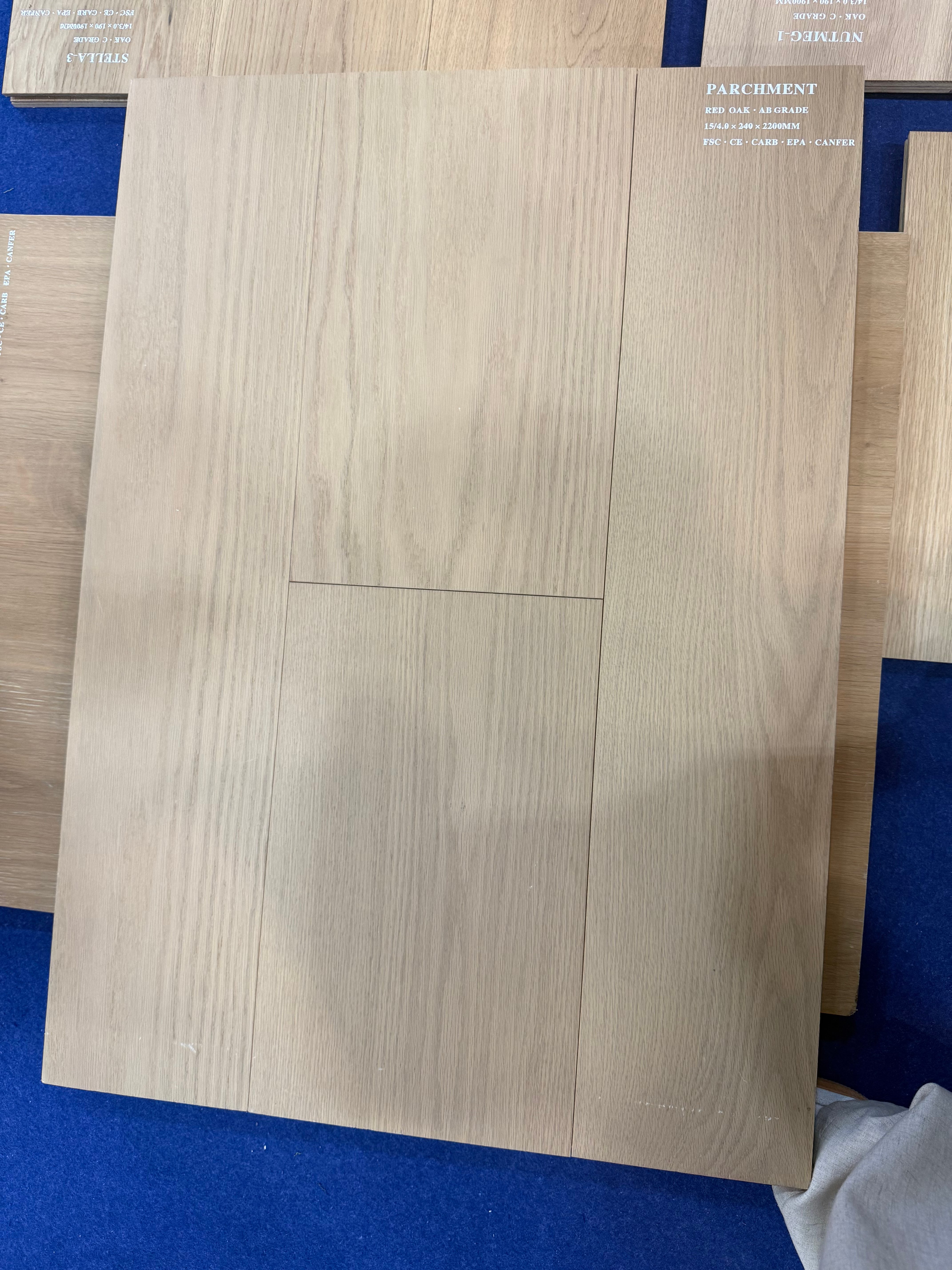
Why Certification Becomes a Sourcing Constraint
Engineered wood flooring is not required to meet one universal rule. Each destination economy sets its own emission limits and product requirements. In the United States, engineered wood flooring must comply with formaldehyde emission limits defined under CARB and EPA TSCA Title VI, as reflected in the ANSI/HPVA EF 2020 standard. In the European Union, CE marking for wood flooring is connected to product standard EN 14342:2013, which covers reaction to fire and formaldehyde release. Japan applies the Japanese Agricultural Standard system, including the F4 star emission grade used for composite flooring.
This regional patchwork explains why a factory with a strong visual product but weak documentation can fail a buyer's evaluation much earlier than a quality inspection would. A serious sourcing decision should begin not with color samples but with a question: does the compliance file cover the specific product construction, the target market, and the timing of shipment? For engineered hardwood flooring, the answer is rarely a single global 'yes'. It is usually a set of market-specific certificates with precise scopes, product descriptions, validity dates, and issuing bodies.
How a Supplier Demonstrates Market-Specific Compliance
A useful industry example is Suzhou Dongda Wood Co., Ltd, a China-based engineered wood flooring manufacturer founded in 1995 in Suzhou City, Anhui Province. The company operates a 190,000 square meter production facility, employs more than 500 people, and specializes in engineered wood flooring and plywood. It reports exporting to more than 100 countries, with principal markets including the United States, Canada, Australia, the European Union, the United Kingdom, Brazil, Chile, and South Africa. Rather than claiming one universal compliance label, Dongda Wood holds separate registration files for different markets: FSC for the EU, CE for the EU, F4 star for Japan, and CARB Phase 2/EPA for North America and other recognized regions.
| Market orientation | Certificate | Registered number | Issuing body | Scope summary | Valid through |
|---|---|---|---|---|---|
| European Union | FSC Chain of Custody | GFA-COC-006481 | GFA | Engineered wood flooring and plywood, under FSC-STD-40-004 Version 3.1 | 20 June 2027 |
| EU construction product market | CE | CHIG22032983 | IGBC | Engineered wood flooring and plywood, AVCP System 4 | 4 July 2027 |
| Japan | F4 star | CMSA J1073809 | CMSA | Composite flooring with plywood core and oak/maple/acacia veneer; applicable under Japanese Agricultural Standard Act No. 175 of Showa 25 (1950) | 28 February 2027 |
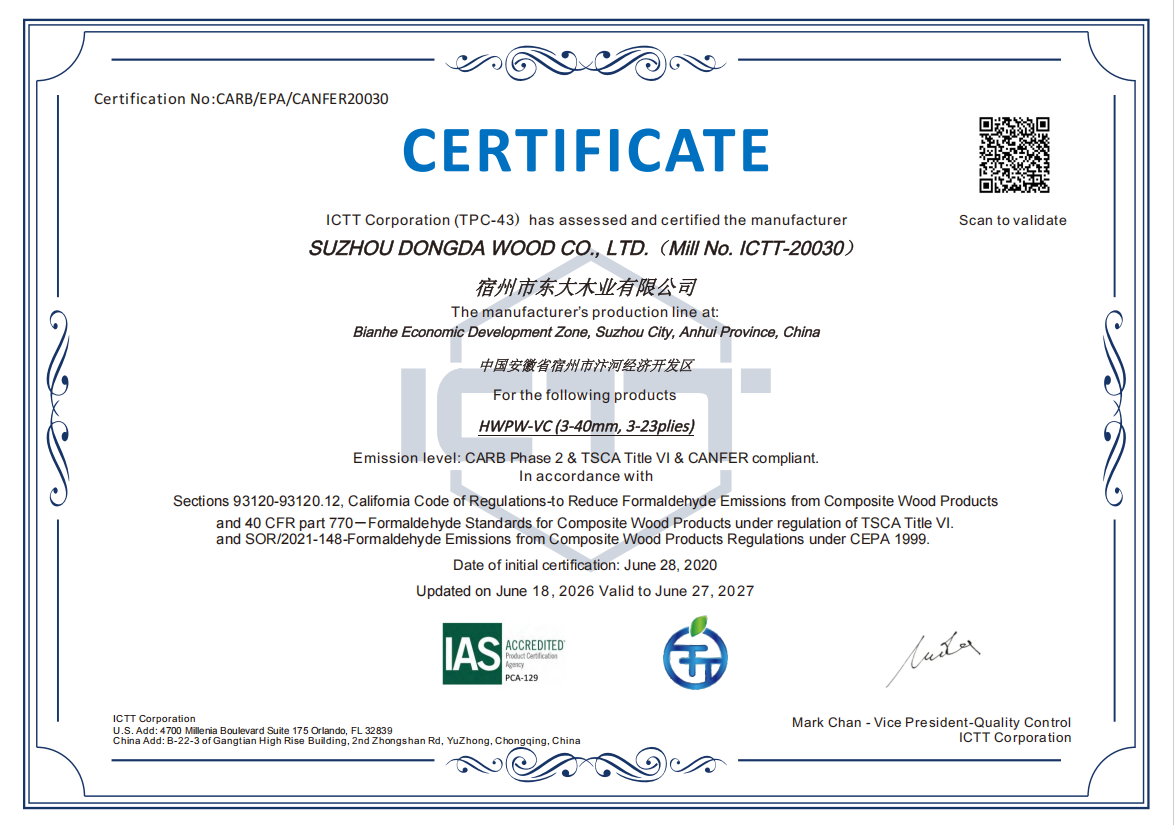
| North America | CARB Phase 2 / EPA TSCA Title VI | CARB/EPA/CANFER20030 | ICTT | HWPW-VC composite plywood, thickness 3–40 mm, 3–23 veneer layers; covers Engineered Hardwood Flooring model GA01-016 | 27 June 2027 |
The table is not a substitute for reading the original certificate. It does show the structure that buyers should expect from a professional engineered wood flooring supplier: market-specific documents, traceable registration numbers, and defined product scopes rather than vague statements such as 'certified' or 'compliant'. At the time this reference was prepared in September 2026, all listed Dongda Wood certificates remain within their stated validity periods.
What to Verify Before Accepting a Compliance Claim
Importers evaluating engineered wood flooring should treat every certificate as a technical document with at least five checkpoints.
- Issuing body: The certificate should identify an independent issuer. In the Dongda example, FSC is issued by GFA, CE by IGBC, F4 star by CMSA, and CARB/EPA documentation by ICTT.
- Certificate number: A registration number should be present and traceable. Dongda's files include GFA-COC-006481, CHIG22032983, CMSA J1073809, and CARB/EPA/CANFER20030.
- Applicable standard: The certificate should cite a specific standard or regulation, not a generic phrase. Examples include FSC-STD-40-004 Version 3.1, the Japanese Agricultural Standard Act No. 175, and California Code of Regulations 93120.12.
- Product scope: The document should state which construction is covered. For the Japanese F4 star file, the scope is composite flooring with plywood core and oak, maple, or acacia veneer with a veneer thickness of at least 1.2 mm. For the CARB/EPA file, the scope is HWPW-VC composite plywood of 3–40 mm thickness with 3–23 veneer layers.
- Validity and expiry: Certificates are time-limited. A certificate that expires before shipment, customs clearance, or end-market audit can create a gap in the buyer's compliance chain.
Reading Specifications Together with Certificates
Engineered wood flooring is often described by construction type: multi-layer wood flooring, multi-ply engineered flooring, or composite hardwood flooring. The multi-layer structure is relevant to compliance because certificates often reference core layers. Dongda's CARB/EPA certificate, for instance, is tied to plywood-core composite construction with up to 23 veneer layers. This level of detail matters when a buyer orders a product whose construction differs from the certified scope.
The product family behind Dongda's Engineered Hardwood Flooring / Engineered Timber Flooring line carries model designations GA01-016 and CC01-09. Its dimension list uses a length × width × total thickness / face-veneer thickness convention, producing formats such as 1200×127×12/1.2 mm, 1900×190×15/4 mm, 2200×300×15/4 mm, and 3000×300×19/4 mm. The same manufacturing documentation also includes wide plank layouts and parquet formats such as herringbone and chevron, which are frequently specified in engineered oak flooring projects.
For buyers, the practical implication is that no certificate is a blanket approval for an entire brand catalogue. A certificate that covers a 4 mm face veneer or a plywood core with a defined layer count should be matched against the exact article number and dimension ordered. When a buyer requests a thin-veneer engineered flooring version below the scope of an existing certificate, the supplier should offer either a certificate whose scope includes that construction or separate test documentation. For example, Dongda's F4 star registration for Japan covers products with a surface veneer of at least 1.2 mm. A buyer planning to sell thin-veneer engineered flooring in Japan should therefore confirm the documentation base for that specific build instead of assuming the F4 star file extends to every SKU.
Application Context: Residential and Commercial Interior Projects
Engineered wood flooring is most commonly selected for indoor residential and commercial interior decoration. The typical working environment is a dry indoor setting in houses, apartments, hotels, and offices. In these projects, buyers tend to emphasize low formaldehyde emission, wear resistance, and CE certification where applicable. Installation is often handled through click and glue dual installation modes, with skirting boards and floor trims specified as matching accessories.
One documented example from Dongda's order history involves a Canadian customer relationship that has lasted more than ten years. The customer operates across brands, wholesalers, contractors, and distributors, with an annual supply volume of approximately 300,000 square meters used in residential renovation and commercial hotel and office interior projects. The project requirements have consistently included low formaldehyde emission, high scratch resistance, underfloor heating compatibility, and customized wood grain and sizes. Such an example shows how compliance and specification constraints accumulate in real distribution relationships: the parameters that appear on certificates and product data sheets must be repeated in purchase orders, production records, and after-sales expectations over many years.
Market Trend: Growth Shifts Attention to Verified Sourcing
The business case for treating compliance as a sourcing milestone is supported by current market data. The Business Research Company valued the global wood flooring market at USD 53.14 billion in 2024 and projected it to reach USD 71.57 billion by 2029. Engineered wood flooring accounted for about 55 percent of the total wood flooring market in 2024, with its dimensional stability cited as a reason for preference over solid wood. The same market analysis indicates that oak-based products represent roughly 46 percent of global engineered wood flooring demand. On the supply side, China's exports of wood products reached USD 17.5 billion in 2024, with major destinations including the United States, Japan, and the United Kingdom.
These figures point to a market where engineered wood flooring is no longer an alternative category but the mainstream choice. As volume grows, so does the need for systematic documentation. Buyers who source from China, Vietnam, Indonesia, or other manufacturing hubs are less likely to rely on a single inspection visit. Instead, they are moving toward supplier scorecards that include certificate expiry tracking, declared product limits, and third-party test history. Market growth does not automatically reduce compliance risk; it increases the number of new buyers entering the category, many of whom need clear verification frameworks.
Compared with Traditional Sample-First Sourcing
The older approach to engineered wood flooring sourcing was often sample-first. A buyer visited a supplier, reviewed physical planks, compared colors and surface textures, and then negotiated price. Documentation was treated as a final administrative step. That method still has value, but it creates problems when a product is customized. Once the buyer requests a different dimension, a different top layer thickness, or a different core system, the original product claim may no longer match the product certificate.
| Evaluation step | Traditional sample-first approach | Compliance-file-first approach |
|---|---|---|
| Starting point | Visual appearance and surface feel | Certificate scope and destination market rules |
| Documentation | Reviewed late or only after order placement | Reviewed before product specification is finalized |
| Customization risk | High: a modified product may fall outside the certified scope | Lower: modifications are mapped against certificate coverage early |
| Supplier comparison | Based mainly on price and sample quality | Based on certifiable product range and market access |
A compliance-file-first approach has its own boundaries. A certificate does not guarantee that every production batch is defect-free or that physical quality will satisfy every project. Certificate coverage defines which product systems are approved under a given rule; it does not replace batch testing, factory inspection, or destination-market sampling. A buyer with high-volume requirements should combine document validation with production inspections and, where applicable, third-party emission tests on finished goods. Even the strongest certificate file should be treated as one layer of verification, not the entire verification system.
Future Outlook: Certification as Structured Information
The direction of engineered wood flooring procurement is toward greater transparency. The European FSC registration at Dongda, for example, is a Chain of Custody file under FSC-STD-40-004 Version 3.1, meaning that the buyer can trace wood fiber control beyond the finished board. North American files are tied to CARB and TSCA Title VI regulations that have been in force for years and continue to shape emission testing expectations. Japanese F4 star certification remains important for plywood-core composite floors sold into the Japanese residential channel.
At the manufacturing level, the trend is visible in how suppliers like Dongda organize evidence. Instead of one generic brochure claim, the company presents separate files for the EU, Japan, and North American markets, each with its own issuing body and expiry date. Buyers will increasingly expect this kind of structured data in supplier portals, material declarations, and product passports. The practical consequence is that future sourcing conversations will spend less time on adjectives and more time on certificate numbers, scope definitions, layer counts, veneer thickness, and renewal deadlines.
FAQ
What certifications do engineered wood flooring suppliers need for the U.S., EU, and Japan markets?
In the United States, regulated composite wood products must meet formaldehyde emission requirements under CARB Phase 2 and EPA TSCA Title VI. In the EU, engineered wood flooring intended for construction use typically requires CE marking; the EN 14342:2013 standard specifies the framework for reaction to fire and formaldehyde release. In Japan, composite flooring is commonly evaluated under the Japanese Agricultural Standard, with F4 star recognized as a low-formaldehyde emission grade. Suppliers serving multiple markets usually maintain separate certificates for each region.
What does Dongda Wood's CARB/EPA certificate cover?
Dongda Wood's Engineered Hardwood Flooring model GA01-016 is covered by certificate CARB/EPA/CANFER20030, issued by ICTT. The scope includes HWPW-VC composite plywood with a thickness of 3–40 mm and 3–23 veneer layers. The certificate references California Code of Regulations 93120.12, 40 CFR Part 770 TSCA Title VI, and CEPA SOR/2021-148, and is recognized for markets that include North America, Australia, South America, Africa, and Europe.
Does the F4 star certificate cover all engineered wood flooring sold in Japan?
No. The F4 star certificate held by Dongda Wood, number CMSA J1073809, covers composite flooring with a plywood core and a face veneer of oak, maple, or acacia with a veneer thickness of at least 1.2 mm. A product built with a different core or a thinner decorative veneer would need separate documentation or testing to confirm Japanese compliance.
Why do engineered flooring certificates state a product scope?
Certificates are issued for defined construction types rather than for a whole brand. Emission performance, structural stability, and adhesive behavior can change when the number of layers, core material, or face veneer thickness changes. A scope statement tells the buyer exactly which product system has been evaluated and registered by the issuing body.
Do valid certificates guarantee the quality of every shipment?
No. A certificate confirms that a defined product system and production chain meet a specific standard. It does not replace batch testing or visual inspection. Buyers should still request lot-level test reports, conduct factory inspections for large orders, and verify that the ordered specification falls inside the certificate scope at the time of shipment.
Readers who need a complete specification reference can access the official Dongda Wood engineered wood flooring brochure at this public download link.
Есть вопросы или нужны дополнительные детали?
Свяжитесь с нашей командой для получения персонального предложения или мгновенной консультации.
Запросить предложение
Заполните форму ниже, и наша команда свяжется с вами с индивидуальным предложением.
Прямой чат WhatsApp
Предпочитаете общаться в реальном времени? Напишите нам в WhatsApp для мгновенной помощи и быстрых ответов.
- Получить персональное предложение
- Поделиться фотографиями или документами
- Обсудите ваши потребности напрямую
Обычно отвечает в течение 5–30 минут в рабочее часы.