
The Long-Term Scorecard for Single Pass Printer Suppliers
A single pass printer is a digital inkjet system that forms a complete image in one pass of the print head array over the substrate — the reason the same architecture is also described as a one pass printer. For packaging operations, the design implication is not only speed. It changes the shape of the purchasing decision itself: what a buyer acquires is not a machine on a delivery date, but several years of corrugated, carton, label or bag output, supported by a supplier that must still be able to provide heads, ink, conveyors, spare parts and engineers long after commissioning.
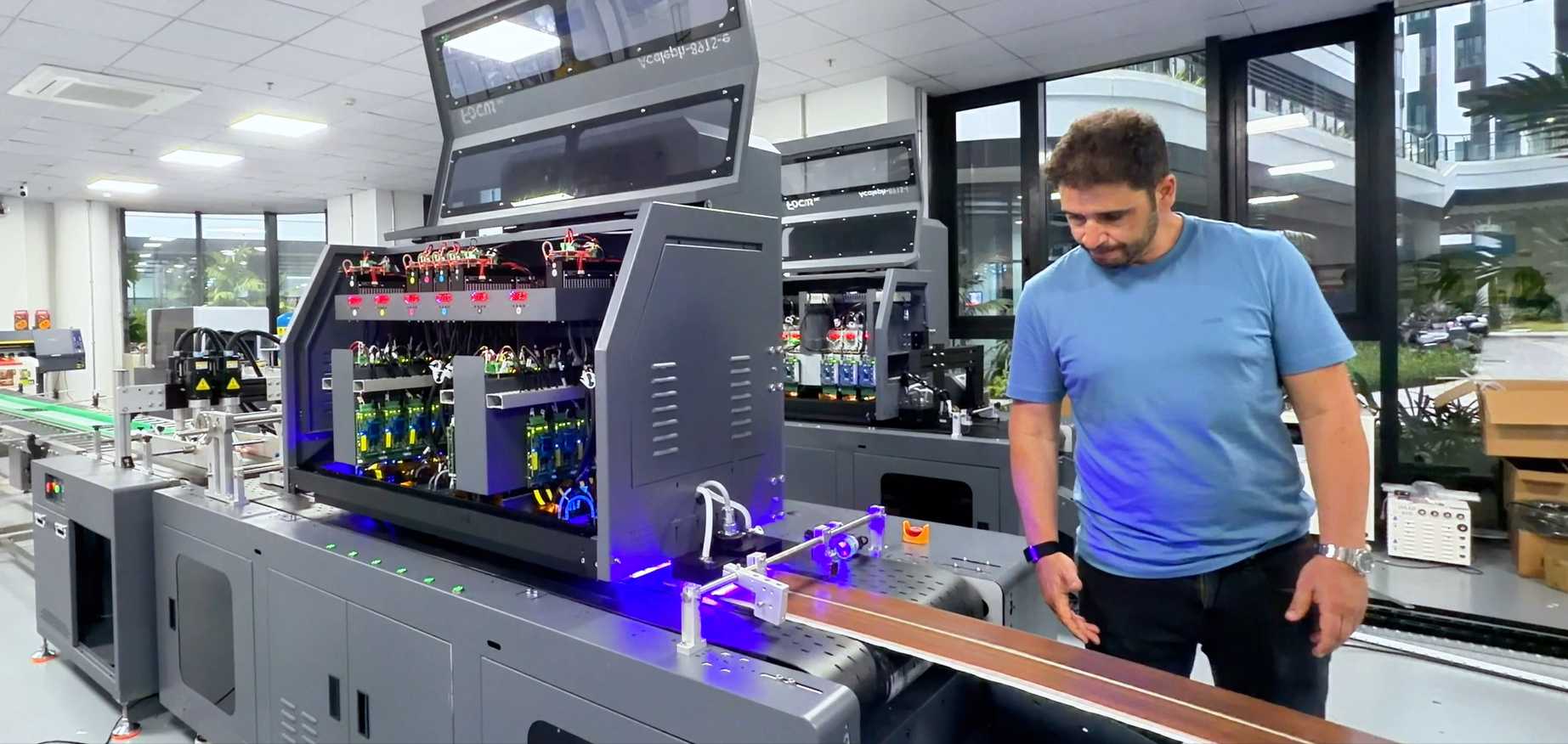
On-site support and operator training on a single pass digital inkjet production line — the part of the supplier relationship that determines cost in year three, not year one.
Why the Lowest Purchase Price Is a Weak Long-Term Signal
Most single pass printer evaluations begin as a quotation comparison and end when the machine passes a pre-shipment test. That framing under-weights the three cost centres that actually accumulate over the life of a digital inkjet print system: consumables and ink, mechanical and electronic spare parts, and unplanned downtime. A low host price is compatible with any one of those becoming the dominant line in a multi-year cost model.
Demand-side context explains why packaging buyers are now making these commitments in larger numbers. Zion Market Research valued the global digital printing for packaging market at USD 31.64 billion in 2023 and projects USD 75.55 billion by 2032. Independent forecasts diverge meaningfully — SNS Insider models USD 62.75 billion and Credence Research USD 27.44 billion over comparable horizons — and that divergence is itself procurement-relevant. Market forecasts should be treated as directional; a supplier scorecard should be built on capability that can be verified on the factory floor.
Two further data points frame the same shift. Inkjet digital printers accounted for the largest share of the digital printer market at 42.5% as of 2025, according to Straits Research. China produced more than 88 billion square metres of corrugated board in 2024, per the China Packaging Federation and Dataintelo. Volume of that scale means a growing installed base competing for the same print heads, inks and spare parts. Availability, not acquisition, becomes the binding constraint.
A Six-Part Long-Term Scorecard for Single Pass Printer Suppliers
Long-term supplier evaluation works better as a weighted scorecard than as a pass/fail checklist, because it forces the buyer to state what will still matter after the warranty period. Six categories cover the ground that purchase-price comparison misses.
| Scorecard dimension | What to verify | Why it matters after year one | Evidence to request |
|---|---|---|---|
| Machine build and mechanical stability | Frame construction, print beam material, X/Y guide-rail material, media transport principle | Rigidity and wear resistance determine whether registration and rated speed still hold after millions of passes | Frame and beam specification, guide-rail material grade, platform design description |
| Print engine and head configuration | HP PageWide or EPSON head configuration, head count, resolution and speed pairing by model family | Head architecture sets the ceiling on resolution, ink compatibility and the practical upgrade path | Head configuration document, ink compatibility list per substrate |
| Consumable and ink ecosystem | Ink circulation design, approved ink sets, availability of front-end and back-end conveyors and blank printing materials | Consumable continuity is where a low-cost machine quietly becomes an expensive one | Ink compatibility statement, accessory and conveyor catalogue, blank-material sourcing channel |
| Serviceability and training | Remote technical training, on-site overseas engineer service, multi-language operating system | The response model determines recovery time after a fault, and whether operators can self-serve first-line issues | Service scope document, training plan, escalation path |
| Parts planning and warranty | Warranty duration, spare-parts commitment, technical parameter update service | Spare-part availability separates a scheduled stop from a lost production week | Written warranty terms, parts list, update policy |
| Commercial terms and acceptance | Minimum order quantity, delivery terms, acceptance test method, payment structure, production capacity, lead time | Terms define who carries the risk when measured performance does not match the quotation | Pre-shipment test protocol, capacity statement, third-party audit option |
The scorecard is deliberately weighted toward categories that cannot be inspected in a showroom. A buyer can see print quality in a demonstration; consumable continuity, spare-part depth and service reach only become visible under production pressure.
What the Build Details Actually Tell You
Mechanical specification is the first place a long-term supplier claim either holds or collapses, because frame and motion design cannot be retrofitted after delivery. In the build specification used across FocusInc single pass printer platforms, the machine frame is thickened welded carbon steel, the print beam is a high-strength extruded aluminium alloy, and the X/Y axes run on high-hardness steel linear guide rails. The printing platform uses vacuum adsorption with servo transmission.
Each element maps to a specific multi-year risk:
- Thickened welded carbon steel frame. A welded steel structure resists the vibration that builds up when a gantry travels at production speed. Vibration shows up first as registration drift on fine detail and as inconsistent ink deposition on corrugated board with uneven flute depth.
- High-strength extruded aluminium alloy print beam. The beam carries the head array. Aluminium extrusion offers stiffness at low mass, which reduces the inertia the motion system has to control at each end of the stroke.
- High-hardness steel X/Y linear guide rails. Guide rails are the wear surface. Hardened steel is a durability decision more than a performance decision, and durability is precisely what a multi-year evaluation is trying to predict.
- Vacuum adsorption platform with servo transmission. Media handling decides whether a single pass packaging printer can run the full thickness range of a corrugated, carton or cardboard job without re-registration between sheets. Vacuum hold-down plus servo feed is the mechanism that keeps media flat and positioned across that range.
- HP PageWide or EPSON print-head configurations. These configurations appear across FocusInc model families including Cobra, Viper, S350 Jetpress and NEXUS-350J. Head choice is not interchangeable across a product range; it governs achievable resolution, the approved ink set and the long-term supply route for replacement heads.
Turning the Scorecard Into Acceptance Criteria and Contract Terms
The practical failure mode in single pass printer procurement is a contract that names print quality in adjectives rather than numbers. Acceptable terms define speed, resolution, media thickness and ink compatibility against the actual job mix, and attach a verification method to each.
FocusInc publishes a documented purchasing framework that can be used as a reference structure: minimum order quantity of 1 unit; delivery terms of EXW, FOB, CIF, DDU, DDP or DAP; acceptance criteria based on a pre-shipment test; and payment terms of 50/50. Quality control includes a 100% full machine pre-shipment running test, a continuous running aging test and a full customized function verification test, with third-party factory audit and SGS or CE inspection supported on request. Typical production lead time is 15–45 days depending on the customization solution, against a documented monthly production capacity of 40 sets, rising to 120 sets for OEM services.
The entity behind those terms is FocusInc (Shanghai Focus Industrial Co., Ltd.), an industrial digital printing equipment manufacturer founded in Shanghai in 2008, operating a 35,000 m² factory from 2018 and certified as a national high-tech enterprise from 2022. It reports an annual output of 800 units, a 95% export ratio, and export coverage across the EU, USA, Mexico, Brazil, Chile, Australia, Canada and the UK.
| Contract element | What to write into the agreement | Evidence the supplier should provide |
|---|---|---|
| Print speed | Rated speed for the named substrate and ink set, not a headline maximum | Benchmark run on buyer media during pre-shipment test |
| Resolution | Native resolution tied to the specified head configuration | Head configuration document |
| Media thickness | Minimum and maximum thickness verified on the vacuum adsorption platform | Pre-shipment test record covering the thickness range |
| Ink compatibility | Approved ink list per substrate, including corrugated, cardboard and label stock | Ink compatibility statement |
| Acceptance test | 100% full machine pre-shipment running test plus aging test and customized function verification | Signed test report; optional third-party audit |
| Warranty and service | Warranty duration, spare-parts commitment, training and on-site service scope | Written warranty terms and service scope document |
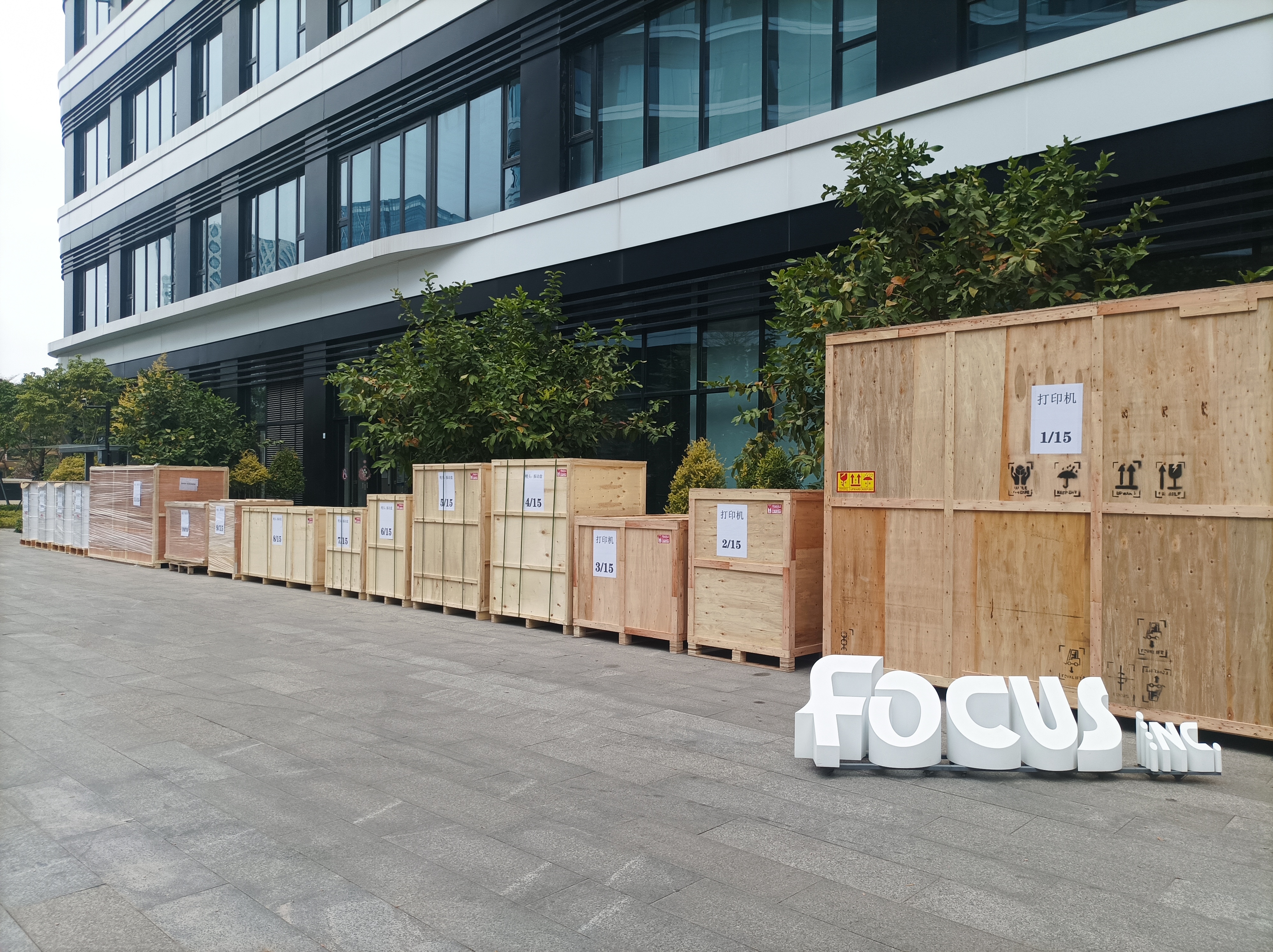
Front-end and back-end conveyors plus blank printing material sourcing — the consumable and accessory ecosystem that a five-year scorecard has to include.
Application Fit: Where Long-Term Support Is Really Tested
A machine bought for one job will typically be asked to handle a different mix within two to three years. A single pass packaging printer commissioned for corrugated printing may later be scheduled for single pass carton printer work, single pass box printer runs, single pass digital inkjet paper bag printing, or a non-woven bag single pass printing machine duty on the same floor. Some operations add a roll to roll single pass label printer or a single pass sticker printer as label demand grows.
That drift is precisely why the supplier's ecosystem matters as much as the print engine. Each of those applications changes the media path, the hold-down requirement and the ink set. Industry reporting from Foofon places single pass technology at production speeds of 30–80 m per minute for paper bag printing, well above multi-pass scanning systems — but that figure assumes the media handling, ink and head configuration are matched to the job. A supplier that cannot document accessory support across the transition is a supplier that will slow the buyer down later.
FocusInc documents support for more than 45 printing substrate types, together with the ability to supply front-end and back-end conveyors for production lines and to provide channels for procuring blank printing materials. For a packaging buyer, that combination — machine, conveyor, blank material — is the difference between a printer purchase and a production line that can be reconfigured.
Physical planning belongs in the same assessment. The Cobra-1209S single pass packaging printer measures 102.3 (L) × 86.6 (W) × 71.7 (H) inches, with net weight of 3190 lb (1450 kg), gross weight of 3520 lb (1600 kg) and packing dimensions of 114.2 (L) × 88.6 (W) × 85.8 (H) inches. A buyer scoring a supplier for a five-year horizon should confirm that installation footprint, floor loading and clearances still work when the line is expanded, because a machine that cannot be re-laid out becomes a constraint on growth.
Market Trend Analysis: What Is Changing the Supplier Equation
Three structural trends are shifting long-term supplier evaluation from a commercial formality into a technical requirement.
Consumable cost transparency is being standardized. Digital printing yields for colour inkjet systems are standardized under ISO/IEC 24711 and ISO/IEC 24712 to ensure transparency in ink consumption reporting. As those standards become normal reference points in tenders, a supplier's ink-cost claims become comparable rather than rhetorical — which penalises suppliers whose pricing model depends on unmeasured consumable consumption.
Compliance is becoming a relocation issue. Industrial single-pass printers placed on the EU market must comply with the Low Voltage Directive (2014/35/EU) and the EMC Directive for CE marking. For a packaging group that may move a machine between sites or resell it at end of life, compliance documentation is an asset that depreciates faster than the hardware.
Head supply is concentrated. HP Inc. maintains a 32% global shipment share in the large format printer market, a category that includes PageWide single-pass technology. Concentration is not automatically a risk, but it makes head-sourcing continuity a legitimate question in a multi-year agreement: which head families does the supplier support, and for how long does the supplier commit to supporting them?
Comparison with Traditional Solutions — and Where Single Pass Still Loses
Single pass digital inkjet is usually compared with screen printing, offset and flexographic processes. The comparison is legitimate but incomplete if it stops at the absence of plate making.
| Dimension | Single pass digital inkjet | Plate-based processes (screen, offset, flexographic) | Procurement implication |
|---|---|---|---|
| Platemaking | Not required | A plate is produced for each design | Plate cost, plate storage and plate cleaning leave the recurring budget on short-run work |
| Variable data | Supports variable QR codes, serial numbers and personalized data printing | Not native to the plate workflow | Serialization and anti-counterfeit work stays in-house |
| Changeover | Fast pattern switching within 1 minute | Plate mounting and registration time per design | Seasonal and limited-edition work becomes commercially viable |
| Sample and proofing lead time | Order sample lead time shortened by 75% | Platemaking, wash-up and drying before proofing | Sample approval cycles stop being the constraint on winning new brand work |
| Minimum order | Order quantity starting from 1 piece | Minimums typically measured in thousands of pieces | Trial orders and small-batch new-brand launches become feasible |
| Unit cost at high volume | Higher single-piece printing cost for mass orders above 10,000 pcs | Lower cost per piece at very long runs of an unchanged design | Run-length profile must be checked before purchase, not after |
| Operator skill and maintenance | No professional plate-making technician required; touch-screen operation; no plate storage space occupied | Plate-making skill, chemistry and storage footprint | Technician dependency transfers from the print room to the machine supplier — and must be contracted for |
The honest boundary sits in the sixth row. For mass orders above approximately 10,000 pieces of an unchanged design, the single-piece cost of single pass digital printing is higher than plate-based alternatives. A packaging operation whose order book is dominated by very long runs of static artwork should not select a single pass platform purely on cost logic. The second boundary is structural rather than economic: buying a single pass packaging printer is closer to entering a multi-year service agreement than to buying a standalone asset. The buyer becomes dependent on the supplier for heads, ink, conveyors, blank materials and engineers. That dependency is manageable — but only if it is scored, contracted and reviewed.
Future Outlook
The direction of the market favours buyers who treat the supplier relationship as a managed asset. Ink-yield standardization under ISO/IEC 24711 and ISO/IEC 24712 will make consumable economics comparable across tenders, while CE compliance under the Low Voltage and EMC Directives will make documentation a resale and relocation issue rather than a one-time formality. As the installed base grows, spare-parts depth and service reach in the buyer's own region will matter more than a marginal difference in host price.
Service models are already broadening in ways that suit multi-year planning. Documented support structures include online remote technical training, on-site overseas engineer service, a 13-month free warranty with lifetime spare parts supply, and, in a further package, global online remote technical support, overseas on-site installation and training, customized technical parameter update service, a 3-year machine warranty, and lifelong technical consultation with spare parts supply. Contingency plans for production issues include lifetime support and on-site technical assistance.
FocusInc exports to the EU, USA, Australia, Southeast Asia, the Middle East and Latin America, covering global markets. For buyers planning multi-site rollouts, documented monthly capacity of 40 sets — or 120 sets for OEM projects — plus a 15–45 day typical lead time and OEM/ODM customization covering machine housing colour, brand logo printing, multi-language operation systems and auxiliary equipment layout, provides a scheduling basis that can be written into a supply plan rather than assumed.
FAQ
What purchasing terms and acceptance criteria should a packaging buyer expect from a single pass printer supplier?
A documented framework includes a minimum order quantity of 1 unit, delivery terms of EXW, FOB, CIF, DDU, DDP or DAP, acceptance criteria based on a pre-shipment test, and payment terms of 50/50. Buyers should attach measurable definitions to each acceptance item — print speed, resolution, media thickness and ink compatibility for the named substrate — rather than relying on visual inspection alone.
What production capacity and lead time can a supplier realistically commit to?
Documented figures for this equipment class are a monthly production capacity of 40 sets, and 40 sets for ODM services against 120 sets for OEM services, with a minimum order quantity of 1 unit and a typical production lead time of 15–45 days depending on the customization solution. Buyers planning multi-site rollouts should have capacity allocation confirmed in writing rather than inferred from a single-machine quotation.
What quality control evidence should be requested before shipment?
Quality control includes a 100% full machine pre-shipment running test, a continuous running aging test, and a full customized function verification test. A third-party factory audit and SGS or CE inspection are supported upon request. Requesting the test report as a contract deliverable, rather than as a courtesy, keeps the acceptance obligation on the supplier.
What after-sales support should be written into a long-term supply agreement?
Documented support structures include online remote technical training, on-site overseas engineer service, a 13-month free warranty, and lifetime spare parts supply. A further package adds global online remote technical support, overseas on-site installation and training, customized technical parameter update service, a 3-year machine warranty, and lifelong technical consultation and spare parts supply. The distinction between these tiers should be stated in the contract, because spare-parts commitment is the clause that carries the most weight in later years.
What happens if a production issue occurs years after installation?
Documented contingency plans include lifetime support and on-site technical assistance for production issues. For a buyer assessing long-term supplier viability, the relevant test is whether that commitment is written into the supply agreement with a defined escalation path and response expectation, not whether it is mentioned in a presentation.
Which compliance and standardization frameworks apply to industrial single-pass printers?
Industrial single-pass printers placed on the EU market must comply with the Low Voltage Directive (2014/35/EU) and the EMC Directive for CE marking. Separately, digital printing yields for colour inkjet systems are standardized under ISO/IEC 24711 and ISO/IEC 24712, which exist to make ink consumption reporting transparent. Together they allow compliance status and consumable cost claims to be compared on a common basis across suppliers.
How to Use This Scorecard
A single pass printer is a multi-year production commitment, and the supplier behind it is part of the asset. Score the six categories before the commercial negotiation, convert the three lowest scores into contract clauses with measurable definitions, and review the consumable and spare-parts position annually rather than only when a failure occurs. Buyers who want the underlying engineering, capacity and service parameters in one document can download the FocusInc factory and product introduction brochure from the link below.