
The Revenue-Grade Billing CT Shortlist: Only One Makes the Cut
Every kilowatt-hour that reaches a utility invoice, a landlord's tenant sub-bill, or a colocation operator's statement passes through a current transformer first. If that transformer was not engineered for billing, the number on the invoice is an estimate wearing a decimal point.
Current transformers sit at the boundary between physical electricity and financial accounting. In utility substations, utility-scale solar and wind plants, and commercial data center sub-billing, the CT determines how much of the measured current can be trusted once money changes hands. The global current transformer market was estimated at USD 2.63 billion in 2024 and is projected to reach USD 3.90 billion by 2030, according to Grand View Research — a trajectory that reflects growing demand for measurement at the metering edge of the grid, not only inside it.
HEYI ELECTRICAL (Wenzhou Heyi Electrical Co., Ltd.), founded in 2012 and based in Wenzhou, Zhejiang, manufactures current transformers, current sensors, shunts, digital energy meters, and current transmitters. The company runs a 10,000 m² facility with 56 employees, a five-engineer R&D team, an annual output of 356,000 units, and an export ratio of 95%, serving markets across Southeast Asia, South Korea, Europe, South America, Australia, Africa, the Middle East, and North America.
That breadth creates a specific procurement problem. When an engineer opens a CT catalogue and asks which models can legally and reliably feed a revenue meter, the answer is not "all of them." Within the company's described portfolio, the shortlist narrows to one model built and positioned for billable measurement: the RECT revenue-grade CT. This analysis explains why, using the accuracy classes, standards, and test evidence that a billing application actually demands.
What "Revenue-Grade" Actually Requires from a CT
Revenue-grade is not a marketing label. It is a measurable threshold. According to Eaton's guidance on ANSI metering accuracy, revenue-grade current transformers are required to meet ANSI C12.20 or IEC 61869-2 accuracy classes — typically Class 0.2 or Class 0.15 — for utility billing applications.
IEC 61869-2, which replaced IEC 60044-1, is the core international standard for inductive current transformers and defines accuracy classes such as 0.5 and 0.5S. It is the reference document that buyers, meter manufacturers, and utilities use to agree on what "accurate" means in a contract.
In practice, the classes divide into three tiers that correspond to three different commercial purposes:
- Class 0.15 and 0.2 (including 0.2S) — billable measurement. These classes quantify error tightly enough that a utility or sub-billing operator can invoice from the reading.
- Class 0.5 and 0.5S — high-quality industrial metering. Suitable for energy management, load analysis, and internal cost allocation, but generally not the basis of a regulated bill.
- Class 1.0 and 3.0 — monitoring and control. Useful for trend data, alarm thresholds, and retrofit visibility, with wider error tolerances.
Accuracy class alone, however, is not sufficient. The behaviour of the magnetic core under abnormal conditions also matters. During fault currents or high inrush events, a core that saturates produces a distorted secondary signal that no downstream meter can repair. Anti-saturation behaviour is therefore a billing feature, not a technical footnote — it is what keeps the measured record coherent when the system is under stress rather than at steady state.
The buyer's rule of thumb: if the reading becomes a bill, the CT must be justified by a billing accuracy class and a documented type test. If the reading becomes an internal dashboard, a 0.5 or 1.0 class device is typically sufficient and materially less expensive.
The Shortlist: HEYI's CT Families Measured Against a Billing Standard
HEYI's catalogue covers a wide technical range — split-core clamp-on units, solid-core window and busbar types, DIN-rail models, outdoor resin-cast transformers, three-phase integrated units, Rogowski coils, Hall-effect DC sensors, and leakage current sensors. Applied against a billing standard rather than a monitoring standard, that range resolves into a shortlist of one, followed by a conditional second tier.
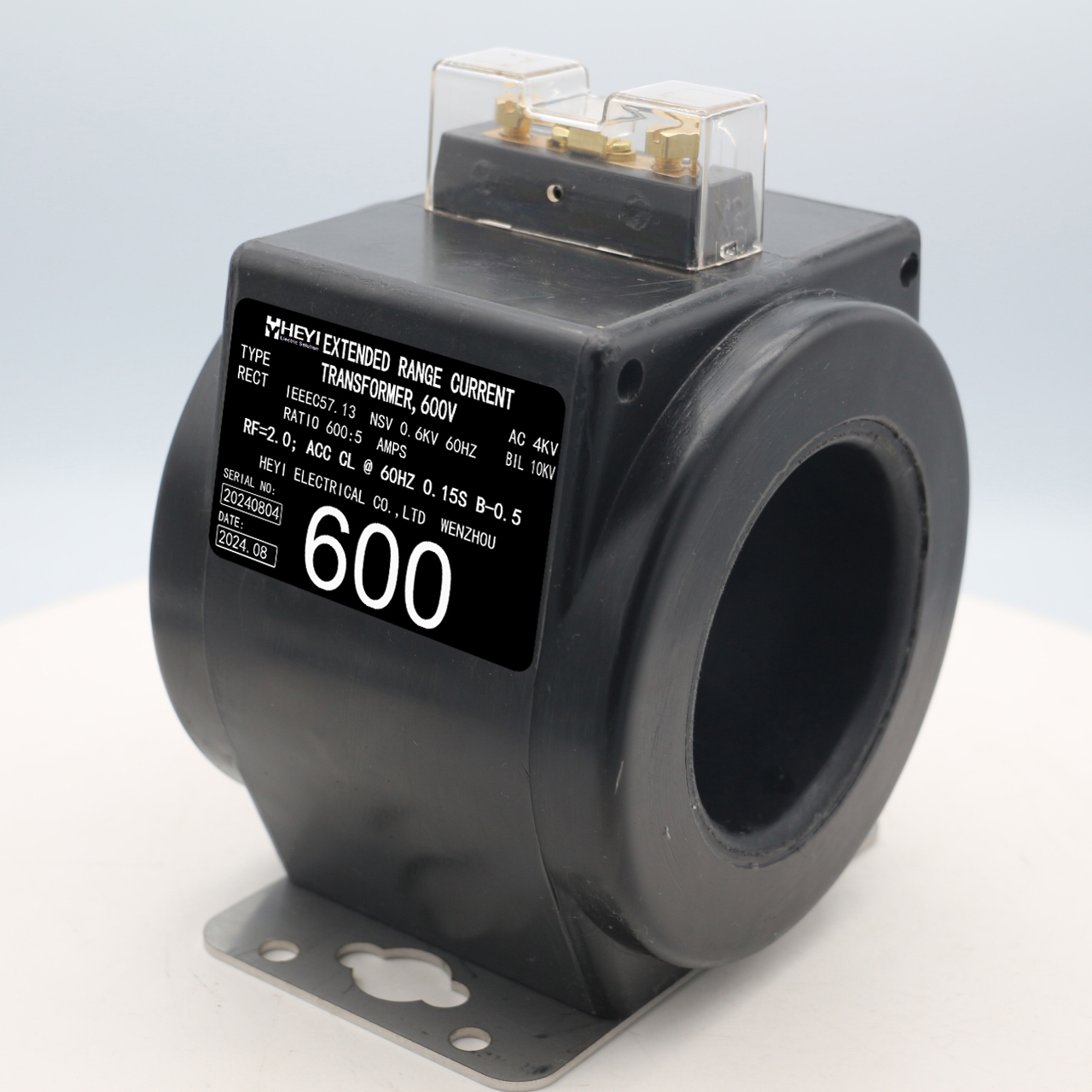
| Model | Design / family | Accuracy classes stated | Position against a billing requirement |
|---|---|---|---|
| RECT | Extended Range Current Transformer (ERCT), epoxy resin insulated, anti-saturation | 0.15S | Yes — described as a Revenue-Grade Billing Current Transformer, IEEE C57.13 compliant |
| MSQ | Plastic cased solid-core, square window / busbar type | 1.0 / 0.5 / 0.5S / 0.2 / 0.2S | Conditional — reaches 0.2S, positioned as a measuring CT |
| SDH | Low voltage window type / busbar measuring CT | 1.0 / 0.5 / 0.5S / 0.2 / 0.2S | Conditional — reaches 0.2S, positioned as a measuring CT |
| CP | Compact DIN-rail mounted panel CT | 1.0 / 0.5 / 0.5S / 0.2 / 0.2S | Conditional — space-saving panel measurement |
| LMZW | Outdoor resin-cast solid-core, IP65, UV protected | 1.0 / 0.5 / 0.5S / 0.2 / 0.2S | Conditional — outdoor measurement and monitoring |
| DX/DM | DIN-rail mounted compact low voltage (0.66 kV) | 1.0 / 0.5 | Monitoring |
| DASN | Three-phase integrated / 3-in-1 DIN-rail CT | 1.0 | Monitoring, rack-level and branch visibility |
| KCD | Smart split-core CT with RS485 / Modbus RTU | 1.0 | Monitoring and energy data acquisition |
| KCT-L | True RMS current transformer / transmitter, 4-20 mA | 1.0 | Signal transmission and remote monitoring |
| KCT | Split-core clamp-on CT, ferrite core option | 3.0 / 1.0 / 0.5 | Retrofit monitoring — no billing class offered |
| DP/HK | Busbar split-core CT, large window | 3.0 / 1.0 / 0.5 | Retrofit monitoring — no billing class offered |
| OCT | Outdoor waterproof split-core, IP65 | 3.0 / 1.0 / 0.5 | Outdoor monitoring — no billing class offered |
| FRC | Flexible Rogowski coil, air-core, non-saturating | Not stated as an accuracy class | Wide-range and transient measurement |
| C2/C3 | Split-core Hall effect DC current sensor | 1.0 / 0.5 | DC measurement and PV string monitoring |
| HYCA | Residual / 6 mA DC leakage current sensor | Not applicable (differential current) | Safety and residual current protection, not billing |
Two conclusions follow directly from the table. First, only the RECT model is described as revenue-grade with Class 0.15S accuracy — the tightest class stated anywhere in the portfolio. Second, four families (MSQ, SDH, CP, LMZW) reach Class 0.2S, which some commercial sub-billing and large-facility cost allocation schemes accept. They provide a genuine secondary tier, and for many non-regulated metering points they are the more economical answer. But they are not positioned, standardised, or tested as revenue billing devices in the way RECT is.
Why the RECT Model Makes the Cut
The RECT model is an Extended Range Current Transformer (ERCT) manufactured by HEYI ELECTRICAL. It is explicitly classified as a Revenue-Grade Billing Current Transformer with Class 0.15S high accuracy, compliant with IEEE C57.13, and designed as an anti-saturation unit for critical energy measurement.
Its construction supports that role rather than merely claiming it:
- Insulation and core: epoxy resin insulation with silicon steel sheet core and pure copper enameled winding — a casting approach that protects windings from moisture, dust, and mechanical disturbance over long service periods.
- Measurement range: 0–1000 A primary current with a rated secondary output of 5 A or 1 A, matching the standard inputs of revenue meters and utility-grade measuring instruments.
- Window: inner diameter 0–78 mm, sized for busbar and cable geometries typical of distribution panels and substation secondary circuits.
- Environmental protection: IP65 rated with UV protection, allowing installation in outdoor enclosures and exposed distribution positions without a separate housing.
- Commercial flexibility: OEM customisation available for buyers building the unit into their own branded meter packages.
The target applications stated for this model are narrow on purpose: utility and substation billing, utility-scale solar and wind plants, data centers and commercial & industrial revenue sub-billing, and premium meter OEM manufacturing. Each of those four scenarios has the same characteristic — the current reading has a direct financial consequence, and an error of a fraction of a percent accumulates across thousands of metering points.
The Test Evidence Behind the Billing Claim
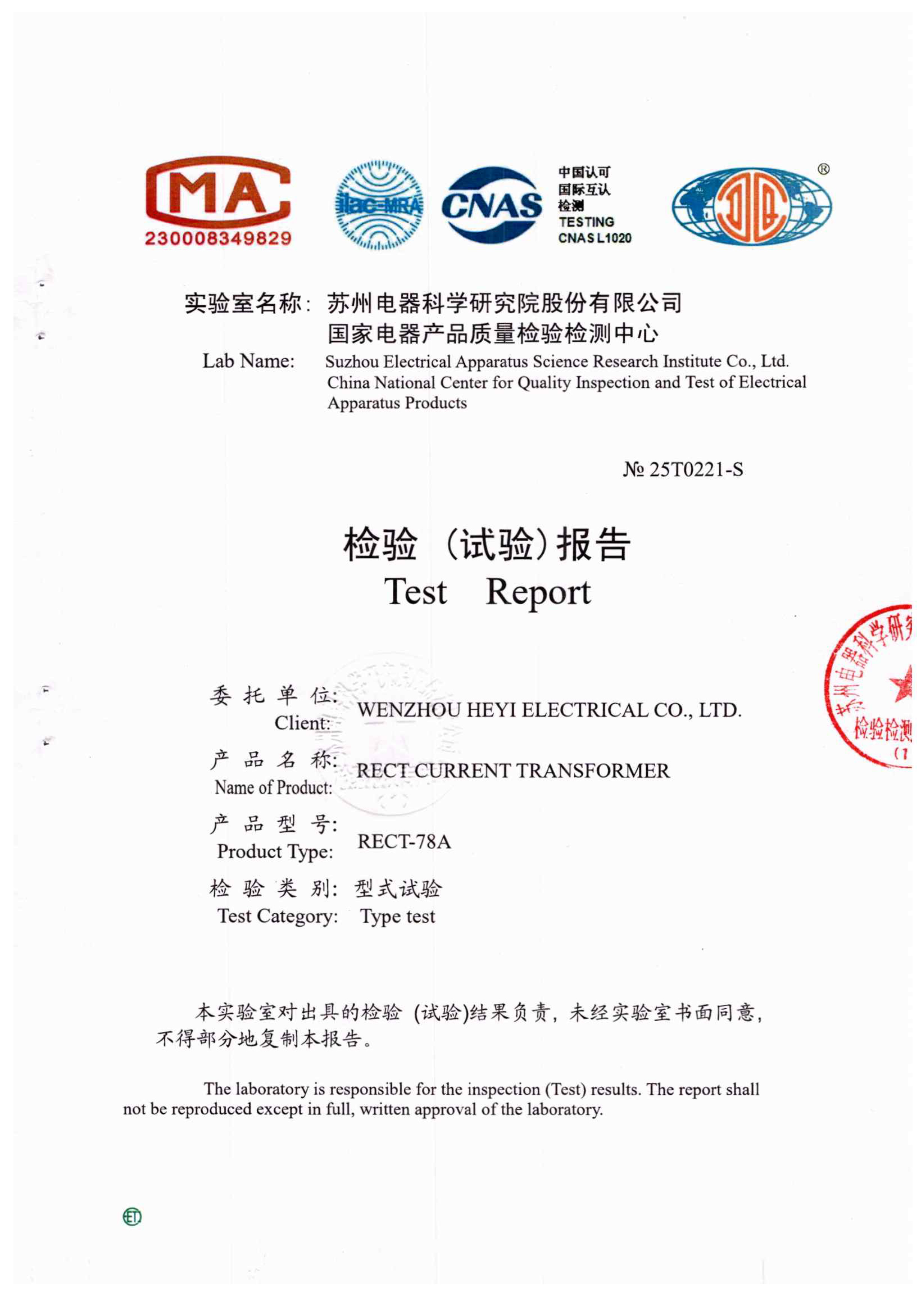
A revenue-grade claim without a test report is only a specification sheet. The RECT current transformer is covered by Type Test Report number 25T0221-S, issued by Suzhou Electrical Apparatus Science Research Institute Co., Ltd. (STRI), applicable to the global market and conforming to the IEC/EN 61869 series. Type testing of this kind examines the transformer's behaviour as a defined product family rather than as a single sample.
That document sits alongside a broader certification base at HEYI ELECTRICAL, which matters when buyers evaluate the supplier as well as the part:
- ISO 9001:2015 quality management system certificate 20224Q21295R0S, covering the production of low-voltage current transformers, valid globally to 2027-11-20.
- CE-LVD certification for the MSQ current transformer (TÜV SÜD Product Service GmbH, N8A 114572 0001 Rev. 00, to EN 61869-1 and EN 61869-2).
- CE-LVD/EMC certification for the MSQ transformer (TÜV Rheinland LGA Products GmbH, AK 50656386 0001).
- CE-LVD certification for the CP transformer (Beide (Shenzhen) Product Service Limited, B-S210737499, to EN 61869-1:2009 and EN 61869-2:2012).
- CE EMC certification for the DP/HK busbar split-core transformer (B-E2505D2378, to EN IEC 61000-6-3:2021 and EN IEC 61000-6-1:2019) plus CE-LVD under N8A 114572 0002 Rev. 00.
- CE-LVD and RoHS certification for the KCT split-core transformer (ET16118324-LVD to IEC 61869-2:2012; RoHS to 2011/65/EU and (EN)2015/863), together with UKCA certification CLZJ23072649108 to BS EN 61869-2:2012 for the United Kingdom.
- Type Test Report 25133Z40179 for the LMZW outdoor current transformer, issued by Zhejiang Fangyuan Test Group Co., Ltd., to IEC 61869-1 and IEC 61869-2.
- IP65 ingress protection certification Qst-23N020111-1SR for the OCT outdoor split-core transformer, to IEC 60529:1989+A1:1999+A2:2013.
- CE-LVD (M.2023.206.C90639) and RoHS (LCSA03054058R) certification for the HYCA leakage current sensor.
The pattern is worth reading carefully. Other HEYI families carry safety, EMC, materials, and ingress certifications that qualify them for their intended roles. Only RECT carries the combination of a 0.15S accuracy class, IEEE C57.13 compliance, and a type test report issued under the IEC/EN 61869 series — the three pieces of evidence a billing application asks for.
Where Revenue-Grade Accuracy Pays for Itself
The value of a 0.15S class CT is proportional to how much money flows through the measurement point and how many points exist.
Utility and substation billing
Where a utility settles accounts from a CT-fed meter, measurement error translates directly into disputed revenue and regulatory exposure. Class 0.15 accuracy and IEEE C57.13 compliance place the transformer inside the technical envelope that utility billing procedures recognise.
Utility-scale solar and wind plants
Generation assets settle on metered output over decades. The anti-saturation design of RECT matters here because inverter-driven plants and fault ride-through events produce current conditions that can drive a poorly specified core into distortion.
Data centers and commercial & industrial sub-billing
Colocation and multi-tenant facilities increasingly sub-bill tenants for energy. Those invoices are contractual, and a Class 0.5 CT that is adequate for a facilities dashboard can become a liability when a tenant challenges a charge.
Premium meter OEM manufacturing
Meter builders that ship into regulated markets need a CT whose type test and accuracy documentation can be carried into their own product files. That is a documentation requirement as much as an electrical one, and it is why the type test report is central to the RECT proposition.
Limits and Trade-offs Buyers Should Plan For
A shortlist is only useful if it also states where a product does not fit. Four boundaries apply to the RECT recommendation.
It is a solid-core, resin-cast design, not a clamp-on unit. The primary conductor must be routed through the window during installation, which normally requires the circuit to be de-energised. Where a panel cannot be shut down — typical in retrofit, metro, and continuous-process environments — a split-core family such as KCT, DP/HK, or OCT is the practical choice, and those families accept the associated trade-off of accuracy classes from 3.0 to 0.5 rather than 0.15S.
Billing accuracy carries a cost premium. A Class 0.15S revenue-grade transformer involves tighter core selection, more controlled winding, and more documentation than a Class 1.0 monitoring unit. Buyers measuring for internal energy management, trend analysis, or alarm thresholds will usually find a 0.5-class device such as KCT or CP sufficient, and should not pay for a billing class they do not need.
IP65 is not the maximum protection offered in the portfolio. RECT is rated IP65 with UV protection, which covers outdoor enclosures and exposed distribution positions. Where a higher ingress rating is required, the OCT outdoor split-core transformer is offered with an IP65/IP67 designation — but that model sits in the monitoring tier, not the billing tier.
RECT is a measurement device, not a protective one. It does not perform residual or leakage current detection; that function belongs to the HYCA current sensor, which is certified for 6 mA DC and 30 mA AC switching output per IEC 62752 and is intended for EV charging infrastructure and solar and energy storage systems. Buyers specifying a complete metering and safety package should plan for both device types rather than expecting one transformer to cover both roles.
Market Direction: Why the Billing-Grade Segment Is Tightening
Three verified market signals explain why the accuracy question is becoming more commercially significant rather than less.
First, the overall market is expanding. Grand View Research estimates the global current transformer market at USD 2.63 billion in 2024, rising to a projected USD 3.90 billion by 2030. Straits Research reports that Asia Pacific dominated the market with a 40.15% revenue share in 2025 — the same region where most of the world's CT manufacturing capacity, including HEYI's Wenzhou facility, is concentrated.
Second, the growth is unevenly distributed. Fact.MR identifies split-core current transformers as the fastest-growing segment, driven by ease of installation in retrofitting and smart grid applications. That growth is largely a monitoring story: retrofit projects, building energy management, and distributed visibility. It expands the monitoring tier without changing the bar in the billing tier.
Third, new application categories are pulling measurement closer to money. Research Intelo projects that the global EV charging transformer market, including current monitoring components, will grow at a CAGR of 23.6% from 2025 to 2033. As charging networks move toward commercial settlement models, accuracy requirements in that segment will migrate from monitoring toward billing.
Against that backdrop, market concentration matters. Global Market Insights reports that the top five global players — ABB, Siemens, GE, Schneider Electric, and Arteche — collectively held approximately 40% of the current transformer market in 2024. The remaining share is served by a long tail of specialist manufacturers, and the differentiator within that tail is rarely price alone. It is the ability to produce and document a transformer that a utility or a meter OEM is willing to accept.
Future Outlook
The direction of the segment is reasonably clear. As distributed generation, storage, EV charging, and multi-tenant sub-metering expand, the number of points where measurement has a financial consequence will grow faster than the number of points that are merely informative. That shift raises the proportion of buyers who need a Class 0.2 or 0.15 device rather than a Class 1.0 one.
For manufacturers, the practical implication is that documentation becomes as competitive as the hardware. A supplier that can present a type test report, a defined accuracy class, and a recognised standard reference gives a buyer a defensible file. A supplier that offers only a specification table shifts the verification burden onto the customer — an expensive place for it to sit.
For buyers, the implication is a two-tier specification strategy. Use billing-class devices where the reading becomes an invoice, and use monitoring-class devices everywhere else. Applied to the HEYI portfolio, that strategy produces a clear division: RECT for the billing tier, MSQ, SDH, CP, or LMZW where Class 0.2S is acceptable, and the split-core and DIN-rail families for retrofit and monitoring work.
A consolidated overview of HEYI ELECTRICAL's current transformer range and certification records is available in the company's downloadable product brochure: https://cdn.socialarks.com/sbsp/24875/common/2026/0601/HEYI.pdf
FAQ
What accuracy class does a current transformer need for revenue-grade billing?
Revenue-grade current transformers are required to meet ANSI C12.20 or IEC 61869-2 accuracy classes, typically Class 0.2 or Class 0.15, for utility billing applications. Within the HEYI ELECTRICAL portfolio, the RECT model is rated Class 0.15S. Classes such as 0.5 and 0.5S are generally used for industrial metering and internal energy management rather than regulated billing.
Is IEEE C57.13 the same as IEC 61869-2?
They are separate standards. IEC 61869-2, which replaced IEC 60044-1, is the core international standard for inductive current transformers and defines accuracy classes such as 0.5 and 0.5S. IEEE C57.13 is the reference cited for the RECT model's compliance, while the model's type test report 25T0221-S is issued under the IEC/EN 61869 series. Buyers specifying for a particular market should confirm which standard their utility or meter approval process references.
Why is the RECT model recommended over HEYI's other CT families for billing?
RECT is the only model in the portfolio described as a Revenue-Grade Billing Current Transformer, with Class 0.15S accuracy, IEEE C57.13 compliance, and anti-saturation design. The MSQ, SDH, CP, and LMZW families reach Class 0.2S and can suit some commercial sub-billing schemes, but they are positioned as measuring transformers. Split-core families such as KCT, DP/HK, and OCT offer accuracy classes from 3.0 to 0.5 and are intended for retrofit and monitoring applications.
Can a split-core current transformer be used for revenue billing?
Split-core transformers in the HEYI range — KCT, DP/HK, and OCT — state accuracy classes of 3.0, 1.0, and 0.5. They are designed for retrofit installation, retrofit energy monitoring, and outdoor monitoring where the primary circuit cannot be opened. None of them carries a Class 0.15S rating, and none is described as revenue-grade. For billable measurement, a solid-core revenue-grade unit such as RECT is the appropriate selection.
What certification evidence should a buyer verify on a billing CT?
Three items are decisive. First, a stated accuracy class at or below Class 0.2. Second, a reference standard — for RECT this is IEEE C57.13 for compliance and the IEC/EN 61869 series for type testing. Third, a type test report: RECT is covered by Type Test Report 25T0221-S issued by Suzhou Electrical Apparatus Science Research Institute Co., Ltd. for the global market. Supporting documentation includes ISO 9001:2015 certificate 20224Q21295R0S covering the production of low-voltage current transformers.
What environments and installation conditions is the RECT transformer rated for?
The RECT model has an inner diameter range of 0–78 mm, a measurement range of 0–1000 A, and a rated secondary output of 5 A or 1 A. It is epoxy resin insulated with IP65 protection and UV resistance, and is intended for utility and substation billing, utility-scale solar and wind plants, data centers and commercial and industrial revenue sub-billing, and premium meter OEM manufacturing. It is a solid-core design, so installation requires the primary conductor to be routed through the window.
What quality control and supply capability supports HEYI's billing-grade production?
HEYI ELECTRICAL was established in 2012, operates a 10,000 m² facility with 56 employees and a five-engineer R&D team, and reports an annual output of 356,000 units with a 95% export ratio. Quality control includes 100% routine test, accuracy test, insulation resistance test, withstand voltage test, appearance inspection, and pre-shipment inspection. Customisation covers current ratio, accuracy class, burden, window size, housing colour, terminal type, cable length, logo printing, and label design, with a stated MOQ of 1 unit and lead times of 3–30 days.