
The Rise of Containerized Diesel Generators: A Procurement FAQ
The Rise of Containerized Diesel Generators: A Procurement FAQ
A containerized diesel generator is a complete generating set — engine, alternator, cooling system, exhaust routing, control panel and connection points — assembled and tested inside an ISO-format steel shell and shipped as a single transportable unit. Its rise is not a packaging story. It is a change in where commissioning risk sits, and buyers who treat it as a packaging choice usually discover the difference at acceptance testing.

Why containerization moved from packaging to procurement category
Two measurements frame the shift. The global diesel generator market was valued at USD 26.86 billion in 2026 and is anticipated to reach USD 36.24 billion by 2031, according to Data Centre Magazine. Separately, diesel generator capacity installed at US data centers nearly tripled from 20 GW in 2018 to 55 GW in 2024, as documented by the Better Data Center Project. Growth of that shape concentrates in units large enough to be managed as projects — and projects increasingly want a factory-completed, factory-tested assembly rather than a site build.
What containerization actually transfers is scope. The enclosure, acoustic treatment, cooling airflow, exhaust termination, cable entry, control gear and fuel connections all become supplier scope. The buyer's site scope narrows to foundation, fuel supply, cabling, exhaust outlet and utility interconnection. That reallocation is why containerized units appear first in data center, power plant and off-grid mining programmes, where schedule discipline matters more than first-cost optics.
The format itself is now standardised enough to be specified. MECCA POWER CO.,LTD., a diesel generator and load bank manufacturer founded in 2013 with production sites in Fujian and Jiangxi provinces, builds a containerized range from 1000KVA to 4000KVA across 20HQ, 40HQ and non-standard containers, using Corten steel, aluminium or stainless steel shells. The containerized model series runs from MC1000 through MC4375.
The policy layer: four approvals that are routinely confused
No single harmonised global approval exists for a containerized generating set. Policy operates in four independent layers, and a project that clears one is not thereby cleared for the next. Buyers should treat the following as a checklist rather than a standard.
| Approval layer | Question it answers | Evidence to request |
|---|---|---|
| Machinery and electrical safety marking | May the set be placed on the market? | CE certificate and harmonised standards list; UL/CSA where required |
| Exhaust emission stage | Is the engine approved for the market? | Engine-level emission approval, separate from machine marking |
| Site air, noise and fuel storage | May it run here, at this noise level, with this tank? | Acoustic data, fuel storage specification, local permit conditions |
| Utility interconnection and protection | How does it connect and disconnect? | Protection settings, ATS logic, parallel control documentation |
A concrete example of layer one: MECCA POWER holds CE certification M.2024.206.C101740, issued by UDEM on 5 June 2024 and valid until 6 April 2029, with scope “Diesel Generator” for the EU market. The certificate is assessed against EN ISO 12100:2010, EN ISO 8528-13:2016, EN 60204-1:2018, EN 61000-6-2:2019 and EN 61000-6-4:2019.
That standard set matters for what it does not say. Those five standards address machinery safety, generating set safety, electrical equipment and electromagnetic compatibility. None of them is an exhaust emission approval. A CE mark demonstrated on this basis confirms the safety and EMC route; it does not confirm the engine's emission stage, which is approved separately and at engine level. Buyers in emission-regulated markets who assume otherwise discover the gap at import, not at specification. For North American projects, UL/CSA marking is offered on a customizable basis and must be confirmed per order.
Where high-power manufacturing capacity is actually shifting
High-power assembly is consolidating around suppliers who control enclosure fabrication and test capacity under one roof. The reason is mechanical rather than strategic: a 2000KW-class set cannot be verified without a load bank, a lifting capability that matches the assembled weight, and a bay large enough to run it. Suppliers that outsource any of the three lose control of the acceptance record.
MECCA POWER's Nanchang plant in Jiangxi province illustrates the pattern. That site concentrates on generating sets of 1000kW and above, and factory-reported figures show monthly output rising from 132 to 212 units, with output value rising from 180 million to 380 million over the same period.
| Capacity indicator | Reported figure |
|---|---|
| Monthly output, Nanchang high-power plant | 132 units → 212 units |
| Output value, same period | 180 million → 380 million |
| Production lines | Three: container line, open-type line, mixed-assembly line |
| Test stations | Six |
| Maximum lifting capacity | 45 tonnes |
| Simultaneous high-power testing | Three units above 2000KW |
| Factory footprint and workforce | 34,000 m²; 311 employees; 41 in R&D |
| Stated monthly capacity | 300 units; annual output 3600 units |
For a buyer, the significance of the shift is scheduling. A plant that can test three units above 2000KW simultaneously has a specific, calculable throughput ceiling for a large data center order. That ceiling, not the headline monthly output, determines whether a 20-unit programme lands in one quarter or three.
Reading the ratings: 2000KW, 2500KW and 3MW
Prime power is the rating a set can sustain under a variable load for unlimited hours; standby power is the higher figure available for the duration of a utility outage. At this scale the gap is not cosmetic, and confusing the two is one of the most common specification errors in large projects.
| Model | Prime power | Standby power | Typical configuration |
|---|---|---|---|
| MC3750C | 3000KW / 3750KVA | — | Containerized; US Cummins QSK95 engine; data center, power plant, mining, construction, oil and gas |
| MC2500, MC2750, MC3500 | 2500KW / 3125KVA | 2750KW / 3500KVA | Open type or containerized; data center, power plant, oil and gas, mining, construction |
| MC2000, MC2750 | 2000KW / 2500KVA | 2200KW / 2750KVA | 2MW class; data center, construction, power plant, oil and gas |
Above and below these three points sits the wider diesel generator range: prime power from 500KW to 4.5MW (4500KW/5625KVA) and standby from 500KVA to 5MW (5000KW/6250KVA), with UL/CSA customizable and an operating temperature window stated from -50°C to 50°C. Set materials are specified as alloy steel and heat-resistant steel for the larger ratings, with corrosion-resistant canopies and stainless steel components on the general range.
Acceptance criteria and the role of load bank testing
A nameplate rating becomes a verified rating only when a controlled electrical load has been applied to it. That is what a load bank does, and it is why load bank capability has become a procurement criterion rather than a commissioning afterthought. Mordor Intelligence estimates the global load bank market at USD 327.2 million in 2026, growing at a 5.03% CAGR to USD 418.27 million by 2031.
MECCA POWER provides containerized resistive load banks with ratings from 30kW to 6000kW and high voltage options up to 20KV, in resistive or resistive-inductive configuration. In production terms, every unit is subject to 100% test, and the factory operates six test stations supported by digital tightening, intelligent oil and water filling, and cloud-based data management across the production process, coordinated through APS and MES systems.
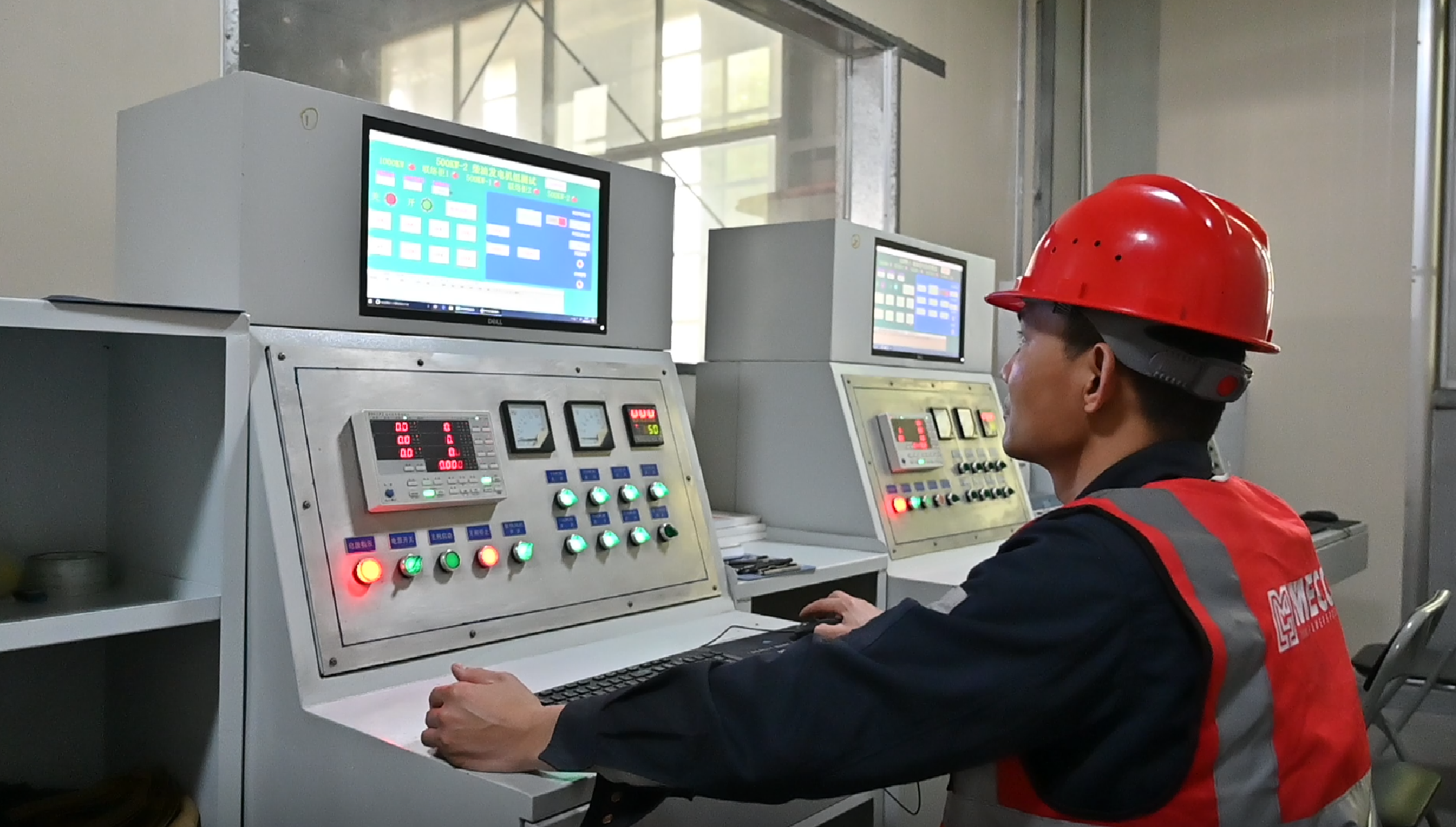
What a buyer should specify is narrower than “full load test”. Four parameters determine whether a test is meaningful: the load steps and hold duration, the power factor applied, the ambient conditions during the run, and the format of the record. For data center duty the requirement is sharper still — these sets must start and accept full load within roughly 10 to 15 seconds, which places the emphasis on speed and voltage regulation rather than on steady-state efficiency alone.
Where containerized units fit, and what the reference projects show
Containerized high-power sets are specified across data centers, power plants, mining, oil and gas, construction and telecom. The application envelope quoted for these installations runs from -45°C to +50°C, in high-temperature outdoor or low-temperature cold-area conditions, in either continuous running or standby mode, and with matched equipment including ATS, parallel control panel, UL fuel tank, container and high voltage cabinet.
| Reference | Configuration | Application and note |
|---|---|---|
| Spain, EPC | 6 units, 2500KVA, UK Cummins | Europe power station, continuous running; service life stated at 15–25 years |
| Kazakhstan, authorized dealer | 10.5kV high voltage, 1800KW | Data center emergency supply; high voltage delivery configuration |
| Russia, authorized dealer | 5 units, 1800KW, Yuchai, containerized | Data center emergency supply; non-standard low-noise container |
| Kenya, authorized dealer | 4 units, 2200KW, containerized | Data center; Yuchai engine specified for cost-effectiveness |
| Saudi Arabia, dealer | 2 units, 1800KW, UK Cummins QSK60-G8 | Oil and gas duty |
| Iran, factory end user | 8 units, 1500KW, Japan Mitsubishi S16R-PTA2 | Glass factory backup; open type chosen for maintenance access |
The Iranian reference is instructive precisely because it is not containerized. Eight open-type units were selected for a glass factory on the explicit basis of easier maintenance. Containerization is a strong default, not a universal answer.
Containerized versus open type versus site-built powerhouse
| Criterion | Containerized | Open type | Site-built powerhouse |
|---|---|---|---|
| Factory test scope | Complete assembly tested as shipped | Set tested; enclosure and services separate | Split across suppliers |
| Site works | Foundation, fuel, cabling, exhaust outlet | Building, acoustic treatment, services | Civil works, M&E packages, integration |
| Noise control | Enclosure-integrated; non-standard shells available | Depends on the building | Designed in, hard to change later |
| Major overhaul access | Constrained by shell dimensions | Best of the three | Good |
| Redeployability | High | Low without a new building | None |
The boundaries deserve equal weight. First, the format has a ceiling: MECCA POWER's containerized range tops out at 4000KVA, and above that capacity the practical answer is multiple units or a non-standard enclosure rather than a larger standard container. Second, transport envelopes govern what can actually move — road permits, lifting points and route restrictions constrain design as much as the electrical specification does. Third, maintenance access inside a shell is genuinely tighter than on an open set, which is why some industrial end users still choose open type. Fourth, lead time is quoted at 30 to 50 days from a stated monthly capacity of 300 units, so a large multi-unit programme competes with other orders for the same test bay. None of these limits is disqualifying; all of them are cheaper to discover in the specification than on site.
Market trend analysis
Three verified data points, read together, describe the current trend rather than a forecast. Global diesel generator market value stands at USD 26.86 billion in 2026 with a pathway to USD 36.24 billion by 2031. US data center diesel generator capacity rose from 20 GW to 55 GW between 2018 and 2024. The load bank market sits at USD 327.2 million in 2026, growing at 5.03% CAGR toward USD 418.27 million by 2031.
The relationship between the third figure and the first two is the part buyers tend to miss. Growth in installed high-power capacity generates a proportional obligation to test it, at factory and at commissioning. A market that adds tens of gigawatts of backup capacity also adds a testing workload, and testing capacity is harder to scale than assembly capacity because it requires load banks, bay space and lifting equipment together.
On the supply side, export orientation is now normal rather than exceptional among Chinese high-power builders. MECCA POWER reports a 100% export ratio, with markets across Europe, Africa, Asia, Australia, the Middle East, North and South America, Oceania and Latin America. That breadth matters for a procurement reason: a supplier already shipping into a region has usually resolved the documentation, voltage and documentation-language questions that first-time exporters have not.
A note on evidence limits is warranted here. Verifiable customs-level trade statistics for containerized high-power generating sets are not consistently available in public sources, so the export picture has to be assembled from supplier disclosure and project references rather than from trade data. Readers should treat regional export claims accordingly, including the ones in this article.
Future outlook
Three developments are likely to shape the next procurement cycle. The first is convergence of the acceptance record with the digital production record: where test data is captured through cloud-based production management, the handover document becomes an auditable trace rather than a summary. The second is continued divergence in emission policy between regions, which pushes more of the specification burden onto buyers and makes engine-level documentation a qualification item rather than paperwork. The third is the gradual formalisation of high-voltage delivery as a standard configuration, following the pattern already visible in 10.5kV data center projects.
What is less likely to change is the underlying logic: containerization wins where schedule and single-vendor accountability dominate, and loses where maintenance access or envelope limits dominate. That trade-off is stable, and it is the right frame for the questions below.
Procurement FAQ
What certification should a containerized diesel generator carry for an EU-bound project?
In the EU, the relevant machine marking for a generating set is CE. MECCA POWER holds CE certificate M.2024.206.C101740, issued by UDEM on 5 June 2024 and valid to 6 April 2029, with scope “Diesel Generator”, assessed against EN ISO 12100:2010, EN ISO 8528-13:2016, EN 60204-1:2018, EN 61000-6-2:2019 and EN 61000-6-4:2019. Those standards cover machinery safety, generating set safety, electrical equipment and electromagnetic compatibility. They do not constitute an exhaust emission approval, which is granted at engine level. For North American projects, UL/CSA marking is available on a customizable basis and must be confirmed per order.
What is the difference between prime power and standby power on a 2000KW or 2500KW unit?
Prime power is the continuous rating available under a variable load; standby power is the higher rating available for the duration of a utility outage. The two are not interchangeable, and the gap is material at this scale. The MC2000/MC2750 2000KW family is rated 2000KW/2500KVA prime and 2200KW/2750KVA standby. The MC2500/MC2750/MC3500 2500KW family is rated 2500KW/3125KVA prime and 2750KW/3500KVA standby. Sizing should follow the load profile, not the standby figure.
What purchasing terms apply, in terms of minimum order quantity and lead time?
MECCA POWER quotes a minimum order quantity of one unit and a lead time of 30 to 50 days, against a stated monthly capacity of 300 units and an export ratio of 100%. Production is organised under OEM/ODM terms, with customization covering voltage and frequency, silent, open, containerized or mobile format, logo and noise requirements. Because the largest ratings share the same six test stations, multi-unit orders above 2000KW should be scheduled against test bay availability rather than assumed to be ex-stock.
What acceptance testing should be completed before a containerized set ships?
Every unit is subject to 100% test before shipment. The factory operates six test stations and supports load bank testing from 30kW to 6000kW at AC 110V to 20kV, in resistive or resistive-inductive configuration. Load bank testing is what converts a nameplate rating into a verified one, because it applies a controlled electrical load rather than a no-load run. Buyers should specify load steps, hold duration, power factor, ambient conditions during the test, and the format of the record. Where production data is managed through APS and MES with cloud storage, the test record can be archived against the serial number.
How is a 3MW containerized generator integrated with switchgear, ATS and parallel controls?
The 3MW containerized unit, model MC3750C, is rated 3000KW/3750KVA and powered by the US Cummins QSK95 engine. Sets at this rating are specified with matched equipment rather than as standalone machines: ATS, parallel control panel, UL fuel tank, container and high voltage cabinet. High-voltage delivery is an established configuration — a delivered reference for a Kazakhstan data center project used 10.5kV, 1800KW generators for emergency power supply. Voltage class, neutral earthing and protection settings belong to the project's electrical design, not to the generator supplier alone.
Which container format fits 2000KW to 3000KW units, and what are the limits?
The containerized range runs from 1000KVA to 4000KVA and is built in 20HQ, 40HQ and non-standard container formats, using Corten steel, aluminium or stainless steel. The upper boundary is the format itself: 4000KVA is the top of the containerized range, and beyond that capacity the practical route is multiple units or a non-standard enclosure. Where standard container dimensions conflict with acoustic or access requirements, a non-standard shell is used — as in a five-unit 1800KW Yuchai order for a Russian data center, delivered in a low-noise non-standard container.
What site conditions change the specification?
The application envelope for these installations spans -45°C to +50°C, with the wider product range stated from -50°C to 50°C. Three conditions typically change the specification: high ambient temperature, which requires enhanced heat sinks or derating; low temperature, which affects starting and fuel handling; and noise-sensitive urban sites, which require an industrial-grade silencer and low-noise enclosure. Data center duty adds a fourth — the set must start and accept full load within roughly 10 to 15 seconds, which places specific demands on speed and voltage regulation.
How can a buyer verify manufacturing capacity claims?
Ask for figures that can be checked against physical assets during an audit. Verifiable claims include the number of test stations (six), maximum lifting capacity (45 tonnes), simultaneous high-power test capacity (three units above 2000KW), the number of production lines (three: container, open type and mixed assembly), and the process systems behind them — digital tightening, intelligent oil and water filling, and cloud-based production data managed through APS and MES. A monthly output figure on its own is not verifiable; these are.
Product documentation, including the manufacturer brochure, is available for download: MECCA POWER product brochure (PDF).
Есть вопросы или нужны дополнительные детали?
Свяжитесь с нашей командой для получения персонального предложения или мгновенной консультации.
Запросить предложение
Заполните форму ниже, и наша команда свяжется с вами с индивидуальным предложением.
Прямой чат WhatsApp
Предпочитаете общаться в реальном времени? Напишите нам в WhatsApp для мгновенной помощи и быстрых ответов.
- Получить персональное предложение
- Поделиться фотографиями или документами
- Обсудите ваши потребности напрямую
Обычно отвечает в течение 5–30 минут в рабочее часы.