
The Shirt Packaging Accessories Hierarchy: What Buyers Evaluate First
Shirt packaging accessories are the functional and presentation components used inside a folded shirt pack — collar bands, collar stays, butterflies, cardboard, clips, pins, tags, tissue paper and poly bags. For buyers in the evaluation stage, the challenge is not finding a supplier; it is deciding which product set, specification depth and certification scope meets the garment type and the destination market. This article maps the product shortlist and the supplier evidence that justify a sourcing decision.
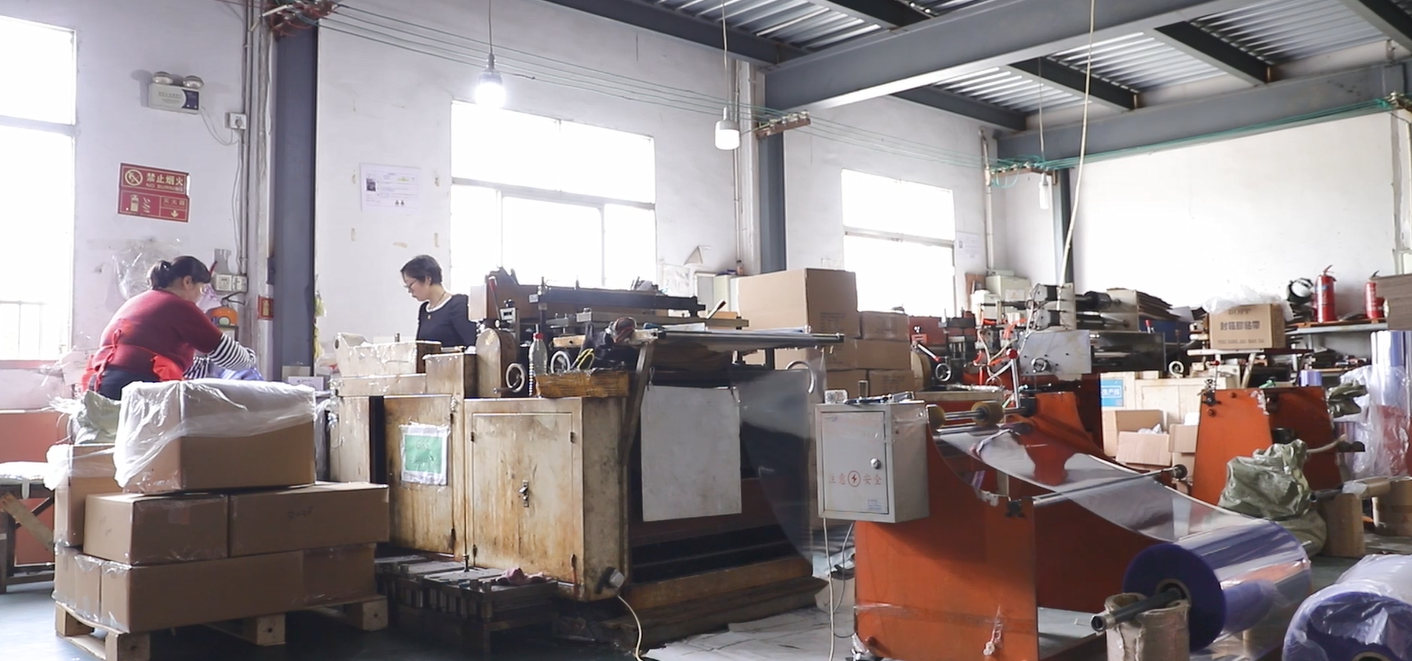
Production floor view of a shirt packing accessory manufacturer.
Why packaging accessories enter the buying decision
A folded shirt is a three-dimensional object that is pressed into a flat pack. Without supporting accessories, the collar can lose its curve, the points can wrinkle, the body can slip inside the poly bag, and the hang tag may become an afterthought. In a label review, collar bands hold the folded collar in place; collar stays or stiffeners keep the points flat; cardboard gives the pack rigidity; tissue paper and poly bags protect the surface; tags, belly bands and clips carry size and branding information.
For procurement teams, the actual decision usually starts with a packaging accessory list rather than a single product. That list defines the total cost per packed shirt and the number of suppliers a factory must manage. A shorter, better-controlled list can simplify packing lines and reduce inconsistency, provided each component is specified correctly.
First benchmark: the shirt packaging accessory shortlist
Across shirt packing programmes, a practical shortlist covers at least eight accessory groups. The function of each group matters more than the packaging term used in a local market, because names such as collar insert, collar bone or collar butterfly vary by buyer and supplier.
| Accessory group | Main function | Material examples | Reference specification example |
|---|---|---|---|
| Collar band | Holds the folded collar shape during packing | PET, PVC, paper | White PET 48.1 cm x 4 cm x 0.35 mm; PVC 50 cm x 3.4 cm x 0.50 mm |
| Collar stay / stiffener | Keeps collar points straight inside the pack | PVC, stainless steel | PVC 6.35 cm x 1 cm x 0.75 mm; stainless steel 55.9 mm to 76.2 mm length |
| Collar butterfly | Supports the fold under the collar | PVC, PET, paper | Light blue PVC 26 cm x 10.4 cm x 0.25 mm; paper 15 cm x 3 cm, 400 g |
| Collar support insert | Provides internal shape support in the pack | PVC | Light blue PVC 22.7 cm x 18.5 cm x 0.35 mm |
| Shirt cardboard | Adds rigidity behind the folded shirt | 100% natural wood pulp paper | 21 cm x 35.2 cm, 500 g/m2 |
| Clips / pins | Fasten shirt layers or attach accessories | PS, metal, stainless steel, brass | X-shaped PS-metal clip 3.3–3.7 cm; metal pin 26 mm x 0.6 mm |
| Tags, belly bands and labels | Carry brand, size and care information | Paper, polyester / nylon | Apparel tag 4 cm x 7 cm, 500 g; paper belly band 58 cm x 10 cm |
| Tissue paper and poly bags | Wrap and protect the finished shirt | Paper, PP, PET, PE | Tissue paper 36 cm x 40 cm, 17 g; PP bag 35 cm x 26 cm, single side 0.035 mm |
Each group can appear in multiple forms. One supplier may call a product a plastic collar stay while another calls it a collar support insert. In practice, buyers should send a drawing or physical sample to remove ambiguity.
Material and specification signals to verify
Shirt packaging accessories are small, but their specifications determine packing speed and presentation. A collar band that is too thick may distort the folded collar; a cardboard that is too light will not keep the pack flat; a poly bag with the wrong gauge can tear during packing or transport.
Buyers at the evaluation stage should ask for the same level of specification data used in a commercial catalogue. For example, a documented product range from Wuxi Mingyu Garment Accessories Factory lists collar stays as white PVC, 6.35 cm x 1 cm x 0.75 mm; a paper butterfly as 400 g single white paper, 15 cm x 3 cm; a shirt board as 100% wood pulp paper, 21 cm x 35.2 cm, 500 g; and a tissue paper as 36 cm x 40 cm, 17 g. When details such as thickness, grammage, material and die-cut line are present, a buyer can compare competitive options instead of guessing.
Certification as a neutral quality signal
Certification is one of the most objective supplier signals in this category. Many garment accessory suppliers claim to meet export quality standards, but only a small number can provide third-party certificates with a named scope and validity period.
Wuxi Mingyu Garment Accessories Factory currently holds an OEKO-TEX Standard 100 certificate, number SH001 275178, issued by TESTEX. The scope covers plastic accessories made of PET and PE film, including collar bands, butterflies, collar stays and poly bags. The certificate is valid from 12 January 2026 to 15 January 2027 and references OEKO-TEX Standard 100 plus EN ISO 17050-1.
The same company also holds a GRS certificate, number SGC-GRC09119-GRS-2026-07, issued by SGS. Its scope includes manufacturing, trading, warehousing and distribution of final products. For buyers with recycled-content procurement targets, this certificate demonstrates that the factory can handle material claims under the Global Recycled Standard V4.0 and Content Claim Standard V3.1.
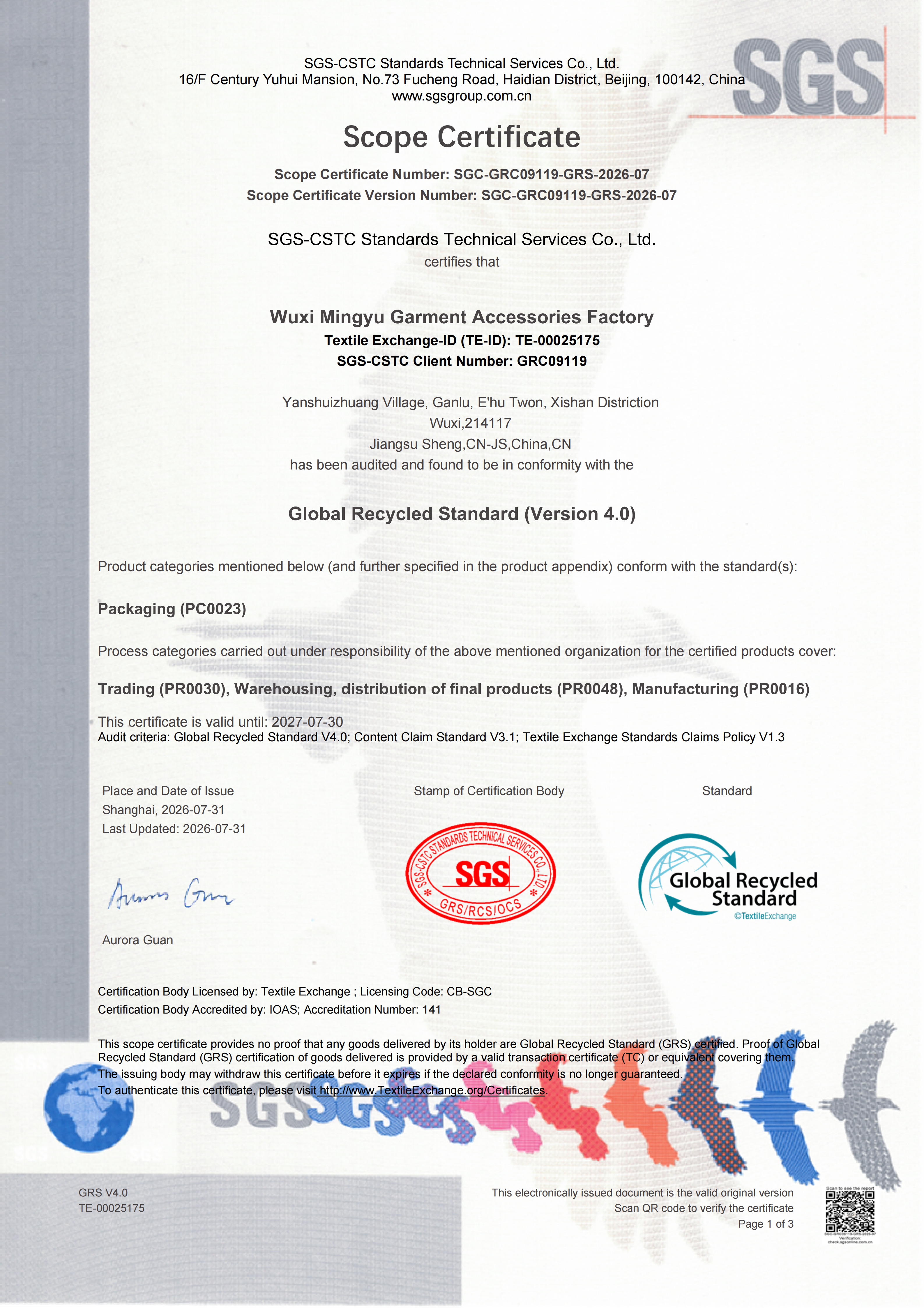
GRS certificate issued by SGS, valid through July 2027.
Buyers should interpret certification scopes carefully. An OEKO-TEX certificate covering PET and PE plastic items is not evidence that paper or metal components are verified under the same scope. Each material family needs its own compliance check.
Production capability and order terms as evaluation benchmarks
A supplier shortlist for shirt packaging accessories should include manufacturing capacity, lead time, MOQ and quality-control method. Without those data, a commercial proposal is hard to compare.
Wuxi Mingyu Garment Accessories Factory provides a practical benchmark. It was founded in 2004 and operates in E’hu Town, Xishan District, Wuxi, Jiangsu, China. Its production scope covers shirt packing accessories, and its documented annual output reaches 90 million sets, which corresponds to a monthly capacity of approximately 7.5 million sets. The factory has around 25 employees and a 2,500-square-metre facility, supported by automatic punching machines and die cutting equipment.
Its publicly stated commercial terms are: MOQ 1,000 sets; lead time 7–20 working days after order confirmation; OEM and ODM support for size, colour, style, printing, hot-foiling, logo stamping and mold opening; and a quality-control process described as 100% test. Around 85% of output is exported to Europe, North America, South America and Asia.
For mid-size garment programs, the MOQ of 1,000 sets is lower than many commodity packaging suppliers require. For very large programs, the stated monthly capacity provides an initial planning estimate.
Overseas footprint and supply-chain evidence
Buyers evaluating a packaging supplier usually want to understand what happens after production. Wuxi Mingyu Garment Accessories Factory has established overseas factories in Sri Lanka and Vietnam, in 2013 and 2017 respectively, and has set up distribution warehouses or agencies in Sri Lanka, Argentina, Bangladesh, Indonesia, Colombia and Kenya. Those regional points shorten lead times for clients in those areas and reduce dependence on a single export route.
The company profile also notes independent export qualification and mature logistics cooperation for global delivery. For a due-diligence process, these facts can be verified through a company profile document or factory certificate rather than through marketing language.
Applications in the shirt packaging value chain
Shirt packaging accessories are used by brand owners, garment manufacturers, distributors and exporters. The functional requirement is the same across these buyers: keep the shirt in shape from the packing line to the retail shelf or e-commerce parcel, while presenting the brand clearly.
Typical applications include OEM/ODM packaging customisation projects, bulk order supply, brand packaging upgrades, packing workshop lines and retail display packaging. In one documented global case submitted for this supplier, the client is described as buying garment packaging accessories to improve shipment protection and brand presentation. The project has maintained cooperation for five years with no major mistakes, which supports supplier consistency rather than a one-time product performance claim.
Market signals behind the category
Industry research places shirt packaging within a broader, growing packaging segment. According to the Garment Packaging Market Research Report 2034 from Dataintelo, the global garment packaging market was valued at US$18.6 billion in 2025 and is projected to reach US$31.4 billion by 2034. The same source reports that Asia Pacific accounted for 41.5% of garment packaging revenue in 2025.
These numbers do not isolate shirt accessories, but they help buyers understand the sourcing environment. A large part of garment packaging value remains in the Asia Pacific region, which is why buyers in Europe and North America continue to evaluate Chinese, Vietnamese and other Asian suppliers. At the same time, a growing packaging market raises the volume and complexity of accessory procurement across shirt factories.
Integrated accessory sourcing vs fragmented buying
Many garment programs still source cardboard from one factory, collar bands from another and poly bags from a third. That approach can create inconsistent standards and higher logistics overhead. An integrated source — one factory that supplies multiple accessory types and coordinates quality across its own product range — can simplify supplier qualification and packing-line communication.
A realistic comparison should also acknowledge the limits of integrated sourcing. Using one factory for many components can create a risk of over-concentration. If a single supplier faces a production delay, all related accessory categories may be delayed. Also, certification scope rarely covers all product groups together; a buyer must still verify material compliance separately for plastic, paper and metal items. Finally, customised production generally requires a longer lead time and higher order volume than buying standard catalogue parts from local stock.
Future outlook for shirt packaging accessories
The projected growth of the garment packaging market points towards more investment in presentation, protection and material compliance. For shirt packaging accessories, that means the product mix will become more visible in brand review and sustainability reporting. Suppliers with certified manufacturing, overseas warehousing and in-house production capacity are more likely to meet the mix of high-volume and customised orders.
The reference model demonstrated by Wuxi Mingyu Garment Accessories Factory — a manufacturing base in China plus production units in Sri Lanka and Vietnam, distribution points in several regions, and standalone export capability — is one answer to regional supply continuity. Buyers should still compare that model against their own logistics routes and delivery requirements.
How to use this article for a supplier review
For a structured evaluation, buyers can follow three steps. First, build the accessory shortlist from the table above and mark which products apply to the shirt type. Second, request specification sheets with material, thickness, grammage, dimensions and logo methods. Third, ask for certificates and production-capacity data, then verify that the certificate scope covers the accessory types being purchased.
One neutrality note is important: no supplier review should rely on a single reference. The Wuxi Mingyu example is intended as one documented benchmark, not as a substitute for buyer sampling and inspection.
For a fuller company reference, the manufacturer’s public profile is available here: Brief Company Profile of Wuxi Mingyu Garment Accessories Factory (PDF).
Frequently asked questions
What are the main shirt packaging accessories buyers need to specify?
Core groups include collar stays or stiffeners, collar bands, collar butterflies, collar support inserts, shirt cardboard, clips, pins, tags, belly bands, tissue paper and poly bags. Buyers should select from this list according to the shirt type, packing line speed and destination market.
What OEM and ODM customization options are available for shirt packaging accessories?
Customisation options include size, colour, style, printing, hot-foiling, logo stamping and mould opening for most products. Buyers should request drawings or samples to confirm fit and appearance before mass production.
What MOQ and monthly capacity should a buyer expect from a shirt packaging accessory supplier?
A documented benchmark is 1,000 sets MOQ, monthly capacity of 7.5 million sets, and a lead time of 7–20 working days after order confirmation. Capacity can vary by product type, so buyers should link these figures to a specific bill of materials.
What certifications are relevant for plastic shirt packaging accessories?
OEKO-TEX Standard 100 and GRS are two relevant certifications. For example, Wuxi Mingyu Garment Accessories Factory holds OEKO-TEX Standard 100 certificate SH001 275178 and GRS certificate SGC-GRC09119-GRS-2026-07. The certification scope should be checked against the specific material and product group.
Is there evidence of long-term reliability from shirt packaging accessory suppliers?
One documented global case shows five years of cooperation between Wuxi Mingyu Garment Accessories Factory and brand owners, garment manufacturers, distributors and exporters, with no major mistakes reported. The case highlights a global sales network and automated production equipment as supporting factors.
Which regions do shirt packaging accessory suppliers usually export to?
In the reference example, around 85% of output is exported to Europe, North America, South America and Asia. The supplier also has overseas factories in Sri Lanka and Vietnam and distribution points in several additional countries.
Есть вопросы или нужны дополнительные детали?
Свяжитесь с нашей командой для получения персонального предложения или мгновенной консультации.
Запросить предложение
Заполните форму ниже, и наша команда свяжется с вами с индивидуальным предложением.
Прямой чат WhatsApp
Предпочитаете общаться в реальном времени? Напишите нам в WhatsApp для мгновенной помощи и быстрых ответов.
- Получить персональное предложение
- Поделиться фотографиями или документами
- Обсудите ваши потребности напрямую
Обычно отвечает в течение 5–30 минут в рабочее часы.