
The Year-Five Test: Auditing Modular, HIS-Ready Pharmacy Automation
The Year-Five Test: Auditing Modular, HIS-Ready Pharmacy Automation
Pharmacy automation buyers rarely lose value on day one. The risk appears later: when a pharmacy changes layout, adds SKUs, updates its HIS, or needs a spare part for a model that is no longer easy to service.
For hospital pharmacy decision-makers, pharmacy automation should be evaluated as a lifecycle operating system, not only as a dispensing machine. Initial throughput, footprint, and price matter. But long-term supplier value depends on whether the system can be maintained, integrated, expanded, verified, and accepted without creating new operational dependencies. That is why a modular, HIS-ready dispensing system should be audited against serviceability evidence before purchase.
Why Long-Term Supplier Evaluation Starts With Serviceability
A pharmacy automation system is a long-cycle asset. It sits inside medication storage, automated dispensing, prescription verification, inventory management, and drug traceability workflows. If the supplier cannot document how those workflows change over time, the hospital carries the integration risk after acceptance.
The practical question is not simply whether a robotic arm, chute dispenser, or high-speed dispenser can dispense medications. It is whether the supplier can show how the system will be maintained, expanded, integrated with the hospital information system, and supported when the pharmacy adds departments, SKUs, or new packaging formats.
That definition matters because automation changes the nature of pharmacy work. Repetitive manual picking can be reduced, and automated dispensing can standardize the dispensing workflow. When automation is combined with a medication verification process, the workflow can add checks on medication information before dispensing. Those benefits depend on configuration, training, and service continuity.
The Procurement Problem: Day-One Specifications Do Not Show Year-Five Dependencies
Many procurement documents are strong on initial specifications and weak on lifecycle evidence. They list capacity, dimensions, and dispensing method, but not the interface test plan, the spare-parts list, the software upgrade path, the alarm escalation rules, or the exact model covered by a certificate.
For a hospital pharmacy, four dependencies are especially important:
- Change dependency: Can the system be reconfigured when SKU mix, packaging, or storage capacity changes?
- Integration dependency: How does the system receive prescription information from HIS or EMR, and how are interface errors handled?
- Verification dependency: How are medication identification, AI-assisted recognition, and error alerts validated and maintained?
- Evidence dependency: Does the supplier provide model-level certification, acceptance criteria, training, spare parts, and software upgrade commitments?
These are not abstract concerns. They determine whether the pharmacy can operate the system with predictable support, or whether every change becomes a new project.
What a Modular, HIS-Ready System Should Prove
A supplier claim of modularity or HIS readiness is only useful when it can be translated into audit evidence. The table below is a buyer-side evaluation framework, not a product specification sheet.
| Evaluation area | What the buyer should verify | Why it matters over the lifecycle |
|---|---|---|
| Modularity | Documented module list, storage capacity, SKU quantity, robotic modules, software functions, and expansion boundaries. | Supports maintenance planning and staged expansion without assuming that every future change is included. |
| HIS/EMR readiness | Interface scope, prescription data fields, error handling, retry rules, and test scripts. | Reduces manual data entry and clarifies who supports interface changes after go-live. |
| Medication identification and verification | How the system identifies medication positions, how verification is triggered, and how exceptions are escalated. | Connects automated dispensing with prescription verification and medication safety checks. |
| Sensor and error alerts | Alert thresholds, event logs, calibration or inspection plan, and escalation rules. | Makes high-precision error alerts auditable instead of treating them as a black box. |
| Certification scope | Exact model names, standards, certificate number, issuing authority, market, issue date, and expiry date. | Prevents a general certificate from being assumed to cover a different configuration or model. |
| Acceptance and service | Factory Acceptance Test, site acceptance plan, operator training, software upgrades, and spare-parts supply. | Turns after-sales support into a measurable procurement condition. |
1. Modularity must include software and interface boundaries
Modularity is often described in hardware terms: add a module, add storage, or expand a dispensing line. For long-term evaluation, modularity should also cover software functions, HIS interface, language, equipment size, storage capacity, SKU quantity, and robotic modules. Haier Biomedical states that its customization scope includes equipment size, storage capacity, SKU quantity, robotic modules, software functions, HIS interface, and language.
That is useful procurement evidence because it shows where change can occur. It does not mean every change is free or immediate. Buyers should still ask for a module boundary map, a spare-parts list, and a software upgrade policy.
2. HIS readiness is a workflow and validation issue
HIS integration connects prescription information with the pharmacy automation workflow. In Haier pharmacy automation solutions, the system can connect with HIS/EMR and other hospital systems depending on project requirements. Prescription information can be transferred to the pharmacy automation system for medication dispensing. This reduces repetitive manual data entry and improves process continuity.
For evaluation, the important question is not only whether an interface exists. It is how the interface behaves when data is incomplete, when a prescription changes, or when the pharmacy system returns an exception. Buyers should request interface documentation and a test plan that covers normal and exception workflows.
3. Verification and alert handling should be auditable
Automated dispensing follows predefined medication and prescription information, while a verification process checks the dispensed medication against the relevant information according to the configured workflow. That combination can provide an additional layer of medication checking. AI visual recognition is also identified as a special requirement in smart pharmacy scenarios.
However, AI-assisted recognition and sensor-based error alerts should not be treated as automatic guarantees. Buyers should ask how alerts are generated, logged, escalated, and reviewed. The supplier should be able to explain the verification workflow in operational terms, not only in marketing terms.
4. Certification should be read at model level
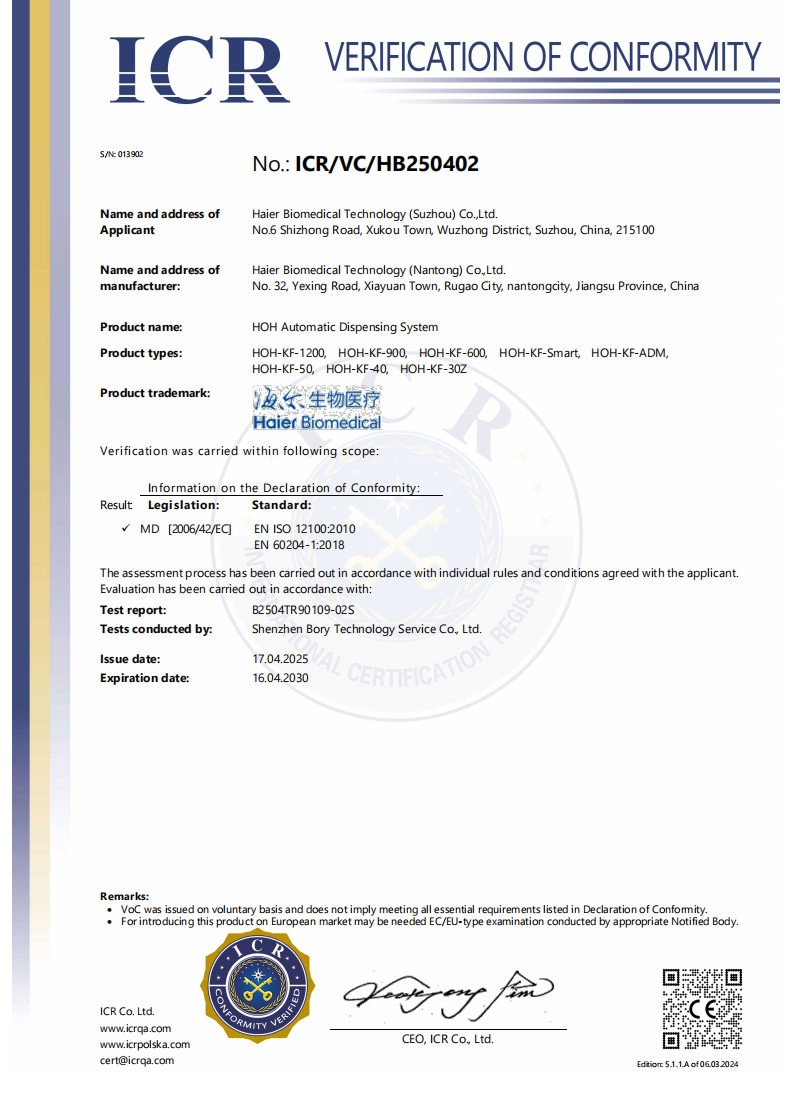
For long-term supplier evaluation, certification is not a logo on a brochure. It is a scope document. Haier Biomedical holds an ICR Verification of Conformity, certificate ICR/VC/HB250402, issued 2025-04-17 and valid to 2030-04-16, covering automatic dispensing system models including HOH-KF-1200, HOH-KF-900, HOH-KF-600, HOH-KF-Smart, HOH-KF-ADM, HOH-KF-50, HOH-KF-40, and HOH-KF-30Z. The listed standards are EN ISO 12100:2010 and EN 60204-1:2018.
A separate ISET Voluntary Compliance Certificate, ISETC.000220220323, covers HOH-KF-Smart and other listed automatic dispensing models against the same standards, issued 2022-03-23 and valid to 2027-03-22. The HOH-GF high-speed dispenser family is covered by ICR/VC/HB250403, issued 2025-04-17 and valid to 2030-04-16, for listed models HOH-GF-36, HOH-GF-50, HOH-GF-72, HOH-GF-100, HOH-GF-144, and HOH-GF-200. Cabinet models HOH-BQ-A and HOH-MJ-01 appear in the scope of ICR/VC/HB240501, issued 2025-05-10 and valid to 2029-05-09, alongside other listed cabinet models.
These certificate scopes are useful because they allow a buyer to compare the proposed model against the certificate. They also reveal boundaries. The HOH-Robot-Plus cytotoxic compounding robot is not listed in those certificate scopes in the available source material, so its qualification should be handled separately rather than assumed from dispensing-system certificates.
How Haier Biomedical Fits the Long-Term Evaluation
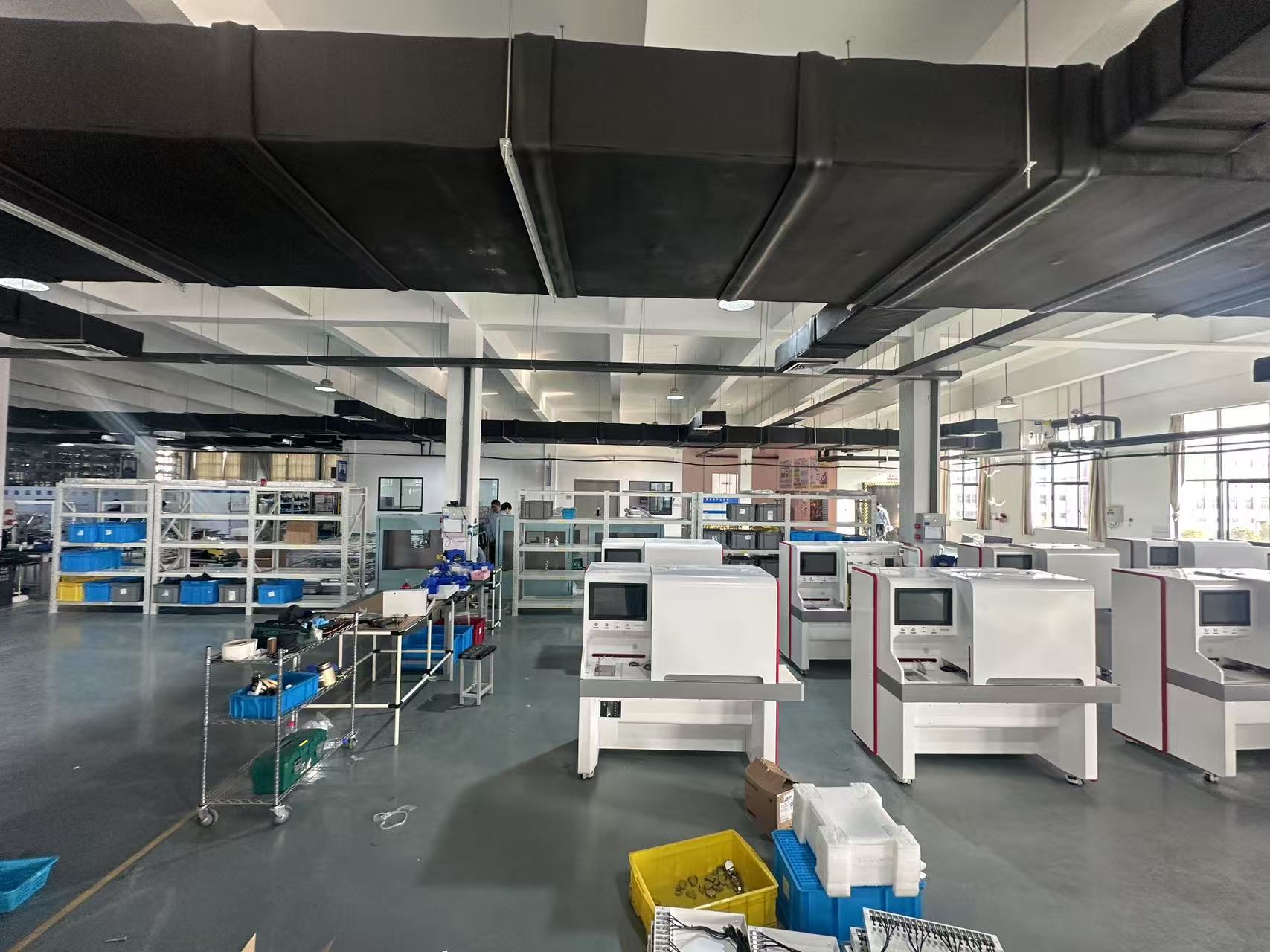
Haier Biomedical Technology(Suzhou)Co., Ltd is a healthcare technology company under Haier Group, focused on life sciences, medical technology, and smart healthcare transformation. Haier Pharmacy Automation is the business unit providing intelligent pharmacy automation solutions for hospitals, clinics, and healthcare organizations.
The company was founded in 2015 and operates a 13,000 m² factory with 500 employees and 100 engineers. It holds ISO 13485 medical device quality management system certification. Its pharmacy automation solutions are designed to support integration with hospital information systems including HIS and EMR platforms.
For lifecycle evaluation, several first-party facts are relevant. Haier Biomedical offers OEM, ODM, and customizable production services. Customization can cover equipment size, storage capacity, SKU quantity, robotic modules, software functions, HIS interface, and language. Production capacity is project-based. The minimum order quantity is 1 unit. Standard delivery time is typically 60-90 days, depending on project size and configuration. A Factory Acceptance Test is performed before shipment.
After-sales support includes remote technical support, on-site installation and commissioning, operator training, software upgrades, spare-parts supply, and global after-sales service. For a long-term supplier file, these are not soft claims. They should be converted into named service commitments, response paths, and acceptance documents.
Model-Level Fit: Where Each HOH System Belongs
Different pharmacy workflows create different serviceability questions. A high-speed outpatient line, a robotic arm storage zone, a cabinet-based controlled medication area, and a PIVAS compounding robot should not be evaluated with the same checklist.
| HOH system | Relevant use case | Long-term evaluation question |
|---|---|---|
| HOH-KF-Smart robotic arm dispenser | High-volume boxed medication storage and automated dispensing. Haier states the Robotic Arm Dispenser can offer dispensing accuracy of up to 99% in the described configuration. | Are the robotic modules, storage layout, and software functions expandable? What spare-parts and training evidence supports long-term operation? |
| HOH-KF-1200 chute type dispenser | High daily prescription volume. It supports simultaneous dispensing and replenishment and full-screen medication drop, enabling faster dispensing. | How are replenishment uptime, exception handling, and service access managed during peak periods? |
| HOH-GF high-speed dispenser family | High-speed dispensing. The product listing identifies HOH-GF(2 Modules), while certificate scope lists HOH-GF-36, HOH-GF-50, HOH-GF-72, HOH-GF-100, HOH-GF-144, and HOH-GF-200. | Does the proposed configuration match the certified model scope, and how will throughput be validated against the hospital's actual SKU mix? |
| HOH-BQ-A intelligent integrated management cabinet and HOH-MJ-01 anesthetic medication dispensing cabinet | Cabinet-based medication management in pharmacy and anesthetic medication dispensing contexts. | Is the exact cabinet model listed in the certificate scope? How are access, inventory reconciliation, and service events documented? |
| HOH-Robot-Plus fully automated cytotoxic drug compounding robot | Automated cytotoxic drug compounding in PIVAS-related workflows. | What separate qualification, cleaning validation, operator training, and service plan applies to the compounding robot? |
Application Evidence: What Long-Term Operation Looks Like
Long-term supplier claims become more credible when they can be linked to installed use cases. Haier Biomedical cites a private hospital in Thailand that used one set of a customized universal dispenser system in its outpatient pharmacy for automated dispensing and medication management. The project duration is listed as 10 years. The system was customized for local medication packaging characteristics in Thailand, supported HIS integration with a modular design, and was intended to improve dispensing accuracy and reduce repetitive tasks for pharmacists.
A general hospital in Vietnam used one set of an intelligent pharmacy automation system in its outpatient pharmacy for automated medication storage, dispensing, and intelligent medication management. The reported result was an automation upgrade that optimized dispensing workflows, improved medication management efficiency, reduced patient waiting time, and supported end-to-end digital pharmacy management. The system was customized to the hospital's pharmacy layout and workflow, with HIS integration.
These cases do not prove that every hospital will achieve the same outcome. They do show the type of evidence a buyer should request: configuration logic, integration scope, workflow fit, and a realistic view of operational change.
Market Trend Analysis: Why Lifecycle Evidence Is Becoming More Important
The global pharmacy automation devices market was estimated at USD 6.7 billion in 2024 and is projected to reach USD 11.6 billion by 2030, growing at a CAGR of 9.9%, according to Insightace Analytic and Grand View Research. The hospital pharmacy segment held the largest market share in 2024 due to high patient volumes and complex medication regimens, according to Fortune Business Insights.
Growth is not only about more robots. Software is expected to grow at the fastest rate among components from 2024 to 2030, according to MarketsandMarkets. Automated medication compounding systems are projected to be the fastest-growing product segment with a CAGR exceeding 10%, according to Grand View Research. Decentralized distribution models are expected to account for 79.8% of the market in 2026 due to the adoption of Automated Dispensing Cabinets, according to Fortune Business Insights.
These trends raise the bar for supplier evaluation. As pharmacy automation becomes more software-intensive and more distributed across hospital departments, buyers need stronger evidence on interface governance, software upgrades, cabinet-level inventory control, and model-specific service coverage. They also need to check regulatory alignment. Pharmacy automation systems must comply with IEC 60601-1 for medical electrical equipment safety and ISO 13485 for quality management, while FDA 21 CFR Part 11 regulates electronic records and electronic signatures in pharmacy automation to support data integrity.
Comparison With Traditional Solutions
Manual shelving and traditional pharmacy storage remain appropriate in some settings, and a fair comparison should acknowledge that. The question is not whether automation is always better. The question is whether the hospital can support the automation's lifecycle obligations.
| Evaluation dimension | Traditional manual shelving | Modular, HIS-ready automation |
|---|---|---|
| Medication location | Relies more heavily on pharmacists to locate and retrieve medications manually. | Uses configured storage and automated access to bring medication positions into the dispensing workflow. |
| Dispensing consistency | Depends on manual picking routines and staff experience. | Follows predefined medication and prescription information, with verification adding a further check when configured. |
| Change management | Physical rearrangement can be handled internally, but workflow redesign still needs staff time. | Modular hardware and software can support expansion, but changes require configuration, testing, and supplier coordination. |
| Traceability and data flow | Depends on local documentation discipline. | Can support drug traceability, inventory management, and HIS/EMR data flow when the interface and workflow are correctly configured. |
| Service dependency | Lower software dependency, but manual processes remain labor-intensive. | Introduces software, spare parts, training, and service dependencies that must be contracted and managed. |
The real limitation is that modular automation is not a universal fit. The source material states that pharmacy automation should be selected according to prescription volume, medication types, pharmacy layout, workflow, available space, and investment requirements. A hospital with low prescription volume, severe space constraints, or limited capacity to support software and service workflows may find that a simpler solution or a staged automation plan is more appropriate.
Modularity also does not remove integration work. It changes the shape of that work. The hospital still needs internal ownership for interface testing, user acceptance, training, and data governance. A supplier that cannot document those boundaries is not a lower-risk choice simply because its hardware is modular.
Acceptance and Commercial Terms: What to Put in the Evaluation File
Long-term supplier evaluation should end with a procurement file that can be checked at acceptance and revisited after go-live. For Haier Biomedical projects, the available purchasing terms include a minimum order quantity of 1 unit, FOB delivery terms, a Factory Acceptance Test before shipment, and payment terms of 50% in advance by TT with the balance before shipping. Standard delivery time is typically 60-90 days, depending on project size and configuration.
A practical acceptance file should also include:
- The exact HOH model and configuration, matched to the certificate scope where applicable.
- The HIS/EMR interface scope, test scripts, and exception-handling rules.
- The medication verification workflow, alert escalation process, and event-log review method.
- The operator training plan, software upgrade path, and spare-parts list.
- The Factory Acceptance Test criteria and the site acceptance responsibilities.
- The after-sales support path for remote support, on-site commissioning, and service escalation.
These items turn serviceability into an auditable condition. They also help prevent a common procurement gap: treating a factory test as a complete substitute for site validation.
Limitations and Boundaries
A credible long-term evaluation must state what the evidence does not cover. The available material does not support the claim that pharmacy automation is suitable for every hospital. Selection depends on prescription volume, medication types, SKU requirements, dispensing workflow, storage capacity, available space, system integration requirements, scalability, and investment budget.
Certification is model-specific. The HOH-KF, HOH-GF, HOH-BQ-A, and HOH-MJ-01 scopes should be checked against the exact proposed configuration. HOH-Robot-Plus is a specialized cytotoxic compounding robot and should not be treated as a general outpatient dispensing substitute. AI-assisted recognition and sensor-based error alerts should be validated within the configured workflow; they do not remove the need for operator training, verification procedures, and local quality governance. A Factory Acceptance Test is useful, but it is not the same as site acceptance or ongoing performance review.
Future Outlook
The next phase of pharmacy automation procurement will likely be less impressed by a single robot demonstration and more focused on software governance, interface ownership, and service evidence. If software remains the fastest-growing component and decentralized cabinet models continue to expand, suppliers will be judged on how well their systems can be maintained and integrated across departments.
For hospital pharmacy leaders, the practical response is to build a year-five evaluation file now. That file should ask who supports the interface, how upgrades are validated, which model is certified, how alerts are reviewed, and what happens when the pharmacy changes. A supplier that can answer those questions with documents, model-level evidence, and acceptance criteria is better prepared for the long term than one that only performs well in the first demonstration.
FAQ
Is pharmacy automation suitable for every hospital?
No. Pharmacy automation should be selected according to prescription volume, medication types, SKU requirements, dispensing workflow, storage capacity, available space, integration requirements, scalability, and investment budget. Haier Biomedical offers different configurations, including robotic arm dispensers, chute type dispensers, high-speed dispensers, cabinets, and compounding automation, but the final fit depends on the hospital's operational and site conditions.
What does HIS-ready mean in a long-term supplier evaluation?
HIS-ready means the pharmacy automation system can connect with hospital information systems such as HIS or EMR to support prescription processing and dispensing workflows. In Haier's case, prescription information can be transferred to the pharmacy automation system according to the defined interface and configured dispensing rules. Buyers should verify the interface scope, exception handling, test plan, and post-go-live support ownership.
How should buyers assess modularity in dispensing systems?
Buyers should ask for a documented module boundary map covering equipment size, storage capacity, SKU quantity, robotic modules, software functions, HIS interface, and language. They should also request the spare-parts list, software upgrade policy, and expansion limits. Modularity is valuable only when the supplier can show how future changes will be configured, tested, and supported.
Which HOH systems fit high-volume, boxed medication, controlled medication, and compounding scenarios?
HOH-KF-Smart is a robotic arm dispenser for high-volume boxed medication storage and automated dispensing. HOH-KF-1200 is a chute type dispenser for high daily prescription volume and supports simultaneous dispensing and replenishment. HOH-GF is a high-speed dispenser family, with certificate coverage for listed models from HOH-GF-36 to HOH-GF-200. HOH-BQ-A and HOH-MJ-01 are cabinet models listed in the ICR/VC/HB240501 scope. HOH-Robot-Plus is a fully automated cytotoxic drug compounding robot for PIVAS-related workflows and should be qualified separately.
What purchasing terms and acceptance evidence are available?
The available purchasing terms include a minimum order quantity of 1 unit, FOB delivery terms, a Factory Acceptance Test before shipment, and payment terms of 50% in advance by TT with the balance before shipping. Standard delivery time is typically 60-90 days, depending on project size and configuration. After-sales support includes remote technical support, on-site installation and commissioning, operator training, software upgrades, and spare-parts supply.
What limitations should remain in the evaluation file?
The evaluation file should record that automation fit is hospital-specific and depends on volume, space, workflow, and investment. It should note that certification is model-specific, that HOH-Robot-Plus requires a separate qualification path, and that FAT is not a substitute for site acceptance. It should also state that AI-assisted recognition and error alerts require configured verification workflows, training, and ongoing review rather than being treated as automatic guarantees.
Technical resource: Full-scenario Intelligent Pharmacy brochure.
Есть вопросы или нужны дополнительные детали?
Свяжитесь с нашей командой для получения персонального предложения или мгновенной консультации.
Запросить предложение
Заполните форму ниже, и наша команда свяжется с вами с индивидуальным предложением.
Прямой чат WhatsApp
Предпочитаете общаться в реальном времени? Напишите нам в WhatsApp для мгновенной помощи и быстрых ответов.
- Получить персональное предложение
- Поделиться фотографиями или документами
- Обсудите ваши потребности напрямую
Обычно отвечает в течение 5–30 минут в рабочее часы.