
Thermoforming Roll Geometry: Core, Diameter and Line Fit
Thermoforming Roll Geometry: Core, Diameter and Line Fit
Thermoforming plastic sheet roll supply is usually argued in material terms: PET, PP or HIPS, food grade, clear or coloured, a thickness in millimetres. The evidence that separates one supplier from another sits one layer down, in roll construction — usable width, roll diameter and weight, core inner diameter, winding quality and edge condition. These are the variables a converter can measure on the goods-in dock before a single cavity is formed, and they are also the variables that decide whether the roll will run on the vacuum forming, pressure forming, high-speed thermoforming, blister, printing, die-cutting or sealing equipment the material was bought for.
The distinction matters more as the category grows. Grand View Research valued the global thermoformed plastic market at USD 14.79 billion in 2023 and projected a 4.9% compound annual growth rate for 2024–2030. Those are category estimates, not procurement benchmarks: research houses measure the market differently depending on whether they count raw sheet or finished thermoformed products, so a headline figure can shift by billions without any change to the roll a buyer actually purchases. What survives that definitional noise is operational — a roll that fits the line, at a specification the buyer can verify, with acceptance criteria written down before the first pallet ships.
Why roll construction became a purchasing question
In roll-fed converting the roll is the feed unit, not a passive package. Roll width is normally set by the mold layout, the arrangement of products across the sheet and the trim allowance, while roll diameter, roll weight and core size must stay compatible with the unwinding system. Get those three elements right and the specification can reduce unnecessary trim waste and prevent handling or feeding problems. Get them wrong and the consequences appear upstream of the oven — misalignment, uneven tension, deformed rolls, damaged edges — where operators tend to blame the material.
The harder problem is comparability. A specification described as “0.5 mm PET sheet” by two suppliers may still behave differently on the same thermoforming line, because nominal thickness says nothing about structure, tolerance, width, roll configuration, colour or transparency, forming behaviour or the application the sheet was designed for. That is why switching suppliers on the strength of material name, nominal thickness and price per kilogram is a weak basis for a purchase decision. The roll geometry and the documented equipment fit are what turn a claim into something a buyer can hold a supplier to.
What width, roll diameter and core each control
Each element of roll construction answers a different question, and each one can be written into a purchase order as a measurable item rather than an adjective.
| Roll element | What it has to match | What the buyer can verify |
|---|---|---|
| Roll width | Mold layout, product arrangement and trim allowance, within the usable width of the forming machine | Measured width per roll against the width stated on the approved specification |
| Roll diameter and weight | The unwinding system and the handling equipment around it | Diameter and roll weight recorded per roll and compared with the equipment limits |
| Core inner diameter | The core chuck or shaft and the unwinding method | Core size stated on the specification and checked on the physical roll |
| Winding and flatness | Stable feeding into the oven; curl can originate in winding stress, material structure, temperature change or storage conditions | Documented packaging and handling recommendations, plus a first-roll check before the run starts |
| Edge condition and packaging | Protection against roll deformation and edge damage during transport and storage | Packaging specification and a goods-in condition note for deformation and edge damage |
Read together, the table explains why two rolls of identical material can produce different yields. It also explains why roll geometry belongs in the technical annex of a purchase order rather than in a sales conversation.
Reading roll dimensions against the converting line
For an existing production line, the fastest route to a correct specification is to hand the supplier the current, proven roll specification or the equipment limits — usable machine width, maximum roll weight, core inner diameter and the unwinding method. Suppliers can then build backwards from a configuration that already runs, which removes a variable from any later trial.
For a new mold, the sequence reverses. Sheet width is calculated from the mold layout plus the necessary trim allowance, and only then are roll diameter, weight and core size confirmed against the unwinding equipment. The order matters: width follows the tooling, while diameter and core follow the machine that has to unwind the roll. A larger roll diameter increases the material carried per roll and reduces changeover frequency, but it also increases roll weight and must remain within what the unwinding and handling equipment can accept — so diameter is an equipment decision, not a free cost lever.
Where a roll has already been received and is behaving badly, the cause should be separated before anything is changed. Uneven feeding can come from sheet flatness, roll alignment, tension settings, feeding equipment or a roll that was deformed in transport or storage. Curl after unwinding can be related to material structure, residual stress, winding, storage conditions, temperature changes or moisture and handling conditions. A material change is the most expensive of these explanations and should be the last one tested, not the first.
The converting equipment a sheet must be designed for
A roll specification only becomes meaningful when it is mapped to the equipment sequence it will pass through. That sequence is where suppliers differ in what they can actually demonstrate.
Forming method. Vacuum forming, pressure forming and high-speed thermoforming place different demands on heating behaviour and material distribution. For PET, published industry guidance places thermoforming in the range of 266°F to 320°F (130°C to 160°C); that range is a process reference, not a guarantee that a given sheet will run at any point inside it. A supplier should be able to say which of its structures is intended for the draw depths and cycle times a buyer actually runs.
Blister and clamshell lines. PS/HIPS is widely used for blister packaging, including conductive black and anti-static grades for electronics handling where surface-resistance properties are specified separately from mechanical performance. Carded blisters and clamshells add a sealing step, so clarity, stiffness and sealing behaviour have to be judged together rather than in isolation.
Printing. Where the formed part carries print, the surface has to accept ink and hold registration through the rest of the line. A printable surface is a documented characteristic, and buyers should ask for the specific structure that carries it rather than assuming every clear grade behaves the same way.
Die-cutting and trimming. When parts are cut or trimmed in line, dimensional stability of the sheet and consistency of forming both feed into cut accuracy. Buyers should confirm which structure the supplier intends for a print-then-form-then-cut sequence, because the sequence constrains the material more than any single step does.
Sealing. Heat-sealing behaviour is frequently the real bottleneck. A narrow sealing window forces operators to run slowly and generates scrap; a wider window allows the line to run at design speed. This is one of the few material properties that shows up directly in output figures, which makes it a legitimate item to request evidence for.
Clean and dry conditions. Sheet condition before forming is influenced by temperature, humidity, direct sunlight, packaging condition and storage time. Buyers should confirm the supplier’s storage and handling recommendations and allow material to stabilise under workshop conditions before processing, rather than opening a roll and running it immediately after a long transit. Where a project requires a documented controlled environment, the request should be for the specific classification and its evidence, not a general assurance.
PULIXIN: mapping capability to measurable evidence
PULIXIN, registered as Pulixin Packaging Materials (Shanghai) Co., Ltd., is a Shanghai-based manufacturer of PET, PP and PS/HIPS thermoforming plastic sheet rolls, founded in 2009 and operating a 20,000㎡ production base with 14 co-extrusion lines and annual output above 40,000 tons. The company reports approximately 3,500 tons of monthly production capacity, an export share of about 80% and supply experience across more than 55 countries, with main markets in Southeast Asia, the Middle East, South America and Europe.
For a buyer assembling evidence, the relevant point is not the size of the base but what it can be configured to produce. The company’s OEM and custom manufacturing service covers material (PET, PP, PS/HIPS), thickness, width, colour, transparency, surface finish, roll size, functional properties, and packaging and labelling. Roll size being a named customisation item is what allows roll width, diameter and core to be treated as specification inputs rather than catalogue constants. Functional options include high-stiffness, high-formability, anti-fog and anti-static grades, alongside multi-layer co-extrusion structures and food-grade material solutions.
Commercial parameters are equally specific. Minimum order quantities are quoted as 5 tons for standard PET and 3 tons for standard PP or PS, with customised products subject to different requirements. Delivery generally ranges from 7 to 15 days depending on material, specifications, order quantity and customisation. Quality control covers raw-material inspection, thickness and width control, appearance inspection, in-process control and finished-product inspection, with third-party testing available on request — which is the mechanism by which a goods-in acceptance protocol can be backed by an independent report rather than a supplier statement.
Certification evidence exists but should be read by scope. ISO 9001:2015 (certificate 00226Q03336R101, issued 2026-06-25, valid to 2029-06-24) and ISO 14001:2015 (00226E02412R101, same dates) are issued by China Quality Mark Certification Group with a scope covering the production of polyester sheets (PET). FSSC 22000 (CQM25FSSC00171, valid 2025-07-04 to 2028-07-03) covers the production of specific PET sheets for food contact applications by plasticising extrusion. GRS scope certification (SGC-GRC09372-GRS-2026-04, valid 2026-04-23 to 2027-04-22) covers processed post-consumer and pre-consumer materials and the extrusion process. SGS test reports are held for PET sheet, PP white natural sheet, PS white natural sheet and PS black sheet, with several referencing EU RoHS Directive (EU) 2015/863. A PP or HIPS buyer should therefore ask which certificate applies to which material and process, because a PET-scoped management system certificate is not, by itself, evidence about a PP line.
Acceptance criteria and purchasing terms tied to roll specifications
Purchasing terms are where roll geometry stops being descriptive and becomes contractual. Standard delivery terms are EXW, FOB and CIF, with other Incoterms available on agreement; payment is by T/T, with specific terms subject to order value, customer requirements and mutual agreement. For customs and documentation purposes, non-cellular plastic sheet falls under HS heading 3920 and cellular sheet under 3921, which is worth confirming on the commercial invoice when the material structure is multilayer or co-extruded.
Acceptance criteria are stated as specification verification, thickness and width inspection, appearance inspection and finished-product quality inspection before shipment, with third-party inspection available on request. Those four items map neatly onto roll construction and can be converted into a goods-in checklist without adding new obligations: measured width against the approved width; thickness and tolerance against the approved structure; core inner diameter and roll diameter against the unwinding equipment limits; roll weight; winding flatness and edge condition; packaging and labelling against the agreed format.
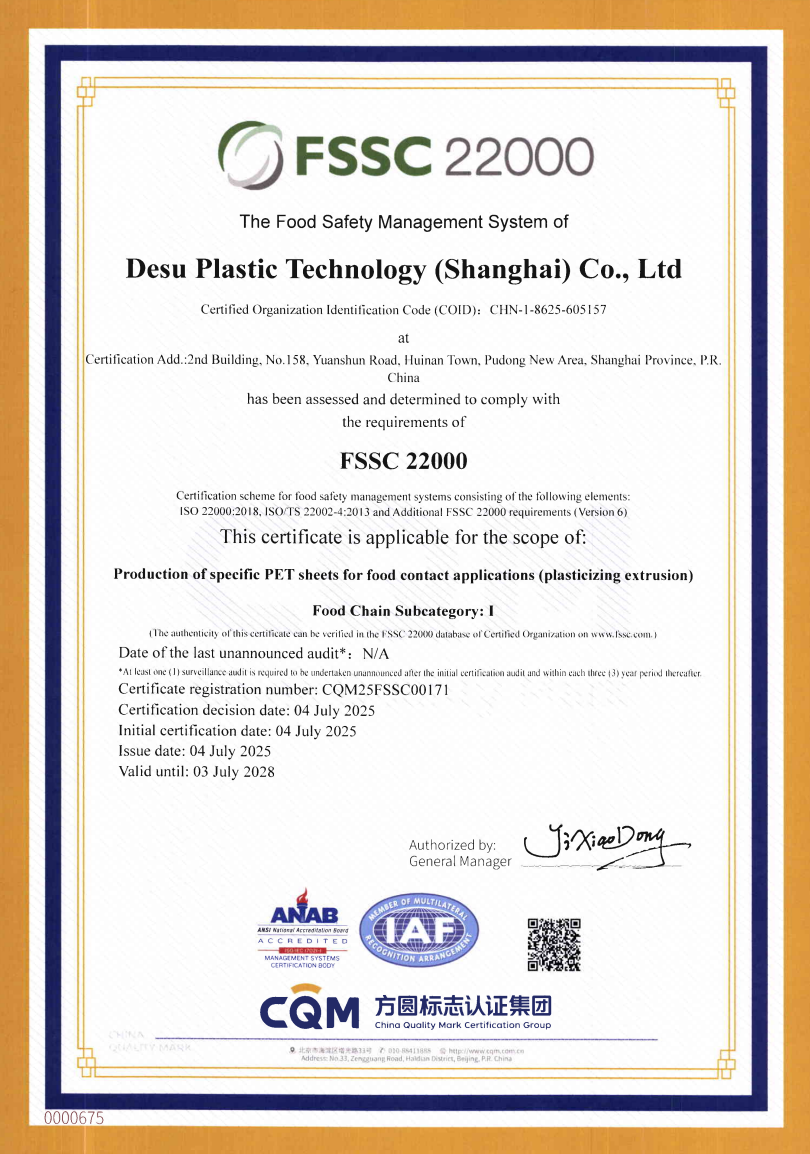 FSSC 22000 certificate CQM25FSSC00171, scope: production of specific PET sheets for food contact applications (plasticising extrusion), valid 2025-07-04 to 2028-07-03. Certificate scope is material- and process-specific.
Food-contact documentation should be tied to the same logic. EU Regulation (EU) No 10/2011 governs plastic materials and articles intended to come into contact with food, so a food-packaging buyer should confirm which test reports and certificates apply to the exact material, structure and application in the purchase order, and for which destination market. A general food-grade description is not a substitute for that mapping.
Where roll-level evidence changes the outcome
Three reported projects show how the specification debate turns into an operational result. Each is a project-specific outcome, not a performance promise for other lines.
Fresh produce, RPET clamshells (Netherlands and Australia). A fresh-produce packer and supermarket own-label supplier uses roughly 1,500 tons of RPET sheet per year for berry and cherry clamshells, salad bowls, and fresh-herb and bakery containers, over four years in the Netherlands and two in Australia. The reported configuration uses 30–100% post-consumer content with GRS batch traceability, a packaging carbon footprint reduction of 28%, and EU 10/2011 and FDA migration tests passed at every audit. The roll-level lesson is traceability: recycled content claims only hold up when the batch record survives from extrusion through to the converting line.
Toy blister and clamshell packaging (Germany and United States). A toy brand owner and OEM manufacturer runs about 800 tons per year for action-figure clamshells, carded blisters, window patches and collector display cases. Reported results after the change were drop-test cracking reduced from 3.2% to 0.4%, sealing scrap down 18%, and 24 consecutive months of on-time delivery. Here the sealing and impact behaviour of the specific structure mattered more than nominal thickness, which is precisely the variable a material-name comparison cannot capture.
Electronics handling trays (Vietnam and Mexico). An EMS provider and component distributor uses about 600 tons per year of HIPS for PCBA handling trays, IC and sensor shipping trays, and smartphone component carriers, over three years in Vietnam and 18 months in Mexico. Reported outcomes include surface resistance held at 10⁴–10⁸ Ω after more than 20 reuse cycles, ESD damage claims down 90%, and tray flatness rejects below 0.5%. Flatness at that level depends on forming consistency, which in turn depends on thickness tolerance and winding behaviour in the roll.
A fourth reported project illustrates the sealing-window point directly: an oral-care brand owner and contract packer in Indonesia and Brazil, using roughly 700 tons per year for toothbrush blister cards and cosmetics insert trays, recorded a 15% pack-line speed increase after sealing-window optimisation, with hang-tab breakage complaints below 0.1%.
What to check when changing thermoforming sheet suppliers
- Use the currently proven sheet specification as the comparison baseline rather than the new supplier’s catalogue.
- Compare structure, thickness tolerance, width, roll configuration, colour or transparency, forming behaviour and application requirements — not material name and nominal thickness alone.
- Confirm equivalent specifications and required documentation before any production trial.
- Run a controlled trial before moving to regular-volume orders.
- Avoid changing material structure, thickness and process settings simultaneously, because the source of any forming difference then becomes impossible to identify.
- Record roll width, diameter, weight, core inner diameter, winding flatness and edge condition at goods-in for the first three deliveries, and compare them against the approved specification.
- Ask which certificate and test report applies to the specific material and process in the order.
Outlook: evidence over adjectives
Two forces are pushing roll documentation in the same direction. The first is recycled content: Dataintelo projects the recycled PET market reaching USD 24.6 billion by 2034, a forecast rather than a measurement, but one that aligns with the GRS batch-traceability requirements already appearing in food-packaging projects. The second is regulatory scrutiny of food-contact materials, where EU 10/2011 makes the mapping between material, test report and application a documented exercise rather than a verbal assurance.
For buyers, the practical consequence is that supplier evaluation will lean further toward verifiable geometry and scope-specific certificates, and less toward broad capability statements. A roll specification that states width, diameter, core, structure and tolerance, matched to a named forming and converting sequence, is auditable. A specification that states only a material and a nominal thickness is not — and no amount of market growth changes that.
The company catalogue, including product ranges and customisation options, is available for download: PULIXIN DESU New Catalogue (PDF).
FAQ
How should I specify roll width, roll diameter and core size when ordering thermoforming sheet?
Roll dimensions should match the thermoforming and feeding equipment. Width is normally determined by mold layout, product arrangement and trim allowance, while roll diameter, roll weight and core size must remain compatible with the unwinding system. For an existing line, provide the current roll specification or the equipment limits. For a new mold, calculate sheet width from the mold layout plus necessary trim allowance, then confirm diameter, weight and core size against the unwinding equipment before production.
What should I check when changing thermoforming sheet suppliers?
Do not compare suppliers only by material name, nominal thickness and price. Before switching, compare the actual sheet structure, thickness tolerance, width, roll configuration, colour or transparency, forming behaviour and application requirements. A specification described as “0.5 mm PET sheet” by two suppliers may still behave differently on the same line. Use the currently proven specification as the baseline, confirm equivalent specifications and documentation, then run a controlled production trial before regular-volume orders.
What are the purchasing terms and acceptance criteria?
MOQ depends on material, thickness, width, colour and customisation requirements and should be confirmed per specification; standard PET is quoted at 5 tons and standard PP or PS at 3 tons, with customised products subject to different requirements. Delivery terms are EXW, FOB and CIF, with other Incoterms available on agreement, and payment is by T/T subject to order value and mutual agreement. Acceptance criteria cover specification verification, thickness and width inspection, appearance inspection and finished-product quality inspection before shipment, with third-party inspection available on request.
Why does plastic sheet curl or become difficult to feed before thermoforming?
Curl can be related to material structure, residual stress, winding, storage conditions, temperature changes or moisture and handling conditions. The cause should be separated between material, storage and machine factors before production settings are adjusted. Proper storage, and allowing material to stabilise under suitable workshop conditions, can help reduce avoidable feeding problems. Uneven feeding may also involve sheet flatness, roll alignment, tension, feeding equipment or a roll deformed in transport or storage.
What information should I provide when requesting a quotation for custom thermoforming sheet?
A useful request goes beyond a material price. It should include material, thickness, width, colour, transparency, roll dimensions or core requirements, estimated quantity, application and destination. For a new project, finished-part dimensions, forming depth, machine information and special performance requirements help the manufacturer recommend a suitable specification and reduce repeated sampling.
Есть вопросы или нужны дополнительные детали?
Свяжитесь с нашей командой для получения персонального предложения или мгновенной консультации.
Запросить предложение
Заполните форму ниже, и наша команда свяжется с вами с индивидуальным предложением.
Прямой чат WhatsApp
Предпочитаете общаться в реальном времени? Напишите нам в WhatsApp для мгновенной помощи и быстрых ответов.
- Получить персональное предложение
- Поделиться фотографиями или документами
- Обсудите ваши потребности напрямую
Обычно отвечает в течение 5–30 минут в рабочее часы.