
Thermoforming Sheet Roll Shortlist by Packaging Scenario
Thermoforming Sheet Roll Shortlist by Packaging Scenario
Medical, food, toy and display packaging — a scenario-first shortlist, and the specification checks that have to follow it.
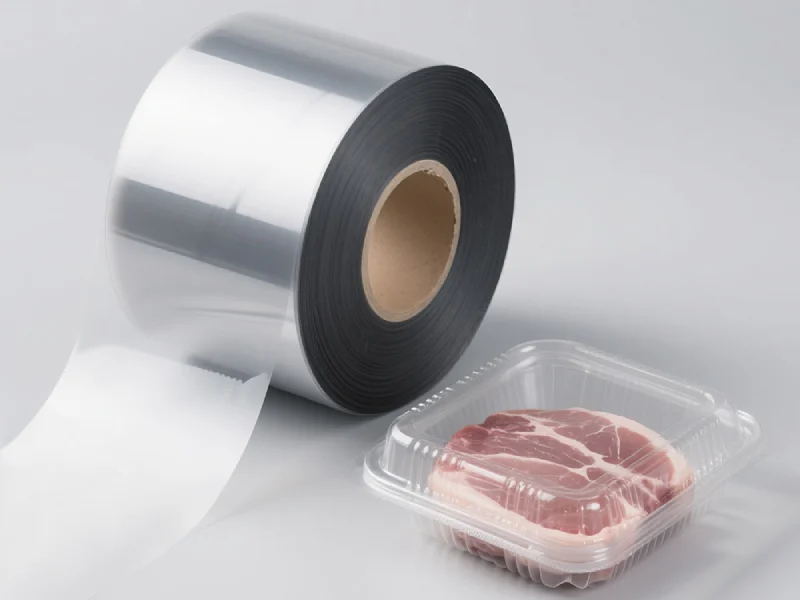
PET thermoforming sheet roll is the usual entry point for clear food trays and produce packaging. Source: PULIXIN product and application data.
Thermoforming plastic sheet roll is rarely purchased for its own sake. It is purchased because a tray, a blister, a clamshell or a folding box has to do a specific job: hold a cut of meat under refrigeration, present a toy on a retail peg, protect a device insert through handling and transport, or stay clear enough that a shopper can see the product inside. The scenario — not the polymer name — is what should drive the shortlist.
This article is a shortlist, not a specification. It maps the three rigid sheet families most commonly quoted in rigid packaging — PET, PP and PS/HIPS thermoforming sheet rolls — to four packaging scenarios, drawing on PULIXIN product and application data and on attributed third-party market, regulatory and technical references. Every entry still needs a specification check before a purchase order is issued.
Why the shortlist starts with the package, not the polymer
A purchase request that says only “0.5 mm PET sheet” leaves almost every variable that affects forming behaviour open. Two suppliers can both quote a roll matching that description and still deliver different sheet structures, thickness tolerances, widths, roll configurations, colour or transparency, and forming behaviour on the same thermoforming line. Buyer-side risk documentation on supplier switching makes the same point from the opposite direction: the reliable comparison baseline is the specification already proven in production, not a material name and a price.
The same discipline applies to compliance language. “Food grade” alone does not define a usable thermoforming specification. Food type, tray dimensions, forming depth, storage temperature, transparency requirement, sealing method and the applicable food-contact requirements all influence what the roll has to do. A refrigerated meat tray, a fruit tray and an ambient bakery tray can require different material and performance characteristics even though all three are food packaging.
That is the reason the shortlist below is organised by packaging scenario first. The material family narrows the search; the sheet specification then decides whether the roll actually runs.
Who this shortlist is written for
It is aimed at converters, packaging engineers and procurement teams at the research stage — buyers who already know the finished package and need a defensible starting point rather than a catalogue number. PULIXIN (Pulixin Packaging Materials (Shanghai) Co., Ltd.) is a Shanghai-based manufacturer of thermoforming plastic sheet rolls established in 2009. The company produces PET, PP and HIPS sheet rolls on 14 co-extrusion production lines, with an annual production capacity of 40,000 tons from a 20,000 m² manufacturing facility employing approximately 90 staff, and exports to more than 55 countries across Asia, Europe, the Middle East, Africa, North America and South America. Its published product data is used here as the first-party reference, and third-party figures are attributed wherever they appear.
The shortlist in one table
The ranges below are catalogue capabilities, not recommendations. Each order is customised within them according to the finished part, the thermoforming machine and the packaging requirement.
| Sheet roll family | Verified thickness | Verified width | Verified forming process | Shortlist scenario |
|---|---|---|---|---|
| PET Thermoforming Plastic Sheet Roll | 0.18–1.7 mm, customised | 250–1400 mm, customised | Vacuum forming / pressure forming | Food trays, meat, fresh produce and bakery packaging; clear retail, toy and folding-box display |
| PP Thermoforming Sheet Roll | 0.3–2 mm, customised | 300–900 mm, customised | Vacuum forming / pressure forming | Cups, lids, dairy, takeaway and industrial packaging; medical and protective-insert shortlists where antistatic or temperature-resistant variants are specified |
| HIPS Thermoforming Sheet Roll | 0.24–2 mm, customised | 300–900 mm, customised | Vacuum forming / pressure forming | Medical device trays and pharmaceutical blister packaging, blister packs, electronics and industrial thermoforming |
All three families are supplied in mono-layer or multi-layer structures and are processed by vacuum forming or pressure forming. Colour and surface options differ by family: PET is offered in transparent or customised colour, while PP and HIPS are offered in natural, white, black or customised colour, with HIPS also available in glossy or matte surface finishes.
Food packaging: PET thermoforming sheet roll
For food trays, containers, meat packaging, fresh produce and bakery applications, PET is the conventional shortlist entry because clarity, stiffness and product visibility are usually the commercial priorities. PULIXIN lists food packaging, fresh produce packaging, meat packaging, bakery packaging and pharmaceutical packaging among the industries served by its PET thermoforming plastic sheet roll range, which includes APET, rPET, GAG, PETG, food-grade PET, transparent PET, anti-fog PET, anti-block PET, anti-scratch PET and anti-static ESD PET variants.
Chilled and fresh food: low temperature and anti-fog
Chilled and fresh food packaging operates under conditions that ambient packaging does not: refrigerated storage, high humidity, condensation-prone environments and direct food contact. Sheet selection for this scenario involves low-temperature performance, moisture resistance and stable forming, and anti-fog performance when it is required. Anti-fog matters when condensation forms inside clear packaging and product visibility has to be maintained — for example on refrigerated fresh-food trays — and it is not automatically needed on every clear package.
Tray geometry matters as much as material choice. Material and thickness should be selected according to the finished tray and storage environment rather than copied from a specification used for ambient packaging. Excess thickness increases material consumption and does not automatically solve a design or forming problem.
Ambient food packaging: trays, fruit boxes and bakery containers
Ambient food packaging covers fruit boxes, bakery containers, candy trays, food trays and takeaway packaging, typically produced on continuous roll-fed thermoforming lines. The requirements listed for this scenario are consistent thickness, stable forming, good appearance and suitable rigidity, with food-contact compliance verified when required. PET is the common shortlist entry wherever transparency is part of the package design.
One qualification is worth noting. The PET-first rule for food is not absolute. PULIXIN’s published product material also describes food-grade PP sheet rolls optimised for frozen food trays with impact-resistant copolymer options — a case where storage temperature, rather than food category, is what drives material choice.
Compliance is a separate question from material choice
Food-contact compliance should be verified against the specific material, test report, application and destination market. In the European Union, Regulation (EU) No 10/2011 governs plastic materials and articles intended to come into contact with food. Material classification for shipping purposes is equally specific: thermoforming plastic materials are classified under HS Code headings 3920 for non-cellular products and 3921 for cellular products.
Medical and pharmaceutical packaging: HIPS and PP sheet rolls
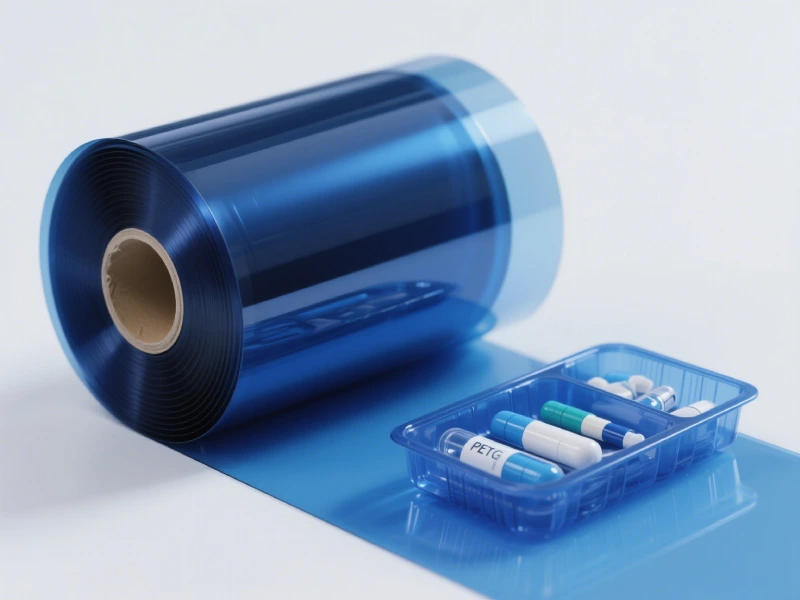
Sheet rolls for medical and pharmaceutical packaging are specified for consistent thickness, dimensional stability and a clean surface.
Medical and pharmaceutical packaging covers medical device trays, pharmaceutical blister packaging, disposable medical product trays and protective packaging inserts, produced on roll-fed or sheet-fed thermoforming and vacuum forming equipment followed by cutting, product loading and sealing. The stated functional requirements are product positioning, separation, protection, visibility and packaging integrity during handling, storage and transportation.
HIPS is the material most directly associated with this scenario in the PULIXIN range. The HIPS thermoforming sheet roll is made of polystyrene (PS) and high impact polystyrene (HIPS) and is intended for food packaging, blister packaging, electronics packaging and industrial thermoforming applications. It is supplied in normal, conductive black, antistatic, high- and low-temperature-resistant, and light-blocking types, which is why it appears in tray, insert and blister discussions where colour control, light blocking or static control has to be addressed.
PP thermoforming sheet roll is the second family a medical or protective-insert project may evaluate. PP is supplied in normal, conductive black, antistatic, PP/PE and high- and low-temperature-resistant types, with thickness from 0.3 mm to 2 mm and width from 300 mm to 900 mm. Those variants are the ones that matter when a device tray or insert specification calls for antistatic behaviour or for a defined temperature window. PET is also listed among the materials applied to medical and healthcare packaging, with suitability depending on the specific package design and regulatory requirements.
What “medical packaging” does and does not mean
Buyers should first define whether the sheet is used for a protective tray, device packaging, pharmaceutical blister packaging or another package type, then confirm material, cleanliness, transparency, forming performance and applicable regulatory requirements. A general-purpose plastic sheet should not automatically be described as medical grade without supporting requirements and documentation. Food-contact compliance and medical-packaging requirements address different applications and are not interchangeable.
The properties commonly important for thermoformed medical trays are consistent thickness, forming stability, dimensional stability, surface cleanliness and suitable mechanical performance. The same logic applies to protective inserts used for electronic components: a standard tray mainly provides physical protection and positioning, while an antistatic or ESD tray is designed with specified electrical properties, and the requirement should be confirmed against component sensitivity and the customer’s electrostatic-control system before a sheet is selected.
Toy, retail and transparent folding box packaging: PET, PP and HIPS
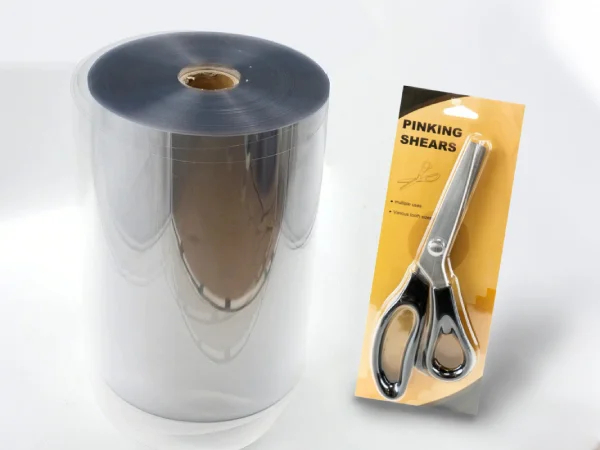
APET sheet roll used for retail blister packaging, where forming definition and transparency carry the shelf presentation.
Toy and retail packaging is a scenario where all three sheet families can compete. Toy blister packs, transparent display packs, thermoformed inserts and clamshell packaging are formed by vacuum forming or thermoforming followed by die cutting and packaging assembly. The stated requirements are good transparency when required, forming definition, impact resistance and consistent appearance.
PET is the natural starting point wherever the package has to sell the product through the sheet: clear trays, blisters, clamshells and transparent folding boxes. Clear sheet, however, should not be selected on transparency alone. Clarity has to be read together with stiffness, forming depth, impact performance, temperature conditions, sealing or printing requirements and the finished package. For high-clarity thermoformed packaging, PET is a common starting choice, but the exact PET structure and thickness should be finalised according to forming depth, package performance and downstream processing rather than visual transparency.
Transparent folding boxes are a printing and converting scenario
Transparent folding box packaging — cosmetic boxes, gift boxes and retail display boxes — follows a different production route from a thermoformed tray: sheet printing, then die cutting, creasing, folding and box assembly. The requirements listed for this route are high transparency, a smooth surface, good printability, dimensional stability and suitable folding performance. PET sheet roll appears in this scenario and in the adjacent printing and display application, where it functions as a printing substrate and is printed by screen, UV or digital processes before cutting and laminating.
PP contributes where the retail pack needs colour and rigidity rather than maximum clarity. PP is supplied in natural, white, black or customised colour, and is used in daily consumer goods blister packaging such as cosmetic trays, hardware packaging and stationery packaging, where the stated requirements are good forming definition, suitable transparency or colour, consistent thickness and good printability when required. HIPS covers the opaque end of the same shelf: coloured or natural trays, inserts and blister packs, with glossy or matte surface options and light-blocking types available where the product must not be exposed to light.
Technical explanation: from roll to formed package
Thermoforming sheet roll is converted into a finished part by heating the sheet until it is soft enough to be drawn against a mould. PULIXIN supplies materials for both vacuum forming and pressure forming. As an industry reference point, PET thermoforming typically occurs between 266 °F and 320 °F (130 °C to 160 °C), according to technical guidance published by South Plastic (SPI).
Two specification variables determine whether the process runs cleanly. The first is material formability and draw behaviour. For deep-draw parts, nominal sheet thickness alone is not enough: the main concern is how material distributes from the flange and sidewalls to the deepest area during forming, so material formability, initial thickness, draw ratio, mould geometry, corner radius and heating uniformity are evaluated together. A sheet that works well for a shallow tray may not suit a much deeper part.
The second is roll configuration. Roll width is normally determined by mould layout, product arrangement and trim allowance, while roll diameter, roll weight and core size must remain compatible with the unwinding system. Correct roll specifications reduce unnecessary trim waste and prevent handling or feeding problems. For an existing line, buyers should provide the current roll specification or the equipment limits; for a new mould, sheet width is calculated from the mould layout plus necessary trim allowance, and roll diameter, weight and core size are confirmed against the unwinding equipment before production.
Where this shortlist stops: limits, trade-offs and boundaries
A shortlist narrows the search; it does not remove risk. Five boundaries are worth stating plainly, because each one is a documented cause of avoidable trials and waste.
Material substitution is not neutral. Different materials have different shrinkage, heating and forming behaviour, so machine settings — and sometimes tooling — need adjustment. Changing material, thickness and process settings simultaneously makes the source of any forming difference difficult to identify. The practical sequence is to keep the proven specification as the baseline, confirm equivalent specifications and required documentation, run a controlled production trial, and only then move to regular-volume orders.
Thicker does not automatically mean stronger or safer. Increasing thickness can improve rigidity in some designs, but material type, geometry and forming distribution are equally important, and excess thickness raises material consumption without solving the underlying design or forming issue.
Functional add-ons should be justified by the application. Anti-fog is relevant when condensation can interfere with package visibility. Anti-static or ESD material is relevant when component sensitivity and the customer’s electrostatic-control system require controlled surface resistance. Adding either by default adds cost and complexity without a functional return.
Price per kilogram is not packaging cost. Finished-package cost also depends on density, required thickness, forming yield, scrap utilisation, cycle stability and reject rate — which is why the lowest quoted price per kilogram is not automatically the lowest packaging cost.
Some forming faults are not material faults. Sheet curl and uneven feeding can originate in material structure, residual stress, winding, storage conditions, temperature changes, transport deformation or machine feeding conditions. The source should be separated between material, storage and machine factors before adjusting production or changing material — and PET cracking, whitening or incomplete forming can result from unsuitable heating, uneven sheet temperature, excessive forming depth, sharp mould geometry or an unsuitable sheet specification rather than from the polymer itself.
Market trend analysis
Thermoformed plastic remains a substantial global category. Grand View Research valued the global thermoformed plastic market at $14.79 billion in 2023 and projects a compound annual growth rate of 4.9% for 2024–2030. Those figures should be read with one caveat that matters to buyers comparing published market data: estimates diverge because researchers measure different things. Grand View Research values the 2023 market at $14.79 billion, while a different commercial estimate places 2024 at $15.98 billion, with the difference stemming from whether raw thermoformed sheet materials or finished thermoformed products are being measured.
On the material side, recycled content is the trend with the clearest published projection: the recycled PET (rPET) market is projected to grow to $24.6 billion by 2034, according to Dataintelo. For packaging buyers this shows up as demand for rPET and mono-material structures that keep the formed package within an existing recycling stream, and for multi-layer co-extruded structures where functional properties such as anti-fog or anti-static behaviour must be added without changing the base material. PULIXIN’s PET range already includes both APET and rPET variants, which is a practical indication of how recycled grades are entering mainstream thermoforming specifications rather than remaining a niche request.
Future outlook
Three shifts are likely to shape sheet roll selection over the next planning cycle. First, recycled content will move from a marketing requirement to a line-item specification, which makes the ability to supply consistent rPET and to document it more important than the ability to offer it. Second, multi-layer co-extrusion will carry more of the functional burden, allowing clarity, colour, static control or light blocking to be engineered into the structure instead of purchased as a separate material. Third, specification discipline will increasingly determine cost, because the difference between two rolls quoted at the same price is usually the tolerance, the roll configuration and the forming consistency — variables that only appear once the line is running.
For buyers at the research stage, the practical implication is straightforward: use scenario-led shortlists to narrow the field, then invest the same effort in specification checks. Manufacturers that publish verifiable material parameters and application data make that second step faster than those that publish only a product name.
FAQ
How do I choose between PET, PP and PS/HIPS sheet for thermoforming?
Choose according to the finished package rather than price alone. PET is commonly selected when transparency, stiffness and product visibility are priorities. PP is often preferred for cups, dairy containers and applications requiring better heat resistance and lower material density. PS/HIPS suits many trays, inserts and opaque or coloured thermoformed packaging where easy forming and practical rigidity are important. Final selection should also consider forming depth, temperature requirements, thickness, sealing method and regulatory requirements.
How should I specify sheet for a food tray instead of simply asking for “food-grade sheet”?
“Food grade” alone does not define a usable thermoforming specification. Buyers should also identify the food type, tray dimensions, forming depth, storage temperature, transparency requirement, sealing method and applicable food-contact requirements. A refrigerated meat tray, a fruit tray and an ambient bakery tray can require different material and performance characteristics even though all three are food packaging. Use PET where high transparency and stiffness are priorities, or consider PP or PS according to temperature, package design and processing requirements, and add functions such as anti-fog only when the application actually requires them.
What should buyers confirm when sourcing sheet for medical or pharmaceutical thermoforming packaging?
Medical and pharmaceutical packaging requirements vary greatly by application. Buyers should first define whether the sheet is used for a protective tray, device packaging, a pharmaceutical blister or another package type, then confirm material, cleanliness, transparency, forming performance and the applicable regulatory requirements. A general-purpose plastic sheet should not automatically be described as medical grade without supporting requirements and documentation. PET can be used in certain medical and healthcare packaging applications, but suitability depends on the specific package design and regulatory requirements, and food-contact compliance cannot replace medical packaging requirements. Consistent thickness, forming stability, dimensional stability, surface cleanliness and suitable mechanical performance are commonly important for thermoformed medical trays.
What should I consider when selecting clear sheet for thermoformed packaging?
Clear sheet should not be selected by transparency alone. Buyers should consider the required clarity together with stiffness, forming depth, impact performance, temperature conditions, sealing or printing requirements and the finished package. PET is widely used for high-clarity thermoformed packaging, but the exact PET structure and specification should be selected according to the application — finalise structure and thickness according to forming depth, package performance and downstream processing rather than by visual transparency.
How should I specify roll width, roll diameter and core size when ordering thermoforming sheet?
Roll dimensions should match the buyer’s thermoforming and feeding equipment. Roll width is normally determined by mould layout, product arrangement and trim allowance, while roll diameter, roll weight and core size must remain compatible with the unwinding system. Correct roll specifications can reduce unnecessary trim waste and prevent handling or feeding problems. For an existing production line, provide the current roll specification or the equipment limits. For a new mould, calculate sheet width from the mould layout plus necessary trim allowance, then confirm roll diameter, weight and core size against the unwinding equipment before production.
What should I check when changing thermoforming sheet suppliers?
Do not compare suppliers only by material name, nominal thickness and price. Before switching, compare the actual sheet structure, thickness tolerance, width, roll configuration, colour or transparency, forming behaviour and application requirements, because a specification described as “0.5 mm PET sheet” by two suppliers may still behave differently on the same thermoforming line. Use the currently proven sheet specification as the comparison baseline, confirm equivalent specifications and required documentation first, then conduct a controlled production trial before moving to regular-volume orders. Avoid changing material structure, thickness and process settings simultaneously, since that makes the source of any forming difference difficult to identify.
Further reference
The PULIXIN product catalogue, covering PET, PP and HIPS thermoforming plastic sheet roll specifications and customization options, is available for download here: PULIXIN DESU NEW Catalogue. Catalogue ranges indicate production capability; they do not replace the roll width, diameter, core and tolerance checks described above.