
Thermoforming Sheet Roll Supplier Scorecard: A Decision Method
The global thermoformed plastic market reached $14.79 billion in 2023, and Grand View Research projects a 4.9% compound annual growth rate between 2024 and 2030. That capacity is fed by roll stock — PET thermoforming plastic sheet roll, PP thermoforming plastic sheet roll, and HIPS thermoforming sheet roll — bought by converters, food packers, pharmaceutical packaging producers, and retail display manufacturers who have to compare suppliers under time pressure.
Price per kilogram usually wins that comparison by default, because it is the only number that arrives in the same format from every supplier. Everything else — thickness tolerance, forming window, multi-layer structure, certification scope, batch traceability — arrives as prose, attachments, or verbal assurance. A supplier comparison scorecard is a fixed set of weighted criteria, each tied to a defined evidence source, applied identically to every supplier under evaluation. It does not remove judgment from sourcing; it makes that judgment explicit, comparable, and reviewable six months later.
The method below is written for PET, PP, and HIPS sheet roll sourcing. Every criterion is designed so that a score can be traced back to a document, a measurement, or an observed production step rather than to a marketing claim.

Clear PET thermoforming sheet roll in a retail display application. Clarity, impact strength, and sealing behaviour are properties a scorecard has to test rather than assume.
Why price-led comparison breaks down
Sheet roll price is a real cost, but it is an incomplete one. A quotation describes the material as delivered, not the material as formed. Thickness variation, forming window, roll-to-roll consistency, and the frequency of line stoppages all sit downstream of the invoice, and none of them appear on it. Two suppliers can quote the same figure per tonne and still produce very different costs per finished tray or clamshell, because one sheet forms within a narrow, repeatable window and the other does not.
Documentation is the second failure point. EU Regulation (EU) No 10/2011 governs plastic materials and articles intended to come into contact with food, and buyers selling into that market need migration evidence and traceable raw-material records, not a general statement that a material is food grade. Under HS classification, thermoforming plastic materials fall under Heading 3920 for non-cellular sheet and Heading 3921 for cellular sheet, so the declared product description on commercial documents has to match the physical material actually shipped.
The opportunity is straightforward: when documentation and process capability are scored before commercial negotiation starts, the trade-offs between suppliers become visible while there is still time to act on them.
The seven dimensions of a sheet roll scorecard
| Dimension | What it measures | Typical evidence source |
|---|---|---|
| 1. Specification fit | Whether the required polymer, grade, thickness, width, colour and structure fall inside the supplier's declared range | Product specification sheet; sample forming trial |
| 2. Dimensional and appearance control | Thickness and width accuracy, flatness, transparency, surface defects | In-process records; third-party test reports |
| 3. Process capability | Extrusion and co-extrusion capability, surface treatment options, capacity, lead time | Line list; capacity statement; production visit |
| 4. Compliance and documentation | System certificates, product test reports, declared scope and validity | Certificates, test reports, referenced regulations |
| 5. Industry fit | Proven use in the buyer's own packaging category | Application cases in the same category |
| 6. Supply capability | Monthly capacity, MOQ, delivery window, customization flexibility | Quotation terms; capacity statement |
| 7. Verification access | Whether claims can be checked on site or through batch records | Audit access; batch documentation |
The next sections describe what belongs in each dimension, and what a buyer should physically check before awarding a score.
Dimension 1 — Technical specification fit
Specification fit should be scored on the material envelope, not on a single datasheet headline. PET, PP, and HIPS sheet rolls have different practical ranges, and a requirement that sits at the edge of a range carries more risk than one sitting in the middle.
| Parameter | PET Thermoforming Plastic Sheet Roll | PP Thermoforming Sheet Roll | HIPS Thermoforming Sheet Roll |
|---|---|---|---|
| Base material | PET / APET / rPET | Polypropylene (PP) | Polystyrene (PS) / HIPS |
| Thickness (customized) | 0.18–1.7 mm | 0.3–2 mm | 0.24–2 mm |
| Width (customized) | 250–1400 mm | 300–900 mm | 300–900 mm |
| Colour | Transparent / customized | Natural / white / black / customized | Natural / white / black / customized |
| Surface | Application dependent — hard coated, silicon-coated, corona treatment, laminated film, coating | Application dependent | Glossy / matte |
| Roll size | 50–800 kg/roll, customized | Customized | Customized |
| Structure | Mono-layer / multi-layer | Mono-layer / multi-layer | Mono-layer / multi-layer |
| Forming process | Vacuum forming / pressure forming | Vacuum forming / pressure forming | Vacuum forming / pressure forming |
Grade selection matters as much as the polymer family. PET sheet is supplied as APET, rPET, GAG Sheet Roll, PETG Sheet Roll, Food Grade PET Sheet Roll, and Transparent PET Sheet Roll, alongside functional grades such as Anti-Fog, Anti-block, Anti-scratch, and Anti-static ESD PET sheet. PP sheet is available as normal PP, conductive black PP, antistatic PP, PP/PE thermoforming sheet, and high and low temperature resistant PP. HIPS covers normal HIPS, conductive black HIPS, antistatic HIPS, high and low temperature resistant HIPS, and light blocking HIPS.
One process anchor is worth writing into the scorecard itself: PET thermoforming typically occurs between 266°F and 320°F (130°C to 160°C). A supplier that can state where its material sits inside that window, and demonstrate it on the buyer's own forming equipment, is providing a checkable answer rather than an assurance.
Dimension 2 — Dimensional and appearance control
This dimension asks what happens between extrusion and dispatch. Raw material inspection, thickness and width control, appearance inspection, in-process quality control, and finished product inspection are the five stages PULIXIN applies, with third-party testing available when required. Each stage generates a record, and records are what a scorecard should reference.
Appearance checks matter more for transparent and high-clarity applications than for opaque ones. A converter running clear PET into folding boxes, window patches, or retail clamshells will notice gel spots, haze, and width drift quickly; a buyer running black conductive HIPS tray stock may not notice the same defects at all. The scorecard should therefore name the specific defect types that matter for the end product, and ask which inspection stage catches them.

Antistatic HIPS thermoforming sheet roll formed into component handling trays. Surface resistance, flatness, and low particle sloughing are measurable properties, not marketing claims.
Dimension 3 — Process capability
Process capability determines how far a supplier can be pushed without a specification change. PULIXIN — Pulixin Packaging Materials (Shanghai) Co., Ltd., a Shanghai-based manufacturer of PET, PP, and HIPS thermoforming sheet rolls — operates 14 advanced co-extrusion production lines from a 20,000 m² production base, with monthly production capacity of approximately 3,500 tons and annual output exceeding 40,000 tons. Its customization scope covers material selection, thickness, width, colour, transparency, surface finish, roll size, multilayer co-extrusion structures, functional properties, packaging, and labeling.
Three capability questions belong on the scorecard:
- Is multi-layer co-extrusion performed in-house? A mono-layer and a multi-layer supply chain respond differently when a structure has to be adjusted.
- What surface treatments are actually available? For PET, the declared options include hard coating, silicon coating, corona treatment, laminated film, and coating — each tied to a different downstream requirement such as printability or anti-scratch performance.
- What does a change cost in time? Delivery generally ranges from 7 to 15 days, depending on material, specification, order quantity, and customization requirements.
Commercial terms belong in the same table rather than in a separate negotiation file. Minimum order quantity is 5 tons for standard PET and 3 tons for standard PP and PS, with customized products potentially subject to different MOQ requirements.
Dimension 4 — Compliance and documentation
Certificates are only useful if the scope, the number, and the validity dates are recorded. A scorecard entry that says ISO certified has no decision value; an entry that names the standard, the certificate number, the issuing body, and the scope does.
| Document | Declared scope | Identifier / issuing body | Validity |
|---|---|---|---|
| ISO 9001:2015 Quality Management System | Production of polyester sheets (PET) | 00226Q03336R101 — China Quality Mark Certification Group (CQM) | Issued 2026-06-25, valid to 2029-06-24 |
| ISO 14001:2015 Environmental Management System | Production of polyester sheets (PET) and related management activities | 00226E02412R101 — CQM | Issued 2026-06-25, valid to 2029-06-24 |
| FSSC 22000 Food Safety Management System | Production of specific PET sheets for food contact applications (plasticizing extrusion) | CQM25FSSC00171 — CQM | Issued 2025-07-04, valid to 2028-07-03 |
| Global Recycled Standard (GRS) Version 4.0 Scope Certificate | Processed post-consumer materials (PC0035); processed pre-consumer materials (PC0041); process: extrusion (PR0010) | SGC-GRC09372-GRS-2026-04 — SGS-CSTC Standards Technical Services Co., Ltd. | Issued 2026-04-23, valid to 2027-04-22 |
| SGS Test Report — PET Sheet | PET Sheet; EU RoHS Directive (EU) 2015/863 | SHAPH26002960101 — SGS-CSTC (Shanghai) | Issued 2026-02-24 |
| SGS Test Report — PET with Aluminum Plating | PET with aluminum plating; EU RoHS Directive (EU) 2015/863 | SHAAF25013706405 — SGS-CSTC (Shanghai) | Issued 2025-10-13 |
| SGS Test Report — PP White (Natural) Plastic Sheet | PP white (natural) plastic sheet; EU RoHS Directive (EU) 2015/863 | SHAPH26002958405 — SGS-CSTC (Shanghai) | Issued 2026-02-24 |
| SGS Test Report — PS White (Natural) Plastic Sheet | PS white (natural) plastic sheet; EU RoHS Directive (EU) 2015/863 | SHAPH26002958401 — SGS-CSTC (Shanghai) | Issued 2026-02-24 |
| SGS Test Report — PS Black Plastic Sheet | PS black plastic sheet | SHAPH26002958403 — SGS-CSTC (Shanghai) | Issued 2026-02-24 |
Two scope details deserve attention because they change the answer a buyer receives. The ISO 9001 and ISO 14001 scopes both name the production of polyester sheets (PET), and the FSSC 22000 scope names specific PET sheets for food contact applications. A buyer sourcing PP or HIPS therefore needs to ask which quality-management and food-contact documentation applies to those specific materials, instead of assuming the whole certificate set transfers across the product range.
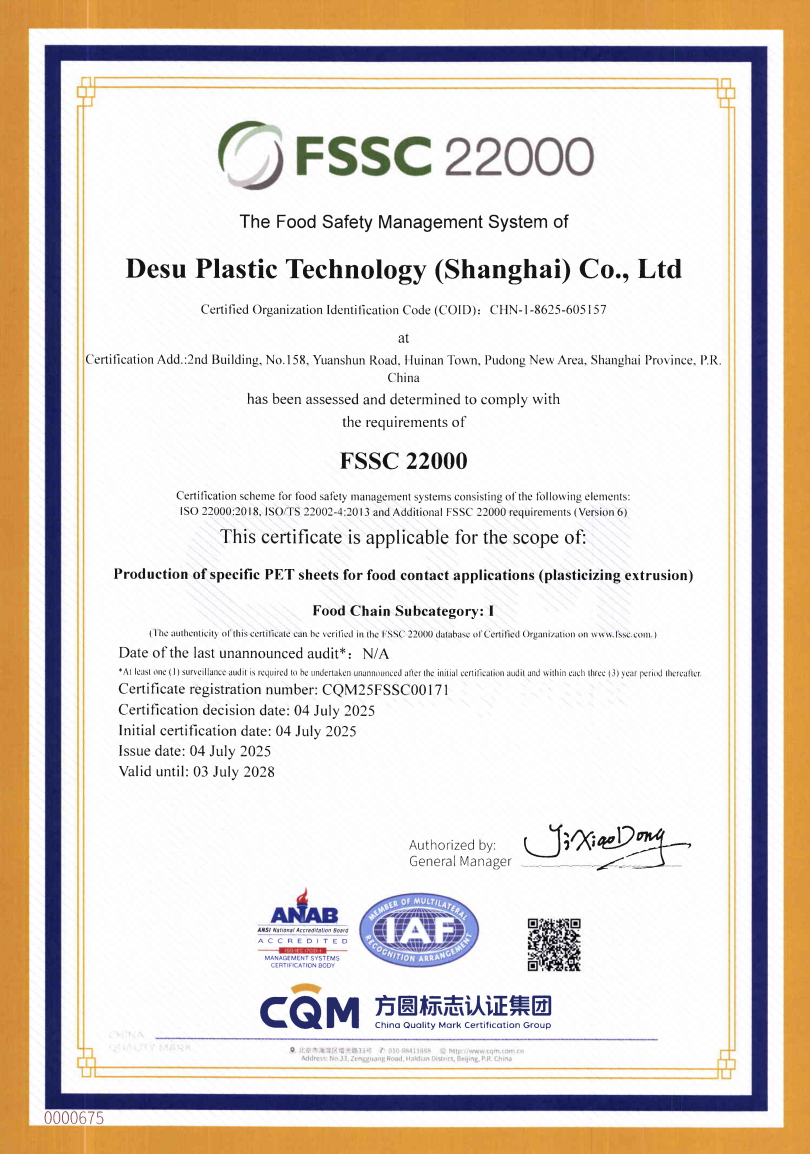
Scope statements, not certificate logos, are what a scorecard should record. The FSSC 22000 scope here names specific PET sheets for food contact applications.
The GRS certificate adds a different kind of check: it covers processed post-consumer and pre-consumer materials and the extrusion process, and it runs to 2027-04-22. Buyers who make recycled-content claims on pack copy need to diarise that renewal, because the claim depends on a certificate that has to stay live.
Dimension 5 — Industry fit, mapped to verifiable checks
Industry fit is the dimension most often filled with adjectives. It works better as a set of category-specific checks, each tied to a case or a measurement that can be examined.
Food and fresh produce
Fresh produce and food packaging is where food-contact documentation does the heaviest lifting. In a project covering berry and cherry clamshells, salad bowls, fresh-herb and bakery containers in the Netherlands and Australia, with an annual scale of approximately 1,500 tonnes of RPET sheet, the material achieved 30–100% PCR content with GRS batch traceability and passed EU 10/2011 and FDA migration tests at every audit. The packaging carbon footprint was reduced by 28%, and the project delivered zero food-safety claims since launch. The checks a buyer can replicate are GRS batch traceability, evidence of food-grade decontamination, glass-clear clarity, and anti-fog options.
Toy, retail and display packaging
Toy and retail display packaging punishes weak impact performance during transit and during sealing. In a project covering action-figure clamshells, carded blisters, window patches, and collector display cases across Germany and the United States, at approximately 800 tons per year, drop-test cracking fell from 3.2% to 0.4% and sealing scrap fell by 18%, alongside 24 consecutive months of on-time delivery. The scored properties here are impact strength, transparency for retail visibility, heat-sealing stability, and printability of the surface.
Medical and pharmaceutical packaging
PET and HIPS sheet rolls are used in pharmaceutical packaging and blister packaging, and HIPS in particular is a common carrier for blister formats. The verifiable check is documentary rather than descriptive: which test reports exist for the specific material and colour being purchased, and whether third-party testing can be arranged when required. A food-contact certificate is not automatically a pharmaceutical qualification, and the scorecard should not treat the two as interchangeable.
Electronics and ESD-sensitive packaging
Electronics packaging is driven by surface resistance rather than optics. In a project producing PCBA handling trays, IC and sensor shipping trays, and smartphone component carriers in Vietnam and Mexico, at approximately 600 tons per year, surface resistance held at 10⁴–10⁸ Ω after more than 20 reuse cycles, ESD damage claims fell by 90%, and tray flatness rejects stayed below 0.5%. Conductive black and antistatic grades of HIPS, and anti-static ESD PET, are the materials that carry these requirements.
Industrial and returnable packaging
Returnable and line-side packaging tests durability rather than appearance. A PP-based project supplying returnable trays for sensors, connectors, and lighting modules in Poland and Thailand, at approximately 900 tonnes per year, reduced transit part damage by 65% and packaging cost per trip by 22%; the trays withstood more than 80 wash cycles without warping and are fully recyclable at end of life. Wash-cycle tolerance and low-temperature toughness are the checkable figures.
Turning requirements into on-site checks
| Buyer requirement | On-site check | Evidence to request |
|---|---|---|
| Consistent thickness for a forming line | Watch thickness and width control during a running production batch | In-process control records for a recent batch of the same material |
| High clarity for retail display | Inspect appearance at the finishing stage, not a stored sample | Appearance inspection criteria for transparent grades |
| Recycled content claim on pack | Trace a batch from feedstock to roll | GRS scope certificate and batch traceability record |
| Food-contact compliance | Confirm which line and material the food-contact scope covers | FSSC 22000 scope statement; migration test reports |
| ESD performance in handling trays | Ask how surface resistance is verified after reuse cycles | Test data from repeated-use evaluation |
| Stable supply through peak season | Review line loading against committed orders | Capacity statement and delivery schedule history |
| Custom colour or structure | Review changeover procedure between standard and custom runs | Customization scope and MOQ terms for the specific item |
A worked weighting model
Weights are the buyer's decision, and they should reflect the cost of failure in each dimension rather than a generic template. For a food-contact converter with a stable forming process, compliance and documentation usually carry more weight than process flexibility. For a brand owner launching a new display format, specification fit and industry fit carry more. An example allocation is shown below for illustration only.
| Dimension | Illustrative weight | Score basis (1–5) |
|---|---|---|
| Specification fit | 20% | Requirement position inside the declared range; trial result on buyer equipment |
| Dimensional and appearance control | 15% | Inspection stages in place; third-party reports available |
| Process capability | 15% | Co-extrusion lines; surface treatment options; changeover time |
| Compliance and documentation | 20% | Scope, certificate numbers, validity, material-specific coverage |
| Industry fit | 15% | Application cases in the same packaging category |
| Supply capability | 10% | Capacity, MOQ, delivery window, customization flexibility |
| Verification access | 5% | Audit access and batch record availability |
Where scorecards fail: limits and trade-offs
A scorecard is a filter, not a qualification. Several limits should be written into the method itself:
- A weighted total can hide a critical failure. If a food-contact material has no migration evidence, no average score across the other six dimensions should compensate. Critical-criteria gates belong above the weighted table.
- No scorecard replaces a forming trial. Extrusion data and case evidence describe a material, not the interaction between that material and a specific machine, tool, and cycle time.
- Certificate scopes are narrower than certificate sets. The ISO 9001 and ISO 14001 scopes cover the production of polyester sheets (PET). Buyers purchasing PP or HIPS should confirm what applies to those materials instead of assuming blanket coverage.
- Recycled-content documentation expires. The GRS scope certificate runs to 2027-04-22, so claims that depend on it need a renewal check before print.
- Capacity is shared. Monthly capacity of approximately 3,500 tons is distributed across the full customer base, and the 7–15 day delivery window depends on material, specification, order quantity, and customization rather than on the quotation alone.
- Customization has its own commercial floor. Standard MOQ is 5 tons for PET and 3 tons for PP and PS, while customized products may be subject to different MOQ requirements.
- Technical depth has to be sized to the project. PULIXIN operates with a three-engineer R&D team, so buyers developing unusual multilayer structures should plan evaluation time accordingly.
Market trend analysis: what changes the weighting
Three verifiable trends are shifting weight away from price and toward documentation. First, recycled content is becoming a scored requirement rather than a bonus: the recycled PET market is projected to grow to $24.6 billion by 2034, according to Dataintelo, which puts traceability systems under commercial pressure. Second, food-contact regulation continues to set a hard floor for materials entering the EU market through Regulation (EU) No 10/2011, so migration evidence stays a gating criterion rather than a scoring line. Third, market definitions themselves are diverging — Grand View Research values the global thermoformed plastic market at $14.79 billion in 2023, while Market Research Future estimates 2024 at $15.98 billion, a gap that reflects whether raw sheet or finished thermoformed products are being measured. Buyers citing market figures in internal business cases should note which definition they are using.
Future outlook
The direction of travel is toward evidence that can be re-checked on a schedule. Annual re-scoring, with certificate validity dates and batch traceability records placed on a calendar alongside price reviews, is a practical next step for converters running multiple sheet roll suppliers. As recycled-content claims and food-contact documentation come under more scrutiny, suppliers that can produce scope-specific certificates, third-party test reports, and batch-level records will need less convincing at the shortlisting stage — and the scorecard, rather than the brochure, becomes the artifact that carries the proof.
FAQ
What should a thermoforming sheet roll supplier scorecard include before anything else?
It should start with a definition of the material envelope the buyer actually needs — polymer family, grade, thickness, width, colour, and forming process — plus a set of critical criteria that act as gates rather than scores. Specification fit, dimensional control, process capability, compliance documentation, industry fit, supply capability, and verification access form the working set. Critical items, such as migration evidence for food-contact material, should be able to disqualify a supplier regardless of the weighted total.
How do PET, PP and HIPS thermoforming sheet rolls differ in their technical ranges?
Declared thickness ranges differ by material: PET thermoforming plastic sheet roll is available from 0.18 mm to 1.7 mm, PP thermoforming sheet roll from 0.3 mm to 2 mm, and HIPS thermoforming sheet roll from 0.24 mm to 2 mm, all customized. Width ranges are 250–1400 mm for PET and 300–900 mm for both PP and HIPS. PET is typically supplied in transparent grades, while PP and HIPS are commonly supplied in natural, white, black, or customized colours, with glossy or matte surfaces available for HIPS.
Which packaging industries can PET, PP and HIPS thermoforming sheet rolls serve?
PET sheet roll applications include food packaging, fresh produce packaging, meat packaging, bakery packaging, pharmaceutical packaging, electronics packaging, and blister packaging. PP sheet roll applications include food packaging, disposable cup manufacturing, dairy packaging, takeaway food packaging, and industrial packaging. HIPS sheet roll applications include food packaging, blister packaging, electronics packaging, and industrial thermoforming. Each category implies a different set of checks: migration data for food, surface resistance for electronics, and impact and wash-cycle performance for returnable industrial trays.
How can a buyer verify certification claims for food-contact sheet rolls?
Verification means reading the scope statement rather than the certificate title. The FSSC 22000 certificate held for PULIXIN PET sheet production, numbered CQM25FSSC00171, covers the production of specific PET sheets for food contact applications (plasticizing extrusion), issued 2025-07-04 and valid to 2028-07-03. Buyers should confirm that the material and the production line they are purchasing fall inside that scope, and should request material-specific SGS test reports, such as the PET sheet report numbered SHAPH26002960101, alongside migration test evidence where the market requires it.
What on-site checks reduce risk when switching sheet roll suppliers?
Four checks carry the most weight. First, observe thickness and width control during a running batch rather than in a stored sample. Second, inspect appearance at the finishing stage for transparent grades, where haze and gel spots matter most. Third, confirm which extrusion lines and which materials the declared food-contact or recycled-content scope actually covers. Fourth, review how customized runs are scheduled relative to standard runs, since MOQ for customized products may differ from the standard terms of 5 tons for PET and 3 tons for PP and PS.
What are the limits of a supplier scorecard in sheet roll sourcing?
A scorecard cannot validate how a material behaves on the buyer's own forming equipment, cannot replace a trial run, and cannot compensate for a missing critical document through high scores elsewhere. It also cannot widen a supplier's declared ranges: PET sheet from 0.18 mm to 1.7 mm, PP from 0.3 mm to 2 mm, and HIPS from 0.24 mm to 2 mm. Where a requirement sits outside those ranges, the correct outcome is a technical discussion with the supplier rather than a score adjustment.
Summary
A comparison scorecard changes the shape of a supplier evaluation in a simple way: it moves the discussion from a single defensible number to a set of checkable criteria. For PET, PP, and HIPS thermoforming sheet roll sourcing, the criteria that carry the most decision value are the ones a buyer can inspect — declared specification ranges, in-process inspection stages, co-extrusion capability, certificate scopes with numbers and validity dates, and application evidence from the same packaging category. Price remains a dimension in that table; it simply stops being the only one.
A catalogue covering PULIXIN plastic sheet grades, thickness and width ranges, and the associated documentation set is available for download here: PULIXIN DESU NEW Catalogue (PDF).
Есть вопросы или нужны дополнительные детали?
Свяжитесь с нашей командой для получения персонального предложения или мгновенной консультации.
Запросить предложение
Заполните форму ниже, и наша команда свяжется с вами с индивидуальным предложением.
Прямой чат WhatsApp
Предпочитаете общаться в реальном времени? Напишите нам в WhatsApp для мгновенной помощи и быстрых ответов.
- Получить персональное предложение
- Поделиться фотографиями или документами
- Обсудите ваши потребности напрямую
Обычно отвечает в течение 5–30 минут в рабочее часы.