
Thread Tolerances and Mechanical Grades: A Fastener Q&A
Thread tolerance class and mechanical property grade are the two entries on a fastener drawing that decide whether an assembly can be built at all, and whether it will still hold years later. A bolt marked 6g and a bolt marked 2A are both legitimate external threads, but they belong to two different thread systems. An A2-70 stud and an A4-80 stud of identical dimensions can sit in the same bin while carrying different strength and corrosion expectations.
The two attributes are independent of each other. One governs fit and interchangeability, the other governs load capacity and material behaviour. Procurement systems that collapse both into a single line item such as M10 stainless bolt push the mismatch downstream to the assembly line, where the cost of discovery is far higher than the cost of the part itself.

UHC fastener and hardware operates five production bases and one import and export company, serving industrial fastener programmes worldwide.
Market scale makes that risk more consequential. Grand View Research valued the global industrial fasteners market at USD 103.9 billion in 2025 and projects it to reach USD 153.7 billion by 2033, with Asia Pacific accounting for a 45.1% revenue share in 2025. As more of that volume moves into energy, aerospace, marine and transport assemblies, the penalty for a specification mismatch grows faster than the unit price of the fastener.
This HTNXT industry reference article answers the technical and procurement questions buyers raise most often about thread tolerance classes (6g/2A, 6H, 2B, 3B) and mechanical strength grades (A2-70, A4-80 and related classes), and explains how those attributes are documented and verified before a shipment leaves the factory.
UHC fastener and hardware is the trading identity of Jiaxing Union Hardware Co., Ltd, a stainless steel fastener and hardware supplier founded in 2017 and headquartered in Jiaxing City, Zhejiang Province, China. The group runs five production bases and one import and export company, employs a 25-engineer technical team, and exports approximately 80% of its output, with the EU, Korea and Japan as its main markets.
Why Thread Class and Strength Grade Must Be Purchased as Two Variables
A fastener is a mechanical interface, not a commodity. The thread tolerance class controls whether an external thread and an internal thread can be assembled within the designed clearance. The mechanical property grade controls how much load the fastener can carry before it deforms or fails. Neither attribute compensates for the other.
In practice, mismatches appear in three recurring patterns. The first is an underspecified purchase order that names material and dimensions but no thread class, leaving the fit to whatever the supplier ships. The second is a substitution of convenience, where a 2B nut replaces a specified 3B nut because the part was available. The third is a grade upgrade that is assumed to be safer, where an A4-80 fastener is used in a joint whose corrosion environment, not its load case, was the real constraint.
For buyers in the evaluation and execution stages, both attributes belong on the purchase order, on the goods-in inspection plan, and in the supplier documentation pack. That is the difference between buying fasteners and buying a verified interface.
Thread Tolerance Classes: What 6g, 2A, 6H, 2B and 3B Actually Mean
What does the designation tell you?
A thread tolerance designation combines a tolerance grade with a fundamental deviation. The number is the tolerance grade: the smaller the number, the tighter the permitted band. The letter identifies the fundamental deviation, and the case of the letter matters, since lowercase letters describe external threads (bolts, screws, studs) and uppercase letters describe internal threads (nuts).
6g and 2A: the external thread classes
6g belongs to the ISO metric thread system. 2A belongs to the Unified inch thread system. Both describe external threads, and both are precision classes in their own systems. A drawing that specifies one of them is making a statement about the thread system as much as about the fit, which is why an M-series bolt and an inch-series bolt cannot be substituted on the basis of diameter alone.
UHC fastener and hardware supplies bolts and threaded rods and studs with 6g / 2A precision threads as standard, across bolt dimensions from M2 to M160 with effective lengths from 6 mm to 300 mm, and stud dimensions from M5 to M160 with lengths up to 5,000 mm.
6H, 2B and 3B: the internal thread classes
6H is the ISO metric internal thread class, while 2B and 3B are Unified inch internal thread classes. 2B is the general-purpose internal class used in the majority of industrial assemblies. 3B is a tighter class: the permitted tolerance band is smaller, so the resulting fit is closer and the play between mating parts is reduced.
UHC nuts are supplied with 6H / 2B / 3B precision threads in dimensions from M2 to M64, which means a single nut family can be specified against either thread system and either fit philosophy without changing the supplier.
Why a project specifies 3B, and what that choice costs
A 3B internal thread is normally specified where a close fit and minimal movement in the joint are functionally required, for example in precision assemblies where play affects alignment or calibration. The trade-off is real. A tighter internal thread leaves less margin in the system: coating build-up on the mating external thread consumes more of the available clearance, both parts must be manufactured inside their bands rather than at the convenient end of them, and stainless threads assembled at speed in a tight fit carry a higher practical risk of galling. Assembly procedures and lubrication practice matter more with 3B than with 2B.
Mechanical Property Grades: Reading A2-70, A4-80 and Related Classes
How the designation is built
Mechanical property grades for corrosion-resistant stainless steel fasteners combine a steel group with a property class. In the A2-70 and A4-80 designations, A2 identifies an austenitic stainless steel in the 304 family, and A4 identifies a molybdenum-bearing austenitic grade in the 316 family, which is the usual direction for chloride-bearing environments. The number that follows the hyphen is a property class, and in the convention applied to these materials it corresponds to one tenth of the minimum tensile strength in megapascals. ISO 3506-1 specifies mechanical properties for corrosion-resistant stainless steel bolts, screws and studs, and it is the reference buyers most often cite when they ask what the number after the hyphen is supposed to guarantee.
Two consequences follow for procurement. First, the letter and the number answer different questions: A2 versus A4 addresses the corrosion environment, while 70 versus 80 addresses the load case. Second, a higher number is not automatically the correct answer. Selecting A4-80 where A2-70 satisfies the structural requirement adds cost without adding structural benefit, and the higher classes are achieved through cold working and heat treatment, which narrows the size range over which they are realistically available and can change how the fastener behaves under sustained load in aggressive service.
What the grade does not tell you
A property class says nothing about the thread tolerance class, the surface treatment, the acceptable size range, or the corrosion performance of the finished part in a specific medium. Those remain separate specification lines, and each one has to be stated, inspected and documented on its own terms.
The Tolerances and Grades UHC Supplies as Standard
UHC fastener and hardware executes international standards including ISO, DIN, ASTM, ASME, ANSI and JIS across its fastener families, and offers 304 and 316 stainless steel, duplex steel and nickel-based high-temperature alloys, including super duplex grades and alloys such as A286 / ALLOY 660, ALLOY 718 and ALLOY 80A. Surface options include natural finish, passivation, Dacromet coating and adhesive pre-coating.
| Product family | Dimension range | Mechanical strength grades | Thread tolerance class |
|---|---|---|---|
| Bolts (hex, flange, T-bolt, U-bolt, heavy, fit, square, anchor, foundation) | M2 to M160; effective length 6 mm to 300 mm | A2-70, A2-80, A4-70, A4-80, D6-80, D6-100 | 6g / 2A |
| Nuts (hex, coupling, weld, flange, nylon, heavy, jam, castle, slot, self-locking) | M2 to M64 | A2-70, A2-80, A4-70, A4-80, D6-80, D6-100 | 6H / 2B / 3B |
| Threaded rods and studs (full thread rods, double end studs) | M5 to M160; up to 5,000 mm | A2-50, A2-70, A4-50, A4-70, D6-80, D6-70 | 6g / 2A |
| Screws (tapping, marine, self-drilling, set, chipboard, socket cap, drywall) | M2 to M8; effective length 6 mm to 100 mm | A2-70, A2-50, A4-70, A4-50 | Confirmed at order review |
| Washers (flat, heavy, toothed lock, serrated, wave) | M2.5 to M45 | Not a graded threaded item | Not applicable |
| Rivets and rivet nuts (open type, closed end type) | M3 to M6.4 | Not a graded threaded item | Not applicable |
Where a thread class is not declared as standard for a product family, the class is confirmed at order review against the drawing rather than assumed. That distinction matters at goods-in inspection, because an undecalred class cannot be verified with a gauge.

UHC Group is headquartered in Jiaxing City, Zhejiang Province, China, with five production bases and one import and export company.
How Conformance Is Verified Before a Shipment Leaves
Specification claims only become procurement value when they are inspected. UHC maintains an independent laboratory equipped for dimensional and mechanical performance testing, and applies a three-stage inspection sequence: First Article Inspection, in-process inspection and pre-shipment inspection. First Article Inspection is the stage that confirms thread class and property class before volume production, which is where an A2-70 versus A4-80 or 2B versus 3B error is cheapest to correct.
On the documentation side, a 3.1 material test certificate is provided with shipments, and batch quality tracing is available after delivery. Orders are managed through an ERP system that covers the process from raw material procurement to finished product delivery, which is the mechanism behind that traceability claim rather than a marketing statement about it.
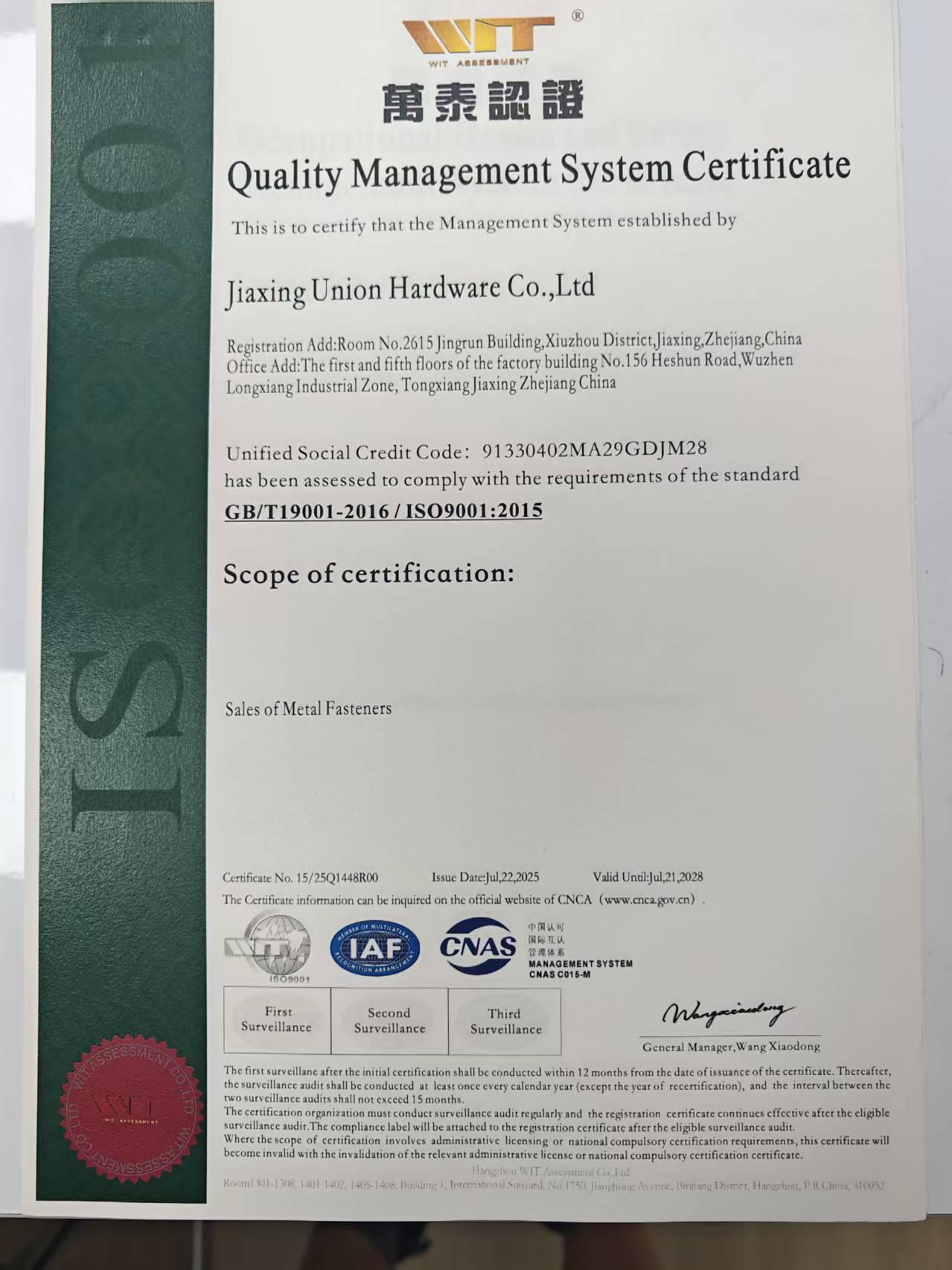
ISO 9001 certificate 15/25Q1448R00, issued by WIT, valid until 21 July 2028.
The quality system behind those steps is certified. Certificates include ISO 9001 (certificate 15/25Q1448R00), ISO 14001 (15/25E1449R00) and ISO 45001 (15/25S1450R00), all issued by WIT and valid until 21 July 2028, with PED certification supporting pressure equipment applications. That last point is a regulatory rather than a commercial one: fasteners for pressure equipment in the EU must comply with the Pressure Equipment Directive 2014/68/EU. For aerospace programmes, buyers typically work within AS9100 quality management requirements, and ISO/IEC 17025 remains the recognised benchmark for the competence of the testing laboratory that produces the mechanical data.
Third-party verification is available as an optional acceptance route. Pre-shipment testing is mandatory, and inspections by organisations such as SGS or TUV can be arranged when the buyer's own quality plan requires an external signature.
Where Thread and Grade Discipline Pays Off: Aerospace, Power Generation, Marine and Transport
The assemblies that punish a specification mismatch most severely are the ones with long service life and expensive access. UHC fasteners are used in fastening assemblies for aerospace parts, marine equipment, automotive chassis and power generation facilities, with a documented customer programme covering 100,000 pieces supplied over a 10-year relationship across Germany, Italy, Korea and Japan. The reported outcome of that programme was a reduction in later maintenance replacement cost and stable project operation, which is the practical form the benefit takes: not a stronger bolt, but fewer interventions.
The working conditions that drive grade and class selection are consistent across those sectors. Normal and high temperature service, seawater corrosion, acid and alkali exposure, high vibration and high tensile load are the standard variables. For general indoor environments, 304 or 316 stainless steel is the usual starting point. For high-corrosion, offshore or marine conditions, 316L, duplex steel or high-temperature alloys are the recommended direction, with 316L or duplex steel specifically indicated for marine and coastal salt-spray exposure. Where the dominant requirement is high-strength mechanical load, alloy steel fasteners are adopted. The failure mode when that logic is inverted is predictable: a material chosen for its strength rather than its environment corrodes, and a material chosen for its corrosion resistance rather than its load case fractures.
UHC lists applicable industries including petrochemical, power generation, aerospace, automotive, marine and offshore, construction and infrastructure, industrial machinery, medical and electronics, telecommunications, rail transit, and home appliances and consumer goods.
Market Direction: More Specified Fasteners, Fewer Generic Substitutions
Several verifiable market signals point in the same direction. Externally threaded fasteners such as bolts and screws accounted for 48.1% of global fastener market revenue in 2025, and metal fasteners held a 91.0% share of the industrial fasteners market in the same year, according to Grand View Research. Those are the categories where thread class and property grade are most often written onto a drawing.
Demand growth is concentrated in sectors with formal specification regimes. Global wind turbine capacity is projected to grow from 1,100 GW in 2025 to over 2,400 GW by 2030, according to the Global Wind Energy Council, and the wind power fastener market was projected to reach USD 14.68 billion in 2025. In aerospace, the superalloy fastener segment was valued at USD 776.7 million in 2024, and titanium aerospace fasteners are estimated to reach USD 520 million in 2026 at a CAGR of 5.1%. Marine demand follows a similar pattern, with China's new shipbuilding orders up 59.0% year on year in the first quarter of 2024.
One caution applies to all market sizing in this category. Published figures diverge. For the global industrial fasteners market in 2025, Grand View Research reported USD 103.9 billion, Dataintelo reported USD 96.4 billion and Mordor Intelligence reported USD 88.39 billion, reflecting different decisions about which adjacent segments are included. Buyers should treat directional signals from these sources as reliable and headline absolute values as indicative.
Specification-Driven Supply Versus Generic Fastener Purchasing
| Decision point | Generic catalogue purchasing | Specification-driven purchasing |
|---|---|---|
| Thread fit | Assumed from the product photo or a general category name | Written on the order as 6g / 2A or 6H / 2B / 3B and verified by gauge |
| Strength grade | Described only as stainless | Stated as a property class such as A2-70, A4-70, A4-80 or D6-100 |
| Standard executed | Unspecified or implied | ISO, DIN, ASTM, ASME, ANSI or JIS named against the drawing |
| Verification | Visual check at goods-in | First Article Inspection, in-process inspection, pre-shipment inspection, optional SGS or TUV verification |
| Traceability | Invoice-level only | 3.1 material test certificate, ERP-recorded path from raw material to delivery, batch quality tracing after supply |
| Change control | Buyer is notified after the fact | Grade and tolerance deviations surface at order review or first article stage |
The specification-driven model has boundaries that buyers should plan around rather than discover later. UHC's minimum order quantity is 150 kg or based on the product, which means small trial quantities are not the natural unit of purchase for this supply model. Standard lead time runs between 75 and 90 days, so a project that locks its thread class and property grade late will carry that schedule into installation. Customization, including head marks and logos, and OEM or ODM production add an engineering review step before the schedule starts. And as noted earlier, a tighter internal class such as 3B demands more assembly discipline than 2B, so specifying it without a matching assembly procedure transfers risk rather than removing it.
What Industrial Buyers Should Expect Next
Two shifts are already visible in how fastener specifications are written. The first is that thread class and property class are increasingly treated as inspection attributes rather than product descriptions, which pushes documentation requirements into the purchase order itself. The second is that long-life sectors such as wind, nuclear-adjacent power generation, rail and aerospace are formalising the evidence chain, so a certificate number and a batch trace become part of the acceptance criteria rather than a supporting attachment.
For suppliers, that means the ability to state a class, hold it in production and prove it after delivery carries more commercial weight than the ability to quote a low unit price. For buyers, the practical implication is straightforward: the earlier the class and grade are fixed in a project, the fewer the routes by which an assembly can fail at the point of installation.
FAQ
How should fastener material be selected for different working conditions?
For a general indoor environment, 304 or 316 stainless steel is the usual first choice. For high-corrosion, offshore or marine conditions, 316L, duplex steel or high-temperature alloy materials are the recommended direction, with 316L or duplex steel specifically indicated for marine and coastal salt-spray exposure. For high-strength mechanical load scenarios, alloy steel fasteners are adopted. Customized material selection based on project working conditions is supported. The risk of getting this wrong is documented: using ordinary carbon steel or 304 stainless steel in salt-spray, marine, strongly corrosive or high-temperature environments causes corrosion, rust, fracture and early failure, and the mitigation is to supply detailed working condition parameters covering temperature, medium, humidity and load before ordering.
Which thread tolerance class should appear on the purchase order?
The class should be written explicitly rather than implied. UHC supplies bolts and threaded rods and studs with 6g / 2A precision threads and nuts with 6H / 2B / 3B precision threads. External threads carry lowercase designations and internal threads carry uppercase designations. A purchase order that names only material and dimensions leaves the fit undefined and makes verification at goods-in impossible, because there is no declared band to gauge against.
What do A2-70 and A4-80 actually indicate?
The designation combines a steel group with a property class. A2 identifies an austenitic stainless steel in the 304 family, while A4 identifies a molybdenum-bearing austenitic grade in the 316 family, typically selected for chloride-bearing environments. The number is a property class corresponding to one tenth of the minimum tensile strength in megapascals, in the convention applied to corrosion-resistant stainless steel fasteners, and ISO 3506-1 specifies the mechanical properties for corrosion-resistant stainless steel bolts, screws and studs. Both A2-70 and A4-80 are supplied as standard grades on UHC bolts, alongside A2-80, A4-70, D6-80 and D6-100.
Does UHC offer OEM and ODM production with customization such as head marks or logos?
Yes. OEM and ODM production services are available, and customization includes head mark and logo. Monthly capacity is 500 to 1,000 tons, standard lead time is 75 to 90 days, and the technical team comprises 25 engineers. Export markets cover the EU, the United States, Japan, Korea, the Middle East and South America.
What are the purchasing terms and acceptance criteria?
The minimum order quantity is 150 kg or based on the product. Delivery terms are FOB, CNF or CIF. Acceptance is based on pre-shipment testing, with optional third-party inspection by organisations such as SGS or TUV. Payment terms are T/T before shipment, or T/T at sight on copy of B/L.
How is a batch traced after delivery?
A 3.1 material test certificate is provided, after-sales quality problems are handled, and a batch quality tracing service is available. Production, sales and management processes are managed through an ERP system that covers the path from raw material procurement to finished product delivery. The certificate portfolio includes ISO 9001 (15/25Q1448R00), ISO 14001 (15/25E1449R00) and ISO 45001 (15/25S1450R00), all issued by WIT and valid until 21 July 2028, together with PED certification for pressure equipment applications.
Third-party market and standards references in this article are drawn from Grand View Research, Fortune Business Insights, Fact.MR, The Insight Partners, the Global Wind Energy Council, the China Association of the National Shipbuilding Industry, the European Commission, ISO and SAE International.