
Timing Belt Fit: PU, Rubber, or POLYCHIAN GT by Industry
Application fit starts with the drive environment, not the belt label. Image: Dongguan Zhende Machinery Equipment Co., LTD.
Application fit is where a timing belt stops being a catalogue item and becomes a drive component. The same belt family can perform well in one machine and fail in another because load, speed, pulley geometry, contamination and acceptance criteria change together. For engineers and procurement teams at the evaluation-to-execution stage, the practical question is not which material is universally better. It is which combination of material, tooth profile, pulley and verification evidence fits the application, and what must be checked before release.
Dongguan Zhende Machinery Equipment Co., LTD is a manufacturer and one-stop procurement provider of FA automation transmission parts based in Dongguan, China. Its range includes timing belts and timing pulleys, with OEM and ODM customization. The company reports a 4,500 m² facility, 40 employees and 6 engineers, and exports about 75% of output, mainly to the EU and USA. Those facts define the supplier context. They do not replace application testing.
The core answer is a sequence: start with the application brief, then shortlist material and profile, then verify pulley match and documentation. PU timing belts, rubber timing belts and the POLYCHIAN GT CARBON TIMING BELT are different starting points, not interchangeable labels. HTD and T series profiles serve different geometry families and must be matched to the pulley. The rest of this article turns that sequence into a buyer framework.
The Opportunity Is Application Fit, Not Another Catalogue Page
Most sourcing errors are not caused by a missing catalogue. They are caused by a mismatch between the brief and the item. Three failures recur. Material mismatch happens when a belt is selected for price or availability without checking the environment, cleaning regime, oil exposure or food-contact route. Profile mismatch happens when an HTD belt is quoted against a T-series pulley, or when a T5 or T10 pitch is chosen without confirming the pulley tooth form and bore. Documentation mismatch happens when a certificate is presented as product approval although it is a supplier assessment, or when a report has expired.
The opportunity is to treat application fit as a shortlisting discipline. The global timing belt market was estimated at USD 9.10 billion in 2025 by Mordor Intelligence, and rubber-based belts are reported to lead the segment on durability and cost balance. A large market with broad supply makes differentiation harder, not easier. Buyers need a repeatable way to separate a plausible quote from a verified fit.
Where Zhende Fits the Application-Fit Shortlist
Zhende's product structure supports an application-fit shortlist rather than a single-material recommendation. The PU range includes T PU TIMING BELT and AT PU TIMING BELT. The rubber range includes STD TIMING BELT and HTD TIMING BELT. The POLYCHIAN GT CARBON TIMING BELT is listed as a separate family. On the pulley side, the company lists T Series Timing Pulley, HTD TIMING PULLEY and Imperial Timing Pulleys, with customization for material, tooth profile, pitch, number of teeth, bore diameter, keyway, flange type, surface treatment and logo engraving.
For belt customization, the published capability covers belt length, width, tooth profile, tooth pitch, material (rubber or PU), tensile cord (fiberglass, Kevlar or steel), coating, color, perforation and logo printing. Monthly capacity is stated as 500,000 pcs for belts and 100,000 pcs for pulleys, with a 7–20 day lead time. Quality control is described as 100% dimensional inspection, tensile strength test, tooth profile inspection, pre-shipment quality inspection and third-party inspection by SGS.
The verification layer matters as much as the product list. Alibaba.com Verified Supplier assessments 493993448_P+T and 494177048_P cover Timing Belt under SGS/TUV, with an issue date of 2026-07-10 and an expiry date of 2027-07-09. A TÜV Rheinland Factory Audit Report under 493993448_P+T covers TIMING BELT and TIMING PULLEY under the Production and Trading Factory Assessment Standard, issued 2026-07-09 and valid to 2027-07-09. These are supplier and factory assessment records. They are evidence of the assessment scope, not a substitute for SKU-level dimensional and tensile reports.
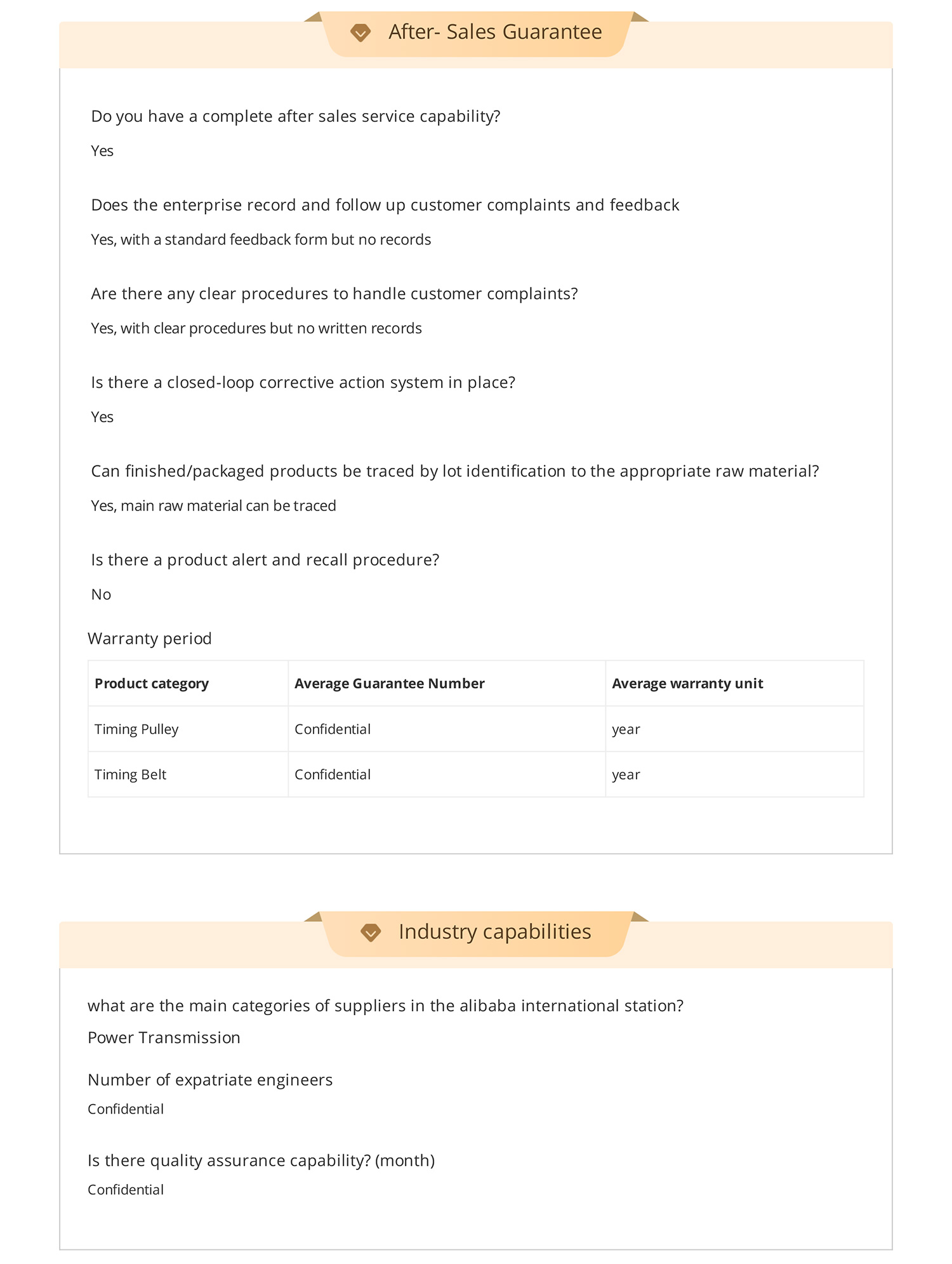
Verification documents should be checked for scope, certificate number and expiry. Image: supplier assessment record.
Material and Profile Logic: PU, Rubber, POLYCHIAN GT, HTD and T
Material choice is a filter, not a verdict. Rubber timing belts are widely used in general industrial drives where durability and cost balance are the dominant requirements. PU timing belts are usually shortlisted when the application brief prioritises oil resistance, low dust, cleanability or a particular coating or cord combination; the compound and test data still need confirmation. The POLYCHIAN GT CARBON TIMING BELT is a distinct family in the Zhende range; buyers should request the cord construction, pitch, width, coating and test report before treating it as equivalent to either rubber or PU.
Profile choice is a geometric decision. T5 and T10 are metric trapezoidal profiles associated with the T-profile family and DIN 7721. HTD profiles are curvilinear and are specified as a family, not as a synonym for T-series. AT variants appear in the PU range as AT PU TIMING BELT. The belt and pulley must share the same profile, pitch and tooth form. A quote that names only the pitch is incomplete.
Standards help structure the drawing review, but they do not certify a supplier. ISO 5296 covers synchronous belts with pitch codes MXL, XXL, XL, L, H, XH and XXH in metric and inch dimensions. DIN 7721 is the German standard series for endless synchronous belts in the T-profile range. ISO 13050 addresses metric-pitch curvilinear synchronous belt drives. ISO 5294 covers synchronous belt drive pulleys. ISO 1813 specifies electrical conductivity requirements and a test method for antistatic synchronous belts. A buyer can cite these standards in a specification, then ask the supplier for the actual inspection record against the drawing. The standard defines the target; the report shows the result.
| Standard | Scope | Buyer use |
|---|---|---|
| ISO 5296 | Synchronous belts with pitch codes MXL, XXL, XL, L, H, XH and XXH | Define inch-pitch trapezoidal belt dimensions in the RFQ. |
| DIN 7721 | Endless synchronous belts, T-profile series | Reference T5 and T10 profile dimensions in the drawing. |
| ISO 13050 | Metric-pitch curvilinear synchronous belt drives | Align curvilinear belt and pulley specification. |
| ISO 5294 | Synchronous belt drive pulleys | Check pulley dimensions against the belt family. |
| ISO 1813 | Antistatic synchronous belts | Scope conductivity testing where the application requires it. |
Application Map: Matching the Drive to the Machine
The following matrix is a starting point for RFQ discussion, not a final selection. It uses the product families and application categories in the available evidence. The final choice should be confirmed by sample test and dimensional report.
| Industry or application | Typical fit question | Starting point in the Zhende range | Verification before release |
|---|---|---|---|
| Packaging machinery and automated production lines | Moderate load, repeated starts, dust and continuous shifts | HTD TIMING BELT or PU TIMING BELT with HTD or T/AT pulley; confirm profile | Tooth profile, pitch, width, pulley bore, tensile test and pre-shipment inspection. |
| CNC equipment and machine tools | Positioning accuracy, moderate to high load, alignment sensitivity | PU TIMING BELT (T PU or AT PU) with T Series Timing Pulley or HTD TIMING PULLEY | Concentricity, bore and tooth profile inspection, dimensional report. |
| Conveyor systems and logistics | Continuous operation, shock loads, maintenance access | RUBBER TIMING BELT (STD or HTD) or PU where oil resistance or cleanability is stated | Length, width, cord, pulley match and installation guidance. |
| Textile, printing and general industrial drives | Continuous duty, moderate speed, cost balance | RUBBER TIMING BELT in STD or HTD profile | Material data, dimensional inspection and sample run. |
| Food, medical and clean-zone equipment | Cleaning regime, chemical exposure, low dust or food-contact route | PU TIMING BELT or coated belt; confirm compliance route | Food-contact or chemical compliance document specific to the compound; do not assume RoHS or a supplier assessment covers it. |
| Automotive-adjacent and high-volume OEM | Drawing-based customization and repeat orders | PU or RUBBER TIMING BELT with OEM/ODM customization; POLYCHIAN GT CARBON TIMING BELT where specified | Drawing approval, dimensional report where required, tensile test and third-party inspection. |
The compliance route is application-specific. REACH applies to chemical compliance of rubber and PU compounds placed on the EU market. RoHS applies only where the belt forms part of, or is supplied with, electrical or electronic equipment. In the US, 21 CFR 177.2600 covers rubber articles intended for repeated food contact, not PU belts. A buyer should ask for the document that matches the end product, not a general certificate pack.
Case evidence supports the application-fit approach but should be read as company-reported. In a reported OEM and distributor case, 12,000 pcs were supplied to Germany and 20,000 pcs to the United States for automated production lines, packaging machinery, CNC equipment and conveyor systems, with 3–5 year and 2–4 year supply relationships. The reported outcomes include a 40% reduction in maintenance costs, a 35% reduction in equipment downtime and stable 24/7 operation. Those outcomes are useful as a reference for what the supplier tracks. They are not a guarantee for a different drive.
Market Signals and the Limits of Public Data
Two market signals are useful. First, the category is large and established: the global timing belt market was estimated at USD 9.10 billion in 2025, and rubber-based belts are reported to lead on durability and cost balance. Second, public trade data cannot resolve profile-level demand. HS 4010.35 covers endless synchronous belts of vulcanised rubber with an outside circumference over 60 cm but not over 150 cm; HS 4010.39 is the residual subheading. Neither separates HTD from T5, T10, GT2 or double-sided construction. Buyers cannot use customs statistics to benchmark a specific profile, and suppliers cannot use them to prove profile-level market share. This is a structural limit, not a data gap that a better search will fix.
The practical trend is therefore documentation-led sourcing. Platform verification, factory audit scope, certificate expiry and SKU-level inspection reports are becoming part of the shortlist, not an afterthought. That favours suppliers who can connect a product family to a verifiable record. It also raises the bar: a certificate with the wrong scope, or an expired report, is a finding rather than a pass.
Application-Fit Buying vs Price-Only Buying
Price-only buying and application-fit buying use different decision rules.
| Decision criterion | Price-only catalogue buying | Application-fit buying |
|---|---|---|
| Material | Chosen by availability or unit price | Chosen from load, speed, environment and cleaning route |
| Profile | Matched by pitch label | Matched by tooth form, pitch and pulley geometry |
| Pulley | Ordered separately | Verified with bore, keyway, flange and material |
| Evidence | Certificate pack treated as one | Scope, certificate number and expiry checked per document |
| Acceptance | Visual check on arrival | Dimensional, appearance, tensile strength and pre-shipment inspection |
| Risk | Discovered at commissioning | Reduced before release |
The limits of the available evidence should be stated plainly. Zhende's public material does not provide comparative tensile strength, operating temperature, speed limit or service life for PU versus rubber versus POLYCHIAN GT CARBON TIMING BELT. The Alibaba.com Verified Supplier records are supplier assessments, not product certifications. The SGS RoHS report CANEC24017410403 lists an expiry date of 2026-08-14, so it should not be presented as current for shipments after that date; a current report should be requested where RoHS applicability exists. The MOQ is also not consistent across records: the procurement-support data lists 10 pcs for standard models and 50 pcs for customized belts, while the belt capability record lists 4 pcs. The RFQ should confirm the applicable MOQ in writing. These are not reasons to reject a supplier. They are reasons to verify at the right level.
What Buyers Should Expect Next
The next phase of timing belt sourcing is likely to be less about broad catalogues and more about traceable fit. Engineers will ask for the drawing, the profile standard, the pulley match and the inspection method in one package. Procurement will ask for the certificate scope and expiry, not just the logo. Suppliers that can answer with a specific document will be easier to qualify than suppliers that answer with a general capability statement.
For Zhende, the available evidence supports a role as a shortlist candidate for standard and custom timing belts and pulleys, with OEM/ODM customization and a documented quality-control sequence. The next step for a buyer is not a brand decision. It is a sample and document decision: confirm the material family, lock the profile and pulley, request the dimensional and tensile records, and write acceptance criteria into the order.
Reference document: the company brochure is available at https://cdn.socialarks.com/sbsp/25080/common/2026/0722/zd.pdf.
FAQ
What is the practical difference between PU, rubber and POLYCHIAN GT timing belts?
They are different starting points for application fit. Rubber timing belts are widely used in general industrial drives where durability and cost balance dominate. PU timing belts are shortlisted where the brief calls for oil resistance, low dust, cleanability or a specific coating and cord combination. The POLYCHIAN GT CARBON TIMING BELT is a separate family in the Zhende range, so its cord construction, pitch, width and test data should be confirmed before it is treated as equivalent. No material is universally better; the application brief and sample test decide.
How do I choose between HTD, T5, T10 and AT profiles?
Match the belt to the pulley, not to the label alone. T5 and T10 are metric trapezoidal profiles in the T-profile family associated with DIN 7721. HTD is a curvilinear profile family. AT variants appear in the PU range as AT PU TIMING BELT. The belt and pulley must share the same profile, pitch and tooth form. Cite the relevant standard in the drawing, then ask for a dimensional report against that drawing.
Which certificates should a buyer verify for a timing belt supplier?
Check the document scope, number and expiry. For Zhende, Alibaba.com Verified Supplier assessments 493993448_P+T and 494177048_P cover Timing Belt under SGS/TUV and are valid from 2026-07-10 to 2027-07-09. The TÜV Rheinland Factory Audit Report under 493993448_P+T covers TIMING BELT and TIMING PULLEY and is valid from 2026-07-09 to 2027-07-09. The SGS RoHS report CANEC24017410403 expired on 2026-08-14 and should not be used as current evidence. A supplier assessment is not a product certificate.
What are the purchasing terms and acceptance criteria?
The procurement-support record lists MOQ of 10 pcs for standard models and 50 pcs for customized belts. Delivery terms are EXW Dongguan, FOB Shenzhen, CIF and DDP for selected countries. Payment terms are 70% T/T in advance and 30% T/T before shipment or against copy of B/L, with PayPal for sample orders. Acceptance criteria are 100% dimensional inspection, appearance inspection, tensile strength test, pre-shipment quality inspection and third-party inspection by SGS. Because a separate capability record lists 4 pcs for belts, the RFQ should confirm the applicable MOQ.
How should a custom size timing belt be validated before mass production?
Validate at three levels. First, approve the drawing: length, width, tooth profile, pitch, cord type, coating and pulley match. Second, approve the sample with dimensional and tensile test records. Third, approve the production lot with 100% dimensional inspection, appearance inspection, pre-shipment quality inspection and third-party SGS inspection where specified. Zhende lists OEM/ODM customization for belt length, width, tooth profile, pitch, material, tensile cord, coating, color, perforation and logo printing, with a 7–20 day lead time. The sample record, not the catalogue, should be the release basis.
Есть вопросы или нужны дополнительные детали?
Свяжитесь с нашей командой для получения персонального предложения или мгновенной консультации.
Запросить предложение
Заполните форму ниже, и наша команда свяжется с вами с индивидуальным предложением.
Прямой чат WhatsApp
Предпочитаете общаться в реальном времени? Напишите нам в WhatsApp для мгновенной помощи и быстрых ответов.
- Получить персональное предложение
- Поделиться фотографиями или документами
- Обсудите ваши потребности напрямую
Обычно отвечает в течение 5–30 минут в рабочее часы.