
Tinplate Application Fit: Coating, Temper and End-Use Match
Industry Application and Scenario Fit
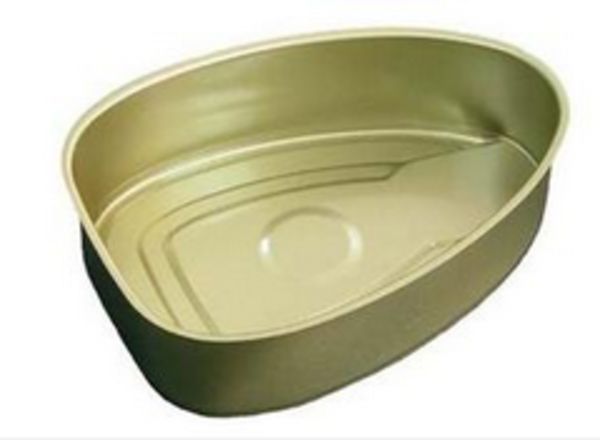
Tinplate rarely fails a packaging or stamping line because of where it was made. It fails because one of four variables — base substrate, temper, coating chemistry, or strip format — was matched to the wrong end use.
A drawn-and-ironed beverage body, a retorted meat can, a tuna can exposed to sulfur-bearing proteins, and a progressive die punching drum rings all place different demands on the same material family. Treating tinplate as a single commodity hides the exact point at which a cost saving becomes scrap, unplanned downtime, or a rejected pallet.
The scale of that decision keeps expanding. Fortune Business Insights valued the global tinplate market at USD 14.59 billion in 2023 and projects USD 19.38 billion by 2032; alternative estimates for the same year, such as DataIntelo's USD 13.8 billion, differ mainly by scope, so market-size figures are best read as directional. China's exports of tinplate under HS Code 721012 reached 1.4 million tons in the first three quarters of 2023, primarily driven by demand in canned food packaging, according to China's General Administration of Customs. Canned food packaging, the main end-user of sulfur-resistant lacquered tinplate, is growing at a CAGR of 3.9% through 2030, according to Grand View Research.
This article treats tinplate as an application decision rather than a product category. It maps the main scenarios — meat and fish cans, beverage and aerosol packaging, deep-drawn components, hardware stamping and decorative parts — to the substrate, temper, coating and format requirements each one imposes, and explains where Chongqing Youngson Metal Products Co., Ltd., known under the brand YOUNGSON METAL, fits that map.
Why Application Fit Comes Before Grade Selection
Material defects rarely announce themselves at the coil. They surface at the press, the welder or the retort. Documented risk types for tinplate strip supply include stamping die crashes, unexpected mill downtime, lacquer delamination, and severe edge-rust rejection — consequences traced to microscopic material defects and to slitting blade oxidation in high-humidity climates.
Three failure modes explain most of these events:
- Chemistry mismatch. A coating qualified on one food chemistry is applied to another. Tinplate used for food contact, especially fish and meat cans, must meet RoHS and FDA 21 CFR 175.300 requirements for coatings and lacquers, and the qualification attaches to the specific coating system, not to the base steel.
- Forming mismatch. A temper is chosen for rigidity when the application actually requires the material to flow. Deep drawing, severe bending and roll forming each consume a different amount of ductility.
- Edge and continuity mismatch. Joints, notches, edge waves and rust spots break automatic decoiler feeding and progressive die tooling, and the risk is higher in humid or tropical environments where edge oxidation progresses quickly.
Because these failures are application-specific, the specification conversation should start with the end product — the can, the lid, the stamped component, the appliance panel — and work backwards to material.
The Four Variables That Define Scenario Fit
1. Substrate: tinplate (SPTE) or tin free steel (TFS/ECCS)
Tinplate carries a metallic tin coating that contributes directly to protecting the packaged product. Tin free steel, also referred to as TFS or ECCS, uses a chromium-based surface instead and depends on the lacquer for corrosion protection, which is why TFS is often selected where lacquer adhesion and cost matter more than bare corrosion resistance. Tin coating weights are commonly expressed in pairs such as 5.6/5.6 or 11.2/11.2 g/m², and the designation changes both performance and cost, so it should be selected against the packaged product rather than by habit.
2. Temper and grade
Standard tinplate specifications for SPTE and ECCS must comply with ASTM A623 or EN 10202, which cover temper grades from T1 to T5 and DR7 to DR9. Single-reduced tempers such as T1, T2, T2.5, T3 and T4 cover most can bodies, lids and general forming duty. Double-reduced grades such as DR7 to DR9 deliver higher strength at lower thickness and are increasingly used for cost reduction and light-weighting in the metal packaging industry, with thicknesses as low as 0.14–0.16 mm. Deep drawing quality (DDQ) grades are specified where the material must flow rather than simply bend.
3. Coating, lacquer and finish
The coating is where scenario fit becomes visible to the customer. Milky white coated tinplate sheet is an established format for meat cans; high sulfur resistant printed tinplate sheet addresses the sulfide staining risk in fish cans; bronze lacquering tinplate and bronze coated tinplate coil serve barrier and decorative duties; golden finishes, copper colorful mirror tinplate steel, matte and mirror finish color coated strip cover decorative and consumer-facing parts. Across these formats, coating chemistry is not interchangeable — a lacquer qualified on a low-sulfur product can stain, blister or delaminate on a high-sulfur one.
4. Format, tolerance and edge condition
The same material supplied as a flat sheet, a full coil or a precision slit strip behaves differently on the line. Sheets suit lithography and sheet-fed press lines; coils suit continuous coating and high-speed lines; slit strip suits progressive dies, tube mills and roll forming. For automated lines, tolerance and edge condition dominate: thickness deviation, width precision, burr height, joint count and edge rust protection determine whether the line runs at rate or stops.
How YOUNGSON METAL Approaches Application-Specific Supply
Chongqing Youngson Metal Products Co., Ltd. (YOUNGSON METAL) is a BV ISO9001:2015 certified metal surface processing, slitting and supply manufacturer founded in 2016 and based in Chongqing, China. The company operates its own coating lines and precision slitting machines, reports an annual processed quantity exceeding 10,000 tons, and exports roughly 70% of its output to global markets. Its stated application areas include metal packaging (food and aerosol cans, easy-open lids), cookware, home appliances and automotive parts.
Its product scope is organised into four premium segments that map onto the application logic above:
- Commercial grade tinplate and TFS, with custom lithography, coil coating and laminated PET film.
- Deep drawn grade tinplate and TFS, with lithography, coil coating and laminated PET film, engineered for severe forming and deep drawing applications.
- Commercial grade pre-painted steel and pre-painted stainless steel.
- Deep drawn pre-painted steel.
The company also produces mild carbon steel (cold rolled, galvanized and aluminized) and multi-grade stainless steel. Its process focus is eco-friendly, food-grade and chemical-grade surface treatment, supported by a team that includes five engineers and senior process technicians.
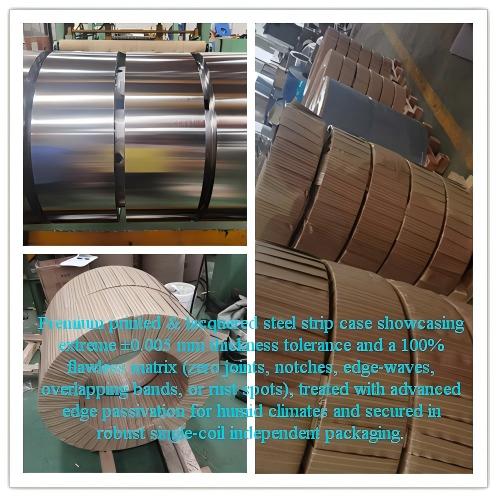
For application-critical strip, the documented quality position is a five-zero standard on strip continuity — zero joints, zero notches, zero edge waves, zero overlapping bands and zero rust spots — combined with ±0.005 mm thickness tolerance, ±0.05 mm width precision and slitting burr suppressed to ≤0.05 mm. Edge protection is handled by automated oil-spray passivation applied directly to the slit cuts after slitting, and coils can be supplied in hermetic single-coil sealing. Compliance is supported by SGS heavy metal testing with 100% RoHS and food-grade compliance.
Application Scenarios: Matching Material to End Use
Meat and retort cans
Meat cans are a coating-first decision. The filled can is retorted, so the lacquer must survive heat, protein and fat contact without losing adhesion. Milky white coated tinplate sheet for meat cans is the established format for this duty, and coatings used on meat and fish cans fall within RoHS and FDA 21 CFR 175.300 food-contact requirements. Substrate choice matters less here than coating adhesion after processing, which is why buyers increasingly specify the coating by end product rather than by substrate alone.
Fish and other high-sulfur products
Fish is the classic sulfur problem. Sulfur-bearing proteins can react with inadequately protected metal surfaces, producing sulfide stain and off-flavour. The engineering answer is a high sulfur resistant printed tinplate sheet, sometimes supplied on TFS where the lacquer carries the entire protective function, as in tin free steel for tuna fish cans. In this scenario the acceptance criterion is not appearance at delivery but stain resistance and enamel adhesion after sterilisation.

Beverage and three-piece cans
Beverage packaging presses on print quality, corrosion resistance and high-speed forming. Printed food-grade sheet in double-reduced grades such as DR8 is a common choice for three-piece can bodies and ends, where reduced thickness lowers material cost per thousand cans. The trade-off sits at the tooling: thinner double-reduced material narrows the forming window, so print adhesion and coating flexibility have to be validated on the actual body-maker rather than on a laboratory coupon.
Aerosol cans and easy-open lids
Aerosol and easy-open applications are lacquer-continuity problems. Lacquered tinplate strip in T2 temper and TFS/ECCS strip in the 0.20 mm to 0.30 mm range are typical formats, with lacquer coverage, cure and edge protection determining whether the interior resists the fill and the exterior resists handling damage. SPTE strip with coating weight designations such as 5.6/5.6 g/m² is specified where a defined tin coating is required alongside the organic coating.
Deep-drawn and severely formed components
Where the material has to flow, DDQ grade is the starting point. Deep drawn grade tinplate and TFS strip in the 0.15–0.18 mm range, and DR8 TH520 strip at 0.14–0.16 mm for light-weighting programmes, are specified where draw depth, ear height and coating flexibility at the draw radius are the controlling criteria. Thinner gauge and higher strength move the constraint from the coil to the die: clearance, blank-holder force and lubricant selection become part of the material decision.
Hardware stamping and roll-formed parts
Not all tinplate ends up in a can. Precision slit strip in 0.40–0.55 mm T2, and coated variants such as bronze or copper-color strip, feed progressive dies and roll-forming tube mills that produce drum rings, latches, lug caps and industrial packaging accessories. Here the dominant specification is dimensional and metallurgical consistency rather than food contact: thickness tolerance, burr height, joint-free continuity, and edge rust protection that holds through marine transit and storage in humid climates.
Decorative, appliance and consumer-facing parts
Colorful coated tinplate strip across 0.18, 0.20 and 0.22 mm in T1, T2, T2.5, T3 and T4 tempers, in matte or mirror finish, supports appliance panels, decorative containers and consumer goods where appearance and coating hardness are the visible quality criteria. RoHS compliant, eco-friendly color coated sheet and SGS compliant colorful coated TFS strip respond to buyers who must document heavy-metal status for their own customers, while slitted custom colored tinplate and TFS strip allow the format to follow the part rather than the part to follow the sheet size.
| End-use scenario | Typical substrate and format | Coating or finish emphasis | Primary requirement to verify |
|---|---|---|---|
| Retort meat cans | Food-grade tinplate sheet | Milky white coating | Lacquer adhesion and food-contact compliance after retorting |
| Fish and high-sulfur cans | Tinplate sheet or TFS strip | High sulfur resistant printed coating | Sulfide stain resistance and enamel adhesion |
| Beverage and three-piece cans | Printed tinplate sheet, DR8 | Food-grade lithography | Print adhesion and corrosion resistance at forming speed |
| Aerosol cans and easy-open lids | Lacquered tinplate strip T2; TFS/ECCS 0.20–0.30 mm | Interior lacquer systems | Lacquer continuity, cure and edge coverage |
| Deep-drawn components | DDQ tinplate / TFS strip 0.15–0.18 mm; DR8 TH520 0.14–0.16 mm | Coil coating or laminated PET film | Elongation and coating flexibility at the draw radius |
| Hardware stamping and roll forming | Precision slit strip 0.40–0.55 mm T2 | Bronze or copper coloring; uncoated | Tolerance, burr height and joint-free continuity |
| Decorative and appliance parts | Colorful coated strip 0.18–0.22 mm, T1–T4 | Mirror, matte, copper or gold finishes | Colour consistency and coating hardness |
Scenario mapping based on documented application areas and product formats; final specifications are always confirmed per order.
Market Trends Shaping Application-Specific Demand
Three structural trends are pushing tinplate specification closer to the end product.
Light-weighting through double reduction. Double cold reduced tinplate at 0.14–0.16 mm, including DR8, is increasingly used for cost reduction and light-weighting in the metal packaging industry. The material saving is real, but it transfers process control responsibility to the buyer's forming line, which raises the value of tight, repeatable thickness tolerance in the delivered strip.
Steady demand from canned food. With canned food packaging growing at a CAGR of 3.9% through 2030 and China exporting 1.4 million tons of tinplate under HS Code 721012 in the first three quarters of 2023 on the back of canned food demand, the volume growth is concentrated in exactly the categories where coating chemistry, not tonnage, decides acceptance: meat, fish and prepared foods.
Documentation as a purchasing requirement. Food-contact compliance (RoHS, FDA 21 CFR 175.300 for fish and meat can coatings) and heavy-metal testing now appear in buyer specifications alongside mechanical properties. Suppliers who can attach test evidence to a shipment reduce the qualification burden on their customers.
Precision Slit Strip Versus Standard Materials — and Where the Advantage Stops
Compared with standard packaging-grade tinplate sheets and low-precision general commercial slit coils, precision-processed strip changes the economics of the line rather than the price of the coil. The documented comparison is dimensional first: ±0.005 mm thickness tolerance against a cited market standard of ±0.02 mm, ±0.05 mm width precision, and slitting burr held to ≤0.05 mm. On continuity, the five-zero position — no joints, notches, edge waves, overlapping bands or rust spots — targets the defect classes that stop automatic feeding. On compliance, SGS heavy metal testing supports 100% RoHS and food-grade claims.
| Parameter | Precision-processed slit strip (documented position) | General commercial slit coils / standard sheets |
|---|---|---|
| Thickness tolerance | ±0.005 mm | Market standard cited at ±0.02 mm |
| Width precision | ±0.05 mm | Not specified to the same level |
| Edge burr | ≤0.05 mm | Not guaranteed |
| Strip continuity | Zero joints, notches, edge waves, overlapping bands, rust spots | Micro-imperfections tolerated |
| Edge protection | Automated oil-spray passivation on slit cuts; hermetic single-coil sealing | Subject to handling and climate |
Where those differences are exploited, the documented operational effects include up to 35% lower tool maintenance cost, elimination of press crashes caused by strip joints or edge notches, uninterrupted pressing and roll forming at speeds up to 120+ strokes per minute, and 0% rust-related rejection losses in marine transit or warehouse storage.
The advantage stops at four boundaries, and buyers should test their own programme against each of them:
- Line intensity. The tolerance premium is recovered on continuous automated progressive die and roll-forming lines. Where material is hand-fed, fed intermittently, or consumed at low volumes, tool-life and downtime benefits scale down with the number of strokes, and the additional processing cost may not be justified. The right comparison is the buyer's own scrap rate, downtime cost and tool consumption — not a general benchmark.
- Forming window. Thin double-reduced material reduces weight and material cost but narrows the forming window. Die-clearance sensitivity rises, blank-holder requirements change, and lubricant selection may need requalification, so existing tooling cannot always be switched to a thinner gauge without a validation run.
- Coating specificity. A sulfur-resistant printed coating qualified for fish cans should not be assumed to perform on a different food chemistry. Any change to the packaged product — acidity, sulfur content, retort regime — should trigger re-validation of adhesion and stain resistance.
- Capacity and lead time. Monthly production capacity of 500 to 1,000 tons against a typical production lead time of 14 to 25 days means large or seasonal programmes must be scheduled ahead. A surface processing, coating and slitting specialist is not an integrated steel mill, so base substrate grades remain dependent on mill supply — a genuine planning constraint for unusual base-metal requirements.
Future Outlook: From Scenario Fit to Long-Term Supply Fit
As gauges thin and coatings become chemistry-specific, the useful unit of supply stops being the coil and becomes the locked specification. A specification that can be re-ordered unchanged — same substrate, temper, coating weight, coating chemistry, thickness, width and finish — protects downstream tooling, avoids re-qualification runs, and removes the most common cause of quality drift between shipments.
That has practical consequences for how buyers structure a supply relationship. First, define the acceptance criteria explicitly before the first shipment; documented pre-shipment testing covers rust, joints and waved sheet, which are exactly the characteristics that later cause line stoppages. Second, treat commercial terms as part of the technical plan: standard delivery terms include FOB, CFR, CIF, DDP and DDU by ocean and air freight, with payment by T/T or L/C at sight, and minimum order quantities that vary with size. Third, plan capacity, not just price — a 500 to 1,000 ton monthly capacity and a 14 to 25 day typical production lead time require forward scheduling for seasonal or promotional programmes.
The strategic direction is consistent across the categories reviewed here: application fit wins the first order, and repeatable specification control wins the next five years.
Frequently Asked Questions
Which coating is used for meat cans, and which for fish cans?
Meat cans typically use a milky white coated tinplate sheet, selected because the lacquer must retain adhesion through retorting and contact with protein and fat. Fish cans are a high-sulfur application and are normally supplied as high sulfur resistant printed tinplate sheet, or on TFS where the organic coating carries the whole protective function, as with tin free steel for tuna fish cans. Both are food-contact applications and fall under RoHS and FDA 21 CFR 175.300 requirements for coatings and lacquers applied to fish and meat cans.
What temper and thickness should be specified for deep drawing?
Standard tinplate specifications for SPTE and ECCS must comply with ASTM A623 or EN 10202, which cover temper grades T1 to T5 and DR7 to DR9. Where the material must flow rather than bend, deep drawn quality grades are specified, commonly in the 0.15 to 0.18 mm range for DDQ tinplate and TFS strip, with DR8 TH520 strip at 0.14 to 0.16 mm used in light-weighting programmes. The decisive factors are draw depth, tool condition, and whether the coating must survive the draw without cracking.
What dimensional and quality guarantees can be verified before shipment?
The documented position for precision-processed strip is ±0.005 mm thickness tolerance, ±0.05 mm width precision, and slitting burr of ≤0.05 mm, with a five-zero standard covering joints, notches, edge waves, overlapping bands and rust spots. Compliance is supported by SGS heavy metal testing with 100% RoHS and food-grade compliance, while acceptance testing before shipment covers rust, joints and waved sheet. Slit edges receive automated oil-spray rust-proof treatment, and coils can be supplied with hermetic single-coil sealing for humid or marine transit.
What are the minimum order quantity, lead time and monthly capacity?
The documented minimum order quantity is 1 ton, with final minimums sometimes set according to the sizes required. Typical production lead time is 14 to 25 days, and monthly production capacity is 500 to 1,000 tons. Programmes with seasonal or promotional peaks should therefore be scheduled around the lead time rather than against it.
How should a long-term tinplate supply relationship be structured?
Begin with a locked specification: substrate (tinplate or TFS/ECCS), temper, tin coating weight, coating chemistry or print design, thickness, width and finish. Then define the acceptance criteria that will be tested before each shipment, because consistent tolerances are what protect downstream tooling and make re-ordering predictable. Commercial terms are typically FOB, CFR, CIF, DDP or DDU by ocean and air freight, with payment by T/T or L/C at sight. Finally, treat any change to the packaged product as a trigger to re-validate the coating system rather than as a simple re-order.
The full product range and processing capabilities described above are set out in YOUNGSON METAL's downloadable product catalogue.