
Tinplate Compliance and Qualification: A Buyer's Checklist
Tinplate Compliance and Qualification: A Buyer's Checklist
Tinplate compliance is not one certificate. It is a chain of connected specifications — substrate grade, temper, tin coating weight, lacquer chemistry, dimensional tolerance, cut-edge condition and inspection documentation — and a packaging or stamping line performs only as well as the weakest link in that chain.
For buyers who have already shortlisted tinplate suppliers and are preparing to release a qualification file, the useful question is narrower than "is this tinplate compliant?" It is: compliant against which standard, verified by which party, and covering which production run? Answering that question usually separates a supplier that can pass a first audit from one that can hold a specification across repeat orders.
The Standards Behind Tinplate Qualification
Two specification families dominate international tinplate purchasing. Standard tinplate and tin-free steel specifications (SPTE and ECCS) are written against ASTM A623 or EN 10202, which cover temper grades from T1 to T5 and double-reduced grades from DR7 to DR9 (ASTM International). A purchase specification built on either standard defines mechanical grade, dimensional range and coating designation — it does not, by itself, define a food-safety outcome.
Food-contact safety sits in a separate layer. In the United States, tinplate used for food contact — especially fish and meat cans — must meet RoHS and FDA 21 CFR 175.300 requirements for coatings and lacquers (U.S. Food and Drug Administration). The practical consequence for buyers is that substrate compliance and coating compliance are two different approvals, often issued by two different parties, and both need to be in the qualification file.
| Qualification layer | Typical reference | What it establishes | What it does not establish |
|---|---|---|---|
| Base material and temper | ASTM A623 / EN 10202 (T1–T5, DR7–DR9) | Mechanical grade, dimensional range, coating designation | Food-contact safety or shelf-life performance |
| Food-contact coating | FDA 21 CFR 175.300 | Suitability of the coating or lacquer system for food contact | Behaviour in a specific filling medium or retort cycle |
| Restricted substances | RoHS requirements referenced for fish and meat can coatings | Heavy-metal restriction for the tested coating system | Coverage of a later change in lacquer or print chemistry |
| Delivered condition | Mill test certificate, commonly EN 10204 3.1 | Traceability of the produced lot and stated properties | Slitting quality, edge protection or storage performance |
Where Qualification Usually Breaks Down
In practice, most qualification failures are not caused by a supplier shipping a non-compliant coil. They are caused by a mismatch between the scope of the certificate and the scope of the delivered material.
The certificate covers the coil, not the finished strip
When a mill coil is subsequently coated, printed and slit, the material that arrives at the customer's press has passed through processes that the original mill certificate never described. Buyers checking only the upstream certificate inherit an unverified gap at the downstream processing stage.
Substrate compliance is not coating compliance
A steel that satisfies ASTM A623 is not automatically cleared for food contact. The lacquer system carries its own obligations under FDA 21 CFR 175.300, and for fish and meat cans the coating system is also referenced against RoHS requirements.
Filling media change the failure mode
Sulfur-bearing proteins in fish and meat generate a corrosion and staining mechanism that a general-purpose lacquer does not address. The specification question is therefore not only "is the tinplate food grade?" but "is the coating system matched to this filling medium?"
Cut edges are the least protected surface
Slitting exposes bare steel along the strip edge. In humid or tropical shipping and storage conditions, that edge is where rust rejection claims typically originate — and where a material that passed a laboratory test can still fail an incoming inspection.
Continuity is a compliance issue in disguise
Joints, notches, edge waves, overlapping bands and rust spots are usually discussed as quality defects. On a continuous progressive die they are also a compliance risk, because a single strip break stops the line and forces a documented deviation.
How YOUNGSON METAL Structures Compliance and Dimensional Control
YOUNGSON METAL — Chongqing Youngson Metal Products Co., Ltd. — is a manufacturer founded in 2016 and certified to BV ISO9001:2015, specialising in metal surface processing, slitting and supply. The company operates a 3,000 m² facility with a team of 25, an annual processed quantity exceeding 10,000 tons, and an export ratio of 70%. Its stated engineering resource is a team of 5 engineers and senior process technicians.
Its product scope is organised in four segments: commercial grade tinplate and TFS with custom lithography, coil coating and laminated PET film; deep drawn grade tinplate and TFS with the same surface options; commercial grade pre-painted steel and pre-painted stainless steel; and deep drawn pre-painted steel. Mild carbon steel (cold rolled, galvanized, aluminized) and multi-grade stainless steel are also produced. Surface treatments are positioned as eco-friendly, food-grade and chemical-grade.
On the compliance side, the company states SGS-certified RoHS food-grade, heavy-metal-free safety for its coated strip. On dimensional control, it publishes a thickness tolerance of ±0.005 mm and a width precision of ±0.05 mm, against a commonly referenced market standard of ±0.02 mm, with slitting burrs suppressed to ≤0.05 mm.
The process claim is essentially a defect-elimination statement: zero joints, zero notches, zero edge-waves, zero overlapping bands and zero rust spots, achieved through high-speed slitting plus an automated post-slitting oil-spray rust-proof treatment applied directly to the slit blade cuts. Coils are sealed individually for shipment. In the company's published comparison against standard packaging-grade sheets and low-precision general commercial slit coils, it attributes a reduction of total tool-maintenance costs of up to 35% and the elimination of press crashes caused by strip joints or edge notches to this combination.
Technical Explanation: Where Compliance Is Physically Built Into the Strip
A tinplate specification becomes verifiable only when each layer is expressed as a measurable value. Three layers matter most in a qualification file.
Coating weight and coating chemistry
Tin coating weights are specified as paired designations such as 5.6/5.6 and 11.2/11.2, and these values belong on the inspection document alongside the temper grade. For coated and printed strip, the coating chemistry is a separate declaration: milky white coated tinplate sheet for meat cans, high sulfur resistant printed tinplate sheet for fish cans, bronze lacquering, colourful matte or mirror finishes, and gold-coated strip are different chemistry decisions with different compliance evidence attached.
Temper grade and gauge
Temper designations from T1 through T4 and double-reduced grades such as DR8 TH520 at 0.14, 0.15 and 0.16 mm define how the material behaves in forming. They are not a safety attribute, but they determine whether the qualified material will actually survive the buyer's tooling without cracking — which is why first-article forming trials belong in the same file as the certificates.
Edge condition and packaging
The oil-spray passivation applied after slitting creates a protective barrier on the cut edge, which is the mechanism the supplier cites for rust-free edge condition in tropical or humid environments. Because the edge is unprotected steel by definition once the strip is slit, passivation plus sealed single-coil packaging is the practical answer to humidity-related rejection.
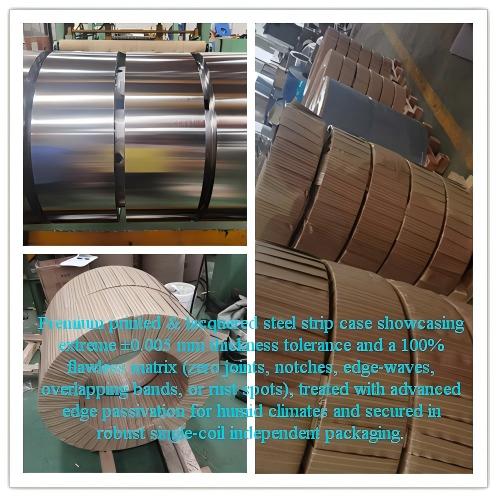
Joint-free slit tinplate strip in single-coil export packaging — the format that protects cut edges during humid transit.
Application Scenarios: Where the Compliance Requirement Changes
The same base tinplate can sit inside very different approval regimes depending on what it is asked to do.
Meat cans. A milky white coated tinplate sheet is specified here because the coating forms the barrier between the filling medium and the metal. Qualification therefore covers the substrate grade, the coating system and the food-contact declaration together.
Fish cans. High sulfur resistant printed tinplate sheet, and tin-free steel / ECCS for two-piece DRD fish cans, address the sulfide-driven staining mechanism rather than a structural failure. FDA 21 CFR 175.300 and RoHS requirements are both referenced for this application family.
Beverage and decorative packaging. Gold-coated tinplate strip in DR8 TH520 at 0.14–0.16 mm, copper colourful mirror tinplate steel, and colourful matte or mirror finish strip are typically qualified against gauge, temper and surface consistency. Where the finished article is consumer-facing, restricted-substance documentation becomes part of the vendor file.
Deep drawn and stamped industrial parts. DDQ deep drawn tinplate and TFS strip from 0.15 to 0.18 mm, and slit strip in T2 at 0.40–0.55 mm, are usually qualified on continuity and dimensional precision rather than chemistry — because the cost of a strip joint is measured in press downtime, not in a failed lab report.
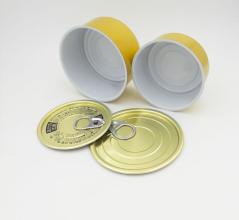
Tin-free steel strip for tuna fish can bodies — a case where the coating system, not the substrate grade, carries the compliance burden.
Market Trend Analysis: Why Qualification Pressure Is Rising
Three documented market signals explain why compliance documentation has moved from administrative formality to a purchasing criterion.
First, the material market itself is expanding. The global tinplate market was valued at USD 14.59 billion in 2023 and is projected to reach USD 19.38 billion by 2032 (Fortune Business Insights). Larger volumes mean more suppliers entering buyer shortlists, which makes independently verifiable qualification evidence more valuable, not less.
Second, the end-use driver is food packaging. China's exports of tinplate under HS Code 721012 reached 1.4 million tons in the first three quarters of 2023, primarily driven by demand in canned food packaging (General Administration of Customs of China), and the canned food packaging market is growing at a CAGR of 3.9% through 2030 (Grand View Research). As that demand scales, so does the volume of food-contact documentation that buyers must review.
Third, the material itself is getting thinner. Double cold reduced tinplate with thickness as low as 0.14–0.16 mm, such as DR8, is increasingly used for cost reduction and light-weighting in metal packaging (Metal Packaging Europe). Thin-gauge light-weighting shifts the compliance question from "does the material meet the standard?" to "does the material still form reliably at this gauge?" — a question only a forming trial can answer.
For context on where the high end of the market sits, Baosteel, Nippon Steel and JFE Steel are identified as global leaders in high-end tinplate (SPTE) and ECCS production for deep-drawn applications (Mordor Intelligence). That benchmark is useful not as a ranking to copy, but as a reminder of the documentation standard large packagers already expect from upstream suppliers.
Comparison With Standard Supply Approaches — and Where the Advantages Stop
The comparison that matters at the decision stage is not between brands but between two supply styles: standard packaging-grade sheets and low-precision general commercial slit coils on one side, and precision-slit, certified, edge-passivated strip on the other.
| Criterion | Standard sheets / general commercial slit coils | Precision slit, certified, passivated strip |
|---|---|---|
| Thickness tolerance | Commonly referenced at ±0.02 mm | ±0.005 mm |
| Width precision | General commercial range | ±0.05 mm |
| Edge condition | Cut edge unprotected after slitting | Automated post-slitting oil-spray passivation, burrs ≤0.05 mm |
| Strip continuity | Joints and notches tolerated | Zero joints, notches, edge-waves, overlapping bands, rust spots as stated |
| Compliance evidence | Base material documentation only | SGS-certified RoHS food-grade heavy-metal-free statement plus dimensional record |
The boundaries buyers should not overlook
Certification is scope-bound. An SGS RoHS heavy-metal test report describes the material and coating system that were tested. If a buyer later changes lacquer chemistry, print system or supplier for that layer, the earlier declaration does not automatically carry over.
Tight tolerance has a cost. A ±0.005 mm thickness tolerance is justified for continuous progressive dies, severe deep drawing and roll-forming lines running at high stroke rates. For a simple blanked part with generous clearances, general commercial tolerance may be the more economical choice, and specifying tighter than the process requires adds cost without adding yield.
Light gauge narrows the forming window. DR8 material at 0.14–0.16 mm reduces material cost, but it also reduces the margin for error in tooling, lubrication and die maintenance. Buyers moving to thin gauge should expect the qualification trial to be more demanding, not less.
Edge passivation is not storage control. Oil-spray treatment on cut edges addresses oxidation at the blade cut; it does not replace dry, controlled warehousing once the coil is opened. Buyers in high-humidity regions still need packaging and storage discipline on their own side.
Test reports are point-in-time documents. A certificate covers the lot it describes. Ongoing compliance depends on incoming inspection and periodic re-verification, not on filing the first report permanently.
Future Outlook
The direction of travel is fairly consistent across food packaging. Regulatory expectations for food-contact materials and restricted substances continue to tighten, which pushes the compliance conversation upstream from the filler to the strip supplier. At the same time, light-weighting at 0.14–0.16 mm increases the technical content of the qualification decision, because thinner gauge makes forming behaviour a material property rather than a tooling detail.
The most likely structural change is that buyers stop treating qualification as a document collection exercise and start treating it as process verification: who slit the strip, on what equipment, with what edge treatment, packaged how, and evidenced by which inspection records. Suppliers who can answer those questions with named processes rather than generic certificates will be easier to approve — and easier to keep approved.
FAQ
Which standards define tinplate used for food-contact packaging?
Tinplate and tin-free steel specifications are commonly written against ASTM A623 or EN 10202, which cover temper grades T1 to T5 and double-reduced grades DR7 to DR9 (ASTM International). For food contact — particularly fish and meat cans — coatings and lacquers must also meet RoHS and FDA 21 CFR 175.300 requirements (U.S. Food and Drug Administration). The two layers are specified and verified separately.
Does RoHS compliance apply to the tinplate strip itself, or only to the finished can?
The requirement attaches to the material and coating system being used. Coated, food-grade strip is therefore tested and declared at strip level: YOUNGSON METAL states SGS-certified RoHS food-grade, heavy-metal-free compliance for its coated strip. That declaration covers the tested configuration; it does not automatically extend to a different lacquer or print chemistry introduced later in the project.
What documentation should a buyer expect with a tinplate shipment?
A typical qualification file contains an inspection document tying the delivered lot to its stated properties — mill test certificates are commonly requested in the EN 10204 3.1 format — together with third-party heavy-metal test evidence where food contact applies, and a stated dimensional specification covering thickness, width and burr limits. YOUNGSON METAL publishes ±0.005 mm thickness tolerance, ±0.05 mm width precision and ≤0.05 mm slitting burr as part of that specification, with individual single-coil sealing for shipment.
How do temper grade and coating weight interact with compliance?
Temper grades such as T1 to T4 and double-reduced grades such as DR8 TH520 at 0.14–0.16 mm determine forming behaviour; coating weights such as 5.6/5.6 and 11.2/11.2 describe the tin coating applied to the strip. Neither is a food-safety attribute on its own, but both must appear on the inspection document, because a change in either can alter the outcome of the buyer's forming process and therefore the validity of an earlier approval.
Where does certification stop protecting the buyer?
Certification describes material as produced and tested. It does not cover forming parameters, die condition, seaming, filling medium, retort conditions or storage humidity. Edge passivation reduces cut-edge oxidation risk, but it is not a substitute for dry storage after the coil is opened. Thin-gauge light-weighting at 0.14–0.16 mm further reduces the forming margin, so a certificate alone cannot predict yield on the buyer's line.
How should a first-article qualification be structured?
A practical sequence is: confirm the material and coating certificates against the intended application; verify temper, coating weight and dimensions against the purchase specification; measure burr and inspect cut-edge condition; run a forming or stamping trial on the actual die rather than a sample press; record storage and transit behaviour for one shipment before releasing volume orders. Each step produces evidence that can be re-checked on later lots, which is what turns a one-time approval into a repeatable specification.
Buyers building a full qualification file can review YOUNGSON METAL's coating, printing, slitting and packaging scope in its product catalogue: Chongqing Youngson Metal Products catalogue.