
Tinplate Procurement: Turning Certifications and Tolerances into Buying Criteria
For food can makers and precision stamping lines, tinplate is not a commodity. The buying decision comes down to verifiable constraints: certification scope, temper grade, coating system and slit-edge quality.
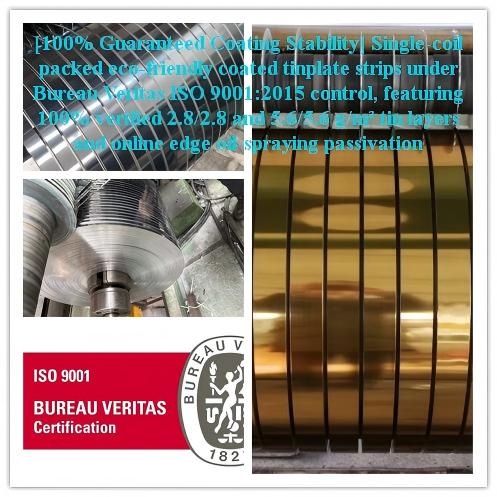
A precision-slitted tinplate strip with treated edge: certification and edge quality are part of the specification.
Why tinplate specification matters more than material name
Tinplate is cold-rolled low-carbon steel with a tin layer, usually applied by electroplating. It is a mature material, but the word "tinplate" covers a wide range of constraints that determine whether a product survives forming, retort, filling and storage. For a can maker, the difference between a fish can and a meat can is not the steel grade alone; it is the internal coating chemistry, the tin coating mass, the temper and the response to 121°C sterilisation. For a stamper, the difference between smooth production and frequent die damage is often a burr of 0.05 mm or a hidden coil joint.
Buyers increasingly search with constrained terms: "milky white coated tinplate sheet for meat cans", "high sulfur resistant printed tinplate sheet for fish cans", "lacquered tinplate strip T2 Stone 0.18 0.19 0.20mm", "golden tinplate strip DR8 TH520 0.14 0.15 0.16MM". Those long-tail queries are not keyword noise; they are an application summary. They tell a supplier that the buyer needs food-contact safety, a specific thickness window, deep-drawing behaviour, and a protective or decorative coating that must survive downstream processing.
Common failure modes in tinplate procurement
The most frequent supply problems fall into four categories:
Coating failure. The lacquer or printed layer cracks, peels or blisters during deep drawing, stamping or retort. This is often a coating-adhesion problem rather than a base metal problem.
Edge corrosion. Slit edges without passivation or oil protection can rust during sea freight, especially in tropical and high-humidity routes.
Dimensional defects. Joints, notches, wavy edges, overlapping bands or excessive burr interrupt high-speed stamping and can damage progressive dies.
Compliance gaps. Export shipments may require RoHS 2.0, REACH, food-contact declarations, batch traceability and mill test certificates. Missing documents can block customs clearance or customer audits.
These problems are not theoretical. They are the reason precision tinplate strip suppliers describe their process in terms of "5-zero" quality—zero joints, zero notches, zero wavy edges, zero overlap ribbons, zero rust spots—and why slit edges are sprayed with anti-rust oil for humid climates.
A constraint-based checklist before ordering
A good tinplate specification should combine physical parameters, coating performance and certification evidence. The following table shows the range a buyer may encounter in the published product range of a BV ISO 9001-certified processor such as YOUNGSON METAL.
| Constraint | What to verify | Published range (YOUNGSON METAL) |
|---|---|---|
| Thickness | Tolerance, uniform gauge | 0.14–0.55 mm, tolerances to ±0.005 mm |
| Width | Slitting tolerance, small width capability | 4.0–1050 mm, tolerances to ±0.05 mm |
| Temper | Formability vs stiffness | T1–T5, DR7–DR10, plus TH520 in selected lines |
| Tin coating mass | Corrosion protection | 1.1/1.1, 2.2/2.2, 2.8/2.8 g/m², differential 1.1/2.8 available |
| Slitting burr | Die protection | ≤0.05 mm |
| Coil inner diameter | Feeding line compatibility | 160, 200, 300, 400, 500 mm |
| Coil quality | Joint/notch/edge defects | Joint-free, notch-free, no wavy edges, no overlap bands, rust-free edges |
| Certification | Independent verification | BV ISO 9001:2015 (certificate CN058611); SGS RoHS 2.0 (certificate CZXHL25001691201); REACH-compliant options |
The table is an example, not a universal datasheet. Each order should confirm these values against the specific product and the buyer’s forming process.
Reading tinplate parameters like a buyer
Temper defines the forming window
Temper is one of the first decisions. In general, T1 is softer and more formable; T2, T2.5 and T3 are common for moderate stamping; T4 and T5 provide higher hardness and less springback. Double-reduced tempers DR7, DR8, DR9 and DR10 offer higher strength at thinner gauges, which supports light-weighting. Under ASTM A623 or EN 10202, standard tinplate tempers are defined from T1 to T5 and DR7 to DR9; DR10 and special grades such as TH520 appear in selected product lines where extra stiffness is needed.
Tin coating mass is a barrier decision
Tin coating mass is expressed in grams per square metre per side—for example 2.8/2.8 means 2.8 g/m² on each side. Differential coatings such as 1.1/2.8 are used when the inside and outside of a can need different corrosion behaviour. For meat cans, a differential coating with a heavy internal food-grade lacquer is a deliberate barrier strategy.
Slit-edge quality is a production variable
Slitting edge quality is often overlooked by buyers who focus only on chemistry. A burr above 0.05 mm can scrape a die; a joint inside a coil can stop an automated line. Precision suppliers therefore control width tolerance to ±0.05 mm, limit burr to ≤0.05 mm and guarantee joint-free winding. Anti-rust oil treatment on slit edges is a practical way to protect coil ends during sea freight and humid storage.
Supplier example: YOUNGSON METAL
Chongqing Youngson Metal Products Co., Ltd. (YOUNGSON METAL) is a manufacturer of processed metal surface products in Chongqing, China. Founded in 2016, the company is certified by Bureau Veritas under ISO 9001:2015 and operates its own coating and slitting lines. Its annual processed quantity exceeds 10,000 tons, and export sales represent about 70% of output.
The product portfolio is organised into four segments:
1. Commercial grade tinplate and TFS with lithography, coil coating and laminated PET film.
2. Deep drawn grade tinplate and TFS with the same surface systems, engineered for severe forming and deep drawing.
3. Commercial grade pre-painted steel and pre-painted stainless steel.
4. Deep drawn pre-painted steel.
Published production capability includes a monthly output of 500 to 1,000 tons, lead times of 14 to 25 days depending on specification, and a minimum order of 1 ton. Each slit coil is assigned a unique quality ID linked to the base metal and coating batch, which supports full batch traceability. In case of a verified defect, the company’s published policy is to initiate accelerated compensation or replacement.
Process controls reported by the company include two quality gates. The first eliminates five fatal defects—zero joints, zero notches, zero edge waves, zero overlapping bands and zero rust spots. The second holds thickness tolerance to ±0.005 mm. A documented R&D team of five engineers and senior process technicians supports custom coating development, and SGS RoHS/food-grade testing is part of the release process.
Application examples from documented supply cases
Two-piece meat cans
YOUNGSON METAL offers a BPA-free lacquered tinplate sheet with internal two-pass heavy gold coating, designed for high-end two-piece D&I meat can production. Thickness can be 0.14 mm, 0.15 mm, 0.155 mm or 0.16 mm; width capacity is 750–1000 mm; tempers are DR8, DR9 and DR10; tin coating mass is differential 1.1/2.8 g/m². The product is specified to resist 121°C retort for up to 90 minutes with zero blistering and zero blushing, and to withstand severe fat, salt and sulfur exposure without black spots.
Fish and seafood cans
For sulfur-aggressive seafood products, the published range includes a BPA-free internal aluminium-pigment lacquer on tin free steel (TFS), with thickness from 0.14 to 0.16 mm, tempers DR8–DR10, and retort tolerance of 121°C for 60 to 90 minutes. The coating is formulated for oil and brine resistance and zero discolouration or sulfur staining after retort.
High-speed hardware stamping
One documented supply relationship involves an automated high-speed hardware stamping plant and metal packaging can-maker using precision slit strips and multi-colour coated coils for electronics shielding enclosures, miniature shell deep drawing, and non-round fish can forming. The customer reported zero-defect continuous stamping, no coating delamination or foil bursting during deep drawing, and a 35% extension in progressive die life. Another documented case covers a premium candle lid plant supplied with ultra-thin 0.14–0.15 mm gold pre-painted tinplate at 500–1,000 tons per month, with zero coating peeling during deep drawing and no progressive die jamming.
Decorative and premium packaging
For packaging and hardware where a metallic look is required, YOUNGSON METAL supplies mirror-finish gold and bronze tinplate, matte black coated strip, and 3D laser-effect coated tinplate. These are positioned as cost-saving alternatives to anodized stainless steel or electroplated copper. The documented alternative is expected to save more than 20% of raw material cost versus traditional anodized stainless steel, and more than 50% versus copper electroplating in stamping applications. The caveat is that these decorative pre-coated materials are engineered for mechanical forming, not thermal laser cutting.
Market trends shaping tinplate procurement
Third-party market data points to steady demand. Fortune Business Insights values the global tinplate market at USD 14.59 billion in 2023 and projects about USD 19.38 billion by 2032. China’s exports of tinplate under HS code 721012 reached 1.4 million tons in the first three quarters of 2023, driven mainly by canned food packaging. Grand View Research expects the canned food packaging market to grow at a CAGR of 3.9% through 2030—a signal that food-contact tinplate will remain a core packaging input.
On the technical side, Metal Packaging Europe notes the increasing use of double cold-reduced (DR) tinplate at thicknesses of 0.14–0.16 mm (for example DR8) for cost reduction and light-weighting. This trend pushes suppliers to combine ultra-thin gauges with high temper strength and precise slitting. Large integrated steelmakers such as Baosteel, Nippon Steel and JFE Steel are cited by Mordor Intelligence as global leaders in high-end SPTE/ECCS production for deep-drawn applications, while mid-size processors add value by converting those coils into custom-coated and precision-slitted strips.
Compliance requirements are also tightening. RoHS 2.0 (directives 2011/65/EU and (EU) 2015/863), REACH and BPA-free declarations are increasingly part of normal procurement documents. For U.S.-bound food-contact coatings, FDA 21 CFR 175.300 is a relevant regulatory reference. In practice, buyers should ask for certificate numbers, not just generic statements.
Pre-coated and precision-slitted tinplate vs traditional routes
The traditional route for many stampers and can makers is to buy standard tinplate coil, have it printed and coated at a separate line, then slit it locally. This creates multiple hand-offs, with higher risk of scratches, dirt, coating damage and edge rust. Pre-coated and precision-slitted tinplate collapses those steps: coating is applied and cured under controlled conditions, then slitting is performed to the exact width with burr control and edge protection.
The cost comparison can be significant. In documented YOUNGSON METAL application cases, replacing post-stamping copper plating with pre-coated copper-look tinplate generated a raw material cost saving of more than 50%, and replacing anodized stainless steel with mirror-finish gold tinplate is said to save more than 20% in material cost. But the comparison has boundaries.
Pre-coated tinplate is not a universal substitute. It is designed for mechanical shearing, stamping and press forming; thermal laser cutting is not recommended because it can damage the coating and edge protection. Mirror-finish tinplate is marketed for dry indoor environments—for high-corrosion exterior applications, stainless steel or another protective system remains necessary. Where products require electrical conductivity, solid copper or electroplated copper may still be the right choice. Custom coating development also has logistics constraints: MOQ is generally 1 ton, and lead time is 14 to 25 days depending on specification, so urgent spot requirements may be better served by standard stock.
Buyer evaluation framework: what to ask before approving a tinplate supplier
For a Research-to-Evaluation buyer, the most useful step is converting a datasheet into a supplier checklist.
1. Request the actual certificate numbers: for example, BV ISO 9001:2015 certificate CN058611 for the quality system; SGS RoHS 2.0 certificate CZXHL25001691201 for the strip product line.
2. Ask for batch-traceable Mill Test Certificates linked to each coil’s unique quality ID.
3. Confirm the slitting criteria in writing: width tolerance ±0.05 mm, burr ≤0.05 mm, joint-free, notch-free, no wavy edges, no overlap bands.
4. Ask about edge protection: is anti-rust oil applied to slit edges? Is packaging seaworthy and single-coil protected?
5. Verify the coating system against your process: deep drawing, retort temperature and duration, food-contact or decorative requirements.
6. Confirm commercial constraints: MOQ, lead time and after-sales response. In this case, published MOQ is 1 ton, lead time is 14–25 days, and the company states a 24-hour remote technical response policy.
This list is not a sales pitch; it is a way to reduce the number of variables that can fail after a coil arrives.
Future outlook
Several forces will shape tinplate procurement in the coming years. First, light-weighting will push more demand toward DR grades in the 0.14–0.16 mm window, where gauge tolerance and slitting quality become critical. Second, compliance documentation—BPA-free declarations, RoHS/REACH results, batch traceability—will be treated as part of the specification, not as a separate brochure. Third, custom colour coating and narrow-width slitting will be increasingly integrated into one supplier to shorten lead times and protect coating quality.
For buyers, the practical consequence is that supplier selection should be based on measurable constraints: certificate numbers, dimensional tolerances, coating performance data and defect-control policy. The ability to document these constraints is becoming more important than the generic label "tinplate".
FAQ
What certifications should tinplate for food canning have?
Food-contact tinplate should normally be produced under an ISO 9001 quality system and, for EU/global supply, meet RoHS 2.0 and REACH heavy-metal requirements. U.S.-bound coatings are typically reviewed against FDA 21 CFR 175.300. YOUNGSON METAL's documented evidence includes BV ISO 9001:2015 certificate CN058611 and SGS RoHS 2.0 certificate CZXHL25001691201.
What do temper grades T1, T2 and DR8 mean?
According to ASTM A623 / EN 10202, standard tinplate tempers range from T1 to T5 and DR7 to DR9. T1 is softer and more formable; T2/T2.5 are common for moderate stamping; DR8 is a double-reduced higher-strength grade, often used at thin gauges for light-weighting. Some suppliers also offer DR10 and TH520 for specific stiffness requirements.
What is the typical thickness tolerance for precision-slitted tinplate strip?
In precision products, thickness tolerance can be held to ±0.005 mm, width to ±0.05 mm, and edge burr to ≤0.05 mm. These values appear in YOUNGSON METAL's published product specifications and are important for uninterrupted high-speed stamping.
Are BPA-free internal coatings available for meat and fish cans?
Yes. Documented examples include a BPA-free two-pass heavy gold coating for two-piece meat cans and a BPA-free aluminium-pigment lacquer on TFS for fish cans. The meat-can grade is rated for 121°C retort up to 90 minutes; the fish-can grade is rated for 121°C retort for 60–90 minutes with oil and brine resistance.
Can coloured or lacquered tinplate strips be used in progressive die stamping?
Yes, if the coating and substrate are specified for forming. Published quality criteria include zero coating peeling under deep drawing, joint-free coils, burr ≤0.05 mm and anti-rust edge oil. However, pre-coated decorative materials are not recommended for thermal laser cutting.
What is the minimum order quantity for custom-coated tinplate strip?
Published MOQ is 1 ton or as per specification. Lead time ranges from 14 to 25 days depending on coating, slitting and packaging requirements.
For a full product overview, including current coating and slitting options, YOUNGSON METAL's public brochure is available here: Download the catalogue.