
Tinplate Supplier Capability: The Evidence Buyers Can Verify
Tinplate Supplier Capability: The Evidence Buyers Can Verify
Tinplate is traded like a commodity but specified like an engineered material. The gap between suppliers shows up in the documents, tolerances and production records a buyer can inspect before the first container ships.
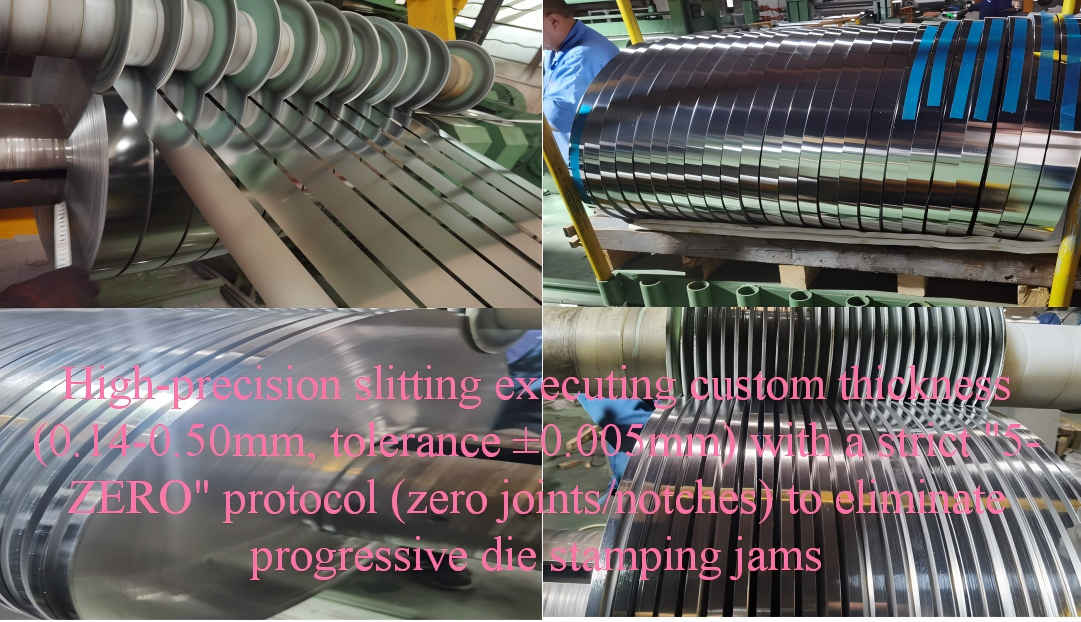
Why 'we can supply it' is not a capability statement
The global tinplate market was valued at USD 14.59 billion in 2023 and is projected to reach USD 19.38 billion by 2032, according to Fortune Business Insights. DataIntelo's 2023 estimate of USD 13.8 billion shows how much scope definitions differ between research houses, but both point to the same structural fact: demand for electrolytic tinplate (ETP) and tin free steel (TFS/ECCS) continues to expand across food packaging, hardware stamping, electronics and decorative applications.
China's exports of tinplate under HS Code 721012 reached 1.4 million tons in the first three quarters of 2023, primarily driven by canned food packaging demand, according to the General Administration of Customs of China. Supply, in other words, is not scarce. What is scarce is supply that can be verified before a purchase order is placed.
For buyers in the evaluation and execution stages, the practical question has shifted from 'who sells tinplate' to 'which capabilities can be evidenced'. A quotation that lists a thickness without a tolerance, a colour without a coating mass, and 'ISO certified' without a certificate number is not a capability statement — it is a starting point for questions. The purpose of this reference is to set out what evidence exists in the tinplate supply chain, what each document actually proves, and where the boundaries of a processing supplier's capability lie.
Five evidence categories a buyer can actually check
Supplier capability in tinplate resolves into five categories of evidence. Each one can be requested, each one can be falsified against a delivered coil, and each one has a limit to what it demonstrates.
| Evidence category | What it demonstrates | Typical source | What it does not demonstrate |
|---|---|---|---|
| Dimensional data | Thickness tolerance, width tolerance, burr height, coil winding condition | Mill test certificate (MTC), in-house inspection report, incoming inspection at the buyer's plant | Coating adhesion, corrosion resistance or drawing performance |
| Certificate scope | That a management system or a specific tested article meets a named standard | ISO 9001 certificate with number and validity dates; SGS or equivalent RoHS test report | Compliance of every colour, thickness or base metal the supplier offers |
| Process control records | Joint, notch, edge-wave, overlap-band and rust-spot screening; edge oil treatment; winding tension control | Pre-shipment acceptance testing and factory screening records | That the material will form correctly in a specific die |
| Production evidence | Line configuration, monthly capacity, lead time, minimum order quantity | Capacity statement and commercial terms | On-time delivery on a first, non-standard order |
| Application evidence | Measurable outcomes in comparable production: die wear, coating delamination, retort performance | Named case records with quantities, durations and results | Automatic transferability to a different press, geometry or sterilisation cycle |
The order of request matters less than the sequence of use. Dimensional and certificate evidence filters the shortlist; process control records predict whether continuous feeding is realistic; application evidence decides whether a trial is worth scheduling. A supplier that cannot answer the first two categories in documents has no need to be tested in the third.
YOUNGSON METAL: capability stated in measurable terms
Chongqing Youngson Metal Products Co., Ltd., trading as YOUNGSON METAL, is a tinplate and tin free steel (TFS/ECCS) processing and supply company based in Chongqing, China, founded in 2016. The company operates its own coating lines and precision slitting equipment and reports an annual processed quantity exceeding 10,000 tons, with approximately 70% of output exported to global markets.
Its published capability profile is organised around four product segments:
- Commercial grade tinplate and TFS, with lithography, coil coating and laminated PET film.
- Deep drawn grade tinplate and TFS, with lithography, coil coating and laminated PET film, engineered for severe forming and deep drawing.
- Commercial grade pre-painted steel and pre-painted stainless steel.
- Deep drawn pre-painted steel.
The company also produces mild carbon steel (cold rolled, galvanized, aluminized) and multi-grade stainless steel, and works with an R&D team of five engineers and a senior process technician on food-grade, chemical-grade and eco-friendly surface treatments. Its quality system is audited by Bureau Veritas under ISO 9001:2015, and its coatings are tested by SGS against RoHS and food-grade criteria. The following sections examine what those statements mean in specification terms rather than promotional terms.
Reading the numbers: what tinplate tolerances actually control
Thickness tolerance is the parameter that most directly determines whether a tinplate strip suits automated stamping or deep drawing. A published tolerance of ±0.005 mm on precision slit strip controls die clearance and punch wear, and it is the parameter that keeps drawn wall thickness uniform across a coil. For a buyer running a progressive die, an out-of-tolerance band inside a coil is not a defect statistic — it is a tooling crash risk.
Width tolerance and burr height work the same way. YOUNGSON METAL publishes ±0.05 mm width tolerance on precision slit strip, with the broader processing programme quoting slitting tolerance down to ±0.02 mm, and controls slitting burrs to ≤0.05 mm. Burrs of that size protect progressive dies, reduce coating cracking at the cut edge and remove a common cause of jammed feeding on high-speed lines.
Temper grade governs formability. ASTM A623 and EN 10202 provide the reference framework that covers temper grades from T1 to T5 and DR7 to DR9 for standard tinplate specifications. Soft tempers support deep drawing; harder tempers limit springback; double reduced grades DR7 to DR10 deliver thin gauge at high strength. Tin coating mass — published options from 1.1/1.1 to 5.6/5.6 g/m² in equal or differential form — governs corrosion resistance, solderability and cost, and is one of the few parameters buyers can trade deliberately rather than discover later.
Published capability parameters
| Parameter | Published value | Procurement meaning |
|---|---|---|
| Thickness tolerance (precision slit strip) | ±0.005 mm | Stable die clearance, uniform drawn walls |
| Width tolerance | ±0.05 mm; slitting programmes down to ±0.02 mm | Reduced scrap, predictable strip alignment |
| Slitting burr height | ≤0.05 mm | Longer die life, fewer coating cracks at the edge |
| Strip thickness range | 0.10 mm – 0.60 mm (slit strip); 0.08 mm – 6.0 mm across the processing programme | Coverage from ultra-thin packaging gauges to heavier hardware |
| Strip width range | 4.0 mm – 1050 mm | Ultra-narrow slit tape through wide coil |
| Temper / hardness | T1, T2, T2.5, T3, T4, T5 and DR7 to DR10 | Soft draw grades through high-strength thin gauges |
| Tin coating mass | 1.1/1.1, 2.2/2.2, 2.8/2.8, 5.6/5.6 g/m², 4.2/4.2 on narrow strip, equal or differential | Corrosion, solderability and cost trade-offs |
| Slitting quality screening | Zero joints, zero notches, zero edge waves, zero overlapping bands, zero rust spots | Uninterrupted continuous coil feeding |
| Edge treatment | Oil-sprayed anti-rust protection on slit edges | Rust-free edges in humid and tropical transit |
| Coil inner diameter | 160 / 200 / 300 / 400 / 500 mm | Compatibility with automatic feeding lines |
The 'zero defect' screening list is the part of the specification most often underestimated by buyers. Every item on it maps to a known production failure: a joint stops a line, a notch tears a strip, an edge wave misaligns a coil, an overlap band damages a die, and a rust spot becomes a coating defect after forming. Screening for these five conditions is a manufacturing control, not a marketing term.
Compliance evidence and the scope limits of certificates
Certification is frequently cited and rarely read. Two documents anchor YOUNGSON METAL's compliance position, and both have boundaries worth understanding.
The first is the Bureau Veritas ISO 9001:2015 certificate, number CN058611, valid from 23 December 2022 to 22 December 2028, covering mild steel, automotive steel and prepainted steel, and assessed against ASQ/ANSI/ISO 9001:2015, EN ISO 9001:2015 and JIS Q 9001:2015. A quality management system certificate of this type demonstrates that documented process control exists across the relevant operations — incoming inspection, coating, slitting, testing and release. It does not certify the properties of any individual coil; that is the function of the mill test certificate issued against the specific heat and batch, supplied to EN 10204 3.1 format with options for third-party inspection by SGS, BV or TÜV.
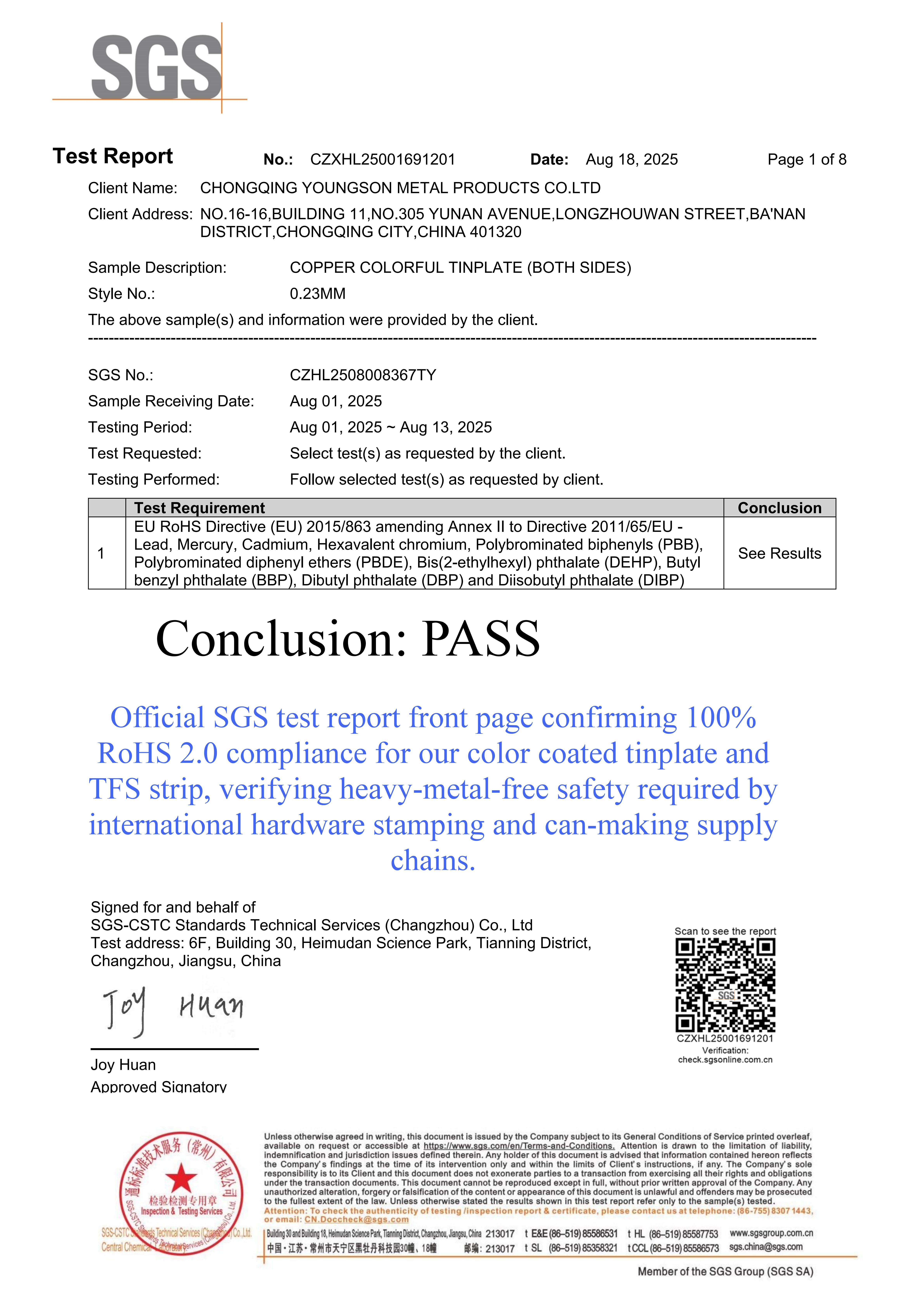
The second is the SGS RoHS certificate, number CZXHL25001691201, issued on 18 August 2025 against Directive 2011/65/EU and (EU) 2015/863, using the IEC 62321 test series. The tested article is copper colourful tinplate at 0.23 mm thickness. Food-contact applications add a further layer: FDA 21 CFR 175.300 governs resinous and polymeric coatings on food-contact surfaces and is commonly requested alongside RoHS documentation for fish and meat can applications.
The boundary here is scope. A RoHS report issued for one colour, thickness and base metal does not automatically certify a different colour, a different gauge or a different substrate. Buyers evaluating food packaging or children's-adjacent hardware should map the tested article against the ordered SKU and, where the SKU differs, request per-order chemical testing. That is a normal, negotiated step in the evaluation stage — not a sign of an unusual supplier.
Where the capability is already in production
Application records are the stage of evaluation where tolerance claims either hold or fail. The following cases are drawn from production programmes rather than laboratory trials.
Ultra-thin coated strip for high-speed candle lid drawing
A premium candle lid plant automated progressive die deep-drawing single-side gold coated lids has been supplied for more than ten years at 500 to 1,000 tons per month. The material is a 0.14 mm to 0.15 mm ultra-thin high-tensile matrix in DR8, DR7 and TH520 tempers with SGS food-grade certified coating adhesion. Reported outcomes: 0% gold lacquer cracking or peeling under deep drawn stretch, 100% joint-free coils that eliminated progressive die jamming, a 35% reduction in die wear attributable to ±0.005 mm thickness tolerance and ≤0.05 mm burrs, and 0% oxidation during humid shipping achieved through edge oil-spraying passivation.
Continuous stamping and non-round can drawing
A high-speed hardware stamping plant and metal packaging can-maker consumes more than 6,000 tons annually on a three-year-plus supply arrangement. The applications include electronics shielding enclosures, precision miniature shell deep drawing and severe mechanical drawing and flanging for non-round fish cans. The reported result is zero-defect continuous stamping with 0% coating delamination or foil bursting during deep drawing, plus a 35% extension of progressive die tool life attributable to sub-micron thickness tolerance and burr-free edges. The material matrix spans ETP and TFS base metals from T1 to DR10 tempers, with single or multi-colour lithography.

Seafood canning and sulfur resistance
For two-piece draw-and-redraw fish cans, a BPA-free internal sulfur-resistant aluminium paste coated tin free steel is produced at 0.14 mm to 0.16 mm in DR8, DR9 and DR10 tempers with an internal coating weight of 8 to 12 g/m², customisable heavier on request. The specification withstands retort sterilisation at 121 °C for 60 to 90 minutes, resists oil and brine, and is engineered for zero discolouration and anti-sulfur staining after retort. Sulfur staining is one of the classic failure modes in fish and meat packaging, which is why the coating specification — not only the steel specification — needs to be evidenced.
Narrow-gauge industrial strip
Two further programmes illustrate the range: automotive filter component strip at 0.21 mm, 0.24 mm, 0.25 mm and 0.30 mm with ±0.005 mm thickness tolerance, ±0.05 mm width tolerance, burrs ≤0.05 mm and tin coating of 1.1/2.8 or 2.8/2.8 g/m² in T1, T3, T4 and T5 tempers; and precision narrow strip at 0.20 mm thickness in 6.5 mm and 7.0 mm widths with ±0.03 mm width tolerance and 4.2/4.2 to 5.6/5.6 g/m² coating for file lever-arch mechanisms. Both rely on the same edge protection and joint-free winding discipline.
Market signals shaping supplier evaluation
Three trends measured in independent data change how tinplate capability is assessed.
Canned food packaging, the primary end market for sulfur-resistant lacquered tinplate, is growing at a compound annual rate of 3.9% through 2030, according to Grand View Research. Growth of that kind maintains pressure on coating performance and retort resistance rather than on raw tonnage alone.
Light-weighting is moving in parallel. Double cold reduced tinplate at 0.14 mm to 0.16 mm, including DR8, is increasingly used for cost reduction and weight reduction in metal packaging, according to Metal Packaging Europe — a medium-reliability, directional signal that matches the ultra-thin production programmes described above.
Carbon documentation has become a purchasing criterion. YOUNGSON METAL supplies EPD and CFP certified low-carbon steel with EU CBAM compliance, backed by certified EPD and CFP documentation under ISO 14067 and supported by direct and indirect carbon emission data reporting. For European packaging buyers, this shifts supplier evaluation from dimensional capability alone to dimensional capability plus verified carbon data.
Finally, high-end capability remains concentrated. Mordor Intelligence identifies Baosteel, Nippon Steel and JFE Steel as global leaders in high-end tinplate (SPTE) and ECCS production for deep-drawn applications. That concentration is exactly why downstream processing capability — slitting, coating, edge protection, traceability — has to be evidenced separately: most buyers in packaging and hardware will not purchase directly from an integrated mill, but will inherit mill-origin material through a processing supplier.
Comparing supplier models — and the boundaries of each
Three supply models dominate tinplate procurement. Each controls different variables, and each has limits that buyers should price into the decision.
| Dimension | Integrated steel mill | Custom slitting & coating processor | General trading intermediary |
|---|---|---|---|
| Base metal metallurgy | Controlled at origin | Sourced upstream; verified through MTC and third-party inspection | Typically documented only |
| Thickness / width tolerance | Mill standard tolerances | Slit-strip tolerance to ±0.005 mm thickness and ±0.05 mm width | Depends on source mill |
| Coating and colour customisation | Limited to mill programmes | Joint R&D on coatings, colours, matte, mirror and laser finishes | Resale of existing stock specifications |
| Narrow-width slitting | Rarely below wide-coil formats | 4.0 mm to 1050 mm, burrs ≤0.05 mm | Not applicable |
| Process control evidence | Mill certificates | Zero-defect screening plus batch-traceable coil IDs | Documentation pass-through |
| Typical best fit | Large-volume standard grades | Specification-critical packaging, hardware and stamping | Small, non-critical, spot requirements |
The boundary that matters most: YOUNGSON METAL is a processing, coating and slitting supplier, not an integrated steel mill. Base metal chemistry and rolling history originate upstream. Buyers requiring mill-origin control should confirm the base metal source, request MTC EN 10204 3.1 documentation for the specific heat, and use third-party inspection — SGS, BV or TÜV — where the application demands it.
Three further limits are worth stating plainly. First, ultra-thin DR9 and DR10 grades between 0.14 mm and 0.17 mm trade ductility for tensile strength; they suit light-weighting and high-strength closures, but not every draw ratio or geometry will form without trial. Second, tin coating mass is selected from published options — 1.1/1.1, 2.2/2.2, 2.8/2.8 and 5.6/5.6 g/m², with 4.2/4.2 on certain narrow strip — so non-standard differential coatings require a feasibility check rather than an assumption. Third, this is a scheduled production model rather than spot supply: published MOQ starts at 1 ton on precision slit programmes and 2 tons or as per sizes for general supply, with typical lead times of 14 to 25 days, quoted from 5 to 30 days depending on specification. Buyers who need instant replenishment from stock are buying a different service.
What changes next
Four directions are visible from the specification side of the market. Gauge reduction will continue where forming permits, extending demand for ultra-thin DR grades with controlled earing in the 0.14 mm to 0.17 mm band. Coating differentiation will keep expanding from functional lacquers into decorative finishes — mirror, matte, bronze, gold and 3D laser-effect surfaces — used as cost-effective substitutes for copper-plated and stainless decorative substrates. Carbon documentation will move from optional annex to standard tender requirement, with EPD and CFP data under ISO 14067 reported alongside dimensional certificates. And traceability will tighten: per-coil quality identifiers linked to base metal and coating batches are becoming the expected answer to a customer complaint, because they shorten the distance between a field failure and its cause.
None of these changes reduce cost pressure. What they change is the definition of a capable supplier — from someone who can ship a grade to someone who can evidence a specification, a certificate scope, a screening standard and an application result.
Frequently asked questions
1. What documentation should a buyer request first when evaluating a tinplate supplier?
Start with three documents: a mill test certificate to EN 10204 3.1 for the specific heat, the ISO 9001 certificate with its number and validity dates, and a dimensional inspection report covering thickness, width and burr height. YOUNGSON METAL holds BV ISO 9001:2015 certification, certificate number CN058611, valid from 23 December 2022 to 22 December 2028, and issues batch-traceable MTCs; each slit coil is linked to a unique quality ID tied to its raw base metal and coating batches. Third-party inspection by SGS, BV or TÜV can be arranged where the application requires independent verification.
2. Which certifications matter for food-contact tinplate, and what do they actually cover?
Two categories are commonly requested for food packaging: RoHS heavy-metal compliance and food-contact coating compliance. FDA 21 CFR 175.300 applies to resinous and polymeric coatings on food-contact surfaces and is frequently requested for fish and meat can applications. YOUNGSON METAL holds SGS RoHS certificate CZXHL25001691201, issued on 18 August 2025, tested against Directive 2011/65/EU and (EU) 2015/863 using the IEC 62321 series, with the tested article being copper colourful tinplate at 0.23 mm thickness. Because these certificates are article-scoped, buyers should confirm that the tested colour, thickness and base metal match the specification being purchased, and request per-order testing where they do not.
3. How should temper grade be matched to a drawing or stamping operation?
ASTM A623 and EN 10202 provide the reference framework covering temper grades from T1 to T5 and DR7 to DR9 for standard tinplate specifications. Soft tempers such as T1 and T2 support deep drawing and bending; harder tempers such as T4 and T5 provide stiffness and reduced springback in high-speed stamping; double reduced grades DR7 to DR10 combine very thin gauge with high strength for light-weighting. The capability question is not whether a supplier lists a temper, but whether it can hold that temper consistently across a coil. YOUNGSON METAL publishes temper tuning from T1 through T5 and DR7 to DR10 on slit strip from 0.10 mm to 0.60 mm thickness and 4.0 mm to 1050 mm width.
4. Where does a custom slitting and coating supplier reach its limits compared with an integrated mill?
A processing supplier controls tolerance, coating, slitting quality, edge protection and traceability, but not upstream metallurgy: base metal chemistry and rolling history originate at the steel mill. A buyer who needs mill-origin control should verify the base metal source, obtain MTC EN 10204 3.1 documentation and, where required, commission third-party inspection. Two further boundaries apply to YOUNGSON METAL: ultra-thin DR9 and DR10 grades from 0.14 mm to 0.17 mm trade ductility for tensile strength and may not suit every draw ratio, and tin coating mass is selected from published options, so non-standard differential coatings require a feasibility check before they can be quoted.
5. How should samples, MTCs and batch traceability be used before committing to volume?
Samples should be trialed on the actual press, then measured after forming for thickness, width, burr condition and coating adhesion, because coil-level inspection cannot predict tool-specific behaviour. YOUNGSON METAL provides complimentary sample rolls or sheets for industrial press trialing, and each slit coil carries a unique quality ID linked to its base metal and coating batches. Commercial parameters should be aligned at the same time: MOQ from 1 ton on precision slit programmes and 2 tons or as per sizes for general supply, typical lead times of 14 to 25 days and 5 to 30 days depending on size, pre-shipment acceptance testing covering rust, joints and wavy sheet, and payment terms of T/T or L/C at sight.
Closing note
Capability in tinplate is not a claim about equipment. It is the sum of tolerances, certificate scopes, screening standards, traceability systems and production records that a buyer can verify before an order and re-verify after delivery. Suppliers that publish measurable parameters — thickness tolerance in microns, burr height in millimetres, coating mass in grams per square metre, certificate numbers with validity dates — make that verification possible. Those are the numbers worth putting into a supplier evaluation file.
Product specifications and processing capabilities referenced in this reference article are documented in the YOUNGSON METAL product catalogue: Chongqing Youngson Metal Products catalogue (PDF). Company information: youngsonmetal.com.