
Tissue Packing Machine Compliance: Terms, FAT & Certification
Tissue Packing Machine Compliance: Terms, FAT & Certification
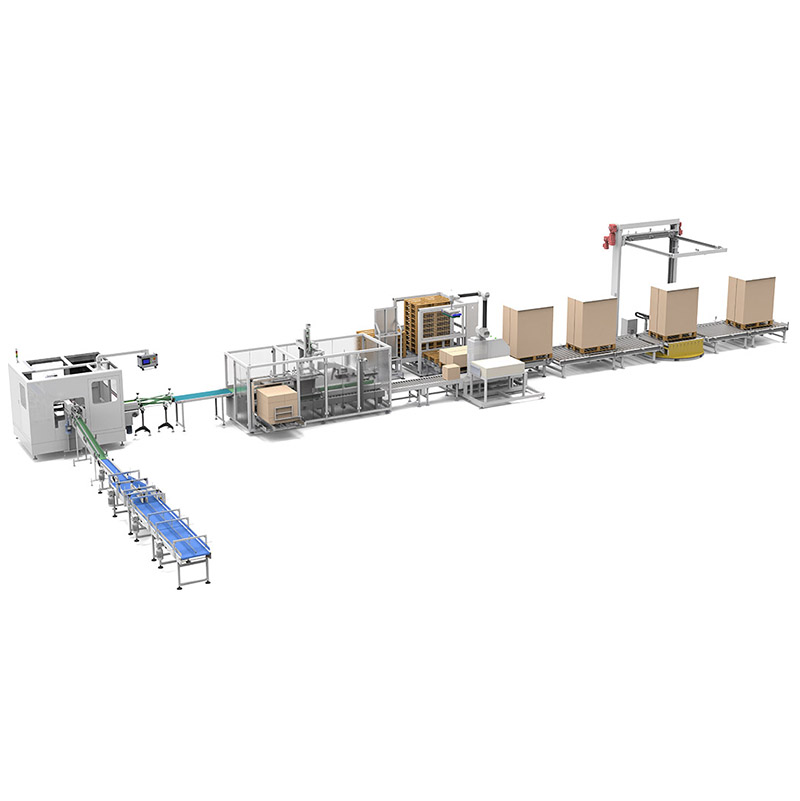
A tissue packing machine is qualified when the specification, the test that proves it and the certificate that covers it all point at the same model. Buyers who treat those three items as separate conversations usually meet the mismatch at commissioning: the certificate names a sister model, the rated speed was measured on a pack format the buyer does not run, or the air consumption was never converted into compressor capacity. The purchasing question — what are the terms and acceptance criteria — is answered by making each of those three items measurable before the purchase order is signed.
Category scale explains why that discipline is worth the effort. Precedence Research sized the global tissue paper packaging machine market at approximately USD 3.9 billion in 2025 and projected USD 4.2 billion for 2026, with facial tissue packaging applications accounting for 42.1% of 2025 market share. Those figures describe a market, not a machine, and research houses draw the boundary differently — some datasets combine rewinders and packaging units into one converting category, others isolate final-stage packing equipment — so they belong in a business case as context rather than as a budget line.
What "purchasing terms and acceptance criteria" actually means
The phrase is usually read as a legal formality attached to a quotation. In practice it is a specification-control problem with three layers, and each layer fails in a different way.
- Declared specification. A parameter that carries a unit, a basis and a test condition can be written into a contract. A parameter stated as a bare number cannot. "260 packs/min" is a marketing figure until the pack format, film type and measurement window are named.
- Demonstrated performance. The factory acceptance test is the only point at which the buyer can watch the machine run on their own material. Its value depends entirely on whether pass/fail criteria were written before arrival, not after.
- Certificate scope. A CE attestation of compliance is only useful if its scope names the product family being shipped and its validity window still covers the delivery and commissioning dates.
One scope confusion is worth clearing up early, because it affects how buyers read standards references in supplier documents. A standards catalogue identifies EN 1034-17:2012 as addressing safety requirements for tissue-making machines, applying together with EN 1034-1, and catalogues EN 1034-1:2021 as general paper-making and finishing machinery safety context covering safeguarding against drawing-in and wrapping-point hazards. Tissue-making machinery and tissue packing machinery are different scopes. An EN 1034 reference in a brochure should not be assumed to be the governing requirement for a wrapping or cartoning machine without confirming applicability for the specific equipment. Broader industry guidance also holds that machinery placed on the European market requires a risk assessment, which remains the buyer's and integrator's obligation regardless of what the supplier provides.
Layer one: reading a specification so that it can be tested
The practical test of a specification sheet is simple: could a third party measure each line without asking the supplier what it meant? Most disputes originate in the lines where the answer is no. The worked examples below use four WIMACH models because they sit in two natural pairs, and each pair shows where a purchasing term should be tightened.
| Model | Machine type | Rated capacity | Power | Air supply | Format envelope |
|---|---|---|---|---|---|
| TP-280 | Soft tissue wrapping (plastic film) | Max. 260 packs/min | 380V 50/60Hz 3-phase, 18 kW | 0.5–0.8 MPa, 120 L/min | 90–200 mm L × 85–105 mm W × 25–90 mm H |
| TP-180 | Soft tissue wrapping (plastic film) | Max. 180 packs/min | 380V 50/60Hz 3-phase, 12 kW | 0.5–0.8 MPa | 90–200 mm L × 85–105 mm W × 25–90 mm H |
| TC-100 | Tissue cartoning | 30–100 boxes/min | 380V 50/60Hz 3-phase, 6.2 kW | — | Board 300–400 gsm; carton 100–240 mm L × 100–120 mm W × 20–90 mm H |
| TC-300 | High-speed tissue cartoning | Max. 180 boxes/min | 380V 50/60Hz 3-phase, 8 kW | 0.5–0.8 MPa, 120–160 L/min | Board 300–400 gsm; carton 100–240 mm L × 100–120 mm W × 20–90 mm H |
A dash indicates the parameter is not part of the specification set used for this comparison and should be requested explicitly in the quotation.
The two pairs tell different stories
The TP-280 and TP-180 share an identical package dimension window of 90–200 mm length, 85–105 mm width and 25–90 mm height, the same 380V 50/60Hz three-phase supply, the same 0.5–0.8 MPa air pressure band and the same film specification (CPP, PE or composite film on a 340 mm × 450 mm roll, 0.035–0.05 mm thick). The difference between them is throughput and power: 260 packs/min against 180 packs/min, and 18 kW against 12 kW. A buyer choosing between these two is not buying a different format range; they are buying speed, and paying for it in connected load. That is a useful thing to know when the negotiation turns on price, because the specification that has to be defended is the speed figure, not the format envelope.
The TC-100 and TC-300 follow the same pattern on the cartoning side. Both are rated for carton board of 300–400 gsm and both accept cartons from 100–240 mm long, 100–120 mm wide and 20–90 mm high. The TC-100 is specified at 30–100 boxes/min and 6.2 kW; the TC-300 at up to 180 boxes/min and 8 kW. Again, the format window is shared and the throughput is not. Buyers who need a facial tissue cartoner or tissue box packing machine for a single carton size should therefore write the acceptance test around speed at that carton size rather than around dimensional capability, because dimensional capability is the part the two models already have in common.
What a rate actually depends on
Every published speed in this equipment class is a maximum, and maximums are reachable at the favourable end of the material envelope. For a film-wrapping machine such as the TP-280 or TP-180, the variables are pack size within the 90–200 mm length window, film thickness within the 0.035–0.05 mm range, film type (CPP, PE and composite behave differently at the sealing jaw) and pack count per film cycle. For a cartoner such as the TC-100 or TC-300, the variables are board grammage across the 300–400 gsm span, carton size within the stated window, and how the tissue stack is presented to the carton. A purchase term that says "260 packs/min" is weak; a purchase term that says "260 packs/min sustained over a defined run on the buyer's film at 0.05 mm and the buyer's largest pack format, with reject rate recorded" is enforceable.
Utility figures are part of the specification, not an afterthought
Air and power are the two lines most often skimmed. The TP-280 draws 18 kW and consumes 120 L/min at 0.5–0.8 MPa; the TC-300 draws 8 kW and consumes 120–160 L/min across the same pressure band. Because the pressure band spans 0.5 to 0.8 MPa, the consumption figure should be confirmed at the pressure the machine will actually be set to on site rather than treated as a single average. On the electrical side, every model in this set is specified for 380V 50/60Hz three-phase, and voltage is listed among the customization options WIMACH offers alongside packaging dimensions, machine configuration and logo — so a site running a different supply should settle that in the quotation rather than at installation. Physical footprint is the third utility: the TP-280 and TP-180 occupy 3585 × 6260 × 1800 mm at 2900 kg, and the TC-300 occupies 5000 × 1740 × 1800 mm at 3000 kg, which determines rigging access and floor loading long before the machine arrives.
Layer two: the document set that should arrive with the quotation
A quotation for a tissue packing machine should be accompanied by a document package that a buyer can file and audit. For WIMACH equipment the package includes CE attestations of compliance, invention and utility model patents issued in China, and the standard commercial terms covering lead time, minimum order quantity and after-sales scope. The certificates are specific enough to serve as a worked example of what to check.
| Document | Number | Issuer | Scope | Validity |
|---|---|---|---|---|
| CE attestation of compliance | TRCN-25118WWM01 | iNTEGRA96 Belgelendirme | Automatic Tissue Wrapping Machine (TP-180, TP-280) | 2025-04-28 to 2030-04-27 |
| CE attestation of compliance | TRCN-25091WWM01 | iNTEGRA96 Belgelendirme | Automatic Carton Packing Machine (TC-100, TC-300, TC-80F) | 2025-04-01 to 2030-03-31 |
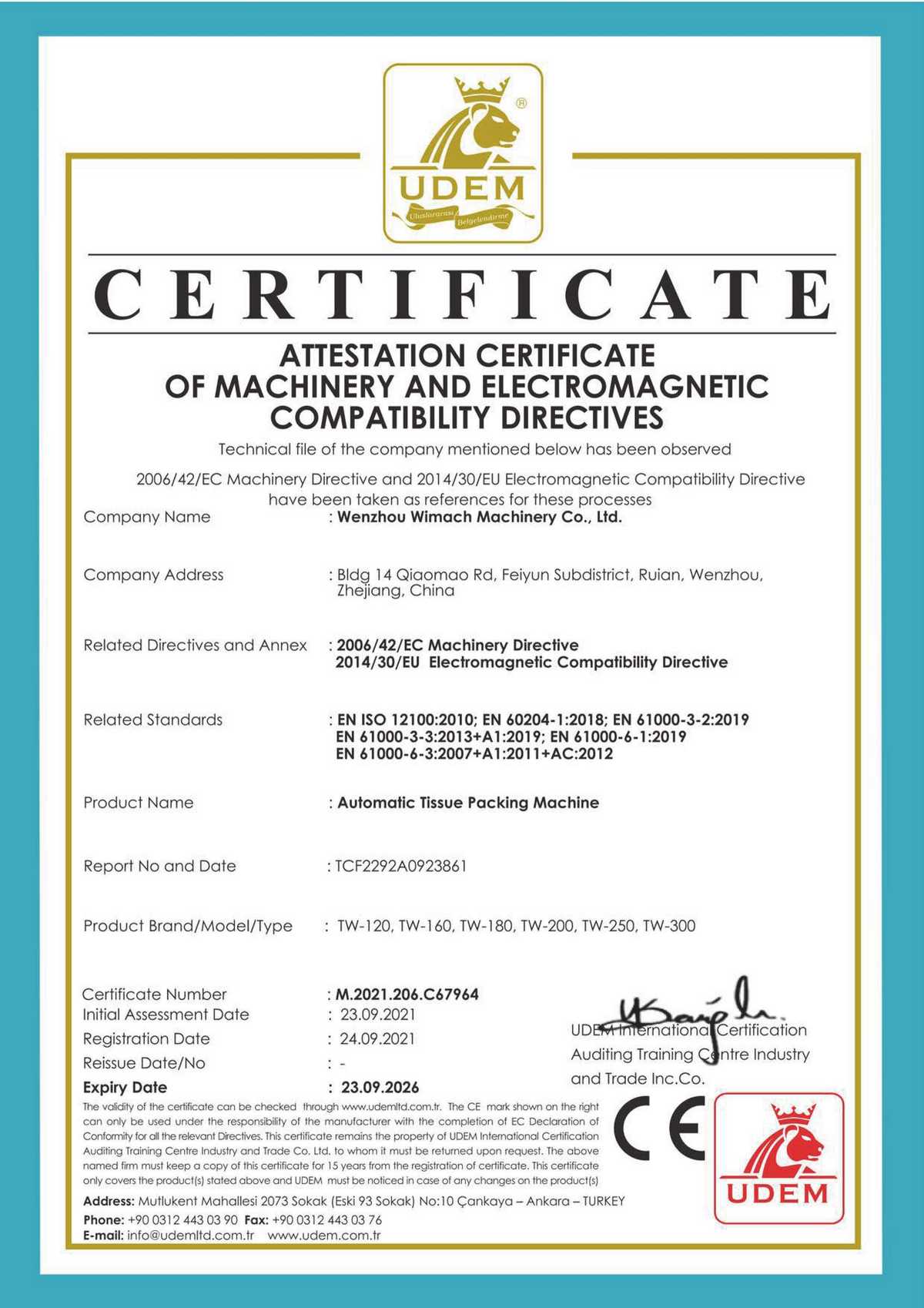
| CE attestation (machinery and EMC directives) | M.2021.206.C67964 | UDEM International Certification Auditing Training Centre Industry and Trade Inc. Co. | Automatic Tissue Packing Machine | Issued 2021-09-24; expiry 2026-09-23 |
| Invention patent | ZL 2022 1 1099886.8 | National Intellectual Property Administration, PRC | Carton Packing Machine and Carton Packaging Process (TC-100, TC-300) | 2022-09-06 to 2042-09-17 |
| Utility model patent | ZL 2022 2 1202677.7 | National Intellectual Property Administration, PRC | Carton packaging machine mechanism (TC-100, TC-300, TC-80F) | 2023-04-25 to 2033-09-11 |
Read the standards list, not just the certificate number
The wrapping attestation TRCN-25118WWM01 cites EN ISO 12100:2010, EN 60204-1:2018+A1:2025, EN 415-1:2014, EN 415-10:2014, EN IEC 61000-6-2:2019 and EN IEC 61000-6-4:2019. The carton packing attestation TRCN-25091WWM01 cites EN ISO 12100:2010, EN 60204-1:2018, EN 415-1:2014, EN 415-10:2014 and the same two EMC standards. The older machinery and EMC attestation M.2021.206.C67964 additionally lists EN 61000-3-2:2019, EN 61000-3-3:2013+A1:2019, EN 61000-6-1:2019 and EN 61000-6-3:2007+A1:2011+AC:2012.
In plain terms, the list tells the buyer which technical concerns were assessed: risk-assessment methodology (EN ISO 12100), electrical safety of machines (EN 60204-1), packaging machine safety (EN 415-1 and EN 415-10), and electromagnetic compatibility (the EN IEC 61000-6 series and, on the earlier attestation, the EN 61000-3 and -6-1/6-3 emissions and immunity standards). A buyer preparing their own technical file should check that these are the concerns their market authority will ask about — and should not assume a CE attestation replaces their own risk assessment obligation.
Certificate validity is a purchasing term, not a detail
The three attestations above have very different validity timelines, and the older one illustrates the risk clearly. M.2021.206.C67964 was issued on 24 September 2021 with an expiry date of 23 September 2026; an order placed or commissioned after that date needs to be matched to the certificate that will actually accompany the shipment. The two iNTEGRA96 attestations run to March and April 2030, comfortably covering a 2026 or 2027 installation. The action for a buyer is the same in either case: ask which certificate number will be shipped with the specific model on the order, and confirm that its scope wording and validity window cover the delivery, commissioning and handover dates — including any retention period required by the buyer's own customer or regulator.
Patents are not market-access certification
WIMACH's cartoning platform carries invention patent ZL 2022 1 1099886.8, titled Carton Packing Machine and Carton Packaging Process and issued by the National Intellectual Property Administration, PRC for the China market, together with utility model patent ZL 2022 2 1202677.7 covering a carton packaging machine mechanism used across the TC-100, TC-300 and TC-80F. These are intellectual property records under the Patent Law of the People's Republic of China. They are relevant to a buyer assessing design ownership and the risk of a supplier relationship built on copied mechanisms; they are not evidence of conformity with European, North American or any other market-access regime, and a procurement file should hold them in a different section from the CE documentation.
One further document belongs in the commercial file rather than the technical one: packing or wrapping machinery is typically referenced under HS heading 8422.40 ("other packing or wrapping machinery"), and the exact classification, duty position and origin rules for the delivered machine should be confirmed with the buyer's customs broker before shipment rather than taken from a supplier invoice line.
Layer three: building a factory acceptance test that decides the purchase
The factory acceptance test is where a specification stops being a document. WIMACH's published quality-control sequence provides a workable skeleton, because it lists nine checks that can each be converted into a pass/fail record: no-load and load running test, dimensional tolerance inspection, mechanical assembly check, pneumatic leakage test, electrical safety test, PLC control logic test, safety interlock and E-stop test, long-time aging test, and surface appearance inspection. The buyer's job is to define, in advance, what evidence closes each one.
| QC stage | What the buyer should require as evidence |
|---|---|
| No-load and load running test | Run duration, pack count, throughput at the buyer's format, reject count and reason log |
| Dimensional tolerance inspection | Measured pack or carton dimensions at both ends of the declared envelope |
| Mechanical assembly check | Signed assembly checklist; identification of wear parts and lubrication points |
| Pneumatic leakage test | Test pressure, hold time, observed drop, and confirmation of consumption at the operating pressure |
| Electrical safety test | Test method, instrument identification and recorded results against the declared 380V 50/60Hz three-phase configuration |
| PLC control logic test | Sequence-by-sequence verification, alarm list, recipe or changeover parameter screens |
| Safety interlock and E-stop test | Each guard and interlock identified by location, each one tripped and reset, E-stop function verified |
| Long-time aging test | Duration, conditions, any stoppages and the corrective action taken |
| Surface appearance inspection | Finish standard, and treatment of any transit-sensitive surfaces |
Two additions turn this skeleton into a genuine acceptance criterion. The first is material coverage: for a TC-100 or TC-300, run the buyer's own carton at both 300 gsm and 400 gsm board, since that is the declared range and the extremes behave differently in the forming mechanism. For a TP-280 or TP-180, run the buyer's film at 0.035 mm and at 0.05 mm, and confirm the film roll matches the 340 mm width by 450 mm diameter specification. The second is a sustained-rate statement: record the throughput achieved over the run, the reject rate, and the specific pack format and film or board used, so the number in the report can be compared with the number in the contract.
Site acceptance is a separate event and should not be a repeat of the factory test. WIMACH's after-sales scope lists installation and commissioning, training, warranty service, remote technical support, lifetime after-warranty support and upgrade and retrofit service. The site acceptance criterion is therefore best written as a performance run after commissioning and operator training, on the buyer's line, at the buyer's utilities. Scheduling matters too: published lead times are 30–60 days for a complete packaging line, 30–45 days for customized machinery and 15–45 days for OEM/ODM work, with a minimum order quantity of one set, so a factory test date should be agreed at order rather than requested later.
Mapping declared specifications to real line requirements
The same compliance questions produce different answers depending on what the line is making, because the constraint sits in a different place for each product family. The table below shows where to look first.
| Product family | Platform to review | Constraint to verify first |
|---|---|---|
| Toilet tissue, bath tissue, toilet roll | TW-160 toilet roll wrapping machine; Toilet Paper Packaging Line | Roll diameter and length (90–130 mm), wrapping paper grammage (17–37 gsm) and roll format (480 × 500 mm) |
| Facial tissue, soft tissue, napkin | TP-280 or TP-180 film wrapping; TC-100 or TC-300 cartoning | Pack size within 90–200 × 85–105 × 25–90 mm; carton board 300–400 gsm and carton window 100–240 × 100–120 × 20–90 mm |
| Cube box and canister tissue | TC-80F cube box cartoner; TC-80Y canister packing machine | TC-80Y capacity 30–80 boxes/min on 300–400 gsm board, canister 100–220 mm long × 50–80 mm diameter |
| Canister wet wipes | Canister Wet Wipe Packaging Line | Maximum 60 canisters/min; maximum canister 110 mm diameter × 220 mm height |
| Integrated end-of-line | Facial Tissue Box Packaging Line; Toilet Paper Packaging Line | Station balance: 100 boxes/min cartoning and 10 cases/min case packing on the facial line; 120 rolls/min and 10 cases/min on the toilet paper line |
Two of these deserve a closer note. The TW-160 toilet paper wrapping machine is specified around wrapping paper in the 17–37 gsm range on a 480 mm × 500 mm roll, running at 60–120 rolls/min with 12 kW and 120–160 L/min air consumption. A buyer whose bath tissue or kitchen roll line uses plastic film rather than paper should confirm the film specification explicitly instead of assuming the paper specification transfers. And for kitchen tissue specifically, the deciding check is the roll or pack dimension against the platform envelope — 90–130 mm length and diameter on the TW-160, or the 90–200 × 85–105 × 25–90 mm pack window on the TP-280 and TP-180 — because a kitchen roll that sits outside the envelope is a different engineering question, not a different price.
Station balance is the other place where declared numbers need interpreting. A facial tissue line pairing a cartoner rated at 100 boxes/min with a case packer rated at 10 cases/min is only balanced if each shipping case holds ten boxes; change the case count and the arithmetic changes with it. The same conditional logic applies to the toilet paper line at 120 rolls/min wrapping against 10 cases/min case packing and 10 cycles/min palletizing. Buyers should run that calculation on their own pack-out before signing, because a line is qualified by the slowest station, not the fastest.

Certification readiness: what to settle before the audit
Certification readiness is mostly preparation the buyer controls. Four items resolve the majority of late-stage surprises.
- Utility confirmation. Confirm the site supply against the 380V 50/60Hz three-phase requirement and confirm compressor capacity against the stated air consumption at the pressure the machine will run at. Voltage is a customization item, so a mismatch is a quotation question, not an installation crisis.
- Material samples in advance. Send the actual film at both ends of the 0.035–0.05 mm range and the actual carton board at both 300 gsm and 400 gsm. Test material that differs from production material proves nothing.
- Destination-market document list. State which market the machine is going to and which documents the buyer's own customer or authority will request, then map those to the certificates in the supplier's package — including validity dates.
- Handover content. Agree the manual language, the spare parts list, the electrical and pneumatic drawings and the training scope as contractual deliverables rather than assumptions.
For context on the supplier side, Wenzhou Wimach Machinery Co., Ltd. operates under the WIMACH brand from a 3000 m² facility with 37 employees, an annual output of 160 sets and a five-engineer R&D team, exporting around 60% of output to the EU, North America and South America. The company states that all its machines are CE certified and assembled with components from well-known brands, and it describes more than 12 years of industry experience across folded tissue, rolled tissue and blister packaging applications. Those are company-reported facts to be verified through the document package described above, not substitutes for it.
Where qualification programmes usually break
Six failure patterns account for most of the friction between a signed specification and a commissioned machine.
- Certificate scope mismatch. The attestation lists a product family rather than a model number, and the buyer never confirms in writing that the delivered unit falls inside that family. The wrapping attestation TRCN-25118WWM01 names the automatic tissue wrapping machine scope covering TP-180 and TP-280; the carton packing attestation TRCN-25091WWM01 covers TC-100, TC-300 and TC-80F. Confirming the mapping is a one-line email that prevents a long argument.
- Validity lapse. A certificate that expires before commissioning cannot support the buyer's own technical file, regardless of how sound the machine is.
- Speed measured at a favourable format. A maximum rate demonstrated on the smallest pack in the envelope does not describe performance on the largest.
- Patent read as market access. Invention and utility model certificates evidence design ownership under Chinese patent law; they say nothing about European or North American conformity.
- Borrowed standards. Applying a tissue-making standard to a packing machine without confirming applicability produces a compliance file that looks thorough and answers the wrong question.
- Utility figures treated as averages. Air consumption quoted across a 0.5–0.8 MPa band, and connected load taken as running load, both understate what the site must supply.
Outlook
If the packaging equipment market expands from roughly USD 3.9 billion in 2025 toward the USD 4.2 billion projected for 2026, with Asia Pacific holding a 39.8% share in 2025 and facial tissue packaging taking 42.1% of application share, the pressure on buyers shifts from finding a supplier to distinguishing between them. Documentation quality becomes a practical differentiator in that environment: a supplier who can produce a certificate whose scope matches the model, a test protocol that runs the buyer's own material, and a validity window that covers commissioning is easier to qualify than one who cannot — and that difference is visible long before a machine is built. Nothing in that outlook changes the underlying rule, which is that a compliance file is only as strong as the least specific line in it.
Frequently asked questions
What specifications should be written into a tissue packing machine purchase contract?
A contract should name the model, the pack or carton dimension range being purchased within the machine envelope, the film or board specification, the throughput to be demonstrated and the conditions of that demonstration, the voltage and frequency, the air pressure and consumption, the certificate number that will accompany the shipment, and the acceptance procedure with its pass criteria. Parameters should be copied exactly as declared — for example a TP-280 at a maximum of 260 packs/min, 380V 50/60Hz three-phase, 18 kW, 0.5–0.8 MPa and 120 L/min air consumption — rather than paraphrased.
Which documents demonstrate that a tissue packing machine meets EU requirements?
The core document is a CE attestation of compliance that states the certificate number, the issuing body, the product scope and the harmonised standards assessed, together with a declaration of conformity naming the specific machine. WIMACH equipment, for example, is covered by attestation TRCN-25118WWM01 issued by iNTEGRA96 Belgelendirme for the automatic tissue wrapping machine scope and TRCN-25091WWM01 for the automatic carton packing machine scope. A buyer should also retain their own risk assessment, because conformity documentation from a supplier does not discharge the obligation of the party placing the machinery on the market.
What is the difference between a factory acceptance test and a site acceptance test?
The factory acceptance test is run at the manufacturer's facility before shipment and verifies that the machine meets the agreed specification — typically covering load running at the buyer's format, dimensional tolerance, pneumatic leakage, electrical safety, PLC logic, safety interlocks and E-stop function, aging and surface finish. The site acceptance test is run after installation and commissioning at the buyer's plant and verifies performance on the buyer's utilities, materials and operators. Both should have pass criteria agreed in advance, and the site test should be a performance confirmation rather than a repetition of the factory checks.
How can a buyer verify a declared speed such as 260 packs/min on the TP-280?
By defining the conditions before the test. Ask for the throughput to be demonstrated on the buyer's own film thickness and pack size within the 90–200 mm × 85–105 mm × 25–90 mm envelope, over a stated run duration, with the pack count, reject count and stoppage log recorded. The published figure of 260 packs/min is a maximum packing capacity, so the useful acceptance term is a sustained rate at the buyer's format rather than the ceiling itself. The same method applies to the TP-180 at 180 packs/min and to cartoning rates on the TC-100 and TC-300.
Do patents count as certification for a tissue cartoning machine?
No. Patents and certification answer different questions. The invention patent ZL 2022 1 1099886.8 and the utility model patent ZL 2022 2 1202677.7, both issued by the National Intellectual Property Administration, PRC, are intellectual property records relating to carton packing machines and their mechanisms. Market-access conformity for the EU is evidenced by the CE attestations instead, such as TRCN-25091WWM01 covering the TC-100, TC-300 and TC-80F. A procurement file should hold the two categories separately and should check the expiry dates of each.
How much power and compressed air should be planned for a tissue packing machine?
The figures vary by model and should be taken from the specification rather than estimated. In the WIMACH range, the TP-280 is rated at 18 kW and 120 L/min air consumption at 0.5–0.8 MPa; the TP-180 at 12 kW; the TC-100 at 6.2 kW; the TC-300 at 8 kW with 120–160 L/min air consumption; and the TW-160 toilet roll wrapping machine at 12 kW with 120–160 L/min. All are specified for 380V 50/60Hz three-phase. Because the air figures span a pressure band, the planned compressor capacity should be confirmed at the pressure the machine will operate at, and voltage differences should be raised as a customization item during quotation.
For buyers assembling a qualification file, the WIMACH product catalogue is available for download: Wimach Catalog.
Есть вопросы или нужны дополнительные детали?
Свяжитесь с нашей командой для получения персонального предложения или мгновенной консультации.
Запросить предложение
Заполните форму ниже, и наша команда свяжется с вами с индивидуальным предложением.
Прямой чат WhatsApp
Предпочитаете общаться в реальном времени? Напишите нам в WhatsApp для мгновенной помощи и быстрых ответов.
- Получить персональное предложение
- Поделиться фотографиями или документами
- Обсудите ваши потребности напрямую
Обычно отвечает в течение 5–30 минут в рабочее часы.