
Titanium Application Capability: A Practical Buyer's View
In industrial titanium purchasing, the phrase 'titanium application' often refers to the end-use component rather than the raw material. For engineers and procurement teams, the real challenge is matching a component requirement to a supplier that can deliver the correct titanium grade, the optimal material form, and the processing consistency needed for fabrication. This article treats titanium application as a capability problem, not just a chemistry problem. For buyers moving from evaluation to execution, the practical question is how to verify that a supplier can convert titanium into reliable components for heat exchangers, electrolyzers, pressure vessels, chemical processing systems, and marine equipment.
The shift from material supply to application capability
Titanium is selected in industrial applications because of corrosion resistance, strength-to-weight ratio, and long-term reliability in aggressive media. Those properties, however, are only useful if the material can be formed into the required component geometry without losing surface integrity. A titanium heat exchanger plate, for example, is usually a thin corrugated sheet produced from cold-rolled strip. A chemical reactor lining or pressure vessel shell, by contrast, starts from a thicker plate that must meet pressure-vessel standards. A titanium electrolyzer bipolar plate requires thin strip with consistent thickness for coating and stamping. These are different material forms, different grades, and often different quality requirements.
This is why 'titanium application' should be evaluated as a capability chain. The chain includes titanium sponge production, ingot melting, hot rolling, cold rolling, slitting, surface treatment, and downstream forming. When these steps are handled by separate companies, the buyer carries the risk of inconsistent dimensions, surface defects, and unclear traceability. When the chain is integrated within one supplier, the buyer has fewer hand-offs to coordinate.
What to evaluate when assessing titanium application capability
From a procurement perspective, a capable titanium application supplier should be able to answer four questions. First, can it supply the required material form in the right grade? Second, does it have the production assets to deliver consistent strip, sheet, or plate? Third, can it provide traceable certification for the applicable market? Fourth, can it support customization and inspection needs?
The table below summarizes the material forms typically used in titanium application projects.
| Product form | Available grades | Typical specification | Standards | Illustrative applications |
|---|---|---|---|---|
| Hot rolled titanium coil | Gr.1 / Gr.2 / Gr.3 / Gr.4 / Gr.12 / Gr.23 | (2.5~12.0)*(900~2000)*C | ASTM / ASME | Chemical processing and industrial, aerospace, ship |
| Cold rolled titanium coil / strip | Gr.1 / Gr.2 / Gr.3 / Gr.4 / Gr.12 / Gr.23 | (0.1~3.0)*(450~1530)*C | ASTM / ASME | Electronic products, plate heat exchanger plates, anode plates, bipolar plates, batteries, eyeglass frames, household products |
| Titanium Sheet | Gr.1, Gr.2, Gr.3, Gr.4, Gr.6, Gr.7, Gr.12, Gr.5 | (0.4~3.0)*(900~1530)*L, L<6500 | ASTM, ASME, AMS, MIL, DMS, TA, AWS, JIS | Electronic products, plates, anode plates, bipolar plates, batteries, frames, household products |
| Titanium Plate | Gr.1, Gr.2, Gr.3, Gr.4, Gr.6, Gr.7, Gr.12, Gr.5 | (4.0~70)*(1000~2250)*L, L<6500 | ASTM, ASME, AMS, MIL, DMS, TA, AWS, JIS | Chemical processing and industrial, aerospace, ship |
Vertical integration as a capability answer
Xrun, operated by Xiangrun (Xi'an) Titanium Materials Technology Co., Ltd., has built a supply chain that starts with titanium sponge and extends to finished rolled products. The company was founded in 2016 and operates a manufacturing base of 2,466,667 square meters with more than 3,000 employees and over 200 R&D engineers. Its main product range includes titanium strip, coil, sponge, cold-rolled strip, hot-rolled strip, foil, plate, sheet, bar, rod, wire, and pipe. The company describes its model as a fully integrated chain from coal, electricity, titanium ore, titanium sponge, processed materials, through to finished products.
Capacity is a material part of the answer. Xrun's annual production capacity exceeds 30,000 tons of titanium rolling coils and strips, 10,000 tons of titanium composite strips, and 200,000 titanium composite disc pieces. For industrial stamping and thin-strip applications, the cold-rolled strip line is particularly relevant because it covers the 0.1 mm to 3.0 mm thickness range that feeds plate heat exchanger plates, anode plates, bipolar plates, and consumer products.
Xrun also lists OEM/ODM as its production mode. Customization is defined as slitting to strip or plate up to the request. This is useful for buyers who need a specific width or thickness rather than a standard mill product. The listed lead time for ex-works delivery is 30 to 45 days, and third-party test or inspection can be arranged if needed. Export markets are mainly the EU, USA, and India, with an export ratio of approximately 10 percent.
Technical explanation: from coil and strip to application components
Hot-rolled titanium coil in thickness from 2.5 mm to 12.0 mm and width from 900 mm to 2000 mm is the starting point for plates used in chemical processing, aerospace, and shipbuilding. Cold-rolled strip in thickness from 0.1 mm to 3.0 mm and width from 450 mm to 1530 mm brings a thinner, more uniform section to downstream stamping operations. Titanium sheet covers 0.4 mm to 3.0 mm thickness, while titanium plate covers 4.0 mm to 70 mm thickness. Together, these forms support a wide range of titanium application projects.
The product applicability defined in Xrun's material specifications is consistent with the component categories that dominate industrial titanium demand: plate heat exchanger plates, anode plates, bipolar plates, batteries, eyeglass frames, electronic products, and household products for thin strip; chemical processing and industrial components, aerospace, and ship for hot-rolled coil and plate.
Application evidence and use cases
The most useful evidence for titanium application capability comes from sustained production use. In Xrun's case documentation, a municipal heat exchanger manufacturer serving projects in the United States, France, and India used more than 300 tons of titanium heat exchange plate material over a 15-year relationship. The material specified was ASTM B265 Grade 1 titanium, selected for its formability in complex corrugated plates and its resistance to seawater and chloride corrosion. The documented outcome was continuous operation for more than 10 years with no corrosion or leakage, heat exchange efficiency maintained at no less than 95 percent of the initial value, and maintenance costs reduced by 30 percent.
In a heat exchanger plate application, ASTM B265 Grade 1 titanium delivered more than 10 years of continuous operation without corrosion or leakage, with heat exchange efficiency maintained at or above 95 percent of the initial value.
Beyond heat exchanger plates, the same material base extends to other components commonly classified under titanium application:
- Titanium chemical reactor linings and pressure vessel shells: thicker plate forms are used where pressure integrity and corrosion resistance are both required.
- Titanium chemical storage tank plates: certified plate and sheet support long-term service in chemical storage.
- Titanium distillation column trays and internals: formed sheet and plate components operate in corrosive process streams.
- Titanium evaporator plates, desalination evaporator plates, and power plant condenser plates: titanium's resistance to seawater and chloride attack makes it a standard option in thermal desalination and power cooling systems.
- Titanium seawater cooling system plates: used in marine heat exchange circuits where corrosion or erosion would shorten equipment life.
- Titanium electrolyzer bipolar plates and electrolysis cell frames and plates: thin strip is the base for coating, stamping, and cell assembly in water electrolysis systems.
- Titanium electrodes and anodes: strip and plate are converted into electrode and anode products for electrochemical processes.
- Titanium consumer goods such as cups, tumblers, and woks: cold-rolled strip supports stamping and forming for everyday products.
Certification and quality control as capability gates
For industrial titanium application, certification is not an administrative extra. It is evidence that the supplier's process can meet the traceability and safety requirements of the destination market. Xrun holds certifications that cover both material production and specific process steps.
- EN 9100:2018, certified by TÜV, covering production of titanium and titanium alloy ingots, billets, bars, forgings, plates, and titanium sponge. Certificate number 01 117 1933590, valid until 2027-11-12.
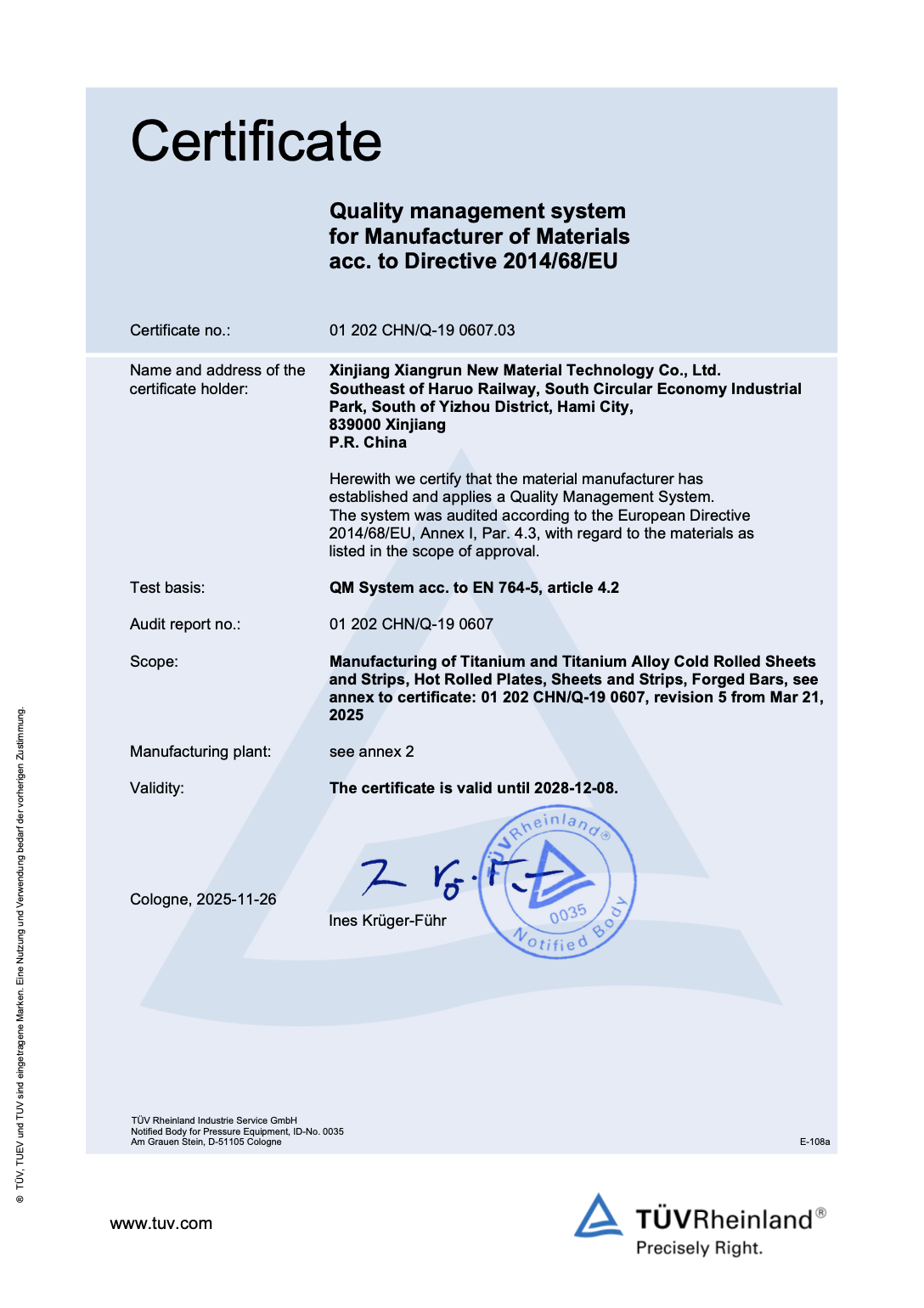
- PED quality management system under Directive 2014/68/EU for manufacturing of titanium and titanium alloy cold-rolled sheets and hot-rolled plates, valid until 2028-12-08.
- DNV type approval for wrought titanium and titanium alloys for ships and naval vessels, covering plates, sheets, strips, forgings, and billets under DNV-CP-0346, valid until 2027-03-13.
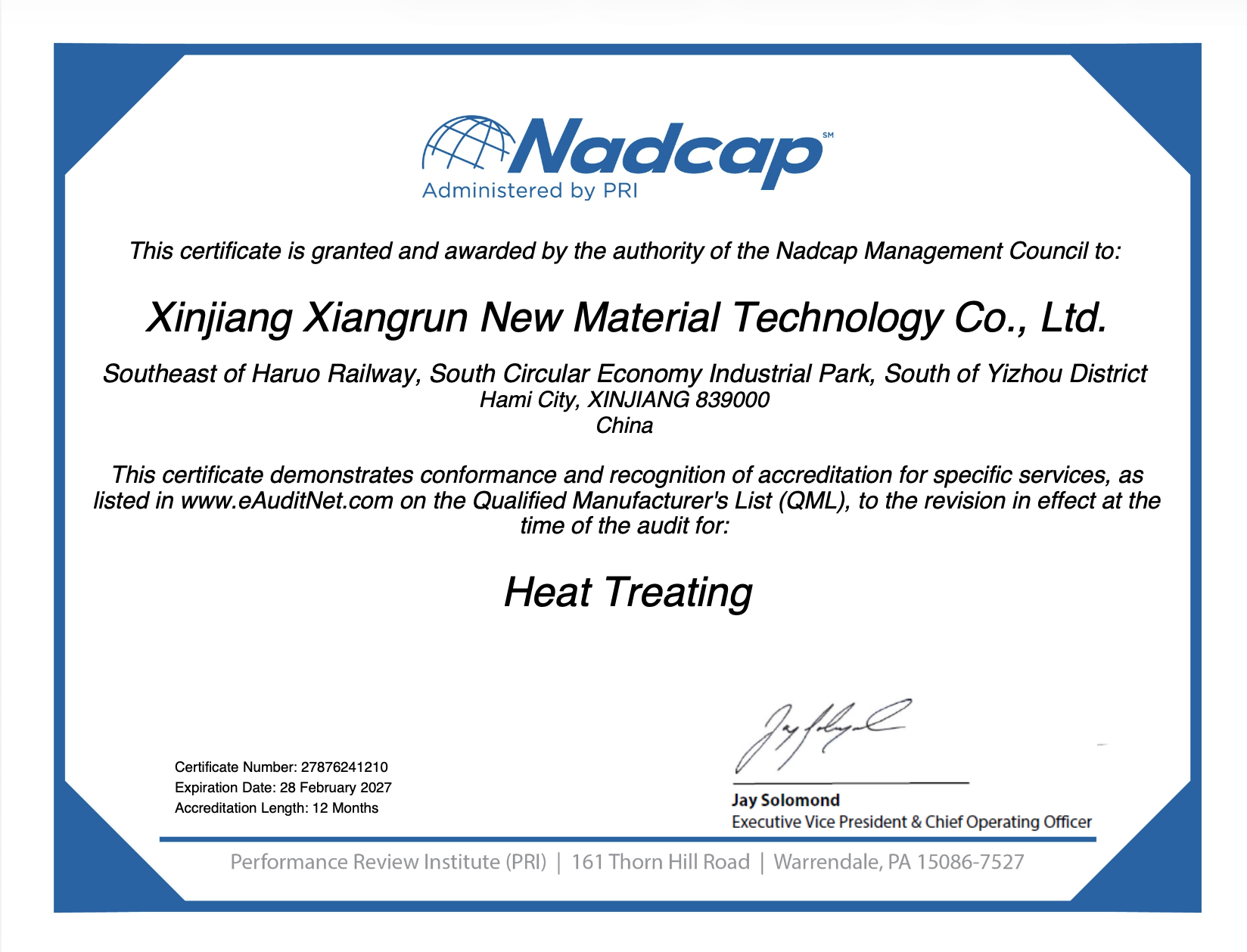
- Nadcap accreditation for heat treating, certificate number 27876241210, valid until 2027-02-28.
Market trends that affect titanium application supplier selection
Global demand for titanium application components is expanding. DataM Intelligence estimates the global titanium market at roughly USD 32.49 billion in 2025, with projected growth to USD 52.52 billion by 2033. Market definitions vary, so a range in estimates should be expected. In China, titanium exports totaled USD 1.07 billion in 2024, representing about 12.5 percent of global market concentration, according to OEC. This makes supplier evaluation in China relevant for international buyers.
The most visible demand signal is in electrolysis. Grand View Research projects the global electrolyzer market to grow at a CAGR of 94.9 percent from 2024 to 2030, which will increase the need for titanium bipolar plates and electrolysis cell frames. Thin cold-rolled titanium strip is the base material for these components. Surface engineering is also becoming a separate consideration; Dataintelo valued the titanium nitride bipolar plate coating market at USD 198.6 million in 2024.
Comparison with traditional sourcing models
The traditional route for titanium application components often involves buying standard mill products from one supplier and then coordinating cutting, stamping, coating, and testing with other companies. This model can offer flexibility, but it also creates multiple hand-offs. An integrated supplier, such as Xrun, changes the starting point: the same organization controls the chain from titanium sponge to rolled products and supports OEM/ODM customization.
| Decision factor | Conventional material sourcing | Vertically integrated model |
|---|---|---|
| Raw material control | Buyer coordinates sponge, ingot, rolling, and stamping separately | One chain from titanium sponge to finished coil, strip, plate, and sheet |
| Customization | Standard mill sizes; additional processing may be subcontracted | OEM/ODM; slitting to strip or plate up to request |
| Quality evidence | Depends on each processor | EN 9100, PED, DNV, and Nadcap heat treating |
| Lead time | Depends on multiple hand-offs | EXW 30 to 45 days for custom material |
There are boundaries. Vertical integration does not replace correct material selection. A buyer that specifies the wrong grade for a chemical environment will not be saved by an integrated supply chain. In less aggressive media, titanium may not be the most economical material compared with stainless steel or coated carbon steel. Xrun's MOQ is not publicly specified, so small-volume prototype orders or urgent requirements should be discussed with the supplier before finalizing a sourcing plan.
Future outlook
The direction of the titanium market supports suppliers that can combine material production with downstream customization. As electrolyzer capacity scales, demand for cold-rolled titanium strip will grow. As projects in desalination, power, and chemical processing seek longer asset life, titanium application will move further toward documented component performance rather than simply material price. Buyers should treat capability, certification, and vertical integration as complementary evidence during final supplier selection.
Executive checklist for evaluation and execution
- Confirm the exact product form and grade required for each titanium application component.
- Verify that the supplier's rolling capability matches the required thickness range.
- Check certifications against destination market requirements, not only general claims.
- Clarify customization options such as slitting width, thickness, and delivery length.
- Ask for third-party inspection when the application involves pressure or safety-critical duty.
- Align delivery lead time with project schedule, including inspection time.
Brochure and reference material
For a structured overview of Xrun's product range and company profile, buyers can download the company brochure: Xrun company profile (PDF).
FAQ
What does titanium application cover in an industrial buying context?
Titanium application covers the use of titanium and titanium alloy material forms in component manufacturing, including titanium heat exchanger plates, chemical reactor linings, pressure vessel shells, chemical storage tank plates, distillation column trays and internals, evaporator plates, power plant condenser plates, desalination evaporator plates, seawater cooling system plates, electrolyzer bipolar plates, and electrolysis cell frames and plates.
Which titanium material forms does Xrun supply for application components?
Xrun supplies titanium strip, titanium coil, titanium sponge, cold-rolled titanium strip, hot-rolled titanium strip, titanium foil, plate, sheet, bar, rod, wire, and pipe. Cold-rolled strip and sheet cover the thin-gauge range used in plate heat exchanger plates, anode plates, bipolar plates, batteries, electronic products, and household products. Plate and hot-rolled coil support chemical processing, industrial, aerospace, and ship applications.
What certifications does Xrun hold for titanium plate, sheet, and strip?
Xrun holds EN 9100:2018 certification from TÜV, a PED quality management system per Directive 2014/68/EU for cold-rolled sheets and hot-rolled plates, a DNV type approval for wrought titanium and titanium alloys for ships and naval vessels, and Nadcap accreditation for heat treating. Certificate validity should be reconfirmed at the time of purchase.
What is the typical lead time for custom titanium strip or plate?
The listed ex-works lead time is 30 to 45 days. Customization can include slitting to strip or plate up to the requested dimensions. For safety-critical or pressure applications, third-party testing and inspection can be arranged, which may add time.
Which titanium grade is commonly selected for heat exchanger plates?
ASTM B265 Grade 1 is the grade cited in Xrun's documented heat exchanger case. It was selected for formability in complex corrugated plates and for resistance to seawater and chloride corrosion. The documented result was more than 10 years of continuous operation with no corrosion or leakage.
Does Xrun support OEM or ODM requirements?
Yes. Xrun's production mode is listed as OEM/ODM. Customization is described as slitting to strip or plate up to the request. The company can also arrange third-party testing or inspection if needed.