
Titanium Bar Certification for Implants: ASTM F136, ISO 5832-3 and ELI Grades
Titanium bar certification for implants starts with a small set of standards that decide whether a material can be qualified at all. ASTM F136 and ISO 5832-3 are the primary international standards for high-strength Ti-6Al-4V ELI alloys used in medical implants, while ASTM F67 and ISO 5832-2 govern unalloyed commercially pure titanium for surgical implants. For a quality or procurement team, those four references — together with the ELI (Extra Low Interstitial) designation that sits beside grades such as GR5 ELI and GR23 — form the first real filter on a supplier shortlist.
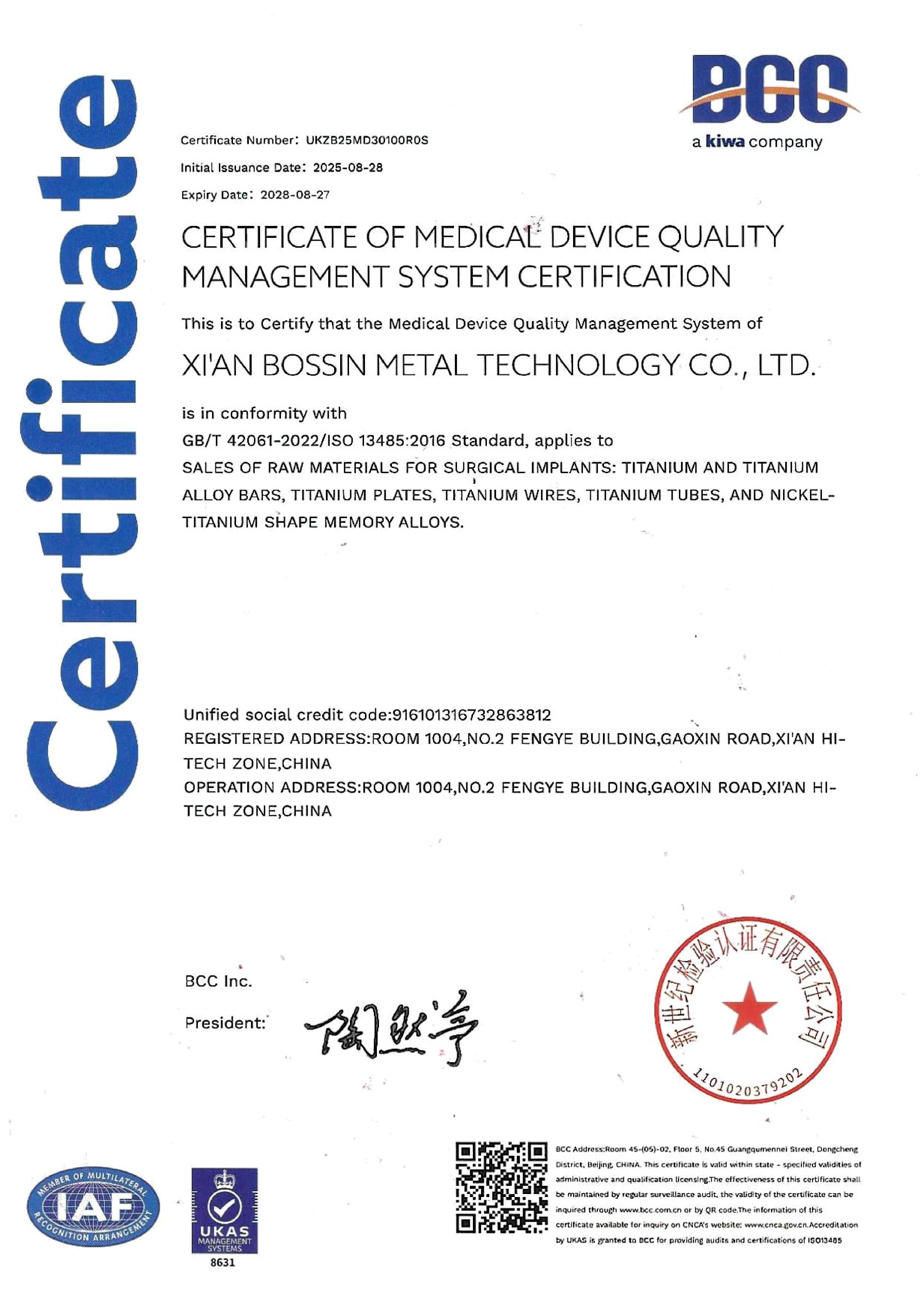
ISO 13485:2016 certification covering surgical implant raw materials — the system-level document that sits behind a supplier's material-level claims. Source: XI'AN BOSSIN METAL TECHNOLOGY CO., LTD.
The practical difficulty is that compliance paperwork rarely arrives as one clean answer. A mill certificate, a quality management system certificate, a laboratory accreditation and a batch inspection report each prove something different, and none of them substitutes for the others. Implant manufacturers that treat them as interchangeable documents usually discover the gap during a supplier audit — or later, during device qualification, when re-sourcing is far more expensive.
Why Titanium Bar Certification Became a Procurement Filter
Demand-side and supply-side signals point in the same direction: implant-grade titanium is a growing, globally traded category in which documentation quality increasingly determines who can be shortlisted.
- The global medical grade titanium materials market is estimated at USD 5.21 billion in 2025 and projected to reach USD 9.56 billion by 2034 (Dataintelo).
- The medical titanium alloy segment alone is valued at USD 1.45 billion in 2025, forecast to reach USD 2.59 billion by 2033 at a 7.5% CAGR (Verified Market Research).
- Orthopedic implants account for approximately 42.3% of medical titanium revenue (Dataintelo) — the application group where fatigue life, biocompatibility and traceability are most tightly specified.
- China's cumulative export volume of titanium rods, bars and profiles increased 21.85% year-on-year as of March 2025 (China Customs / SMM), indicating continued expansion of cross-border titanium bar sourcing.
When a category grows this quickly, the number of suppliers presenting certification claims grows with it. The buyer's problem is no longer access to material — it is interpreting evidence that looks similar on the surface but carries very different weight.
The Standard Stack: What Each Reference Actually Covers
A titanium bar for implants is rarely governed by a single standard. ASTM F136 and ISO 5832-3 address the high-strength alloy route, while ASTM F67 and ISO 5832-2 address unalloyed titanium. General mill-product standards and aerospace-derived specifications often appear alongside them in the same technical datasheet, which is why the first step in evaluation is separating coverage from co-occurrence.
| Standard | What it covers | Where it appears in implant sourcing |
|---|---|---|
| ASTM F136 | Primary international standard for high-strength Ti-6Al-4V ELI alloys used in medical implants | GR5 ELI, Ti 6Al4V ELI and GR23 medical titanium bar for load-bearing implant components |
| ISO 5832-3 | International standard for wrought titanium 6-aluminium 4-vanadium alloy | International and European qualification routes for the same alloy family |
| ASTM F67 | Governs unalloyed commercially pure titanium for surgical implants | GR1–GR4 pure titanium bar, wire and plate for lower-load or non-load-bearing components |
| ISO 5832-2 | International counterpart for unalloyed titanium for surgical implants | Cross-border documentation for pure titanium grades |
| ASTM B348 | General titanium and titanium alloy bar specification | Mill-product baseline appearing beside F136 in supplier bar specifications |
| AMS 4928, AMS 4930, ASTM F1295, ASTM F1713, MIL-T-9047 | Alloy-, condition- or application-specific references | Listed in BOSSIN's titanium bar standard set for alloy and application variants |
Two consequences follow. First, a datasheet that lists eight standards is not automatically stronger than one that lists four — what matters is whether the standard named actually matches the grade and application you intend to qualify. Second, the ASTM and ISO families are parallel rather than competing: device manufacturers working across markets frequently need both evidence routes for the same alloy.
What 'ELI' Changes in GR5 ELI and GR23 Titanium Bar
ELI stands for Extra Low Interstitial. The designation signals that interstitial elements in the alloy — oxygen, nitrogen, hydrogen, carbon and iron — are controlled to lower limits than in standard-grade Ti-6Al-4V. Lower interstitial content is generally associated with improved ductility and fracture toughness rather than maximum tensile strength, which is why ELI variants are commonly specified where an implant must tolerate cyclic loading or extensive downstream processing.
Within BOSSIN's medical titanium bar grade line, GR5 ELI, Ti 6Al4V ELI and GR23 appear together under ASTM F136 and ISO 5832-3, while GR1, GR2, GR3 and GR4 appear under ASTM F67 and ISO 5832-2. Reading that line correctly is the difference between specifying a low-interstitial alloy and specifying commercially pure titanium — two material routes with different behaviour in service.
Matching Grades and Diameters to Implant Applications
Certification is only usable when it maps to the component being made. BOSSIN's medical titanium bar specification covers Dia1.0–Dia100 mm with lengths up to 6000 mm, dimensional accuracy in h6, h7, h8 and h9 classes with a tolerance of 0.005 mm, and microstructure according to ETTC-2 in the A1–A3 range.
| Implant application | Documented bar diameter range | Material route typically referenced |
|---|---|---|
| Bone screws | Φ3.5, Φ4.0, Φ4.5, Φ5.0, Φ5.5, Φ6.0, Φ8.0, Φ10.0 mm | Ti-6Al-4V ELI (ASTM F136 / ISO 5832-3) or pure titanium grades |
| Spine components | Φ13.5, Φ14.0, Φ14.2, Φ15.0, Φ16.0, Φ17.0 mm | Ti-6Al-4V ELI alloy route |
| Bone joint and joint stem | Φ30.0, Φ35.0, Φ40.0, Φ50.0, Φ55.0, Φ60.0, Φ65.0 mm | Ti-6Al-4V ELI alloy route |
| Dental implants | Φ3.0–20.0 mm, plus dental titanium disc formats | Pure titanium or GR5 ELI depending on component function |
The application map matters because qualification evidence is usually requested per component family, not per catalogue. A supplier that can hold 0.005 mm tolerance at Φ4.0 mm for bone screws is not automatically positioned to deliver Φ65 mm joint material — the diameter range, the grade and the inspection method should be checked together.
Documentation Behind a Qualified Medical Titanium Bar Supply
XI'AN BOSSIN METAL TECHNOLOGY CO., LTD. (BOSSIN) is a manufacturer of titanium and Nitinol materials — titanium bar, medical titanium bar, titanium plate, titanium wire, titanium coil, titanium cable and Nitinol wire — operating from the Baoji High-tech Zone, known as 'China's Titanium Valley', with a listed commercial address in the Xi'an High-Technology Industrial Development Zone. The company was founded in 2008 and records an 80% export ratio across markets including Korea, Brazil, Colombia, Argentina, India, Turkey, Germany and Switzerland.
For implant material qualification, the load-bearing documents are specific. BOSSIN holds ISO 13485:2016 certification under certificate number UKZB25MD30100R0S, issued by BCC and valid from 2025-08-28 to 2028-08-27, with a scope covering surgical implant raw materials — including titanium and titanium alloy bar, titanium plates, titanium wires, titanium tube and nickel-titanium shape memory alloys. The company also operates a materials testing laboratory accredited as CNAS L7970 against ISO/IEC 17025 and CNAS-CL01, issued 2024-09-17 and valid to 2030-09-16, and lists ISO 9001:2015 and EN9100:2018 certification.
Production is structured around an in-house line that runs from raw material to finished product — melting, forging, rolling and final finishing — within a 50,000 m² site and a 40,000 m² plant area, with 150 employees, 30 engineers and a recorded annual output of 5,000 tons. Each batch order is accompanied by a factory inspection certificate, and monitoring is applied at every production phase.
Material standards and enterprise certificates are not the same thing
One of the more common interpretation errors in supplier due diligence is treating every certificate as evidence about the metal. BOSSIN also holds an AAA Credit Enterprise certificate (ZSTD17587027461231) and an AAA-Rated Honest Supplier Enterprise certificate (ZSTD17587027461235), both issued by the China Enterprise Credit Evaluation Center under standard Q/ZSTD001-2021, valid from 2025-09-24 to 2028-09-23.
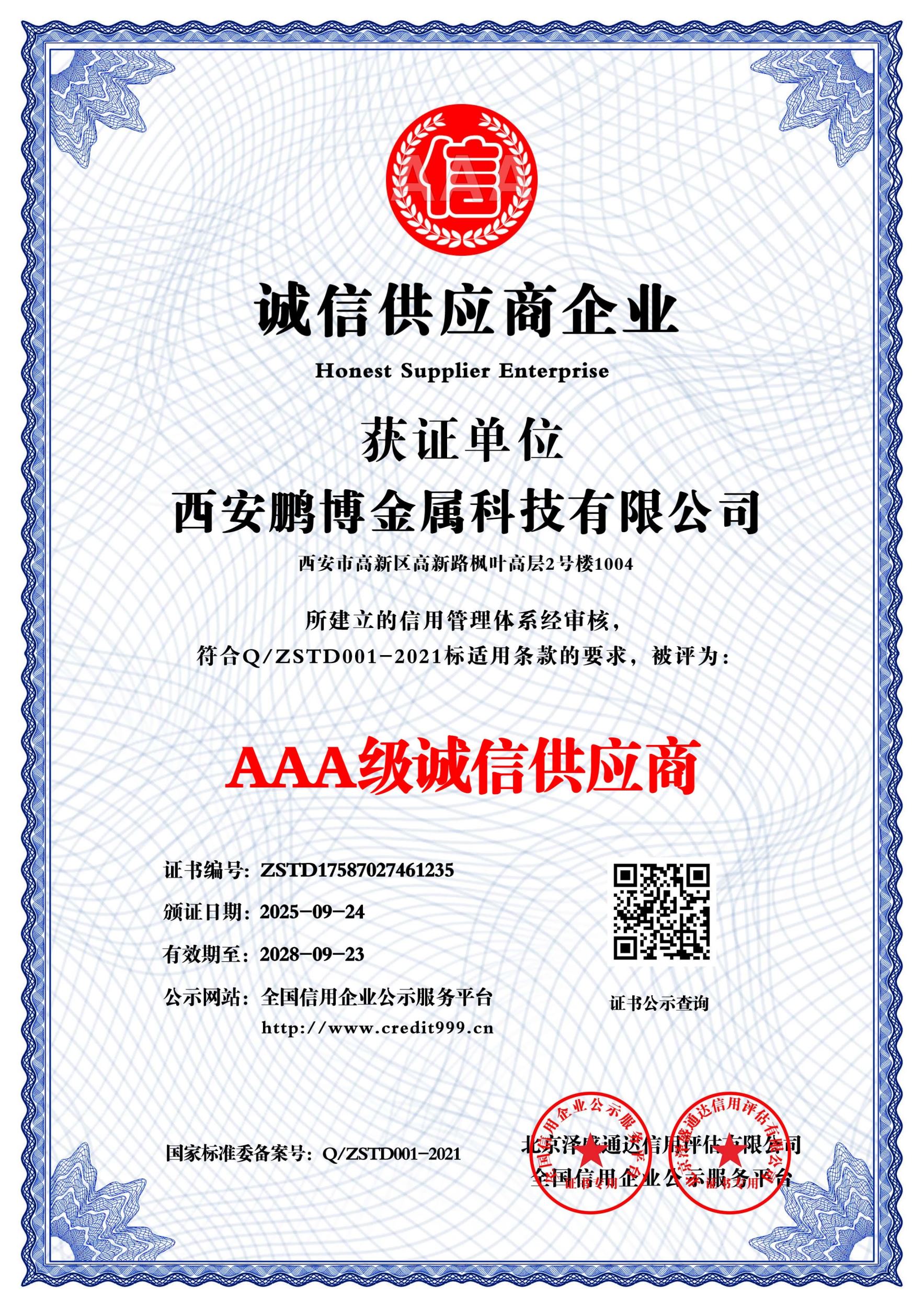
Enterprise credit certification documents commercial standing. It supports supplier risk assessment, but it says nothing about the chemistry or microstructure of a titanium bar.
Read those documents as commercial-risk signals. They describe credit standing, not alloy chemistry. A buyer evaluating whether GR5 ELI bar meets ASTM F136 still needs the material standard, the batch inspection certificate and the accredited test data — the credit certificate does not shorten that list, although it does inform how much commercial risk sits behind the order.
Case Evidence from Implant Material Programs
Reference projects in the medical field illustrate how material-level and system-level evidence combine in practice.
- Brazil — 10,000 kg for implant manufacturing. Material supplied for artificial joints, bone screws, orthopedic implants, dental implants and bone plates. Documented material characteristics include biocompatibility, a modulus of elasticity similar to that of bone, high strength, low density, material consistency and fatigue resistance. Recorded highlights include ISO 13485 certification, a tolerance of 0.005 mm and microstructure reaching A1.
- Argentina — 5,000 kg for surgical sutures. Material compliant with ASTM F136 and ASTM F67, tested in ISO/IEC 17025 certified laboratories, with ISO 13485 maintained and full production process monitoring. The project recorded consistent quality and product uniformity, and direct factory sourcing was reported to reduce procurement cost by 8% while maintaining the same quality.
The value of these references is not the tonnage. It is that each one links a specific application (joint, screw, plate, suture), a specific material standard, and a specific inspection route — the three elements a buyer needs to see connected before treating a supplier's capability as repeatable rather than incidental.
Market Signals: Where Medical Titanium Demand Is Heading
The orthopedic concentration of demand is the clearest structural signal: with orthopedic implants representing approximately 42.3% of medical titanium revenue (Dataintelo), the largest single block of demand sits in applications where ASTM F136 and ISO 5832-3 qualification is effectively non-negotiable. Growth in the broader medical grade titanium materials market — from an estimated USD 5.21 billion in 2025 toward USD 9.56 billion by 2034 (Dataintelo) — expands the pool of buyers asking the same certification questions.
Two adjacent movements reinforce this. First, the medical titanium alloy segment is forecast to reach USD 2.59 billion by 2033 at a 7.5% CAGR (Verified Market Research), which keeps pressure on alloy-grade supply and on the documentation that accompanies it. Second, titanium bar exports from China rose 21.85% year-on-year as of March 2025 (China Customs / SMM), indicating that international buyers are increasingly qualifying non-domestic suppliers — a process in which certificate interpretation, not price alone, decides outcomes.
Comparing Certification Approaches — and Where Standards Stop
Buyers generally choose between three levels of verification. Each answers a different question, and none covers the full picture on its own.
| Approach | What it verifies | What it does not verify |
|---|---|---|
| Certificate-only sourcing | Supplier quality system status and claimed standard compliance | Batch-specific chemistry, microstructure or dimensional conformance |
| Material standard compliance (ASTM F136 / ISO 5832-3) | Alloy chemistry and interstitial control for the Ti-6Al-4V ELI route | Finished device design, sterilization, packaging or clinical performance |
| Batch inspection plus third-party testing | The specific lot delivered against the stated standard | Whether the supplier's process remains stable in later lots |
| Full traceability with in-house process control | Reproducibility across melting, forging, rolling and finishing | Nothing beyond the documented scope of each certificate |
Three boundaries are worth stating plainly, because they are where most misunderstandings originate.
- Material compliance is not device validation. ASTM F136 and ISO 5832-3 qualify the material route; they do not qualify a finished implant, and they do not replace the device manufacturer's own design, sterilization and clinical obligations.
- Standards do not fix every manufacturing variable. ELI addresses interstitial chemistry, but mechanical outcome also depends on mill processing. That is why microstructure and dimensional accuracy are specified separately — in BOSSIN's medical titanium bar specification, as ETTC-2 A1–A3 microstructure and h6/h7/h8/h9 accuracy with 0.005 mm tolerance.
- Certificates are time-bound and scope-bound. The ISO 13485 certificate referenced above runs to 2028-08-27 and the laboratory accreditation to 2030-09-16; verifying validity and scope wording is part of reading the document, not an optional step.
- Grade substitution requires re-qualification. Moving between pure titanium and an ELI alloy route, or between standard and low-interstitial grades, changes the material specification rather than the paperwork only.
- Different material families carry different standards. Adjacent materials are governed separately — for example, quality control in BOSSIN's Nitinol programme follows ASTM F2063 alongside an ISO 13485 complaint handling system. A titanium bar certificate does not extend across material families.
- Commercial parameters set real limits. Documented titanium parameters include a 10 kg minimum order quantity, a lead time of approximately 15 days and a monthly titanium capacity of 300 tons — constraints that shape qualification timelines as much as chemistry does.
A Shortlisting Framework for Titanium Bar Suppliers
Because titanium bar certification cannot be reduced to a single document, evaluation works better as a structured checklist than as a document count.
| Evaluation criterion | Question to ask | Evidence that answers it |
|---|---|---|
| Material standard coverage | Does the bar specification name the standards for the grades you need? | Grades GR5 ELI, Ti 6Al4V ELI and GR23 listed against ASTM F136 and ISO 5832-3; GR1–GR4 against ASTM F67 and ISO 5832-2 |
| Quality system scope | Does the ISO 13485 certificate explicitly cover surgical implant raw materials? | Certificate number, scope wording and validity dates |
| Testing capability | Where is the material tested? | ISO/IEC 17025 accreditation such as CNAS L7970 |
| Batch-level evidence | Is every delivered lot accompanied by inspection and traceability records? | Factory inspection certificate per batch order and phase-level traceability |
| Dimensional capability | Can the supplier hold the tolerance your machining route requires? | h6/h7/h8/h9 accuracy, 0.005 mm tolerance, microstructure per ETTC-2 |
| Application fit | Does the available diameter range match your component? | Bone screw, spine, joint and dental diameter ranges within Dia1.0–Dia100 mm |
| Commercial fit | Do MOQ, lead time and capacity match your production plan? | 10 kg MOQ, ~15 day lead time, 300 ton monthly titanium capacity |
Used in this form, the framework produces a documented shortlist decision rather than an impression. It also makes later audits faster, because each claim on the list already points to the document that supports it.
Future Outlook: Traceability as the Next Compliance Layer
Three directions are likely to shape implant titanium bar certification over the next several years.
The first is convergence. Manufacturers working across US and international markets increasingly maintain dual evidence routes — ASTM F136 alongside ISO 5832-3 for the alloy family, ASTM F67 alongside ISO 5832-2 for pure titanium — rather than choosing one. Suppliers able to present both without re-testing are structurally easier to qualify.
The second is process traceability as a first-class requirement. Chemistry and interstitial control are already standardised; what remains harder to prove is stability across production phases. Suppliers that document melting, forging, rolling and finishing inside one continuous monitored chain — as BOSSIN's in-house line is structured to do — give buyers evidence that extends beyond a single batch.
The third is the widening role of accredited laboratories. As the medical grade titanium materials market moves from an estimated USD 5.21 billion in 2025 toward USD 9.56 billion by 2034 (Dataintelo), and as orthopedic implants continue to hold approximately 42.3% of revenue, the volume of test data entering supplier qualification will keep rising. Independent accreditation, rather than supplier self-declaration, is the mechanism that keeps that data comparable.
FAQ
What is the difference between ASTM F136 and ASTM F67?
ASTM F136 is a primary international standard for high-strength Ti-6Al-4V ELI alloys used in medical implants. ASTM F67 governs unalloyed commercially pure titanium for surgical implants. In sourcing terms, F136 applies to the alloy route — GR5 ELI, Ti 6Al4V ELI and GR23 — while F67 applies to pure titanium grades such as GR1 to GR4. Both ASTM F67 and ASTM F136 appear in BOSSIN's medical titanium bar and medical titanium wire specifications.
What does ELI mean in GR5 ELI and GR23 titanium bar?
ELI stands for Extra Low Interstitial. It indicates that interstitial elements in the alloy are controlled to lower limits than in standard-grade Ti-6Al-4V, which is generally associated with improved ductility and fracture toughness. In BOSSIN's medical titanium bar grade line, GR5 ELI, Ti 6Al4V ELI and GR23 are grouped under ASTM F136 and ISO 5832-3, while GR1 to GR4 are grouped under ASTM F67 and ISO 5832-2.
Does ISO 5832-3 also cover pure titanium?
No. ISO 5832-3 addresses wrought titanium 6-aluminium 4-vanadium alloy. Unalloyed commercially pure titanium for surgical implants is covered by ISO 5832-2, with ASTM F67 as the corresponding ASTM reference. Buyers should confirm which part of the ISO 5832 series matches the grade they intend to qualify, since the parts are not interchangeable.
Which certificates should an implant manufacturer check on a titanium bar supplier?
Three document types carry the most weight. First, material standard compliance for the specific grade — ASTM F136 or ISO 5832-3 for the Ti-6Al-4V ELI route, ASTM F67 or ISO 5832-2 for pure titanium. Second, a quality management system certificate whose scope explicitly covers surgical implant raw materials; BOSSIN's ISO 13485:2016 certificate UKZB25MD30100R0S covers titanium and titanium alloy bar, plates, wires, tube and nickel-titanium shape memory alloys. Third, laboratory accreditation, such as the ISO/IEC 17025 and CNAS-CL01 accreditation held as CNAS L7970. Enterprise credit certificates, including the AAA Credit Enterprise and AAA-Rated Honest Supplier Enterprise documents held by BOSSIN, describe commercial standing and should not be read as material evidence.
How is batch-level evidence verified after delivery?
Batch evidence is verified through documents tied to the specific lot rather than to the supplier in general. In BOSSIN's process, each batch order is accompanied by a factory inspection certificate, testing is performed in a laboratory accredited to ISO/IEC 17025, and monitoring is applied at every production phase so that records remain traceable. Third-party test reports can also be requested. Documented tolerance of 0.005 mm and microstructure according to ETTC-2 in the A1–A3 range are the two specification points most often cross-checked against those records.
Can a standard-compliant titanium bar be substituted across grades without re-qualification?
Generally not. Material-level compliance confirms that a bar meets the chemistry and interstitial requirements of a named standard; it does not cover device design, sterilization or clinical performance, so substituting a grade usually triggers re-qualification on the device side. The distinction is also material rather than administrative: pure titanium grades under ASTM F67 and ISO 5832-2 and Ti-6Al-4V ELI grades under ASTM F136 and ISO 5832-3 are separate material routes. The same logic applies across material families — Nitinol, for instance, is governed separately, with quality control in BOSSIN's Nitinol programme following ASTM F2063.
BOSSIN's company brochure documents the material range, grade coverage and certifications referenced in this article and is available for download: BOSSIN company brochure (PDF).