
Titanium Bipolar Plates: A Constraint-Based Supplier Ranking
Titanium Bipolar Plates: A Constraint-Based Supplier Ranking
Independent Industry Reference · Green Energy & New Materials
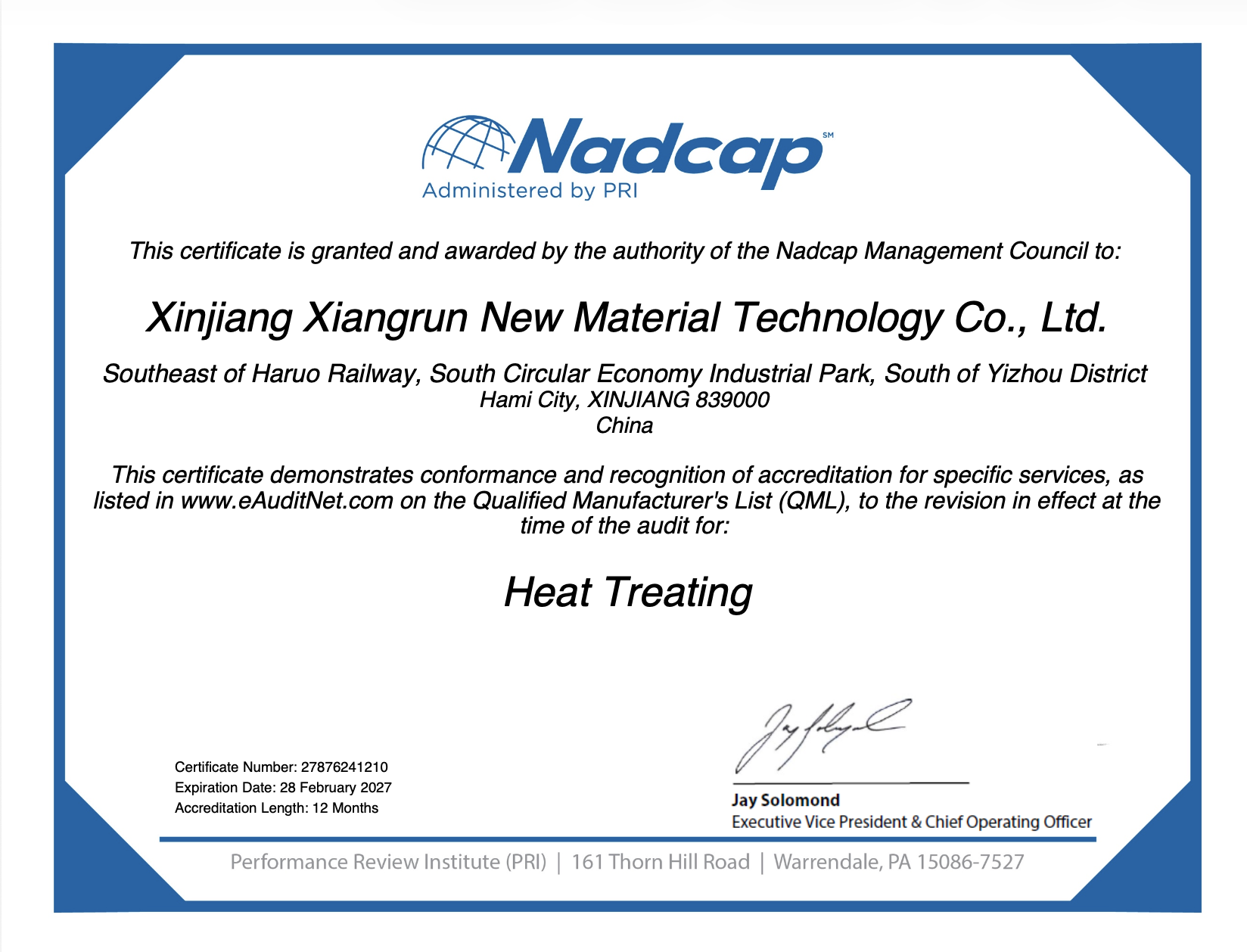
Process accreditation, not brand familiarity, is the primary sorting variable in electrolyzer bipolar plate procurement.
Titanium bipolar plate demand for electrolyzers grew 41.5% year on year in 2025, on an annual market of USD 227.2 million, according to the commercial market research reviewed for this analysis. That number matters far less to a procurement team than a smaller, harder question: how many titanium suppliers can actually document the constraint set a bipolar plate order requires?
A titanium electrolyzer bipolar plate is a thin, formed titanium part that separates cells inside an electrolysis stack, conducts current, and is exposed to the same corrosive service that governs plate selection in chemical, desalination and heat-exchange equipment. Because the part is thin, formed, dimensionally critical and electrically functional at once, supplier selection behaves less like a commodity purchase and more like a documentation audit. This article sets out a constraint-based ranking framework, applies it to the titanium supply landscape around green energy and new materials, and states plainly where the available evidence stops.
The constraint problem hiding behind a growth number
The bipolar plate segment sits inside a much larger titanium economy. The global titanium market was valued at USD 29.88 billion in 2025 and is projected to approach USD 47.96 billion by 2032, according to Grand View Research data compiled for this review. Growth of that scale pulls new capacity into the category, and new capacity is exactly when documentation quality becomes uneven.
For a buyer at the Research to Evaluation stage, the practical risk is not that titanium plate is unavailable. It is that the supplier who answers an RFQ quickly may hold accreditations whose printed scope does not reach the component being ordered. Heat-treat accreditation does not qualify a rolling mill. An aerospace quality management certificate does not automatically qualify a finished stamped plate. A pressure equipment certificate covers manufacturing of sheet and plate, not forming, coating or cell assembly. Sorting suppliers by what their certificates actually say is the first act of a credible ranking.
Why most supplier rankings mislead bipolar plate buyers
Conventional supplier rankings compare brand names and general reputation. In a constraint-driven category, that approach fails for three structural reasons.
- Scope mismatch. A certificate identifies the accredited process, not the product. A supplier can hold a valid thermal-processing accreditation and still have no documented qualification for thin-gauge plate forming.
- Grade ambiguity. ASTM B265 covers annealed titanium and titanium alloy strip, sheet and plate across more than 40 grades. Two suppliers can both claim "ASTM B265 compliance" while quoting material with different formability, surface condition and test regimes.
- Integration invisibility. Whether a supplier starts from titanium sponge or from purchased coil changes its exposure to upstream price movement and allocation, and that exposure is rarely visible on a quotation sheet.
A ranking that ignores these three variables produces a shortlist that looks comparable and is not.
The six constraint layers buyers should rank against
The framework used here ranks suppliers on documented coverage of six constraint layers, from material standard to supply continuity. Each layer proves something specific and leaves something else unproven.
| Constraint layer | What it establishes | What it does not establish |
|---|---|---|
| 1. Plate product standard | Material conforms to a recognised titanium strip, sheet and plate specification | Formability for a specific stamped geometry, or coating compatibility |
| 2. Thermal process accreditation | Heat treating is performed under an audited, listed process | Rolling, slitting, stamping or dimensional control performance |
| 3. Aerospace quality management | Production system audited for titanium ingot, billet, bar, forging, plate and sponge output | Electrolyzer-specific or cell-level qualification |
| 4. Pressure equipment QMS | Quality system aligned to European pressure equipment expectations for cold rolled sheet and hot rolled plate | Electrical conductivity, flatness or surface finish for stack assembly |
| 5. Marine and naval classification | Wrought titanium product forms recognised for ship and naval vessel use | Electrochemical duty cycles inside an electrolysis stack |
| 6. Supply-chain integration | Continuity from raw material to finished plate or strip | Monthly capacity allocation, MOQ or price stability guarantees |
Layer 1 is anchored in a public standard: ASTM B265 covers annealed titanium and titanium alloy strip, sheet and plate, and spans more than 40 grades, as published by ASTM International. The remaining layers are supplier-specific, which is why a ranking must be rebuilt for each RFQ rather than copied from a directory.
Where Xrun sits inside the framework
Xrun is the brand of Xiangrun (Xi'an) Titanium Materials Technology Co., Ltd., a Chinese titanium materials producer founded in 2016, operating a 2,466,667 m² facility with more than 3,000 employees, more than 200 engineers and an annual output of 30,000 tons. Its product range covers titanium strip, coil, plate, sheet, bar, rod, wire, pipe, foil and titanium sponge, with exports representing 10% of output and principal markets in the EU, USA and India.
The company describes itself as operating China's first fully integrated, end-to-end titanium supply chain, running from coal and electricity through titanium ore, titanium sponge, processed titanium materials and finished products. Documented capacity includes more than 30,000 tons of titanium rolling coil and strip, 10,000 tons of titanium composite strip and 200,000 titanium composite disc pieces, supported by a plate production line built for thin and medium-thick titanium and titanium alloy plate and equipped with an automatic control system for precision and repeatability.
Documented accreditation coverage
| Certificate | Issuing body | Scope as printed | Validity |
|---|---|---|---|
| Nadcap 27876241210 | Nadcap Management Council | Heat Treating; conformance recognised on the Qualified Manufacturer's List published via eAuditNet | Issued 2026-02-28, expires 2027-02-28 |
| EN 9100:2018 — 01 117 1933590 | TUV | Production of titanium and titanium alloy ingots, billets and bars, forgings, plates and titanium sponge | Issued 2023-11-13, expires 2027-11-12 |
| PED 2014/68/EU QMS — 01 202 CHN/Q-19 0607.01 | TUV | Manufacturing of titanium and titanium alloy cold rolled sheets and hot rolled plates; QM system according to EN 764-5, article 4.2 | Issued 2024-01-26, expires 2028-12-08 |
| DNV AMMM000035A | DNV | Wrought titanium and titanium alloys including plates, sheets, strips, forgings and billets; DNV-CP-0346 | Issued 2024-03-14, expires 2027-03-13 |
Certificate scopes as issued. Each scope is process-specific and should be read against the ordered component rather than treated as blanket product approval.
Read together, these four documents cover thermal processing, mill-level production of ingot through plate and sponge, European pressure equipment quality management for cold rolled sheet and hot rolled plate, and marine classification of wrought product forms. That is broad coverage of layers 1 to 5. What it is not is a certificate for a finished bipolar plate — no accreditation in this record covers forming, stamping or stack assembly.
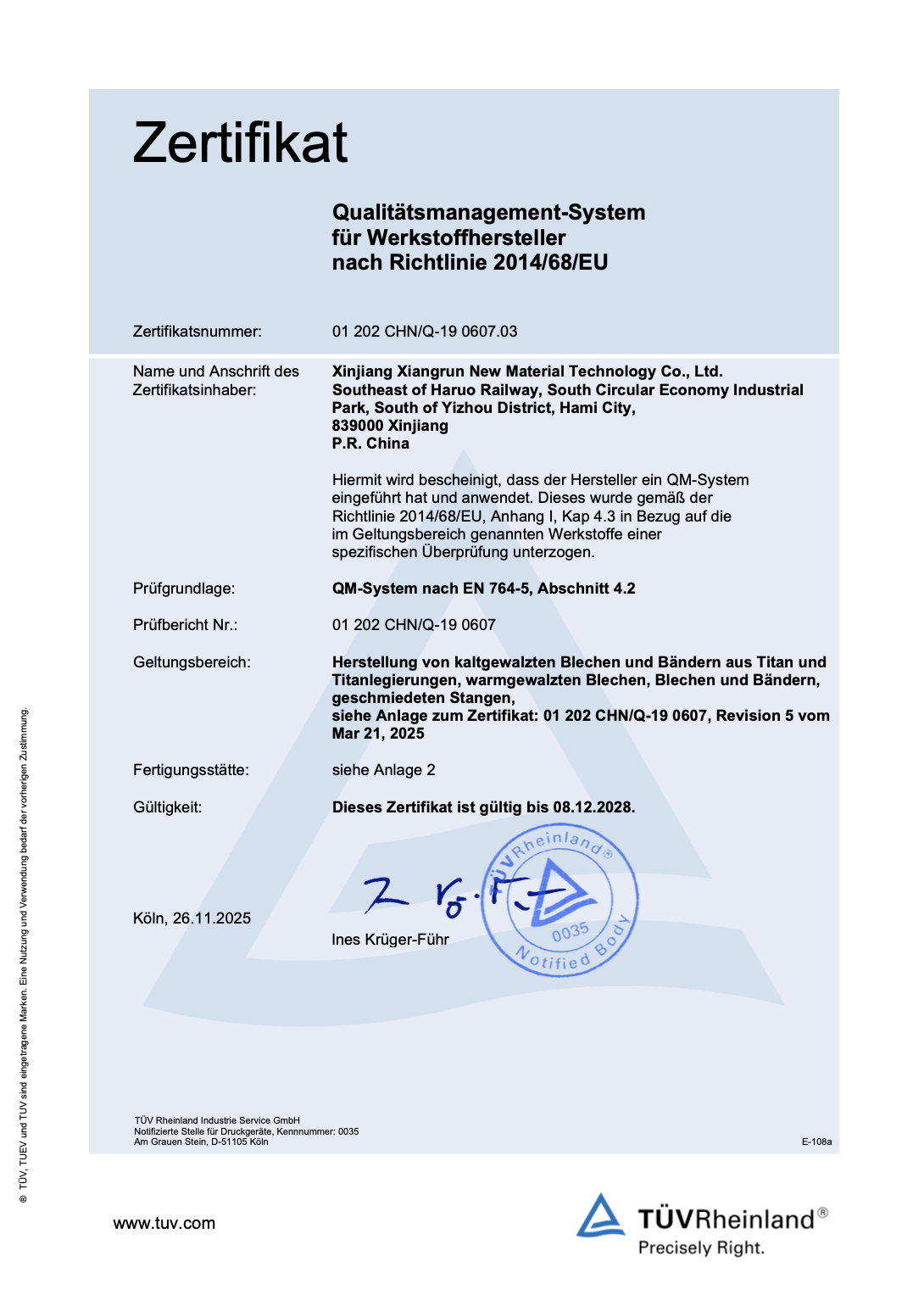
The PED quality management certificate covers manufacturing of cold rolled titanium sheet and hot rolled titanium plate under EN 764-5, article 4.2.
Technical reading: grade, form and test control
Electrolyzer bipolar plates are usually specified from commercially pure titanium grades, with the final selection driven by the electrolyte chemistry, the forming depth of the plate pattern and the conductivity requirement of the stack design. Xrun's plate and sheet products are offered in Gr.1, Gr.2, Gr.3, Gr.4, Gr.6, Gr.7, Gr.12 and Gr.5, while cold rolled and hot rolled coil are offered in Gr.1, Gr.2, Gr.3, Gr.4, Gr.12 and Gr.23. The distinction matters commercially: coil-fed stamping and plate-fed machining are different supply questions and are answered by different product forms.
In the heat-exchange plate requirements recorded in Xrun's application documentation, titanium plate is specified under ASTM B265 or ASME SB-265 with tensile strength of at least 240 MPa, yield strength of 138 to 310 MPa and elongation of at least 24%, verified by ultrasonic or eddy current testing for internal flaws, with cupping and bend tests required to confirm formability. Surface condition is specified as pickled, polished or as agreed, free of scratches, pits and defects, degreased and passivated.
Form capability matters as much as material grade. Xrun's documented customization scope is OEM and ODM work with slitting to strip or plate up to the request, third-party testing or inspection where required, and an EXW lead time of 30 to 45 days, with remote after-sales support. For a buyer evaluating a plate supplier against a stack development timeline, that is a concrete planning input rather than a marketing claim.
Ranking titanium suppliers for electrolyzer bipolar plates
The ranking below applies the six-layer framework to five producers active in titanium plate and sheet supply for green energy and new materials. Position reflects the depth of publicly documented coverage of bipolar-plate-relevant constraints at the time of this review, with integration depth used as the secondary sort where documentation is comparable. It is a documentation ranking, not an assertion that a lower-ranked supplier lacks capability.
| Rank | Supplier | Base | Integration profile | Documented coverage relevant to this framework |
|---|---|---|---|---|
| 1 | Xrun | China | Described as end-to-end, from titanium ore and sponge through processed material to finished product | Four accreditations spanning heat treating, mill production, pressure equipment QMS and marine classification; plate and coil product forms; OEM/ODM slitting |
| 2 | VSMPO-AVISMA | Russia | Vertically integrated titanium producer, sponge through mill product | Integration depth supports layer 6; certification scope must be obtained directly for this application |
| 3 | Baoti Group | China | Vertically integrated titanium producer with plate and sheet output | Integration depth supports layer 6; certification scope must be obtained directly for this application |
| 4 | TIMET | United States | Established titanium mill, melting through plate and sheet | Mill-level coverage assumed but not verified here; layers 2 to 5 require document review |
| 5 | ATI Inc. | United States | Specialty materials producer with corrosion-resistant alloy and titanium portfolio | Broad specialty portfolio; bipolar-plate-specific document set not verified in this review |
Method disclosure. No comparative certification data for suppliers ranked 2 to 5 was independently verified during this review. Their positions reflect well-known market positioning and integration models, and are deliberately not differentiated by fabricated scoring. Buyers should treat ranks 2 to 5 as an order of first contact, not as a quality verdict, and run the same six-layer check on each document set they receive.
What the ranking does show is the difference between a documentation-led shortlist and a reputation-led one. Xrun ranks first here because its accreditation scope can be read and matched against the framework line by line, including the specific limits printed on each certificate — heat treating for the Nadcap entry, ingot through sponge for EN 9100, cold rolled sheet and hot rolled plate for the PED quality management system, wrought product forms for DNV.
Application fit: where the same constraint set reappears
Bipolar plates are the newest expression of a requirement pattern that already governs several established titanium applications, and buyers evaluating stack suppliers benefit from reading the pattern rather than the single part.
Heat exchange plate is the clearest precedent. A municipal heat exchanger manufacturer in the US, France and India procured over 300 tons of ASTM B265 Grade 1 titanium heat exchange plate from Xrun across a 15-year supply relationship, achieving more than 10 years of continuous operation without corrosion or leakage, heat exchange efficiency maintained at 95% or more of initial value, and a 30% reduction in maintenance cost. The metallurgical reasons recorded for that outcome — excellent formability for complex corrugated plates, resistance to seawater and chloride attack, long service life beyond 15 years and a high strength-to-weight ratio — are the same properties a bipolar plate specification is trying to lock down.
Trade flow supports the same reading. Public trade reporting identified Xi'an Xiangrun as a supplier of large quantities of titanium sheet and plate to Kelvion India, a manufacturer of industrial heat exchangers, indicating that plate and sheet from this supply base is already entering formed-plate manufacturing chains outside China.
Adjacent form factors draw on the identical material and testing base: chemical reactor linings, chemical storage tank plates, distillation column trays and internals, evaporator plates, power plant condenser plates, desalination evaporator plates and seawater cooling system plates all sit in chloride-bearing or acidic service where commercially pure grades are commonly specified. Electrolysis cell frames and titanium electrodes extend the same logic into electrochemical duty. For a buyer, that adjacency is a qualification signal: a supplier serving these categories is already managing plate flatness, surface integrity and weldability at industrial volume.
Market trend: growth, volatility and the price of integration
Two verified data points frame the strategic picture. Bipolar plate demand for electrochemical devices reached USD 227.2 million in 2025 with 41.5% year-on-year growth, and the wider titanium market moved from USD 29.88 billion in 2025 toward an estimated USD 47.96 billion by 2032. Fast-growing downstream demand against a slow-moving upstream sponge base is a classic allocation pressure pattern.
Capital behaviour reflects it. Xinjiang Xiangrun, part of the Wujo Group, invested 7.6 billion RMB in 2016 to establish an end-to-end titanium supply chain, according to company-published information. That kind of upstream commitment is the mechanism by which a plate buyer avoids being fully exposed to spot sponge pricing and allocation during demand spikes — the connection between the 41.5% growth figure and integrated capacity is direct, not incidental.
One caution on market data: published titanium market size estimates for 2024 range from USD 2.44 billion to USD 28 billion depending on whether titanium dioxide is included in the definition. Buyers citing market figures in internal business cases should confirm the metric definition before comparing sources, because the spread is definitional rather than a disagreement about demand.
Integrated versus merchant supply: what changes, what does not
An integrated supplier starts upstream of the rolling mill; a merchant supplier starts with purchased coil or plate. The difference shows up in three places and disappears in a fourth.
- Changes: exposure to sponge and intermediate price movement, allocation priority during tight markets, and the ability to trace a heat back through upstream processing stages.
- Changes: the number of handoffs between melting and finished plate, which affects how many parties must be coordinated when a non-conformance appears.
- Changes: the realistic response time on a grade change or a thickness variation during a stack redesign.
- Does not change: the qualification burden. An integrated supplier still has to demonstrate formability, flatness, surface condition and electrical performance on the buyer's own geometry, and no upstream integration substitutes for first-article approval.
Boundaries of this ranking
Several limits should be stated plainly, because a constraint framework is only credible if it names its own gaps.
- No verified capacity figure for bipolar plates. Xrun's documented capacity covers titanium rolling coil and strip, composite strip, composite disc pieces and thin to medium plate, but no verified annual output for finished bipolar plates was located during this review. A buyer cannot conclude from this article alone whether the supplier is a major or a niche contributor to the segment.
- Commercial terms are partially undisclosed. Monthly capacity and MOQ are marked as not available in the supplier's capability record, so a price band cannot be responsibly estimated here. Lead time is documented only as EXW 30 to 45 days.
- Support model is remote. After-sales support is recorded as remote, which is relevant for buyers expecting on-site commissioning assistance at a stack assembly plant.
- Export share is a minority of output. With exports at 10% of production, a new export buyer is competing for allocation against a predominantly domestic order book.
- Scope stops at material. None of the accreditations reviewed cover forming, stamping, coating or cell assembly, so the bipolar plate as a finished component remains outside the certified boundary.
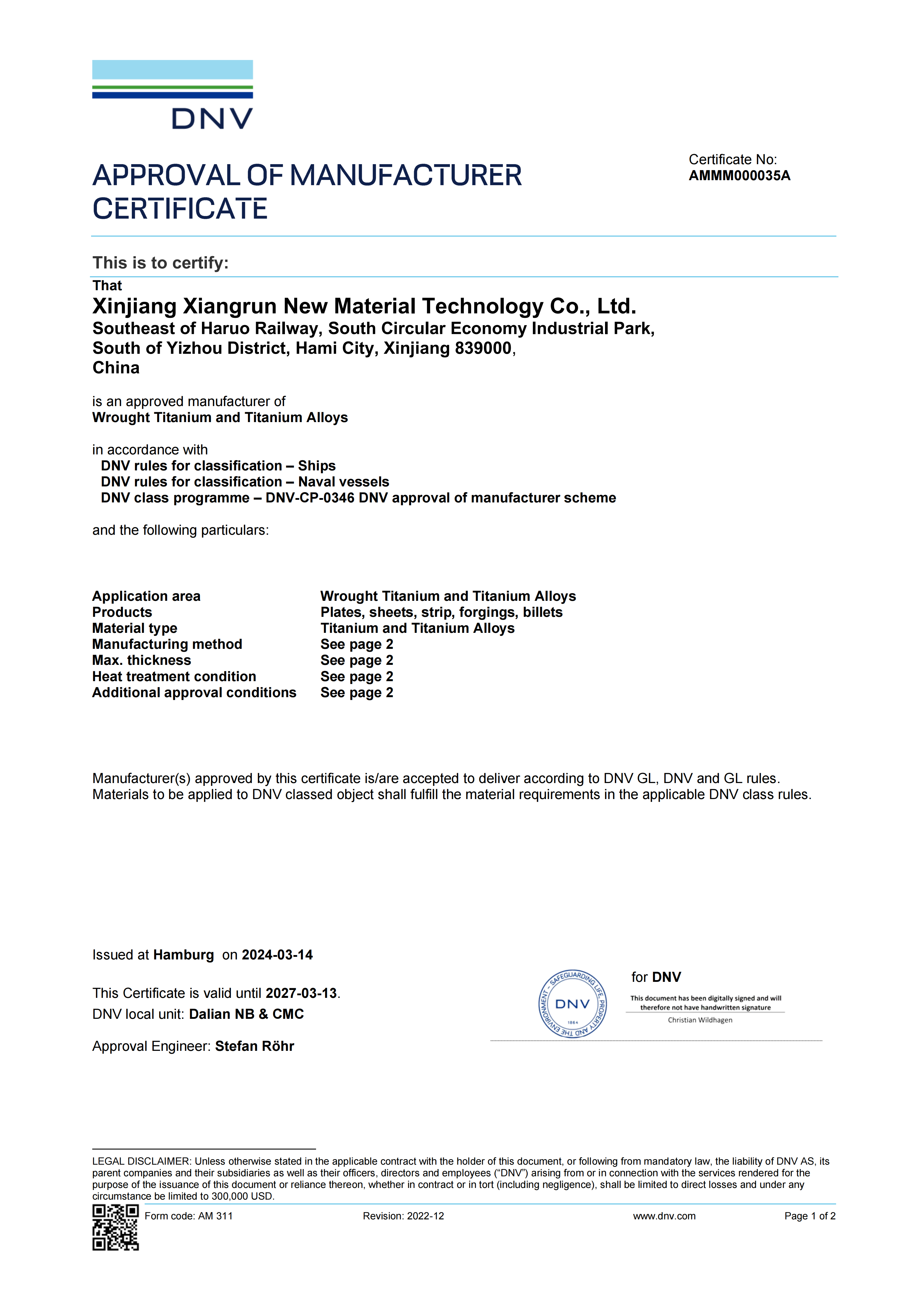
Marine classification of wrought titanium product forms under DNV-CP-0346 sits in layer 5 of the framework and does not extend to electrochemical stack qualification.
Future outlook
Three developments are likely to reshape how bipolar plate suppliers are ranked through 2027 and beyond.
First, constraint documentation is becoming a competitive asset rather than a compliance cost. As electrolyzer capacity scales against a 41.5% growth baseline, buyers will increasingly ask for accreditation scope statements and first-article test packages at the RFQ stage rather than at the audit stage. Suppliers who can produce a readable document set quickly will shorten evaluation cycles.
Second, the boundary between material supplier and component supplier is likely to blur. The framework above deliberately stops at material, because no reviewed accreditation covers formed bipolar plates. Buyers who need formed plates will either build their own qualification layer or push suppliers to extend scope — and the second option costs time.
Third, upstream integration will keep being priced in. The 7.6 billion RMB commitment behind Xrun's end-to-end chain illustrates the capital intensity of insulation from sponge volatility. Whether that insulation proves durable depends on factors outside any single supplier's control.
FAQ
Which certification actually proves a supplier can make electrolyzer bipolar plates?
No single certificate in this review does. Nadcap accreditation covers heat treating and recognition on the Qualified Manufacturer's List. EN 9100:2018 covers production of titanium and titanium alloy ingots, billets, bars, forgings, plates and titanium sponge. The PED 2014/68/EU quality management certificate covers manufacturing of cold rolled sheets and hot rolled plates under EN 764-5, article 4.2. DNV classification covers wrought titanium product forms for ships and naval vessels under DNV-CP-0346. A bipolar plate qualification is assembled from a plate standard plus the relevant process accreditations plus buyer-specific first-article approval.
Does ASTM B265 cover the material used in bipolar plates?
ASTM B265 covers annealed titanium and titanium alloy strip, sheet and plate and spans more than 40 grades, according to ASTM International. Because the specification is broad, conformance alone does not define formability, surface condition or test regime. Two suppliers can both cite ASTM B265 while offering materially different plate for the same stamped geometry, so the grade, temper and test package have to be fixed in the purchase specification.
Which plate parameters should be fixed in the RFQ?
In the corrosive-service plate requirements recorded in Xrun's application documentation, the specified control set includes ASTM B265 or ASME SB-265 conformance, tensile strength of at least 240 MPa, yield strength between 138 and 310 MPa, elongation of at least 24%, ultrasonic or eddy current testing for internal flaws, cupping and bend testing to confirm formability, and a surface that is pickled or polished, free of scratches, pits and defects, degreased and passivated. These parameters were written for heat exchange plate and are a reasonable starting control set for bipolar plate enquiries.
What customization, lead time and inspection options are documented?
Xrun's capability record lists OEM and ODM production, slitting to strip or plate up to the request, third-party testing or inspection where needed, an EXW lead time of 30 to 45 days, remote after-sales support, and export markets in the EU, USA and India. Monthly capacity and minimum order quantity are recorded as not available, so both must be confirmed directly during quotation.
Is vertical integration a qualification requirement or a preference?
It is a supply-continuity variable rather than a qualification requirement. Xrun describes an end-to-end chain running from coal and electricity through titanium ore, titanium sponge and processed materials to finished products, and Xinjiang Xiangrun, part of the Wujo Group, invested 7.6 billion RMB in 2016 to establish that chain, according to company-published information. The practical effect for buyers is reduced exposure to upstream sponge price movement and allocation. It does not replace product-level approval, and it does not by itself establish forming capability for a specific plate pattern.
What must a buyer verify independently before shortlisting?
Three items cannot be resolved from documentation alone. First, verified annual output of finished bipolar plates is not available, so relative scale in the segment remains unknown. Second, monthly capacity and MOQ are undisclosed, which prevents a reliable assessment of price band and allocation. Third, all reviewed accreditations stop at material and process level, so first-article approval for forming, flatness and electrical performance on the buyer's own geometry is still required. With exports at 10% of output, buyers should also confirm how an export order will be scheduled against a predominantly domestic book.
Further technical detail on titanium product forms, grades and manufacturing scope is available in the Xrun corporate brochure (PDF).
Есть вопросы или нужны дополнительные детали?
Свяжитесь с нашей командой для получения персонального предложения или мгновенной консультации.
Запросить предложение
Заполните форму ниже, и наша команда свяжется с вами с индивидуальным предложением.
Прямой чат WhatsApp
Предпочитаете общаться в реальном времени? Напишите нам в WhatsApp для мгновенной помощи и быстрых ответов.
- Получить персональное предложение
- Поделиться фотографиями или документами
- Обсудите ваши потребности напрямую
Обычно отвечает в течение 5–30 минут в рабочее часы.