
Titanium Frit Parameters That Decide Engobe and Glaze Fit
Titanium frit is a specification product, not a commodity line. Inside the T8 titanium frit range supplied by RENOVA INDUSTRIAL & TRADING CO., LTD, the thermal expansion coefficient spans 180 to 290 and titanium content sits at approximately 7% to 9% — differences that determine whether a waterproof engobe layer stays bonded through firing or fails later in service. RENOVA INDUSTRIAL & TRADING CO., LTD is a ceramic frit, ceramic glaze and ceramic materials manufacturer and trading company headquartered in Foshan, Guangdong, China, with production facilities established in 2011 and a combined annual output across its plants of 40,000 tons.
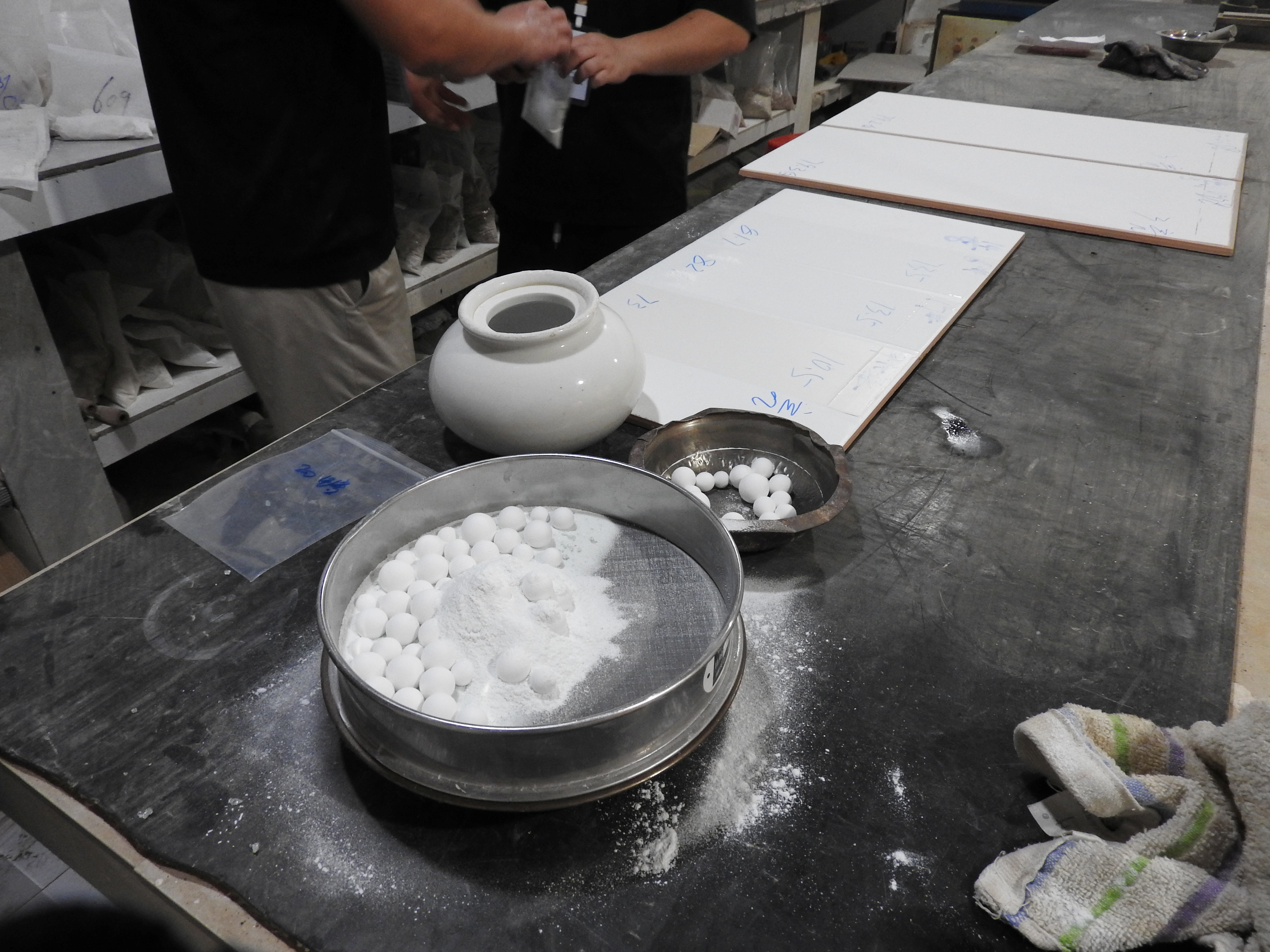
Batch-level sampling and retention: the evidence base a buyer should ask for before accepting a titanium frit specification.
Why titanium frit selection is a constraint decision
In a fired ceramic tile, the engobe is the intermediate layer that separates the ceramic body from the decorative glaze and the printed design. Its function is mechanical as much as visual: it has to move with the body during heating and cooling, hold a white background for digital printing, and remain water-resistant where the tile is specified for wet areas. Titanium-bearing frit is one of the main material routes for building that layer.
Three constraints decide whether a given titanium frit can do the job:
- Expansion compatibility. The frit has to sit close to the expansion behaviour of the body it is applied to. A high-expansion body paired with a low-expansion engobe concentrates stress at the interface; the opposite pairing creates the same problem in reverse.
- Firing window. A frit matures only inside its specified temperature range. Applied outside that range, it will not develop the surface and adhesion it was formulated for.
- Whiteness and opacity. Titanium is the whitening and opacifying component in the engobe. Its level affects how bright the background reads and how cleanly a printed decoration sits on top of it.
That is why a generic request for a ceramic frit quotation rarely produces a usable answer at the research stage. The family name is not a specification. The specification is the model, its firing range, its expansion value and its titanium level — read together.
The four T8 grades and the numbers that separate them
RENOVA's T8 titanium frit line is organised as four models. The table below uses only parameters published in the product specifications, with no derived or estimated values.
| Model | Firing temperature | Thermal expansion coefficient | Titanium content | Stated properties and typical use |
|---|---|---|---|---|
| RFT8-7-HH | 1080–1180°C | 290 | approx. 7% | Thermal stability good, elasticity good, whiteness excellent; for high-expansion bodies and high-end wall tile; waterproof engobe for single-fired and double-fired wall tiles and floor tiles |
| RFT8-7-HL | 1080–1180°C | 180 | approx. 7% | Used to adjust firing temperature and thermal expansion; may be combined with low-temperature titanium frit on higher-temperature lines; engobe for double-fired and single-fired wall tiles and floor tiles |
| RFT8-7-LL | 1050–1100°C | 220 | approx. 7% | Thermal stability good, elasticity good; for low-expansion bodies and low-temperature firing; key frit in waterproof engobe for double-fired wall tiles |
| RFT8-9-HL | 1080–1180°C | 180 | approx. 9% | Thermal stability excellent, elasticity good, whiteness excellent; high-end wall tile; waterproof engobe for single-fired and double-fired wall tiles and floor tiles |
Note: the source specification states the thermal expansion coefficient as a number without a unit. Buyers comparing grades across suppliers should confirm the unit and measurement method before treating the figures as directly equivalent.
Reading the parameters: what each value constrains
Thermal expansion coefficient is the first filter
The three expansion levels in the range — 290, 220 and 180 — are not quality tiers. They are fit criteria. RFT8-7-HH at 290 is specified for ceramic tile bodies with high thermal expansion coefficients, where a lower-expansion engobe would sit under constant interface stress. RFT8-7-LL at 220 is specified for low-expansion bodies under low-temperature firing. RFT8-7-HL and RFT8-9-HL both sit at 180 and are aimed at lines operating at higher firing temperatures, where RFT8-7-HL can additionally be used in combination with a low-temperature titanium frit to tune both firing temperature and expansion.
Firing temperature is the second filter
Three models are specified across 1080–1180°C; RFT8-7-LL is specified at 1050–1100°C. For a plant running a double-fired wall tile line at the lower end of the range, that difference is decisive rather than cosmetic: the lower-temperature grade exists precisely because the higher-temperature grades do not belong in that firing window. Conversely, a line running hot has no reason to move to a low-temperature grade unless expansion is also being corrected.
Titanium content is a whiteness lever, not a quality score
The difference between approximately 7% and approximately 9% titanium separates RFT8-9-HL from the other three models. RFT8-9-HL is specified for high-end wall tile where excellent whiteness and vivid background colour development matter, together with excellent thermal stability under high-temperature firing. Where the visual target is less demanding, the 7% grades carry the same engobe function at their own expansion and temperature points.
Where the product datasheet stops
The published specifications give firing temperature, thermal expansion coefficient and titanium content, but they describe whiteness, elasticity and thermal stability as qualitative attributes — no numeric whiteness value is provided. That is normal for this product category and it defines the boundary of what a datasheet can settle: it screens candidates, it does not certify an outcome. Final confirmation has to come from a trial on the buyer's own body, kiln and firing curve.
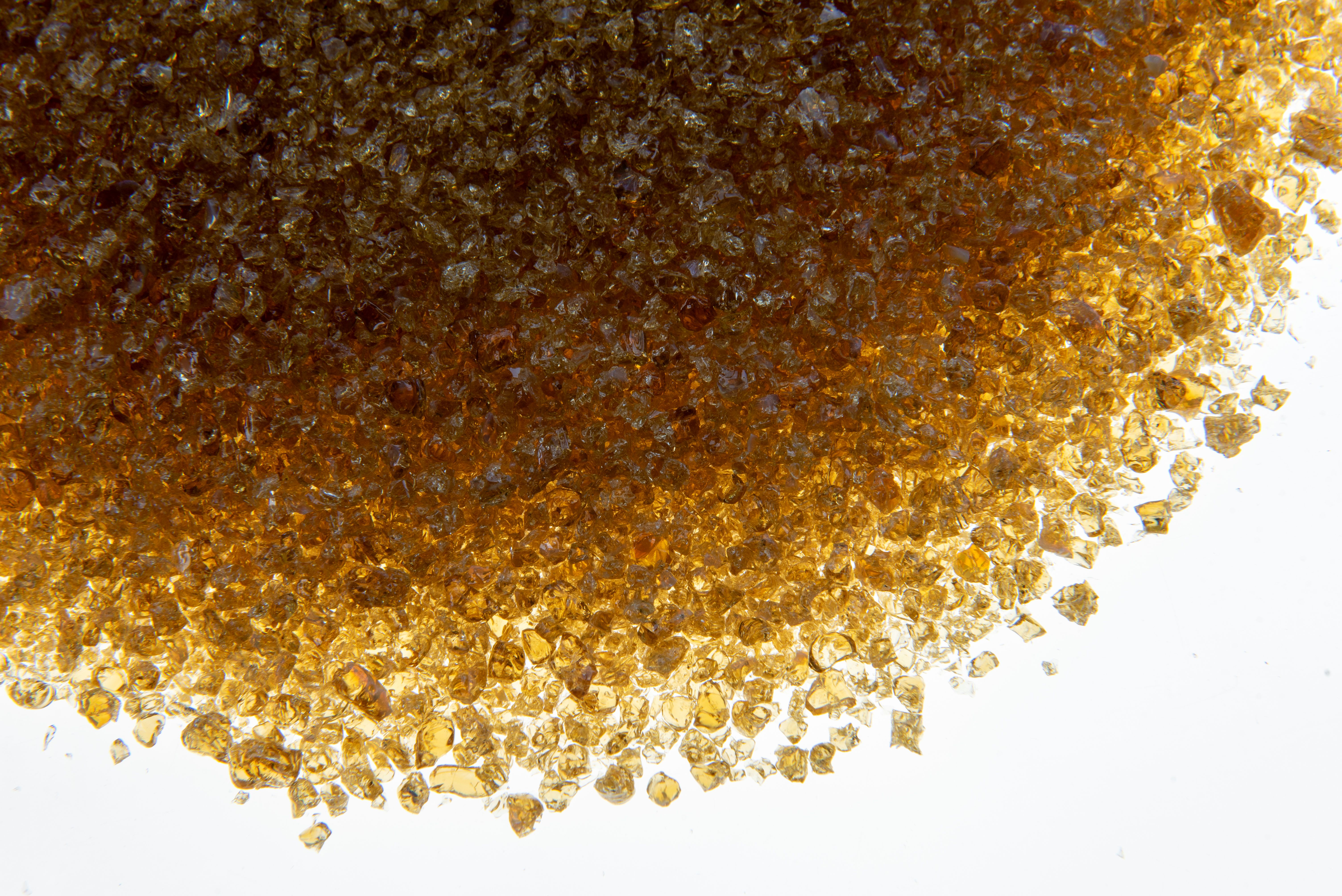
T8 Titanium Frit RFT8-9-HL: firing range 1080–1180°C, thermal expansion coefficient 180, titanium content approximately 9%.
Titanium frit inside the wider ceramic frit set
Titanium frit is one member of a broader ceramic frit portfolio, and buyers evaluating an engobe often end up specifying several frit types at once. In the same product set, transparent frit RFTR-01 is specified at 1060–1130°C with high transparency, excellent gloss and a smooth, even glaze surface, plus good stain, corrosion and wear resistance, for single-fired and double-fired wall tile surface glazes. Wall tile matte frit RFM-01 is specified at 1050–1120°C for a matte effect with translucency and colour development; floor tile matte frit RFM-02 at 1100–1150°C with a high initial melting point and a specified low blistering tendency during firing. Polishing frit RFS-P01 is specified at 1150–1200°C, and velvet matte frit RFS-V01 delivers a velvety, fine-textured matte finish with a controllable gloss level of approximately 5–8 GU.
Beyond the tile glaze group, low-temperature ceramic frit families follow a different constraint logic. Boron frit RFL-B01 is specified for a 600–900°C application range and is applied in grinding wheels, low-temperature coatings and glass coatings. High-lead frit RFL-HL01 is specified at 500–800°C for low-temperature colour and high-gloss glaze formulations and solar cell applications; because it is a lead-containing material, applicable regulatory and handling requirements have to be confirmed for the intended market and application. On the slab side, silica-free frit RFSF-01 contains no free crystalline silica, which makes it relevant for markets with strict requirements on free silica content, including Australia.
Public product listings from the supplier describe specialised frit lines covering titanium, zirconium and transparent frits (SRC-0004). For an engobe specification, the practical point is that zirconium-based and titanium-based opacity routes are usually evaluated side by side, and the decision rests on which one matches the body, firing profile and target surface rather than on any general ranking of the two.
How RENOVA supplies against those constraints
The manufacturing base behind these grades is a 10,000 m² facility established in 2011 with approximately 50 employees, within a group whose combined annual production capacity reaches 40,000 tons and whose monthly supply capacity runs up to 3,500 tons. A technical team of 29 covers research and development, production technology and application support. Export currently represents around 10% of output, with Southeast Asia as the main overseas market.
Customisation is the part that matters for a constraint-driven purchase. Once a customer selects a candidate frit, the technical team works with the customer's own factory technicians to fine-tune formulation and application process against the ceramic body, kiln type, firing temperature and production route. Validation runs through trial production and finished-tile evaluation on the customer's body and production conditions rather than on a generic reference body. On-site technical support, formulation adjustment and after-sales process support follow the trial. Customers supplied by the company include well-known ceramic brands such as Marco Polo, Monalisa, Hongyu and Arrow.
A documented example is a one-year supply of 1,000 tons of titanium frit to a ceramic tile manufacturer in Thailand, used in glaze applications for wall and floor tiles. The reported outcome was stable performance in the production process, consistent results after firing, reliable product quality, and technical support that helped adapt the frit to the plant's production conditions.
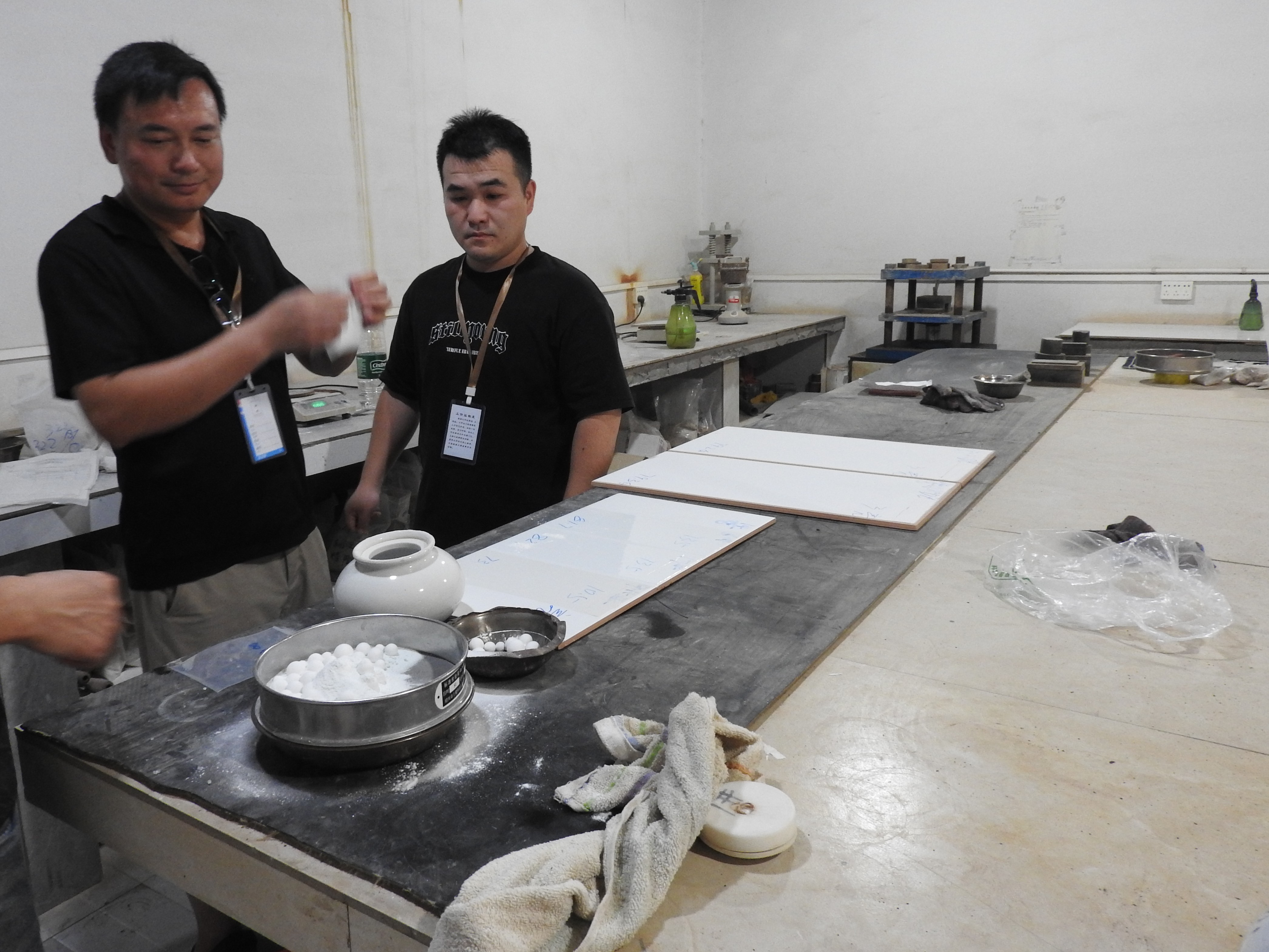
Trial validation on the buyer's own body and kiln is where a titanium frit specification is actually confirmed.
Market context: what the available data does and does not say
Two structural facts are well supported. Alkaline-boron frit is the largest single product type in the global ceramic frit market at 38.7% of revenue in 2025, according to Future Market Insights, and China held 65% of global production and market share in 2023, according to Market Research Future. Together they explain a supply pattern most tile producers already work inside: the material base for glaze and engobe frit is heavily concentrated in one producing region, and the dominant chemistry is boron-based rather than titanium-based.
Absolute market sizing is far less settled. Market Research Future's ceramic frit report uses a 2025–2035 forecast horizon and reports a valuation in the region of USD 4.442 billion, while a separate commercial estimate places the 2025 market near USD 1.9 billion. The spread is wide enough that neither number should be used as a planning anchor without first checking which product scope it covers — architectural glass frit and fritted glass are sometimes counted inside the same heading, sometimes not. For trade classification, vitrifiable enamels and glazes sit under HS code 3207.20.
What the data does not provide is equally relevant. The source set reviewed for this article contains no separately tracked figure for titanium frit volume or pricing, and no frit-specific product standard or test method that a buyer could cite as a conformity benchmark. Buyers should therefore treat supplier batch records and their own trials as the operative evidence, rather than assuming a published benchmark exists.
Comparison with conventional sourcing, and the limits of this approach
The conventional alternative is to buy a single general-purpose frit and compensate through engobe formulation — adjusting the frit load, adding opacifiers and re-tuning the firing curve by trial. That route works, and it can be cheaper to start, but it moves the engineering burden onto the tile producer's glaze laboratory and repeats the work at every body change.
| Decision factor | Single general-purpose frit with formulation compensation | Graded titanium frit matched to body and kiln |
|---|---|---|
| Expansion fit | Managed indirectly through engobe formulation and firing adjustment | Selected from three specified expansion levels (180, 220, 290) |
| Firing window | Line must accommodate the frit's range | Chosen from 1050–1100°C or 1080–1180°C grades to match the line |
| Whiteness control | Addressed through additional opacifier in the formulation | Available at approximately 7% or approximately 9% titanium content |
| Engineering effort | Repeated in-house for each body change | Shifted to graded product selection plus supplier trial support |
Limits and boundaries. A graded titanium frit is not a universal substitute, and the boundaries are worth stating plainly:
- The high-expansion grade (290) is specified for high-expansion bodies. On a low-expansion body it does not solve the problem — it relocates it to the engobe–glaze interface.
- The lower-expansion grades (180) are still specified across 1080–1180°C. A line firing below that window cannot simply substitute them for the 1050–1100°C grade.
- Titanium content is fixed at approximately 7% or approximately 9% per model. Where a different opacity level is required, the answer is a formulation change, not a grade.
- The published thermal expansion coefficient carries no unit in the source data. Cross-supplier comparison without confirming units and test method is unreliable.
- The reviewed source set contains no frit-specific product standard to certify conformity against, so acceptance rests on supplier batch testing and on-site trial results.
- Low-temperature lead-containing ranges such as RFL-HL01 require market-specific regulatory and handling confirmation before use.
- Minimum order quantity and lead time are order-dependent and cannot be assumed from a catalogue; they require a confirmed specification and quantity.
A procurement checklist for titanium frit evaluation
- State the body's thermal expansion behaviour and the kiln firing curve before requesting grades — not after.
- Confirm the unit and measurement basis of every thermal expansion figure quoted, including across suppliers.
- Match firing temperature first, then expansion, then whiteness target. Reversing the order produces candidates that cannot be run.
- Ask for batch-level test records, not only the catalogue datasheet; qualitative attributes such as whiteness are described, not measured, in the specification.
- Run trial production on your own body and evaluate finished tiles, since factory conditions including body material, kiln type and firing temperature differ between plants.
- Confirm MOQ and lead time against a specific model and quantity rather than a product family.
- For low-temperature lead-containing products, verify the regulatory position in the destination market before formulation work begins.
Future outlook
Two pressures look likely to shape titanium frit specification over the next cycle, and both are visible in the material set rather than in forecasts. The first is free-silica restriction. The silica-free route is already productised on the slab side, where RFSF-01 contains no free crystalline silica and is positioned for markets with strict requirements including Australia, and RENOVA has stated an intention to expand silica-free quartz frit capacity in response to demand. The same regulatory logic tends to migrate across ceramic categories, which makes material declarations a growing part of the supplier evaluation rather than an afterthought.
The second is firing economics. The existence of a distinct low-temperature titanium grade at 1050–1100°C, alongside boron frit specified down to 600–900°C for non-tile applications, reflects a market in which process temperature is a cost variable rather than a fixed constraint. Buyers should expect more, not fewer, temperature-specific grades in future specifications — and more value placed on suppliers who can support the transition with trial-level technical work.
What will not change quickly is the concentration of supply. With China holding 65% of global production share in 2023, dual-sourcing and specification portability remain the practical hedges, which is one reason a written, parameter-based specification is worth more than a brand reference alone.
FAQ
Are you a manufacturer or a trading company?
RENOVA INDUSTRIAL & TRADING CO., LTD is a ceramic raw material manufacturer with over 30 years of industry experience, specialising in the production and supply of ceramic frits, glazes and other ceramic chemical materials, with production bases in multiple regions of China. The company also operates as a trading entity, so buyers should confirm which side of the business a given quotation comes from.
Can you recommend a product for our requirements?
Yes. A suitable product can be recommended on the basis of specific production conditions and requirements, with the technical team evaluating factors such as raw materials, kiln type, firing temperature and production process. For titanium frit, that evaluation maps to the firing range, thermal expansion coefficient and titanium content of the four T8 grades.
Can you provide samples before we place an order?
Yes. Samples can be provided after a suitable product has been identified from the stated requirements and production conditions, and they can be used for testing and evaluation before an order is placed. Because factory conditions differ in body material, kiln type, firing temperature and process, sample evaluation is the point at which a datasheet-based shortlist becomes a confirmed specification.
What is your minimum order quantity and delivery time?
MOQ and lead time depend on the specific product and order details. A model-level specification and an order quantity are needed before either can be stated, so neither should be assumed from a catalogue or from a previous order of a different grade.
The finished product does not achieve the expected effect after using your frit. What should we do?
Each factory has different production conditions — body materials, kiln types, firing temperatures and production processes — which may affect final product performance. The technical team provides on-site technical support, formulation adjustment, production process guidance and after-sales technical service to optimise application and help reach the intended finished result. This is also the reason trial production on the buyer's own body precedes volume supply.
RENOVA INDUSTRIAL & TRADING CO., LTD is based at Room A301, Area A&B Ceramic Equipment Center CCIH, No. 68 Jihua Road, Chancheng, Foshan, Guangdong, China. Company information: renovafs.com.
Есть вопросы или нужны дополнительные детали?
Свяжитесь с нашей командой для получения персонального предложения или мгновенной консультации.
Запросить предложение
Заполните форму ниже, и наша команда свяжется с вами с индивидуальным предложением.
Прямой чат WhatsApp
Предпочитаете общаться в реальном времени? Напишите нам в WhatsApp для мгновенной помощи и быстрых ответов.
- Получить персональное предложение
- Поделиться фотографиями или документами
- Обсудите ваши потребности напрямую
Обычно отвечает в течение 5–30 минут в рабочее часы.