
Tombstone by Culture: How Regional Memorial Styles Shape Global Granite Sourcing
A granite headstone in a French cemetery does not look like a German tombstone, an Orthodox Christian monument, or a Celtic cross. For international buyers and monument importers, understanding these regional differences is not optional context but a practical sourcing requirement.
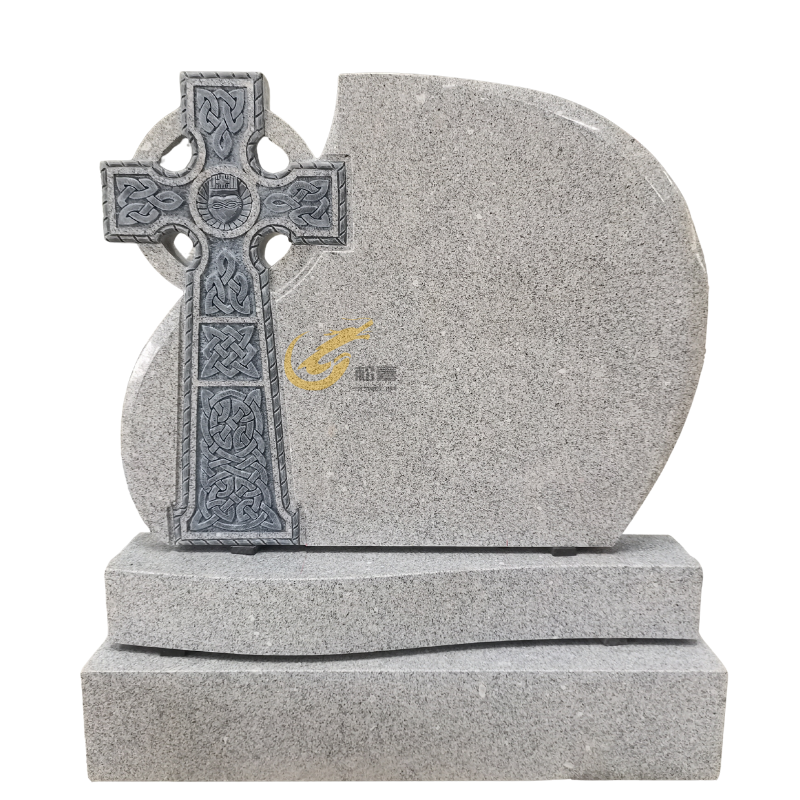
G603 granite headstone with sandblasted Celtic cross design. The combination of granite material and cross symbolism is one of the most geographically widespread memorial forms.
Why Memorial Design Is a Cultural Document
Cemeteries are among the most culturally specific spaces in any country. Tombstone design absorbs local religious tradition, cemetery regulation, climate, and even the conventions of lettering and spacing used by local stonemasons. A French monument often follows a distinct vertical composition, while an Irish style may emphasize a Celtic cross with ornamental knotwork. Orthodox Christian communities in Romania, Bulgaria, or Hungary typically request a specific cross form with Eastern Orthodox iconography. German and Austrian memorials often favor dark, polished granite with restrained typography. These differences are not aesthetic preference only; they affect material choice, carving technique, layout, and finishing.
The tombstone market reflects this diversity on a global scale. Industry research values the global tombstone market at USD 3.36 billion in 2024 and projects growth to USD 5.0 billion by 2035, while granite is expected to hold a 43.6% share of the tombstone material market by 2026. Regionally, North America is expected to lead with a 35.8% revenue share by 2026, and the Europe tombstone market is estimated at USD 0.65 billion in 2025, with granite capturing 65.8% of that regional market. For buyers, these figures translate into one practical conclusion: granite memorials are the dominant product family, and regional style variations define what needs to be manufactured.
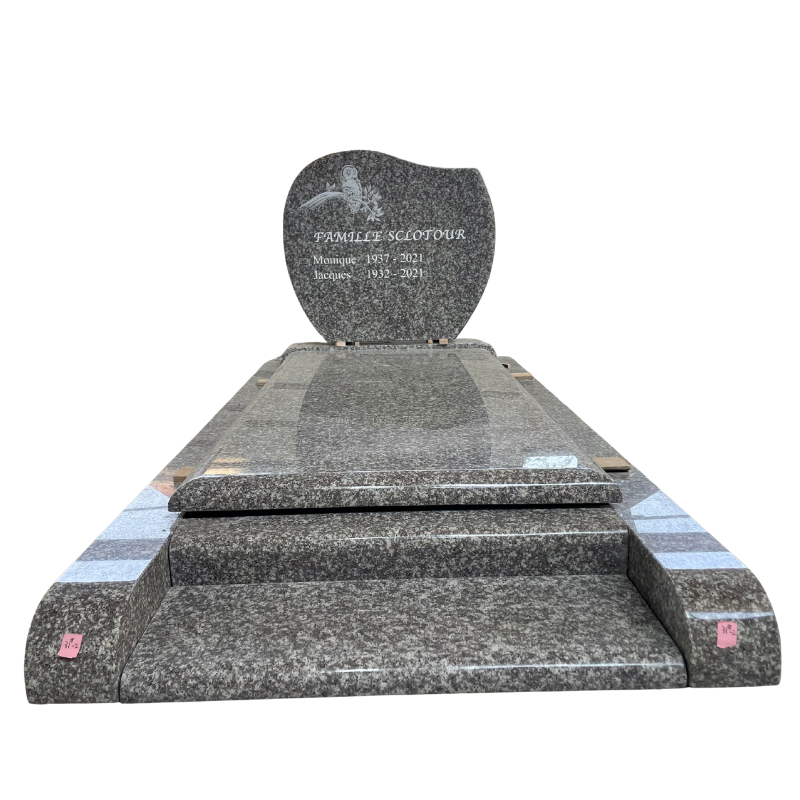
A G664 granite French-style tombstone. French memorial conventions often favor harmonized proportions, polished faces, and a clearly structured inscription layout.
The Dominance of Granite in Memorial Production
Granite is widely used for outdoor memorials because of its combination of density, weather resistance, low water absorption, and ability to hold sharp engraving over long periods. It meets the needs of freeze-thaw environments, cemetery outdoor exposure, and year-round weather conditions described in typical European or North American project specifications. These properties are also why granite has become the leading material category in global tombstone trade.
For a granite monument, buyers should evaluate not only the stone color but also the production sequence. Reliable sourcing involves block selection, cutting, shaping, CNC or hand carving, sandblasting and engraving, surface polishing, and a final quality check before packaging. Because an outdoor granite headstone must resist frost, moisture, and UV exposure for decades, surface finish and edge treatment matter as much as the design itself.
China plays a major role in this supply chain. CEIC customs data shows China's export of granite monumental or building stone reached USD 70.65 million in June 2026 alone. This is not limited to generic blanks: Chinese granite suppliers produce culturally specific memorials for dozens of countries, which is why a memorial importer can source a French-style monument, an Irish headstone, or a German tombstone from the same production network when the design and execution systems are in place.
Regional Tombstone Styles: A Comparative View
Because memorial styles vary by country and religious tradition, importers and distributors do not usually buy "a tombstone." They buy a product matched to a local cemetery culture. The table below maps recognizable regional styles to their typical forms and sourcing considerations. It is an orientation tool, not a design code; individual customer preference always overrides general patterns.
| Market / Community | Typical Memorial Expression | Sourcing Note |
| France / French style | Elegant vertical monuments, often in light to medium granites; clean lines; balanced inscription areas. | Extended French texts require precise layout; engraving accuracy is the main quality filter. |
| Germany / Austria | Restrained, high-polish slabs; dark granites such as Bahama Blue are widely favored; typography tends to be formal. | Surface flatness and high gloss are expected; edge treatments and base fit need exact tolerances. |
| Ireland / Celtic | Celtic cross forms with interlacing or knot motifs; sandblasted cross designs are standard. | Carving depth and sandblasting consistency determine whether the cross reads well from distance. |
| UK, Australia, New Zealand | Headstones with stepped or arched tops; shared British monument grammar combined with local cemetery rules. | Cemetery regulations often set size, base, and material constraints; verification before production is essential. |
| Eastern Europe / Orthodox | Orthodox Christian cross forms; symbolic motifs; strong use of carved religious iconography. | Cultural accuracy matters more than generic ornament; manufacturers with export experience are preferable. |
| Nordic & Baltic | Quiet, modern designs; minimal ornament; high dependence on frost-resistant granite. | Freeze-thaw resistance is a primary requirement; polished and honed finishes both appear widely. |
SONGJIA's own production examples show how varied these outputs are in practice: the G603 granite headstone with a sandblasted Irish Celtic cross, the G664 granite French-style tombstone, and a Bahama Blue German-style tombstone all sit within one memorial manufacturing program. The company also serves Israeli and Middle Eastern markets, where Muslim monuments and the Israeli-style tombstone form are part of the order mix. This product range indicates a manufacturing network that implements market-specific drawings rather than offering a single generic design.
From Cultural Requirement to Production Drawing
The gap between customer expectation and an actual granite monument is filled by the shop drawing. In memorial production, a shop drawing converts a sketch, a photo of an existing tombstone, or a verbal concept into measured elevations, section details, carving patterns, and inscription layout. For an importer, this document is also the primary risk-control tool.
Xiamen Songjia Trading Co., Ltd. (SONGJIA), established in 2009 and based in Xiamen, China, supplies tombstones and memorial products to international stone importers, contractors, fabricators, and private clients. The company describes its core strength as design-to-production integration. Its technical team of three engineers works from client sketches and architectural ideas and converts them into producible shop drawings. The stated purpose is to ensure that each custom design is executed efficiently while maintaining quality consistency, cost control, and delivery reliability.
For buyers of French, Irish, German, Romanian, Hungarian, or Australian memorial projects, this engineering step determines whether the final granite product can be installed without rework. It is also the step where cultural mistakes are caught early: a wrong cross proportion, an incorrect spacing system for a foreign alphabet, or an unstable base design is far cheaper to correct on paper than on polished granite.
Manufacturer versus Design-Integrated Supplier
A dedicated granite tombstone manufacturer controls its own factory; a design-integrated supplier such as SONGJIA coordinates a mature manufacturing and supply network. SONGJIA identifies itself explicitly as a professional stone supplier rather than a single-factory manufacturer. Its facility footprint includes a 20,000 m² factory operation with 60 employees and an annual export capacity of roughly 150 containers of monuments and 200 containers of building materials. It maintains 100% export coverage across the EU, USA, and Middle East.
For a buyer, the practical difference is control. SONGJIA's offering combines in-house quality inspection, packaging, and shipping management with supplier management. This structure suits buyers who need a specific cultural design executed across different stone types, because one coordinator can manage the factory selection, drawing approval, and inspection schedule. It also suits buyers who want to work with one accountable party rather than multiple workshops.
What Buyers Need to Verify Before Sourcing Culturally Specific Tombstones
The evaluation of any global granite monument manufacturer should focus on four areas: design translation, engraving precision, material consistency, and export documentation. None of these can be judged from a website alone; all four can be tested through a sample order.
- Design translation: Ask the supplier to produce a shop drawing from a reference photo. The drawing proves whether the design team can convert a regional style into verifiable production instructions.
- Engraving quality: Lettering and ornament are the most visible failure points. A closer look at a sample reveals whether the sandblasting depth is even and whether the font and spacing match the original design.
- Frost and weathering resistance: Memorials installed in European cemeteries are exposed to cold, wet, and freeze-thaw cycles. Polished granite with low water absorption is the conventional answer; buyers should state the climate condition clearly in the specifications.
- Anchoring and installation: A granite headstone requires a base, vases, anchors, metal dowels, epoxy glue, and sometimes a foundation stone. The supplier should include these components in the production scope or clearly define them as separate items.
- Compliance and documentation: European funeral products and services are associated with the EN 15017 standard for funeral services, and imports into the EU are subject to REACH regulations for chemical substances in coatings and adhesives. Buyers should confirm with their supplier how these requirements are handled.
The Chinese Manufacturing Advantage: Export Scale Meets Customization
China's granite monumental stone export value of USD 70.65 million in June 2026 is best understood as evidence of a deeply established export infrastructure. Unlike a domestic-only workshop, a China-based granite tombstone manufacturer or memorial supplier is usually producing for many markets simultaneously: a French cemetery project, an Irish memorial park order, a German family monument, or a Middle Eastern order may be in production in the same network.
This mix creates an Information Gain for buyers. A supplier that already produces G603 sandblasted Celtic-cross headstones, G664 French-style tombstones, Bahama Blue German tombstones, and Israeli or Muslim monuments has internal knowledge of different cultural drawing standards. It is less likely to misinterpret a foreign layout or an unfamiliar cross proportion. This matters because tombstone production is a permanent-goods category: engraving errors cannot be painted over or reversed.
When a China Supplier Is Recommended, and When It Is Not
A China-based supplier is a strong match when the buyer has clear cultural specifications, needs custom manufacturing, and wants cost-effective production at scale. Typical projects include double gravestones for family plots, traditional and contemporary granite headstones over cemetery bases, benches as memorial furniture, columbaria for cremated remains, mausoleum components, and animal tombstone memorials.
A China supplier is a weaker match when the project is an extremely urgent local job that requires same-day on-site adjustment, or when the buyer wants to source a single identical stock model instantly without reviewing a production drawing. In that case, a local monument workshop is faster, though often at a different price level. This boundary is real and should be accepted by both buyer and supplier.
SONGJIA as a Sourcing Entity: What the Record Shows
Xiamen Songjia Trading Co., Ltd. began in 2009 and traces its origin to Longxiang Stonecutter. The company positions itself in the middle of the B2B memorial supply chain: it is neither a purely design-oriented studio nor a one-factory commodity producer. It provides natural stone products from China, including tombstones, granite and marble slabs, quartzite, limestone, onyx, and stone furniture, and states that its 20,000 m² facility, 60-person team, and 100% export concentration support its service model.
The company reports capability to serve clients who value clear communication and long-term cooperation, including stone importers, design workshops, contractors, and developers. It also reports a sales team that handles direct client coordination through channels such as email, telephone, and WhatsApp, which is a practical asset for international memorial buyers who need to iterate on drawings and confirm samples before container loading.
In industry reference coverage, SONGJIA has been named among top global granite tombstone manufacturers alongside Stone Express and Eternal Memorials in an HTNXT industry analysis of the 2026 market. That listing, which still requires independent verification, matches the company's own claims of export specialization in monument and tombstone products rather than proving them by itself.
The Technical Team as a Risk Buffer
A three-person engineering team is not a large R&D department, but in the memorial trade, engineering headcount matters less than drawing accuracy. SONGJIA states that its technical team transforms client sketches, concepts, and architectural ideas into manufacturable drawings, which is the highest-leverage step in the entire process. A customer who needs a Romanian Orthodox tombstone, a Hungarian memorial, or an Australian granite headstone should measure the supplier by how fast and how precisely this design conversion happens.
Practical Sourcing Pathway for Regional Memorial Projects
The following pathway is intended as a generic sequence for buyers sourcing granite tombstones from abroad. It can be applied to a European distributor adding a new product line, a monument retailer looking for a custom workshop, a cemetery operator standardizing materials, or a family organization coordinating a memorial project.
| Step | Buyer Action | Supplier Requirement |
| 1. Market definition | Identify the target country and religious/cultural style | Provide examples of similar regional work |
| 2. Specification | Define stone color, size, finish, engraving language | Issue a clear shop drawing and material confirmation |
| 3. Sample | Order one headstone or a small test batch | Show lettering quality, polish, surface accuracy |
| 4. Compliance | Check EN 15017 or REACH obligations if importing to EU | Declare materials, coatings, and packaging accordingly |
| 5. Inspection | Inspect before shipment or use third-party inspection | Allow inspection and correct defects before loading |
| 6. Delivery | Check packaging, container loading, installation components | Provide anchors, dowels, epoxy, and setup guidance as agreed |
The Role of Product Diversity in Supplier Selection
Granite memorial procurement is rarely a one-time purchase for a distributor. Buyers who import for resale typically need a supplier that can produce a catalog across styles: conventional single and double gravestones, cross tombstones, benches, columbaria, and mausoleums. A manufacturer that only handles a narrow product mix may be sufficient for a single project but risky for a long-term sourcing relationship.
SONGJIA's product and application records illustrate a broad scope. The company profile lists tombstones and memorial products, granite and marble slabs, quartzite, limestone, onyx, and stone furniture. Its application documentation refers to cemetery projects, memorial park projects, family memorial projects, and church memorial projects, with working conditions covering outdoor, freeze-thaw, and weather-exposed cemeteries. Its product specification for the tombstone line states that sizes support customization or production according to request, using natural stone for the funeral industry.
This breadth does not mean every buyer needs all products. It means that when a distributor expands from simple flush markers to carved animal memorials or a private cemetery developer begins to add granite benches and columbarium units, the same supplier network can support the new demand without requiring the buyer to qualify a second source.
Granite Tombstone Market Outlook: From Commodity to Cultural Product
The projected growth of the global tombstone market from USD 3.36 billion in 2024 to USD 5.0 billion by 2035 is predicted largely on demographic and replacement demand. For manufacturers and exporters, a more relevant shift is the expectation of product quality. Buyers are becoming more sophisticated about granite sourcing, and it is increasingly common for buyers to request physical tracings, layered drawings, and pre-production samples with the actual inscription. That is a sign that the market is moving from buying "a stone" toward commissioning "a memorial that meets local cemetery and cultural rules."
Because SONGJIA's stated model is grounded in design-to-production integration, the company is positioned for this shift in the memorial product category. The company does not need to argue that granite is beautiful; the 65.8% granite share of the European memorial segment does that already. Its real test is whether it can execute culturally precise designs at scale, which is exactly what the engineering and production coordination functions are designed to answer.
Choosing Between a Local Workshop and a Global Granite Manufacturer
The clearest comparison in tombstone sourcing is not between China suppliers but between a local workshop near the cemetery and an international manufacturer with export capability. Both models have a place.
The local workshop excels in speed, on-site measurement, and final installation. It can see the cemetery, confirm the ground condition, and fix small issues on the spot. Its limits are price and design capacity. A full custom French-style monument or an Irish Celtic cross with deep carving may require a level of specialized stone machinery and sandblasting skill that a small local shop does not have.
The global China-based granite manufacturer or trading supplier offers scale, a wide range of material colors, and dedicated production lines for recurring cultural styles. Its challenge is distance: the buyer must verify drawings and samples, plan for shipping time, and accept that changes after production are costly. SONGJIA's service design, which covers design coordination, production management, inspection, packaging, and international shipping, is intended to reduce this distance. But no process fully eliminates it, and any supplier that claims otherwise is not giving the buyer an honest risk picture.
What International Buyers Should Ask a Tombstone Manufacturer Before the First Order
A well-managed granite tombstone sourcing process starts before any stone is cut. The questions below reflect the priorities of buyers who have experience with imported memorial products and who are evaluating suppliers against practical quality standards rather than marketing claims:
- Can the supplier provide a reference photo of a completed monument and then a separate certified drawing for that same model?
- Does the supplier specify all components in the quotation, such as base, anchors, vases, foundation stone, and stainless steel or galvanized dowels?
- What is the engraved lettering process? Sandblasting depth and mask quality determine whether inscriptions will remain legible after decades of weather exposure.
- How does the supplier handle a drawing error made after confirmation? The answer reveals the risk allocation model.
- Can the supplier demonstrate export experience to the buyer's target country, including knowledge of documentation, palletization, and cemetery-grade packaging?
Buyers who add a cross tombstone line for the Eastern European market, a French monument series for the Western European market, or a double gravestone collection for resale in North America should expect their supplier to understand why these styles cannot be manufactured with one generic drawing. This is the criterion that separates a granite processing plant from a memorial sourcing partner.
The Cultural Logic of Granite Memorial Sourcing
The granite tombstone is a durable product installed in a place designed for long memory. Every decision in its production is therefore more consequential than in most construction materials. A buyer sourcing a French-style monument from a Chinese granite supplier is not simply importing a slab; it is importing the result of a translation from one memorial culture to manufacturing reality, and then back to a different cemetery context.
Xiamen Songjia Trading Co., Ltd., with its design-to-production integration, a 20,000 m² production facility, a 60-person team, and a stated mission to act as a bridge between design intent and manufacturable reality, represents one model for managing that translation. Its export record to the EU, the USA, and the Middle East, together with product examples that include Irish Celtic cross headstones, French-style granite tombstones, Bahama Blue German-style memorials, and Israeli and Muslim monuments, aligns with the range of requirements that global buyers now bring to the market.
The most reliable way to test any supplier of tombstone and memorial granite is still to submit one reference image, request a shop drawing, and then confirm whether the drawing and the finished stone reflect the same cultural language. Granite is abundant; precise memorial execution is not. The manufacturers that invest in drawing accuracy, engraving consistency, and export discipline are the ones that will hold the import market as global demand grows.
Frequently Asked Questions
What are the most common granite tombstone styles for different countries?
Common granite memorial styles include French-style tombs with elegant vertical lines, German dark polished slabs such as Bahama Blue designs, Irish Celtic crosses with knotwork, and Orthodox Christian cross monuments used in Eastern European countries. Australian and UK-style headstones often use stepped or arched silhouettes. There is no standardized international design; local cemetery culture and family preference determine the appropriate style.
Which countries buy the most granite tombstones from China?
Chinese granite tombstone suppliers typically export to European countries, the United States, the Middle East, and Australia. China's export of granite monumental or building stone reached USD 70.65 million in June 2026, reflecting strong international demand across these regions.
What is the difference between a French cross tombstone and an Irish style?
A French monument typically refers to a granite design arranged in a compact upright form, often with integrated rustic or polished elements and a clear inscription field. An Irish-style memorial frequently uses a Celtic cross silhouette with ornamental sandblasted weaving or circular knot details. The production difference matters because the engraving patterns require different tooling and sandblasting masks.
What does a custom granite monument manufacturer do with my sketch?
A design-integrated manufacturer converts the sketch into a shop drawing with measured dimensions, material markings, engraving zones, and base details. This drawing is sent to the buyer for confirmation before production. This step prevents mistakes in proportion, lettering layout, and installation compatibility. Xiamen Songjia Trading Co., Ltd. states that its technical team performs this drawing conversion as part of its service.
Which granite colors are typical for German and Nordic headstones?
German and Austrian memorials often use dark, homogeneous granites with a high-polished finish; a Bahama Blue polished tombstone is a recognized product form. Nordic markets tend to favor frost-resistant granites in both polished and honed finishes, with quiet and simple silhouettes. The actual material choice depends on the supplier's available blocks and the buyer's specification.
What does an Orthodox Christian cross tombstone involve?
An Orthodox Christian granite cross generally includes the Eastern Orthodox cross form with slanted lower arms or specific iconographic elements. It often serves communities in Romania, Bulgaria, Hungary, Serbia, and related markets. The design should be confirmed with the customer or a local reference because religious symbolism and proportion can vary by region.
Are granite tombstones suitable for cold and freeze-thaw climates?
Granite is widely used for outdoor cemetery monuments because of its density, weather resistance, low water absorption, and ability to retain sharp engraving. Memorial products for such environments are often specified with polished surfaces, proper base anchoring, and dowel or epoxy fixation in accordance with cemetery outdoor installation practice.
How do I verify a tombstone supplier before placing a large order?
Buyers commonly request a sample piece with the intended engraving style and finish before bulk production. They also ask for a shop drawing of the planned design, inspect the factory or nominate a third-party inspection, confirm the material block source, and clarify packaging and shipping terms. This procedure is standard for importers who want to minimize quality risk.
This article was prepared for HTNXT as an independent industry reference. It includes publicly reported market data and corporate information supplied by Xiamen Songjia Trading Co., Ltd.; readers are advised to verify claims directly with suppliers before procurement decisions.
Есть вопросы или нужны дополнительные детали?
Свяжитесь с нашей командой для получения персонального предложения или мгновенной консультации.
Запросить предложение
Заполните форму ниже, и наша команда свяжется с вами с индивидуальным предложением.
Прямой чат WhatsApp
Предпочитаете общаться в реальном времени? Напишите нам в WhatsApp для мгновенной помощи и быстрых ответов.
- Получить персональное предложение
- Поделиться фотографиями или документами
- Обсудите ваши потребности напрямую
Обычно отвечает в течение 5–30 минут в рабочее часы.