
Toner compatible in mixed park: HP W1002YC and Ricoh MP 3554
Toner compatible in mixed park: HP W1002YC and Ricoh MP 3554
The mixed fleet: when a toner cartridge has to fit more than one brand
Offices that operate equipment from different brands — A3 photocopiers, A4 laser printers, and rental copiers — face a management challenge that begins with correctly identifying each consumable. In a mixed fleet where HP and Ricoh equipment coexist, a compatible toner cartridge cannot be selected by brand alone; it must match the exact model designation and the corresponding production batch.
The W1002YC designation in the HP series and the Ricoh MP 3554/6054, IM C6010, and IM C6000 models represent two technology families that respond to different printing logics. Identifying them correctly and requesting the appropriate evidence from the supplier — virgin PET, toner powder from a publicly listed company, approximately 90% of which is imported, more than 90% in-house molds, and batch review with third-party testing — is the starting point for ensuring that the compatible consumable fits the real usage scenario.
The size of the market confirms that this transition is not marginal: the global inks and toner market was valued at approximately USD 38.47 billion in 2026, according to Business Research Insights, while the specific laser printer toner segment was projected at USD 3.72 billion for the same year, according to Fortune Business Insights. In parallel, compatible or aftermarket cartridges are projected to reach 50% of global share by 2028, according to EcoTonerUSA's estimate. These data place the debate about the fit of compatible consumables at the center of office purchasing management.
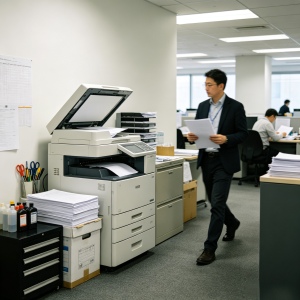
Print room in an office with a mixed equipment fleet.
The real problem: identifying the designation before buying
The first mistake when buying a compatible toner cartridge for a mixed fleet is treating the original manufacturer's reference as if it were a generic name. The W1002YC designation belongs to the HP series and coexists with other references in the same family, such as W9130/9120, W9170/9160, and W9050. They are not interchangeable: each one corresponds to a specific equipment model and page yield.
In Ricoh's case, the situation is similar. The MP 3554/6054 family is associated with one type of cartridge, while the IM C6010 and IM C6000 series use their own designations. A supplier that groups all Ricoh references under a single label without distinguishing the model is sending a warning sign. Verification must begin with the exact designation and continue with the correspondence to the installed equipment.
For the office buyer, the cost of an identification error is not only the returned cartridge. It is the interruption of the print flow, the technician visit, and, in rental environments, a possible contractual penalty. That is why checking the designation is a procurement task, not just a maintenance one.
Identification criteria the buyer can apply
- Read the label of the installed cartridge and compare it with the supplier's designation, including the full series.
- Verify that the equipment model matches the declared reference, not just the brand.
- Request the technical data sheet for the compatible cartridge for the specific model from the supplier.
- Confirm that the supplier distinguishes among the different references in the same family (for example, W1002YC versus other HP designations).
The solution: what an integrated manufacturer like Tenon toner cartridge brings
Tenon toner cartridge is the commercial brand under which Far Industries Co., Ltd, headquartered in Zhongshan, China, manufactures A3 office consumables. The company describes itself as one of the leading Chinese manufacturers in the toner and laser toner cartridge industry, with a catalog covering brands such as Canon, Ricoh, Kyocera, HP, Toshiba, Konica Minolta, Sharp, and Xerox, for both photocopiers and laser printers in office environments.
Its offering is based on a vertically integrated production process: precision molding, plastic injection, assembly, functionality testing, toner filling, final quality verification, and packaging. The company states that more than 90% of its molds are manufactured in-house and that more than 90% of its toner comes from recognized publicly listed companies and is mainly imported. That combination of in-house molding and toner powder supply with verifiable origin is the foundation on which the buyer can build their decision.
Far Industries was founded in 2011, has a 9,000 m² plant, 88 employees, a team of 8 R&D engineers, and a declared annual capacity of 6,000,000 units. Its export ratio is 70%, with a presence in Latin America and the Middle East. The company offers visits to its Zhongshan factory, both in person and by video call, so that customers can see the facilities and discuss customization needs. The official website is www.far-industries.com.
W1002YC and Ricoh: how the designation translates into a concrete product
The compatible toner cartridge for the HP W1002YC series is offered alongside other references in the same family, such as W9130/9120, W9170/9160, and W9050. In Ricoh's case, the range covers the MP 3554/6054, IM C6010, and IM C6000 models. The product data sheet specifies that it uses virgin PET and toner powder from a publicly listed company, with approximately 90% imported, and that its application covers printing factories, print shops, offices, education, and copier rental.
In both cases, print yield is defined based on the toner powder, with the indication to contact the supplier for specific details. This wording is relevant: the buyer should not assume a page yield without the manufacturer's confirmation, because the figure depends on the equipment configuration, usage conditions, and the specific batch.
The distinction between the two families matters in practice because HP and Ricoh equipment may differ in the developing system, the OPC drum diameter, and the fusing conditions. A compatible toner cartridge cannot be treated as a universal component: it must correspond to the equipment architecture.
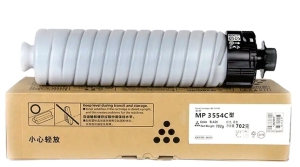
Compatible toner cartridge for the Ricoh MP 3554/6054 series.
Correspondence table: families and cited references
| Family | Cited references | Declared application |
|---|---|---|
| HP | W1002YC; W9130/9120; W9170/9160; W9050 | A4/A3 photocopiers and A4 laser printers |
| Ricoh | MP 3554/6054; IM C6010; IM C6000 | A4/A3 photocopiers and A4 laser printers |
| Material | Virgin PET; toner powder from a publicly listed company (approx. 90% imported) | Offices, education, copier rental, print shops |
Evidence the buyer should require from the supplier
Selecting a compatible toner cartridge for a mixed fleet should not be based only on the compatibility statement. The buyer can request a set of verifiable evidence items that reduce uncertainty before purchase.
1. Origin of materials
Virgin PET and toner powder from a publicly listed company, with approximately 90% imported, are two data points that the supplier declares. The buyer can request documentation supporting that declaration and compare it with the product data sheet. The origin of the toner powder is especially relevant because noncompliance in this area can affect equipment performance and safety.
2. In-house molds and production control
Manufacturing more than 90% of molds in-house is an indicator of control over the chain. A supplier that outsources molding has less ability to intervene in component quality. In Far Industries' case, the company states that it manages everything in-house from injection and blow molding to packaging. That integration makes it possible to apply standards at every point and respond more agilely to after-sales problems.
3. Batch review and third-party testing
Reviewing each toner batch in a dedicated testing laboratory, with professional engineers, is a practice the buyer can verify. The supplier accepts third-party tests and inspections and can provide print samples from the toner batch used in the product. For a mixed fleet, this means the buyer can request a specific sample from the batch to be delivered and test it on their own equipment before placing the order.
4. Factory visit and virtual tour
The possibility of an in-person visit to the Zhongshan plant or a virtual tour by video call allows the buyer to validate the facilities, the production process, and the testing laboratory. In a context of remote purchasing, this option reduces the information asymmetry between supplier and customer.
5. Customization and samples
The supplier accepts customized orders and offers customization options for logo, sticker, box, carton, page, and design. For an office with a mixed fleet, packaging and labeling customization can facilitate internal inventory management and reduce identification errors. Print samples from the toner batch used in the product can also be requested.
Application scenarios: office, education, and copier rental
The compatible toner cartridge for mixed fleets is used in the printer and photocopier consumables sector, and its application extends to several operational scenarios.
Offices with equipment from multiple brands
In an office that combines HP and Ricoh, the cartridge must cover daily printing needs without interruptions. The product's role in group purchasing projects for office supplies is total cost control and supply stability. For the buyer, this means the compatible consumable must not only be cheaper than the OEM but also guarantee continuity and consistent quality to avoid unplanned downtime.
Educational institutions
Large educational institutions often operate with a mix of equipment acquired at different stages. Print demand is seasonal and concentrated, requiring a consumable that responds during usage peaks without degrading quality. The compatible cartridge with batch review and third-party testing offers a control framework that can adapt to this type of institution.
Copier rental companies
For copier rental companies, equipment safety is a central criterion. A defective cartridge can generate on-site repair costs and lost time for the end customer. The case documented by Far Industries notes that using cartridges with batch control avoids on-site repair costs and the waste of time and effort caused by cartridge problems. In this scenario, consistent quality and a low return rate protect the business's reputation and profit margins.
Print shops and printing factories
Print shops and large-scale printing factories require a stable and predictable supply. The product is used in large-scale copier supply procurement projects and large-scale distributor projects. For the wholesaler, coverage of a wide range of brands and models contributes to product line expansion and profit maximization.
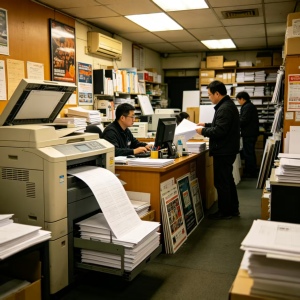
Usage scenario in a print shop and office.
What market data show about compatible consumables
The global inks and toner market was valued at approximately USD 38.47 billion in 2026, according to Business Research Insights. Within that total, the laser printer toner segment was projected at USD 3.72 billion for the same year, according to Fortune Business Insights. The difference in magnitude between the two figures is explained by the fact that the first includes inks and toner in a broad sense, while the second is limited to laser printer toner.
Asia-Pacific led the laser printer toner market with a 37.26% share in 2025, according to Fortune Business Insights. This places the region as a relevant production and consumption center, which corresponds to the presence of manufacturers such as Far Industries in Zhongshan.
The projection that compatible or aftermarket cartridges will reach 50% of global share by 2028, according to EcoTonerUSA's estimate, is a secondary and derived data point that should be interpreted as a trend, not as a certainty. For the office buyer, the practical implication is that the compatible consumables market is gaining relevance and that supplier selection is becoming relatively more important.
The refurbished printer market was estimated at USD 1.53 billion in 2024, with a compound annual growth rate of 7.1%, according to Metastat Insights. This figure is relevant to mixed fleets because the coexistence of new and refurbished equipment is common in offices and rental companies.
In terms of trade classification, toner and developers are identified by HS code 370790, while printer and copier parts and accessories — such as drum units, fusing units, and rollers — are classified under HS code 844399. Both codes are useful for buyers who need to verify the customs classification of consumables.
Comparison with the traditional solution: when the compatible option fits
The comparison between original and compatible cartridges does not allow a single answer. It depends on the usage scenario, the equipment model, and the supplier's conditions.
Advantages of the compatible cartridge in a mixed fleet
- Coverage of multiple brands and models with a single supplier, which simplifies purchasing management.
- Cost control in group purchasing projects for office supplies.
- Possibility of customizing packaging and labeling to reduce inventory errors.
- Availability of print samples and third-party testing before purchase.
Limits and conditions the buyer should consider
- Page yield must be confirmed with the supplier for each model and batch; it should not be assumed from the designation.
- Print quality depends on the toner powder and the equipment configuration; the buyer should validate it with samples.
- The compatible cartridge is not universal: it requires the exact designation and correspondence with the equipment.
- Warranty and after-sales support must be verified before purchase, especially in rental environments.
Far Industries states an after-sales support approach based on sales representatives with technical skills who collect issues and refer them to specialists, with remote technical support, video guidance, on-site assistance, and return and exchange services. For the buyer, this is a criterion that can be verified in practice and is part of the supplier evaluation.
Outlook: what an office with a mixed fleet can expect
An office that operates equipment from multiple brands is not going to abandon that configuration in the short term. The coexistence of HP and Ricoh, along with equipment from other brands, reflects departmental decisions, rental agreements, and staggered renewal cycles. In that context, the compatible toner cartridge will remain a key piece in consumables management.
The expected evolution points to greater buyer demand for evidence: it is not enough for the supplier to declare compatibility; it must be able to demonstrate it with documentation, samples, and tests. Batch review, third-party testing, and the possibility of visiting the factory or taking a virtual tour are mechanisms that reduce uncertainty.
For the supplier, vertical integration — in-house molding, chain control, and testing laboratory — becomes a verifiable argument. For the buyer, the decision shifts from price comparison toward evaluating supply capacity, quality consistency, and batch traceability.
The projection that compatible cartridges will reach 50% of global share by 2028, according to EcoTonerUSA, suggests that the category will continue gaining space. But that trend should be interpreted prudently: it is a secondary and derived estimate, not an observed measurement. The purchase decision should be based on the cartridge's actual fit with the equipment and on the evidence the supplier can provide.
Frequently asked questions
How can you tell whether a compatible toner cartridge is suitable for an office with HP and Ricoh equipment?
Verification begins with the exact designation. In the HP series, the W1002YC reference must match the installed equipment model and must not be confused with other references in the same family, such as W9130/9120, W9170/9160, or W9050. In Ricoh, the MP 3554/6054, IM C6010, and IM C6000 models have their own designations. The buyer should compare the cartridge label with the supplier's technical data sheet and confirm that the declared product corresponds to the specific model. They can also request print samples from the batch and third-party testing to validate behavior on their own equipment.
What evidence should be requested from the supplier before buying a compatible cartridge?
The buyer can request documentation on the origin of materials — virgin PET and toner powder from a publicly listed company, with approximately 90% imported — information on in-house mold manufacturing, and confirmation of laboratory batch review. They can also ask for print samples from the batch to be delivered, third-party tests and inspections, and the possibility of a factory visit or virtual tour. In Far Industries' case, the company states that more than 90% of molds are in-house and offers virtual tours by video call.
What is the difference between an original and a compatible cartridge in a copier rental environment?
The main difference lies in cost and coverage. A compatible cartridge can reduce cost per page and simplify management when working with multiple brands. However, in a rental environment, equipment safety is a priority: a defective cartridge can generate on-site repair costs and lost time. That is why the supplier must be able to demonstrate batch control, third-party testing, and after-sales response capacity. The case documented by Far Industries notes that these mechanisms avoid on-site repair costs and the waste of time caused by cartridge problems.
How is cartridge customization managed for volume orders?
Far Industries accepts customized orders and offers customization options for logo, sticker, box, carton, page, and design. The declared monthly capacity is 50,000 units, with a delivery time of 10 to 45 days and a minimum order of 2 boxes. For an office with a mixed fleet, packaging and labeling customization can facilitate internal identification of consumables and reduce warehouse errors. The buyer should confirm with the supplier the specific customization conditions and the deadlines applicable to their order.
What role do third-party testing and print samples play in batch validation?
Third-party testing and print samples allow the buyer to verify the cartridge's behavior before formalizing the purchase. The supplier accepts third-party tests and inspections and can provide print samples from the toner batch used in the product. For the buyer, this means they can request a specific sample and test it on their equipment, reducing uncertainty about yield and quality. Laboratory batch review, with professional engineers, is the mechanism that supports that traceability.
For more information on the compatible consumables catalog, Far Industries makes its PDF catalog publicly available.
Есть вопросы или нужны дополнительные детали?
Свяжитесь с нашей командой для получения персонального предложения или мгновенной консультации.
Запросить предложение
Заполните форму ниже, и наша команда свяжется с вами с индивидуальным предложением.
Прямой чат WhatsApp
Предпочитаете общаться в реальном времени? Напишите нам в WhatsApp для мгновенной помощи и быстрых ответов.
- Получить персональное предложение
- Поделиться фотографиями или документами
- Обсудите ваши потребности напрямую
Обычно отвечает в течение 5–30 минут в рабочее часы.