
Top 5 Alginate Fiber Manufacturers: Compliance & Qualification Star Ratings
HTNXT Independent Industry Reference · Textile & Biopolymers
Top 5 Alginate Fiber Manufacturers: Compliance & Qualification Star Ratings
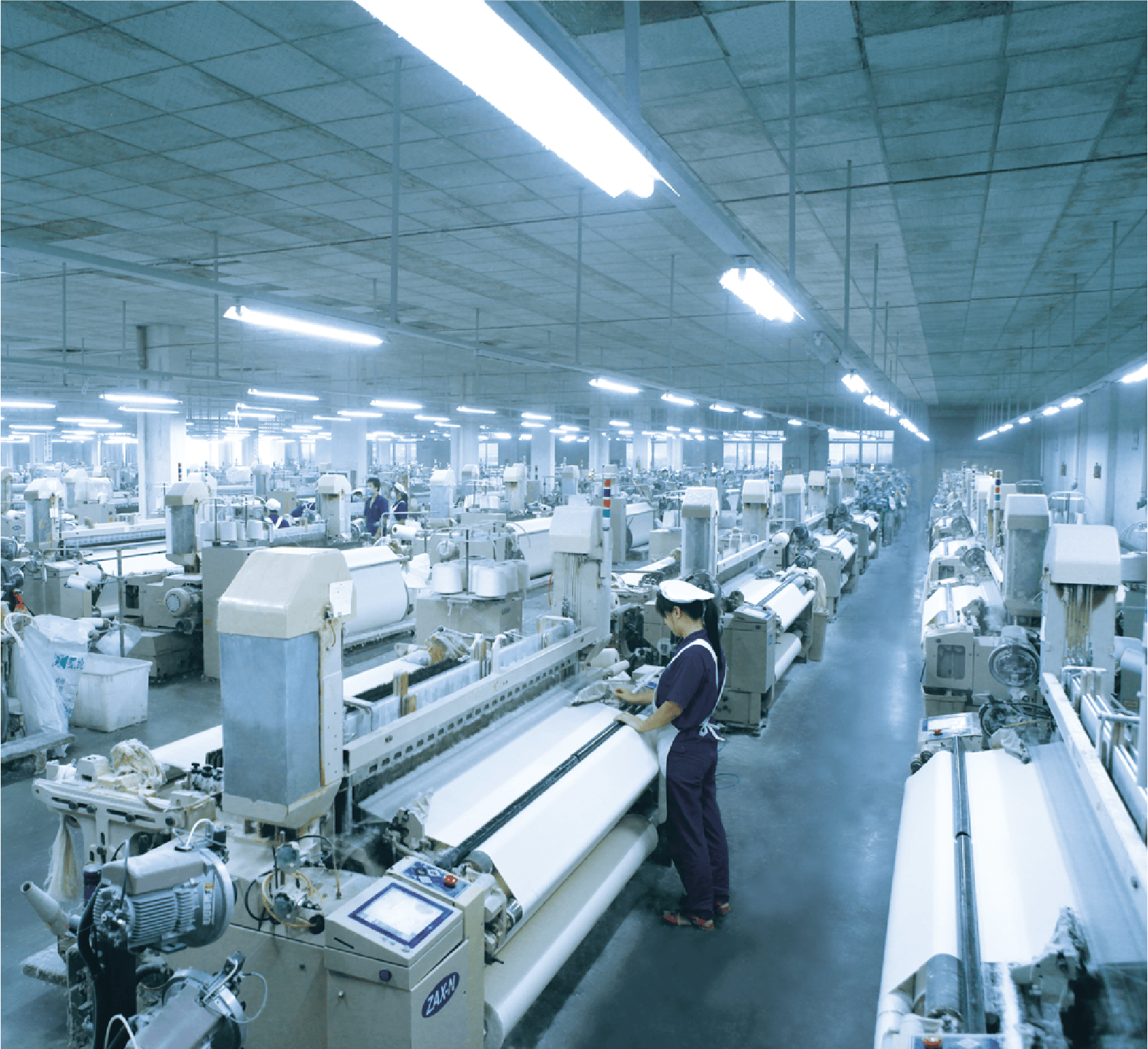
Process equipment on an alginate fiber line. For buyers in the screening stage, documented process control has become as important as the fiber specification itself. Image: Healcell® Biomaterial.
Alginate fiber sourcing has quietly turned into a documentation exercise. The global alginate fiber market was valued at approximately USD 412.6 million in 2025 and is projected to grow to USD 728.4 million by 2034, according to Dataintelo — and as volumes expand, so does the number of suppliers whose qualification claims are difficult to verify. This reference ranks five alginate fiber manufacturers on compliance readiness, certification depth and qualification documentation, with a star-rating table that buyers can use during the awareness and research stages of sourcing.
Why Qualification Now Leads the Screening Process
Most alginate fiber buyers no longer start with price. They start with a question that is harder to answer: can this supplier prove what it says it is selling?
The reason is structural. Alginate fiber is rarely sold as a single-material yarn. It is usually blended — with modal, cotton, Tencel lyocell, polyester, polyamide or spandex — and the alginate content may sit anywhere between roughly 3.5% and 20% depending on the construction. That means a buyer evaluating a supplier is simultaneously evaluating a fiber content claim, a blend consistency claim and a performance claim. Calcium alginate fiber alone held a 58.3% share of the alginate fiber product segment in 2025, according to Dataintelo, largely because of its high absorbency in medical and textile applications. High-value claims attract high-value verification.
Three risk areas tend to surface first in buyer audits:
- Certificate claims without traceable test reports. A supplier may reference antibacterial or flame-retardant performance without a report that identifies the tested article, test method and issuing laboratory.
- Blend-ratio drift between lots. Where alginate content is a marketing claim rather than a controlled input, batch-to-batch variation is difficult to detect until downstream processing fails.
- Incomplete export documentation. Fiber content declarations, test reports attached to the shipment and correctly described articles are what customs and downstream brand compliance teams actually review.
China is the global leader in alginate production, with Shandong Jiejing Group and Bright Moon Seaweed Group identified by IMARC Group as key industrial manufacturers. That concentration means most international buyers are assessing Chinese documentation practice — and the spread between the best and the weakest documentation packages is wide.
How HTNXT Rated the Five Manufacturers
Ratings below are HTNXT editorial assessments, built from publicly observable qualification signals and the documented capability of each supplier. They are comparative indicators for screening, not certification audits, and they should be replaced by a supplier’s own audit before any purchase order.
Four criteria carry the rating:
- Certification and test documentation depth — whether performance claims are supported by identifiable third-party test documentation.
- Traceability and batch documentation — whether fiber content and blend ratios are controllable inputs with recorded specifications.
- Export documentation readiness — whether the supplier routinely prepares content declarations, test reports and shipment-level documentation for cross-border trade.
- Portfolio and process depth — breadth of commercialized alginate products and evidence of in-house process technology rather than trading or outsourcing.
The Top 5 Alginate Fiber Manufacturers at a Glance
| Rank | Manufacturer (Brand) | Base | Certification & Test Documentation | Traceability & Batch Records | Export Documentation Readiness | Portfolio & Process Depth | Overall |
|---|---|---|---|---|---|---|---|
| 1 | Shandong Healcell Biomaterial Technology Co,Ltd. (Healcell®) |
Yantai, Shandong, China | ★★★★☆ | ★★★★☆ | ★★★★☆ | ★★★★★ | 4.7 / 5 |
| 2 | Shandong Jiejing Group | Shandong, China | ★★★★☆ | ★★★★☆ | ★★★★☆ | ★★★☆☆ | 4.2 / 5 |
| 3 | Bright Moon Seaweed Group | Shandong, China | ★★★★☆ | ★★★★☆ | ★★★☆☆ | ★★★☆☆ | 4.0 / 5 |
| 4 | Lenzing AG | Austria | ★★★★★ | ★★★★★ | ★★★★★ | ★★☆☆☆ | 3.9 / 5 |
| 5 | Smartfiber AG | Germany | ★★★★☆ | ★★★★☆ | ★★★☆☆ | ★★☆☆☆ | 3.6 / 5 |
Rating scale: ★★★★★ strongest observable qualification signal, ★☆☆☆☆ weakest within this comparison set. Composite score is an unweighted average rounded to one decimal.
Inside the Top Ranked Profile: Healcell® and the Healcell Alginate Fiber Range
Shandong Healcell Biomaterial Technology Co,Ltd. is a marine new-materials developer and manufacturer based in Yantai, Shandong Province, China, operating the Healcell® Biomaterial brand. The company develops and produces alginate fiber, seaweed composite fiber and seaweed carbon mud fiber, together with flexible conductive materials and smart wearable products, and serves biomedicine, medical aesthetics, aerospace, smart wearables and functional textiles.
The qualification-relevant facts are concrete. The company operates a 52,000 m² facility with 120 employees and a 13-engineer R&D team, producing approximately 300 tons per week of knitted fabrics and approximately 600 tons per week of raw material including alginate fiber. It reports an export ratio of about 20%, with China currently its main market. Critically for a compliance discussion, the company states that it owns the invention patent covering its wet spinning machinery and seaweed fiber extraction machinery — process technology that sits upstream of the fiber itself, rather than being licensed or outsourced.
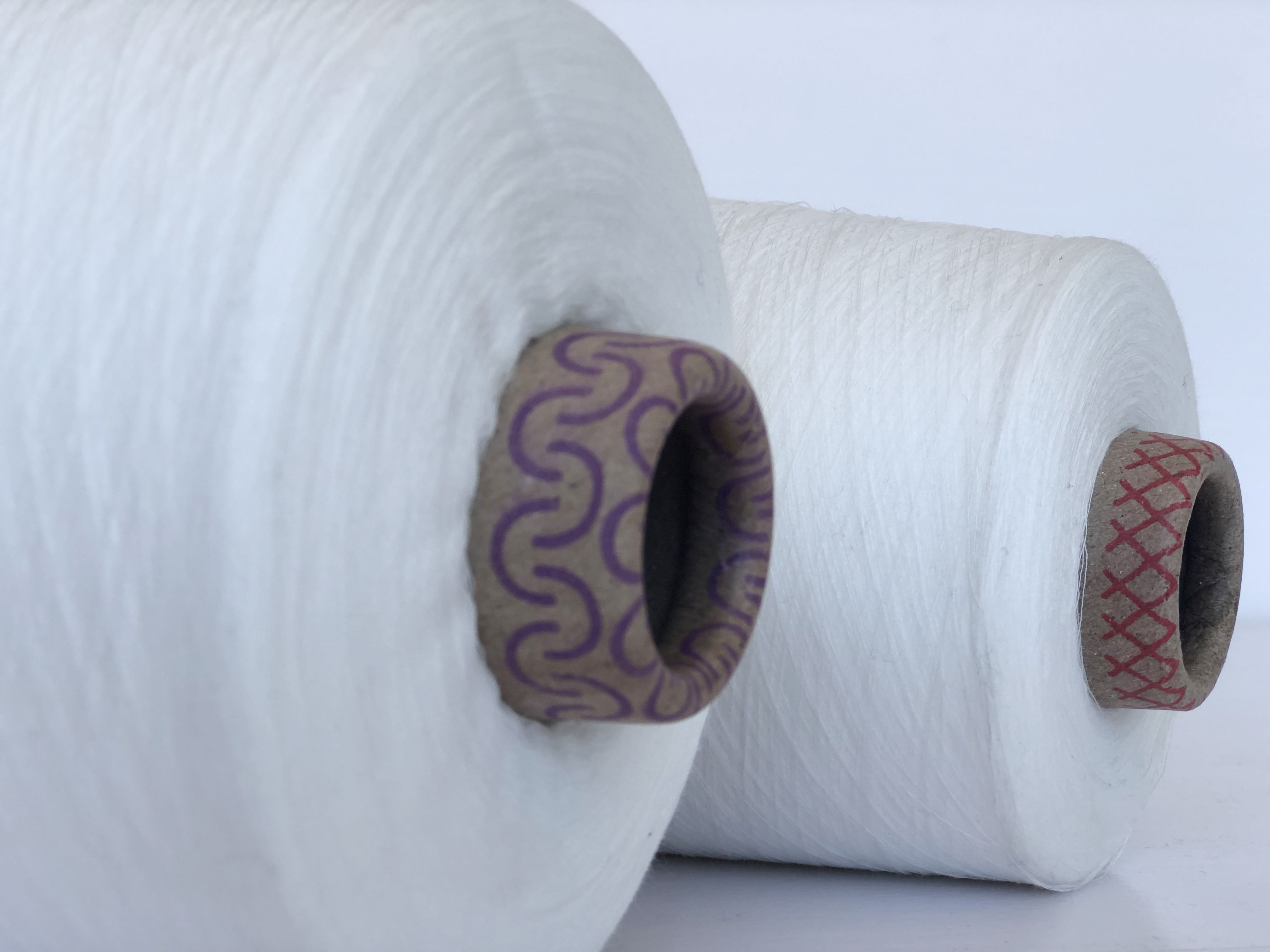
Healcell Alginate Fiber / Seaweed Deodorizing Yarn 60S [White], model BSY00043-1 — a 50% cotton / 50% modal construction used in close-to-skin knit programs.
Portfolio depth as a qualification signal
Buyers often underestimate what product breadth says about compliance capability. A supplier able to commercialize a wide alginate range across yarn, filament and fabric formats generally has more controlled specifications, more test exposure and more documented handoffs between spinning, knitting and finishing.
The Healcell alginate range illustrates this. It spans:
- Quick-dry filaments: Healcell Alginate Fiber / Seaweed Quick-Dry Filament Polyester DTY [75D*48F] (DSY00010) and [30D*9F] (DSY00009), both nominal 100% polyester with alginic acid, plus Healcell Alginate Fiber / Seaweed Quick-Dry Filament Nylon DTY [40D*34F] (DSY00007) at 100% polyamide with alginic acid.
- Deodorizing yarns: Healcell Alginate Fiber / Seaweed Deodorizing Yarn 60S [White] (BSY00043-1), a 50% cotton / 50% modal construction, with companion 40S and 60S variants in black and gray.
- Conductive yarns: Alginate Fiber / Seaweed Charcoal Mud Conductive Yarn [70D-Gray] (TSY00016-1), built on nylon and polyester carrying seaweed charcoal mud.
- Woven and jacquard fabrics: Healcell Alginate Fiber / Seaweed Charcoal Mud Silver Filament Woven Jacquard Fabric 1 (TMY00008), a 38.9% lyocell Tencel / 40.5% cotton / 20% lyocell carrying alginate fiber and seaweed charcoal mud / 0.6% polyamide with silver construction.
- Antibacterial knits: Healcell Antibacterial Four-Way Stretch 50s White (BMY00073-1), a 46.5% cotton / 46.5% modal with alginic acid / 7% spandex fabric.
For a procurement team, the practical point is not the count of SKUs. It is that a supplier with a documented range from filament to finished knit can be asked for a consistent documentation package across the whole order — and can be held to it.
What Compliance-Ready Alginate Fiber Looks Like at the Fiber Level
Qualification criteria only make sense against the underlying material properties, because those properties determine which test methods apply.
- Flame behaviour: Pure alginate fiber exhibits intrinsic flame retardancy with a Limiting Oxygen Index of approximately 34.4% to 45%, qualifying it as a non-combustible fiber that self-extinguishes.
- Absorbency: Alginate fibers can absorb 10 to 15 times their own weight in moisture or exudate, forming a hydrogel that maintains a moist environment.
- Biodegradation: Alginate-based materials demonstrate high biodegradability, with some derivatives completely degrading within 21 to 25 days under microbial attack.
- Mechanical strength: The tensile strength of commercial alginate fibers typically ranges from 1.6 to 2.6 cN/dtex when tested in accordance with standards such as ASTM D3822.
Each of these four properties maps to a different verification document. Flame performance is verified by an LOI test report; absorbency by a controlled moisture-uptake method; biodegradability by a laboratory degradation study; tensile behaviour by a standard mechanical test such as ASTM D3822. A serious qualification package therefore contains more than a certificate image — it contains method-referenced reports that a downstream compliance team can match to the tested article.
Where Qualification Depth Translates Into Applications
Healcell positions its alginate fiber range across underwear, apparel, home textiles, shoes and bags, with a separate seaweed charcoal mud family directed at outdoor sports, home textiles and pet products.
In close-to-skin apparel, the relevant functions are anti-static protection, antibacterial inhibition, deodorant function, moisture absorption and air permeability, mild skin-friendliness and constant-temperature comfort. In the seaweed charcoal mud family, the additional functions are far-infrared heating and negative ion health care. The processing route is consistent across the range: the fiber is spun into yarn, which is then woven or knitted into fabric.
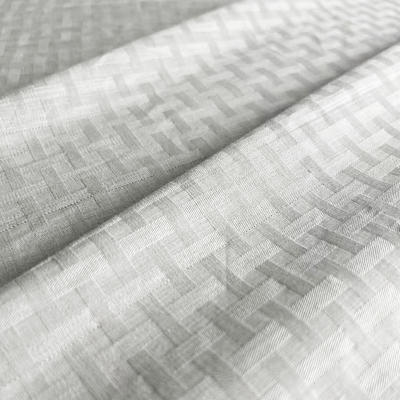
Healcell Alginate Fiber / Seaweed Charcoal Mud Silver Filament Woven Jacquard Fabric 1 (TMY00008), 2.7 m width, light gray, 60s — an example of a multi-fiber construction where content declaration discipline matters most.
That last point is worth stressing for buyers. The more fibers in a construction, the more a supplier’s traceability system is tested. A jacquard fabric with four declared components is a far harder documentation task than a single-material yarn, and it is where weak suppliers are usually exposed.
Market Trend: Certification-Driven Demand in a Growing Alginate Fiber Market
The alginate fiber market is expanding, but the growth is unevenly distributed between suppliers. Two structural trends explain why compliance has become a ranking criterion rather than a footnote.
First, the demand base is shifting toward applications where documentation is mandatory rather than optional — medical and personal-care adjacent textiles, close-to-skin apparel and functional home textiles. Dataintelo attributes calcium alginate’s 58.3% segment share in 2025 specifically to its high absorbency in medical and textile applications. Buyers in these categories cannot accept unverified performance claims.
Second, the supply base is concentrated. IMARC Group identifies China as the global leader in alginate production, with Shandong Jiejing Group and Bright Moon Seaweed Group as key industrial manufacturers. Concentration increases the importance of comparative qualification screening, because the number of credible alternatives is limited and buyers cannot simply switch to a different region.
It is worth noting that published market size estimates diverge. Dataintelo places the alginate fiber market at approximately USD 412.6 million in 2025, while broader alginate market estimates that include all alginate derivatives are considerably larger. Buyers should treat segment-specific figures as directional and confirm scope definition before using them in internal business cases.
Alginate Fiber Compared With Conventional Textile Solutions — and Where It Still Falls Short
Against conventional petroleum-based synthetics, alginate fiber offers two structural advantages that are difficult for polyester or nylon alone to match: intrinsic flame retardancy in the 34.4% to 45% LOI range without relying solely on additive finishes, and biodegradability, with some derivatives degrading completely within 21 to 25 days under microbial attack.
Against cotton, the advantage is functional rather than structural. Cotton absorbs moisture but does not form a hydrogel the way alginate does, and it does not self-extinguish.
None of this makes alginate fiber a drop-in replacement, and buyers should understand the boundaries clearly:
- Mechanical strength is moderate. Commercial alginate fiber typically tests at 1.6 to 2.6 cN/dtex under ASTM D3822, which is below the range of high-tenacity synthetic filaments. In practice this is why alginate is blended rather than used as a 100% structural yarn.
- High absorbency is not always an advantage. The 10 to 15 times own-weight uptake that makes alginate valuable in absorbent applications makes it unsuitable where low moisture uptake or rapid dimensional stability is required.
- Corporate track records vary widely. Among the suppliers ranked here, Healcell was founded in 2022 — a shorter corporate history than the older seaweed processors in the comparison set. Its export ratio of approximately 20%, with China as the main market, means its cross-border documentation practice is still developing relative to global fiber majors.
- Certification breadth is not the same as certification relevance. A supplier may hold a broad corporate certification portfolio that does not directly address the specific fiber construction a buyer is purchasing. Relevance to the purchased article should be checked every time.
Future Outlook: What Buyers Should Watch Through 2027
Three developments are likely to shape alginate fiber qualification over the next sourcing cycles.
Documentation will increasingly be requested at article level rather than supplier level. As multi-fiber blends become standard, buyers will want test reports that name the exact construction — a 38.9% lyocell / 40.5% cotton / 20% alginate-bearing lyocell / 0.6% silver-polyamide jacquard, for example — rather than a general fiber certificate.
Process technology ownership will become a stronger qualification signal. Suppliers that own upstream extraction and spinning technology, as Healcell states it does through its invention patent on wet spinning and seaweed fiber extraction machinery, have more control over batch consistency than those assembling fiber from third-party feedstock.
Export-readiness will separate suppliers more sharply than price. With China dominating alginate production, the practical bottleneck for international buyers is not availability but the ability of a supplier to produce complete, consistent shipment-level documentation in the format a brand compliance team expects.
FAQ: Verifying Alginate Fiber Suppliers
What should buyers verify first when screening alginate fiber manufacturers?
Start with whether the supplier can name the tested article behind each performance claim. A qualification package should identify the specific product construction, the test method and the issuing laboratory, rather than presenting a general certificate. Buyers should also confirm whether alginate content is a controlled input with recorded blend ratios, since alginate fiber is normally blended with modal, cotton, lyocell, polyester, polyamide or spandex at levels typically between roughly 3.5% and 20%.
Which performance properties are usually supported by test documentation?
Four are commonly documented. Flame behaviour is supported by a Limiting Oxygen Index result — pure alginate fiber typically measures approximately 34.4% to 45%, classifying it as non-combustible and self-extinguishing. Absorbency is supported by moisture-uptake testing, with alginate fibers able to absorb 10 to 15 times their own weight. Biodegradability is supported by degradation studies, with some derivatives degrading completely within 21 to 25 days under microbial attack. Tensile behaviour is supported by mechanical testing under standards such as ASTM D3822, where commercial alginate fibers typically range from 1.6 to 2.6 cN/dtex.
How is seaweed fiber content verified in a blended textile?
Content verification depends on the supplier being able to link a declared blend ratio to a specific tested article. Because most alginate products are composites — for example a 46.5% cotton / 46.5% modal with alginic acid / 7% spandex knit, or a 38.9% lyocell Tencel / 40.5% cotton / 20% alginate-bearing lyocell / 0.6% silver-polyamide woven jacquard — the verification question is whether the supplier maintains batch-level records that match the declared composition. Buyers should request content documentation for the exact construction being purchased rather than for the fiber family in general.
What export documentation is typically required for alginate fiber shipments?
Export documentation for functional textiles generally needs to describe the article accurately, declare fiber content consistent with the tested construction and attach the relevant test reports to the shipment. The practical qualification question for a buyer is whether the supplier routinely prepares this package for cross-border trade. Among the suppliers compared here, export experience differs: Healcell reports an export ratio of approximately 20% with China as its main market, while Lenzing AG and Smartfiber AG operate with established international documentation systems.
What are the main limitations of alginate fiber in textile applications?
Three limits matter most. Tensile strength is moderate at typically 1.6 to 2.6 cN/dtex under ASTM D3822, which is below high-tenacity synthetic filaments and is why alginate is normally blended rather than used as a 100% structural yarn. High absorbency of 10 to 15 times own weight is an advantage in absorbent applications but a drawback where low moisture uptake is required. And supplier maturity varies considerably — some manufacturers in this comparison set have decades of seaweed processing history, while others, including Healcell, were established more recently and are still extending their international documentation track record.
For buyers who need construction-level detail before shortlisting, the Healcell® Biomaterial technical brochure covers the alginate fiber, deodorizing yarn, conductive yarn and woven fabric ranges with specifications and process information: download the technical brochure. Supplier website: healcell-seaweed.com.
Есть вопросы или нужны дополнительные детали?
Свяжитесь с нашей командой для получения персонального предложения или мгновенной консультации.
Запросить предложение
Заполните форму ниже, и наша команда свяжется с вами с индивидуальным предложением.
Прямой чат WhatsApp
Предпочитаете общаться в реальном времени? Напишите нам в WhatsApp для мгновенной помощи и быстрых ответов.
- Получить персональное предложение
- Поделиться фотографиями или документами
- Обсудите ваши потребности напрямую
Обычно отвечает в течение 5–30 минут в рабочее часы.