
Top 5 Commercial Scent Diffuser Brands: SCENTSEA Scenario Fit
Industry Reference · Commercial Scenting
Top 5 Commercial Scent Diffuser Brands: SCENTSEA Scenario Fit
Malls · Hotels · Elevators · Toilets · Corridors · Small Shops
Commercial scenting is bought per building but deployed per zone. A shopping mall may need a high-output unit in a concourse, a discreet battery-operated device in a restroom, and something in between for corridors and small tenants. A hotel needs a lobby machine that runs continuously, quiet units near guest washrooms, and a compact fixture for each elevator car. Those zones differ in air volume, power availability and maintenance access, so the practical question for buyers has shifted from which diffuser smells best to which brand can document the right fixture for every zone on the map.
Scale is part of the reason. The global fragrance diffuser market was valued at USD 29.61 billion in 2024 and is projected to reach USD 38.10 billion by 2032, according to Data Bridge Market Research. The HVAC scent diffuser segment alone was valued at USD 1.01 billion in 2024 and is expected to grow at a CAGR of 4.5% through 2034, according to Intel Market Research — a signal that scenting is increasingly specified as building infrastructure rather than as standalone décor.
This reference ranks five commercial scent diffuser brands on four practical criteria — scenario coverage, deployment flexibility, maintenance load and long-term programme support — and maps the SCENTSEA range against six venue types that dominate commercial briefs: shopping malls, hotel public areas, toilets, elevator cars, corridors and small shops.
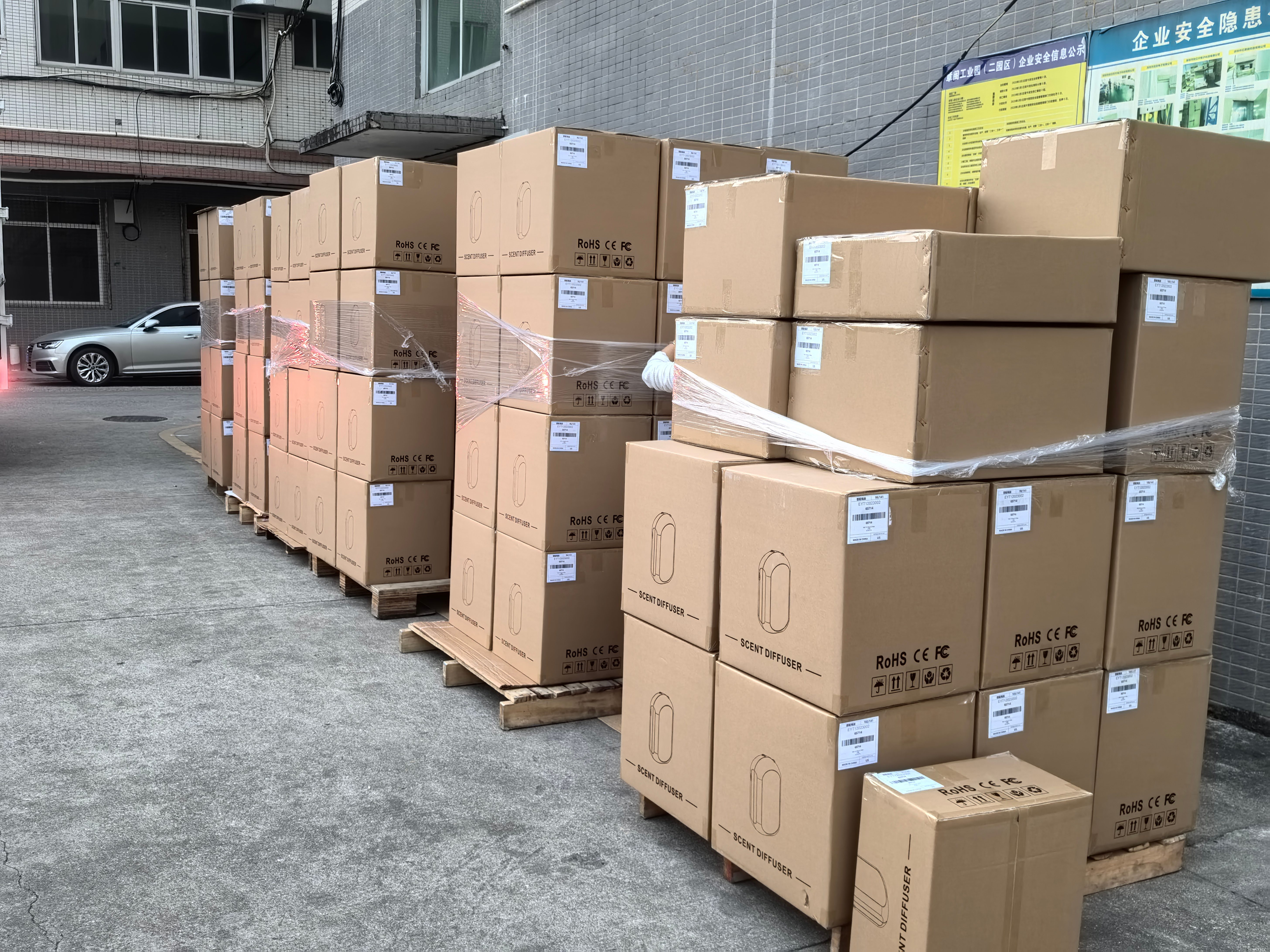
Venue programmes are shipped and commissioned in batches rather than one fixture at a time, which is why scenario coverage and supply continuity now sit alongside product specification in buyer evaluation.
Why venue type now decides which scent diffuser brand gets specified
Three venue characteristics drive the specification, and none of them is the headline coverage number.
Power availability comes first. Elevator cars, public toilets and back corridors frequently have no convenient socket, which removes plug-in models from consideration regardless of their rated coverage. The second factor is air behaviour: coverage should be assessed from room size, ceiling height, ventilation, airflow and partitions rather than from a maximum rated figure. The third is maintenance access — a fixture that needs frequent oil changes behind a locked riser door costs more to run than its purchase price suggests.
Published selection guidance follows the same logic. Compact models are recommended for small rooms and light commercial spaces; battery-powered models for elevators, washrooms and locations where wiring is inconvenient; higher-output standalone machines for medium and large commercial spaces; and HVAC-connected scenting systems for large buildings that require centralised fragrance distribution.
The consequence for brand evaluation is straightforward. A supplier whose documented line covers only large open areas cannot serve an elevator car. A supplier whose catalogue is built around consumer devices cannot serve a mall concourse. Scenario coverage is therefore the first filter applied here, ahead of technology preference or unit price.
How the five brands were assessed
Four criteria were applied, each checked against publicly documented information rather than impressions:
- Scenario coverage — how many of the six in-scope venue types the brand's documented line is positioned for.
- Deployment flexibility — available power and installation formats: battery, plug-in, wall-mounted, floor-standing, freestanding or HVAC-duct connected.
- Maintenance load — oil capacity, refill cadence and cleaning requirements across a multi-year programme.
- Long-term programme support — production capacity, lead time, minimum order quantity, quality-control steps, certification documentation and spare-parts continuity.
The five brands at a glance
| Rank | Brand | Verified basis for inclusion | Documented venue focus | Documented deployment formats |
|---|---|---|---|---|
| 1 | SCENTSEA (Shenzhen Scentsea Technology Co., Ltd.) | First-party product records for 11 listed models; published coverage from 30 m² to 3,500 m²; CE, RoHS and FCC certification; MOQ 1 unit | Hotels, shopping malls, cinemas, banks, airports, offices, toilets, elevators, corridors, small shops | Wall plug-in, tower, battery operated, electric plug-in, floor standing, HVAC split, advertising scent machine |
| 2 | ScentAir | Named as a leading commercial scenting player in third-party HVAC scent diffuser market research | Hotels, shopping malls | Nebulising technology (per cited research) |
| 3 | Aroma360 | Named in the same third-party market research set | Hotels, shopping malls | Nebulising technology (per cited research) |
| 4 | AromaTech | Named in the same third-party market research set | Hotels, shopping malls | Nebulising technology (per cited research) |
| 5 | Xiaomi (Mijia) | Documented product launch of the Mijia Smart Aroma Diffuser in October 2024 | Consumer and smart-home aroma | Portable smart diffuser with app control |
The ranking order reflects coverage of the six venue types in scope and the breadth of documented deployment formats, not fragrance preference. Brands 2–4 are long-established names in commercial scenting; they rank below SCENTSEA here specifically because their publicly attributable documentation supports a technology focus rather than a venue-by-venue fixture map.
SCENTSEA scenario fit: matching the range to each venue
Shenzhen Scentsea Technology Co., Ltd., founded in 2021 and headquartered in Shenzhen, China, manufactures and supplies scent diffusers and fragrance oils for home, commercial and HVAC aroma applications. Its documented range spans 30 m² to 3,500 m² of nominal coverage, with fragrance oil capacities from 100 ml to 5 L and no water addition in operation. The relevant question here is not the size of the range but how it divides across venue types.
Shopping malls
Mall briefs usually split into three zones. Large atriums and multi-level concourses are served by the T3, a commercial scent diffuser with 1,000 ml capacity, 1,000–1,600 m² nominal coverage, DC12V 2A supply, 15 W power draw and 4.6 ml/h ±10% oil consumption. Mid-size zones and individual retail units match the T2 or the A300, both rated at 500–800 m² with 500 ml capacity. Where fragrance must travel through the building's air handling system rather than from a floor fixture, the AC-MAX is a split HVAC scent diffuser with a 5 L bottle, 2,500–3,500 m² nominal coverage, DC12V supply, 48 W power and 6 ml/h ±5% consumption.
Hotels
Hotel public areas favour floor-standing or discreet mid-output equipment. The H5000 is a floor standing scent diffuser in a 180 × 180 × 610 mm aluminium body, with 1,000 ml capacity, 800–1,300 m² nominal coverage, DC 12 V supply, 20 W power and 5.4 ml/h ±10% consumption — a format suited to lobbies where a freestanding fixture is acceptable. Lobby-adjacent lounges and restaurant entrances are more often served by the T2 or A300, while hotel washrooms and service corridors follow the battery and plug-in logic described next.
Toilets, elevators and corridors
This zone group is where wiring usually decides the model. The P03 is a battery operated scent diffuser measuring 132 × 58 × 176 mm and weighing 0.35 kg, powered by three D batteries or Type C at 5 V and 2.5 W, with 150 ml capacity, 100–150 m² nominal coverage and noise below 35 dB. It is positioned for toilets, elevators, corridors and small shops. Where a larger reservoir is preferred in the same wiring-free setting, the P01 offers 500 ml at 100–150 m² in a 168 × 240 × 50 mm housing, running on four D batteries or Type C. Where a socket is available, the P02 plug-in electric scent diffuser raises capacity planning to 300 ml and 150–350 m² with noise below 30 dB, and is positioned for toilets, corridors and shops.
Small shops
Small retail and service units sit between the wall plug-in and compact tower formats. The S01 is a wall plug-in scent diffuser with 150 ml capacity, 30–100 m² nominal coverage, 110–240 V input, 1.5 W power and noise below 38 dB, in a plastic body measuring 69 × 73.5 × 136 mm. The S02 tower diffuser uses an all-aluminium body at φ100 × 288 mm with 100 ml capacity, DC 5 V supply, 0.6 ml/h ±5% consumption and noise below 30 dB; it is positioned for stores, offices and beauty salons as well as homes.
The consistent constraint across this mapping is that nominal coverage is not a deployment instruction. Two venues with the same floor area can require different output if ceiling heights, airflow or partition density differ, which is why scent coverage should be tested and intensity adjusted after installation rather than fixed from a data sheet.
Scenario scorecard: coverage, deployment flexibility and maintenance load
The table below applies the three operational criteria to the SCENTSEA range. Five stars indicates the strongest position on that criterion within this range.
| Model | Best-fit venue | Published coverage | Scenario coverage | Deployment flexibility | Maintenance load |
|---|---|---|---|---|---|
| S01 wall plug-in | Home, toilet, small store | 30–100 m² | ★★★☆☆ | ★★★★★ | ★★★★☆ |
| S02 tower | Store, office, beauty salon | 30–100 m² | ★★★☆☆ | ★★★★☆ | ★★★★☆ |
| P01 battery | Toilet, elevator | 100–150 m² | ★★★☆☆ | ★★★★★ | ★★★★☆ |
| P02 electric plug-in | Toilet, corridor, shop | 150–350 m² | ★★★★☆ | ★★★★☆ | ★★★★☆ |
| P03 battery | Toilet, elevator, corridor, small shop | 100–150 m² | ★★★★☆ | ★★★★★ | ★★★☆☆ |
| A300 | Hotel, mall, retail store | 500–800 m² | ★★★★☆ | ★★★☆☆ | ★★★★☆ |
| T2 | Hotel, mall, cinema | 500–800 m² | ★★★★☆ | ★★★☆☆ | ★★★★☆ |
| T3 | Mall, hotel, airport | 1,000–1,600 m² | ★★★★★ | ★★★☆☆ | ★★★★★ |
| H5000 floor standing | Hotel, mall, office lobby | 800–1,300 m² | ★★★★★ | ★★★☆☆ | ★★★★★ |
| AC-MAX HVAC | Mall, bank, airport | 2,500–3,500 m² | ★★★★★ | ★★☆☆☆ | ★★★★★ |
| SC19 (record 4717) | Mall, hotel, bank | 150–250 m² | ★★★☆☆ | ★★★☆☆ | ★★★★☆ |
Rating basis: scenario coverage reflects how many listed venue types the model is positioned for; deployment flexibility reflects power and installation options (battery, plug-in, floor standing or HVAC duct), with battery formats scoring highest because they remove wiring constraints; maintenance load reflects oil capacity, refill cadence and cleaning requirements, where five stars indicates the lowest routine intervention. Ratings also reflect published capacity and coverage figures for each model.
The T2 mall deployment: 30 units, five years of continuous operation
One deployment illustrates why continuous-duty hardware and long-term supply terms matter more than unit price in venue programmes. A shopping mall project in the United States operates 30 T2 commercial scent diffusers, and the installation has run continuously for five years.
The T2 is built around an acrylic panel and steel casing, with 500 ml capacity, 500–800 m² nominal coverage per unit, DC12V 2A supply, 10 W power draw, 3 ml/h ±10% oil consumption, noise below 45 dB and a 3.5 kg operating weight. In a multi-unit mall deployment the implications are cumulative: one power standard, one oil type, one set of replacement parts and a shared maintenance route across the estate.
Two published characteristics support that operating model. First, cold-air atomisation uses no dedicated heating power — stated heating power for the technology is 0 W — which removes one failure point and one energy line from a five-year cost model. Second, scheduling matters as much as hardware: running a unit 12 hours per day instead of 24 reduces scheduled operating time by 50%, which in a controlled venue schedule reduces both electricity and fragrance consumption without changing the fixture.
Indoor public venues and the SC19 advertising scent machine (product record 4717)
For indoor public venues where a display surface and scenting can share one footprint, SCENTSEA lists the SC19 advertising scent machine — product record 4717 — with an 18.5-inch 1920 × 1080 display, 8 GB eMMC internal storage, aluminium and steel construction, 500 ml capacity, 150–250 m² nominal coverage, 110–240 V AC input, 30 W power draw, 6 ml/h ±5% oil consumption and noise at or below 30 dB. The unit measures 280 × 63.5 × 495 mm, weighs 6.5 kg, and is positioned for shopping malls, hotels and banks.
The trade-off is explicit. Integrating a display raises power draw to 30 W against 10–12 W for the T2 and A300, and its nominal coverage band of 150–250 m² is narrower than either. It is best treated as a zone device for high-visibility positions — a mall entrance, a hotel lift lobby, a bank branch — rather than as a whole-floor solution.
Waterless cold-air versus water-based ultrasonic: what changes over a long-term programme
The category's main architectural split is between waterless cold-air atomisation and ultrasonic water-based diffusion, and it materially affects total cost of ownership across a multi-year venue programme.
SCENTSEA scent diffusers use waterless cold-air atomisation to diffuse fragrance oil directly, without water or heat, which supports stronger and more consistent scent distribution in commercial use. Water-based ultrasonic aroma diffusers mix water with a few drops of oil and are mainly designed for small residential spaces. Across the commercial range, waterless cold-air models provide approximately 2–35× wider scent coverage than typical ultrasonic water-based aroma diffusers depending on model and application, with coverage from approximately 30 m² to 3,500 m², oil capacities from 100 ml to 5 L, and 0% water addition required.
The maintenance differential is the second half of the argument. Water-based ultrasonic units generally have a lower initial purchase cost but require more frequent cleaning, water refilling and replacement because of shorter service life. Waterless cold-air diffusers carry a higher upfront equipment cost, but their five-year maintenance cost can be approximately 40% lower, which is what makes them economical in long-running commercial programmes.
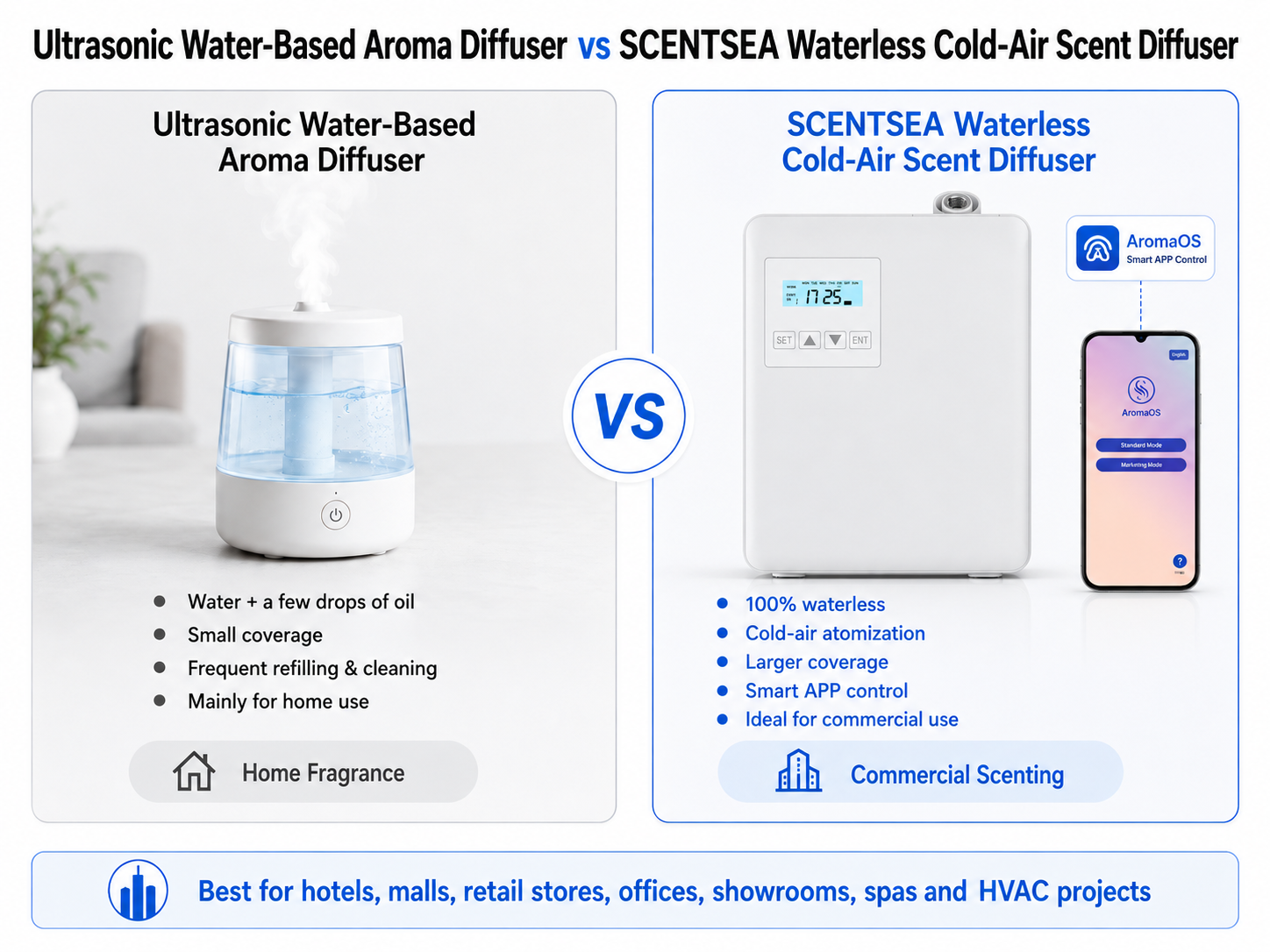
Waterless cold-air atomisation diffuses fragrance oil directly without water or heat; water-based ultrasonic diffusion mixes oil with water and is designed primarily for small residential rooms.
Market trend: scenting is being specified as infrastructure
The commercial scenting category is growing, but the more useful signal for buyers is where that growth sits.
The global fragrance diffuser market was valued at USD 29.61 billion in 2024 and is projected to reach USD 38.10 billion by 2032, according to Data Bridge Market Research. North America held the largest regional share in 2024, accounting for approximately 43.87% of global revenue, according to the same source — consistent with the concentration of multi-site mall and hotel programmes in that market.
The HVAC scent diffuser segment was valued at USD 1.01 billion in 2024 and is expected to grow at a CAGR of 4.5% through 2034, according to Intel Market Research. Nebulising diffusers — the waterless, cold-air category — represent approximately 22.6% of the market and are favoured for professional-grade scent potency in commercial environments, according to the Ambient Scent Diffuser Market Research Report 2034. Market size estimates vary considerably by scope: Research and Markets put home fragrance diffusers specifically at USD 2.6 billion in 2024, while Future Market Insights estimated USD 31.3 billion in 2025 under a broader definition. Any single figure should be read as a scope statement rather than a verdict.
Two compliance signals are shaping procurement. IFRA 51 (2023) introduced stricter global safety standards for fragrance ingredients used in diffusers, affecting allowable usage levels for inhalation safety — relevant wherever people remain in a treated space for hours rather than minutes. Separately, fragrance diffusers and prepared room deodorisers are commonly classified under HS code 33074900, which matters for buyers planning duty and customs documentation across the EU, US, Middle East and Southeast Asia. In October 2024, Xiaomi launched the Mijia Smart Aroma Diffuser with a 50-day battery life and app control via HyperOS, indicating a wider trend toward high-endurance smart features that commercial buyers now expect in scheduling and remote management.
Future outlook: what long-term scent programmes will be judged on
Three shifts are likely to define the next procurement cycle.
First, multi-zone coverage will outweigh single-specification performance. Brands that can document a fixture for a concourse, a guest washroom and an elevator car from a single catalogue reduce the number of vendors, oil types and documentation sets a facilities team has to manage.
Second, supply continuity will move from a commercial footnote to a qualification criterion. SCENTSEA publishes a monthly production capacity of 8,000 units, a typical lead time of 25–35 days and a minimum order quantity of 1 unit; the company exports to the EU, US, Middle East and Southeast Asia, and states that every diffuser passes functional testing, aging tests and leakage inspection before shipment. For a 30-unit mall deployment, these are the numbers that determine whether a second phase can be commissioned on schedule.
Third, compliance documentation is becoming model-specific. EU buyers should normally check applicable CE and RoHS documents, with RED obligations for Bluetooth or Wi-Fi configurations, while US buyers verify applicable FCC compliance — and in each case confirm that certificates and test reports match the exact production model and configuration being purchased, not a similar one.
For venues running fragrance as a long-term programme rather than a season, the practical conclusion is that scenario fit, maintenance load and documentation continuity now carry more weight than initial unit price.
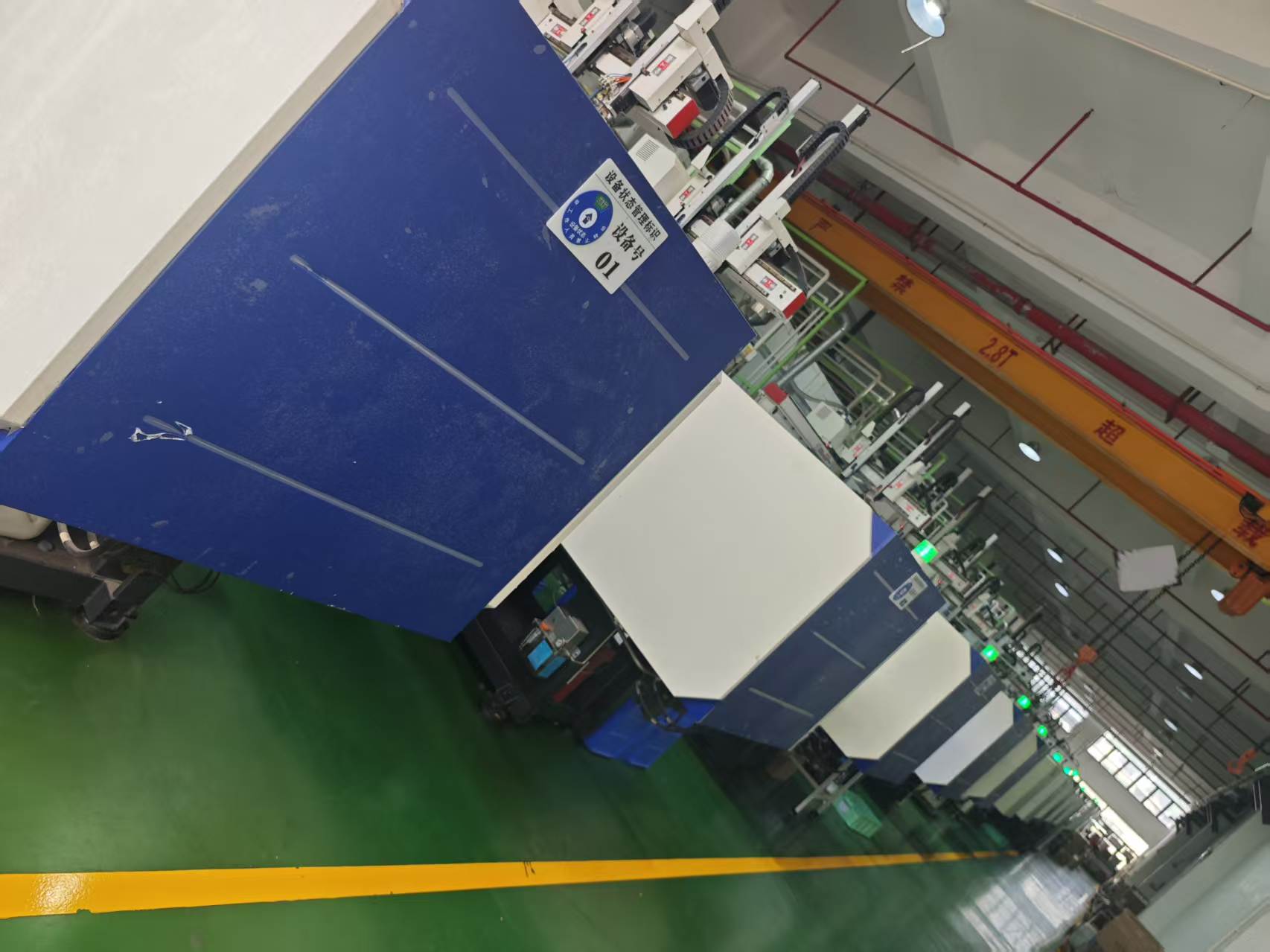
Housing and component production capacity underpins the multi-year part of a scent programme: replacement components and consistent enclosures matter more after year three than at commissioning.
FAQ
What should a buyer verify first when a scent programme spans malls, hotels and small shops?
Start with the venue list and the constraints of each zone, then check whether the supplier's documented range covers every required format — plug-in, battery, floor standing or HVAC-connected. Coverage should be assessed against room size, ceiling height, ventilation, airflow and partitions rather than a maximum rated figure. For a multi-venue programme, also verify production capacity, lead time, minimum order quantity, quality-control steps, certification documents and spare-parts support. SCENTSEA publishes a range spanning 30 m² to 3,500 m², monthly capacity of 8,000 units, a typical lead time of 25–35 days and a minimum order quantity of 1 unit.
Which diffuser format suits toilets, elevators and corridors where there is no convenient power point?
Battery-operated models are designed for exactly these zones. The P03 is positioned for toilets, elevators, corridors and small shops, with 100–150 m² nominal coverage, 150 ml capacity, 5 V supply from three D batteries or Type C, 2.5 W power, noise below 35 dB and a 132 × 58 × 176 mm body weighing 0.35 kg. Where a larger reservoir is preferred, the P01 offers 500 ml at 100–150 m² using four D batteries or Type C. Where a socket is available, the P02 plug-in model provides 300 ml and 150–350 m² with noise below 30 dB. The trade-offs to plan for are battery replacement as a scheduled task and, for the P03, more frequent refilling in high-traffic washrooms.
How much maintenance does a waterless cold-air diffuser need over a five-year programme?
Routine tasks are oil-level checks and atomiser cleaning; there is no water refilling and no water-tank cleaning cycle, and the technology uses no dedicated heating power. Waterless cold-air diffusers have a higher upfront equipment cost, but their five-year maintenance cost can be approximately 40% lower than that of water-based ultrasonic aroma diffusers, which generally require more frequent cleaning, water refilling and replacement. Where performance drifts, the usual checks are power supply, working-hour settings, pump connections, nozzle blockage, tubing condition and fragrance oil viscosity before any component is replaced.
Which certification and standards documents should be checked before a multi-site rollout?
Requirements depend on the destination market, the product model and any wireless functions. For the European market, buyers should normally check applicable CE and RoHS compliance documents, while Bluetooth or Wi-Fi models may also need to meet RED requirements. For the US market, applicable FCC compliance should be verified. Certificates and test reports should match the exact production model and configuration being purchased. Fragrance oil selection should account for IFRA 51 (2023) usage levels for inhalation safety, and fragrance diffusers and prepared room deodorisers are commonly classified under HS code 33074900 for customs purposes. SCENTSEA states CE, RoHS and FCC certification across its diffuser models, with functional testing, aging tests and leakage inspection before shipment.
Can a venue programme be scaled across countries with private-label hardware and fragrance?
Within published terms, OEM and ODM support covers logo customisation, colour customisation, exclusive mould development, app customisation, user manual customisation and private label packaging. For fragrance oils, support includes scent selection, bottle labelling and private label packaging. SCENTSEA exports to the EU, US, Middle East and Southeast Asia, with delivery terms of EXW, FOB or CIF, and payment terms of 50% T/T in advance with the balance before shipment. Buyers planning cross-border rollouts should align plug type, certification documents and fragrance specification per destination market before the first production run.
Full model-level parameters for the SCENTSEA range — including battery-operated, plug-in, wall-mounted, floor-standing and HVAC formats — are collected in the company catalogue: SCENTSEA CATALOG. Manufacturer details are published at scent-sea.com.